🔎 Reverse Image Search
Image search techniques made simple: upload a photo or paste a URL and search 6 engines at once. 100% free, nothing stored.
🔒 Your image is never stored on our servers longer than 24 hours and is never shared.
You made a picture with Stable Diffusion and now you want to put it on a blog, a product page or a T-shirt, and you are not sure whether that is allowed. The short answer is yes, in most cases, but the licence that covers your image depends on the exact version you used. SD 3.5 and SDXL Turbo sit under Stability’s Community Licence, which is free below $1 million in annual revenue and needs an Enterprise licence above it. SD 1.5, SD 2.1 and SDXL base sit under the Open RAIL licences, which have no revenue cap at all. The rest of this guide checks each version against a blog header, a product listing and merchandise, so you know where your image stands.
The direct answer: can I use Stable Diffusion images commercially? Yes, in most cases. If the image was made with SD 3.5 or SDXL Turbo and your total annual revenue is under $1 million, the Stability AI Community Licence lets you use it commercially for free, once you register. If it was made with SD 1.5, SD 2.1 or SDXL base, the Open RAIL licences apply instead, and they have no revenue cap. The version is what decides the answer, so the first job is to find out which version made your image. This is general information, not legal advice, and every figure below was checked on Stability AI’s own licence page on 26 November 2026.
Which licence covers your image: the version split
There is no single Stable Diffusion licence covering the whole family. It is a family of models, and different versions sit under different licences. This is the single most important fact in this guide, and it is also the point most short answers get wrong. Google’s own AI Overview, for example, groups SDXL with the older Open RAIL models. That is only half right. SDXL base is Open RAIL, but SDXL Turbo moved to the other side. If you treat the family as one licence, you will get the wrong answer for at least one version.
| Version | Licence | Commercial use | Revenue cap | What to do |
|---|---|---|---|---|
| SD 1.5 | CreativeML Open RAIL-M | Yes | None | Follow the use restrictions and keep the licence notice |
| SD 2.1 | CreativeML Open RAIL-M | Yes | None | Follow the use restrictions and keep the licence notice |
| SDXL base 1.0 | Open RAIL++-M | Yes | None | Follow the use restrictions and keep the licence notice |
| SDXL Turbo | Community Licence (Stability AI) | Yes, free | Under $1 million a year | Register with Stability AI; Enterprise licence above $1 million |
| SD 3.5 Large, Medium and Large Turbo | Stability AI Community Licence | Yes, free | Under $1 million a year | Register with Stability AI; Enterprise licence above $1 million |
| SD 3.5 Flash | Not listed on the Core Models page | Unclear | Check before use | Do not assume it is covered; check the current Core Models page first |
Three details in that table deserve a closer look. First, the licence names matter. SD 1.5 and SD 2.1 use Open RAIL-M. SDXL base uses the double-plus version of the licence. They are different licences, so write down the one your version actually uses. Second, SDXL commercial use splits in two at the Turbo line, and SDXL Turbo is the trap. It carries the SDXL name, so people assume it shares the SDXL base licence. It does not. The SDXL Turbo licence is the Community Licence, and Stability’s own licence page lists it under the Community side, next to the SD 3.5 Suite, which means the $1 million rule applies to it. Third, SD 3.5 Flash does not appear on Stability’s Core Models page, which was last updated on 20 May 2026. That does not mean Flash is banned. It means its self-host terms are unstated, so do not claim it is covered until you have checked the current page.
How do you find out which version made your image? Check the model card if you downloaded the weights, the generation log if you ran it locally, or the service page if you used a hosted tool. The file name alone is not enough, because a file can be renamed. If you cannot identify the version at all, treat the image as if it sits under the stricter Community rules. That is the safe default, and it costs you nothing if your revenue is under $1 million anyway.
The $1 million rule, worked through honestly
The Community Licence is free for individuals and organisations with less than $1 million in annual revenue. That sounds simple, and the number is simple, but the way it is counted catches people out. The $1 million is your total annual revenue, plus the revenue of your affiliates, from any source. It is not just the money you make from AI images. One independent guide works through an example in which a business makes $850,000 in total, of which only $40,000 comes from AI work, and the full $850,000 still counts. The free grant for Stable Diffusion commercial use ends on the date you cross the threshold, not at the end of the year. If you cross it in March, the free grant stops in March.
Above $1 million, you need a Stable Diffusion Enterprise licence, which is custom priced. Stability’s licence page lists commercial use and implementation support under Enterprise, with custom training and consulting as upgrades. There is no published price to quote, so do not trust any site that gives you one. If you are near the line, the honest move is to contact Stability AI before you publish, not after.
There is one exemption worth knowing. If you use a Core Model for research purposes only, that falls within the Community Licence and you do not need to pay, regardless of how much revenue your organisation makes. But the exemption ends the moment the research is used for a commercial purpose, for example inside a product or a service. At that point you must register with Stability AI, and you may also need a paid Enterprise licence if your annual revenue is above $1 million. A research project that quietly becomes a product is the most common way a small team trips over this rule.
Stable Diffusion registration: the step most people skip
Stable Diffusion commercial use under the Community Licence requires registering with Stability AI. Independent guides agree on this, and Stability’s own licence page states the registration requirement for research that is used for a commercial purpose. Yet registration is the step almost nobody mentions when they say “Stable Diffusion is free for commercial use”. Free and unregistered are not the same thing. The $1M revenue test and the registration step are separate duties.
I am not going to print a form address here, because the registration step lives on Stability’s site and it can move. Go to Stability AI’s licence page, find the registration step for commercial use, and complete it before the image goes live. Then save a dated copy of whatever confirmation you receive, next to the record described at the end of this guide. If you generated the image months ago and never registered, register now. The licence is the thing that lets you use the image, and registration is part of it.
Blog header, product listing, merchandise: three real uses checked
A licence answer is only useful if it maps onto something you actually want to do. Here are the three uses readers ask about most, checked against the version split above. In each case, assume your revenue is under $1 million and you have registered, unless stated otherwise.
A Stable Diffusion blog header. This is the lowest risk use. SD 3.5 commercial use on a blog header is covered by the Community Licence, and an SD 1.5 or SDXL base image is covered by the Open RAIL licences. The one thing to check is what the image shows, which is covered in the section on third-party rights below. A blog header that happens to contain a recognisable logo is a different problem from the licence, and the licence does not fix it.
A Stable Diffusion product listing. Also covered, on the same terms as a blog header. The extra wrinkle is the platform, not the licence. Some stock sites, marketplaces and ad platforms require AI-generated images to be labelled, and some do not accept them at all. Check the rules of the place where the listing will appear before you upload. A licence from Stability does not overrule a marketplace ban.
Merchandise. Can I sell Stable Diffusion images on a T-shirt, a mug or a poster? Yes, the licence covers merchandise on the same terms as a blog header, and this is the use where the third-party rights problem bites hardest. A design that includes a cartoon character, a sports logo or a celebrity likeness can infringe even though the model licence is fine. Stable Diffusion merchandise is also where the copyright point matters most. Because a purely AI-generated image has no copyright in the US, someone else can sell the same image on their own T-shirt, and you have no copyright claim to stop them. Our guide to selling AI art on products covers what the licences allow across the main generators. That is not a licence breach. It is the law working as written.
Client work deserves a line of its own. Stable Diffusion images for clients are covered by your licence, but the client needs to know the version and the revenue position behind it. Put the model version, the licence and the date in the handover note. If the client is above $1 million in revenue and the image is SD 3.5, the Community grant does not cover them, and the client needs an Enterprise licence. Handing over an image without that note is how a client discovers the problem after the campaign is live.
The worked example: one real Stable Diffusion image, checked
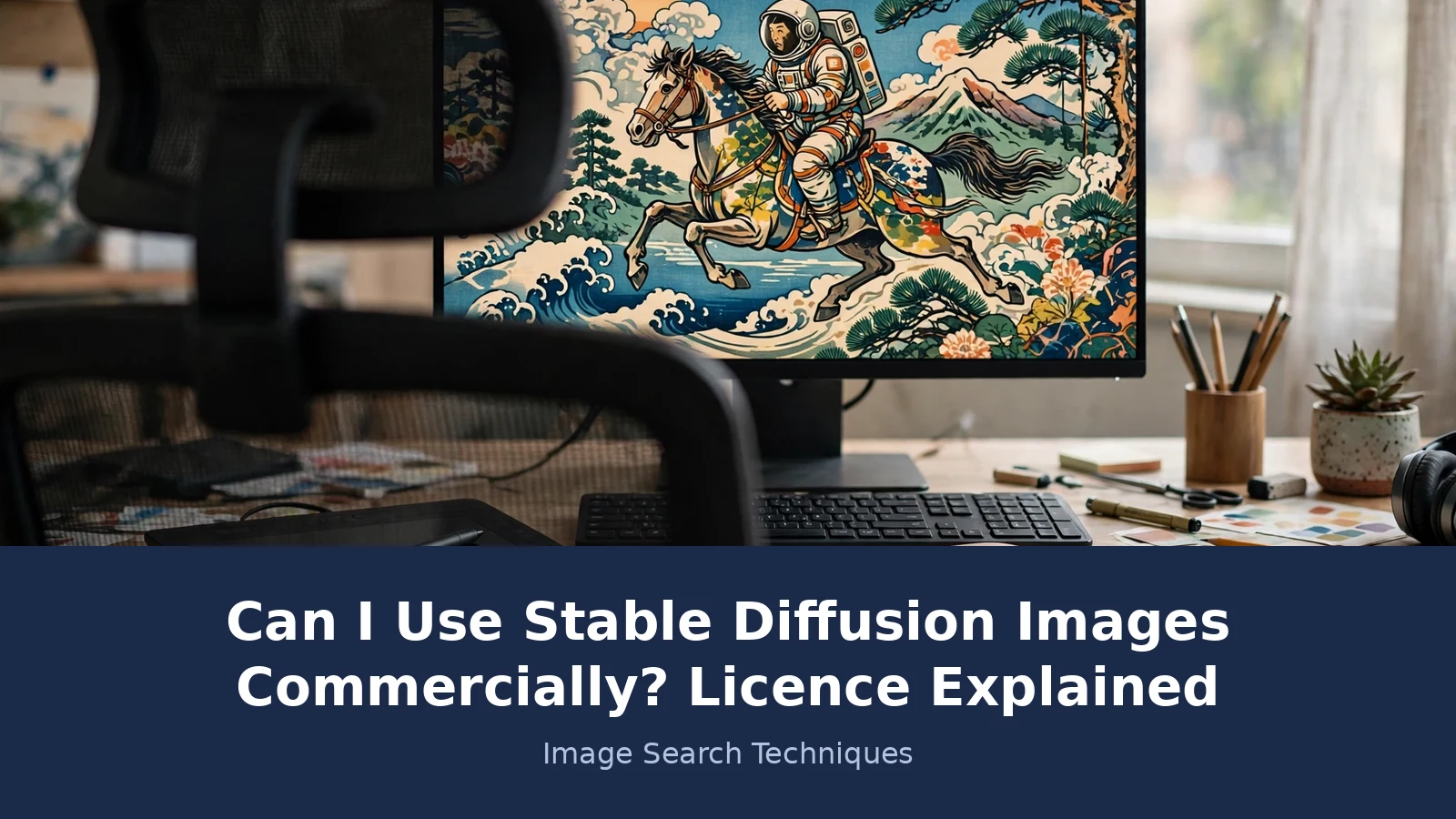
To keep this guide honest, I checked one real image instead of a made-up one. The image is “Astronaut Riding a Horse Hiroshige”, a generative artwork of an astronaut riding a horse in the style of the Japanese artist Hiroshige. It was made in HuggingFace Space with Stable Diffusion 3.5 Large, from the prompt “an astronaut riding a horse, by Hiroshige”, on 23 October 2024, by the user VulcanSphere. It sits on Wikimedia Commons under a CC0 public domain dedication, which is the uploader’s own statement that the work has no copyright to claim.
I reverse-searched the image live. Google Lens returned 26 exact matches on its exact matches tab and 60 visual matches on its visual matches tab. Lens shows no numeric total, so those are the results displayed, not a Lens-stated total. The top exact matches are the file page itself on Wikimedia Commons and the “Text-to-image model” article on Wikipedia, in English and in several other languages. Lens’s own AI Overview identified the image as generated by a text-to-image model such as Stable Diffusion 3.5, using the exact prompt quoted above. TinEye found 1 result out of 86.9 billion images searched, first indexed on 1 July 2026, on the English Wikipedia article “Computer-generated imagery”. One honest method note: Lens’s upload-by-URL page failed twice with “No image at the URL”, so the search ran through Google’s older search-by-image endpoint, which loaded the same image and returned real results.
If you are not sure an image was made with Stable Diffusion at all, our guide to telling whether an image was made with Stable Diffusion shows how to read the clues. What does this check prove? Two things. First, the version is SD 3.5 Large, so the Community Licence applies: free commercial use under $1 million in annual revenue, with registration, and an Enterprise licence above it. Second, the image is already public and reused. It appears on Wikipedia articles in many languages, which is the copyright point in action. Nobody owns this image exclusively, and a reverse search finds it in seconds. If you use a Stable Diffusion image commercially, assume it can be found and reused the same way, and pick images that still work for you on that basis.
Stable Diffusion output ownership is not copyright
This is the distinction the whole licence family turns on, so it is worth stating plainly. Stability AI says that, as between you and Stability, you own the outputs generated from its Core Models or Derivative Works, so long as you use them in compliance with the law and its Acceptable Use Policy. That is a statement about the contract between you and Stability. It is not a statement about copyright law, and the two can point in different directions.
In the United States, purely AI-generated output has no copyright. The US Copyright Office’s January 2025 report on copyrightability takes the position that copyright needs a human author, so material generated wholly by AI is not protected, while human-authored parts and creative selection, arrangement or modification of AI output can be protected. A federal appeals court upheld the human-authorship requirement in 2025. That means others may be free to reuse an image like the astronaut picture above, even though Stability says you own the output as between you and Stability. That is the Stable Diffusion copyright problem in one line: the licence lets you use the image, but the law may not let you stop anyone else using it.
In the United Kingdom, the position is more permissive. The Copyright, Designs and Patents Act 1988, section 9(3), gives copyright in a computer-generated work to the person who made the arrangements necessary for its creation, and that copyright lasts 50 years. So the same image can be unprotected in the US and protected in the UK. If you sell in both countries, plan for the stricter US position, because that is the one that limits what you can stop others doing.
Two short rules follow from all of this. A commercial licence is not copyright ownership, and our guide to AI image copyright explains who owns AI pictures in more depth. And credit is not permission: naming Stability AI, or the model, or the person who wrote the prompt, does not clear an image that shows someone else’s logo, character or artwork.
The API route: different rules again
If you generate images through Stability’s API, or through a third-party app or hosting service, instead of running the model yourself, the provider’s terms govern how you can use the output, not only the open-weights licence. Google’s AI Overview makes the same point, and it is worth repeating, because it is the most common surprise in this area. The licence on the model weights is not the only document that matters. The terms of the service you actually called matter too.
Stability’s own FAQ says Stable Diffusion API commercial use is allowed as long as outputs do not violate anyone’s copyright, with the details in its Terms of Service. The API is priced per credit, at $0.01 a credit, and the per-image cost depends on the model: SD 3.5 Large costs 6.5 credits, or $0.065 an image, Medium costs 3.5 credits, Large Turbo costs 4 credits, and Flash costs 2.5 credits, with 25 free credits to start. Those figures were listed on Stability’s pricing page on 20 November 2026, so check the current page before you budget around them.
Third-party apps are a separate case again. Some let you use outputs commercially, some do not, and some change their terms without telling you. If you made the image in someone else’s app, read that app’s terms before you publish. The open-weights licence does not rescue you from an app that forbids commercial use.
Fine-tunes, LoRAs and merges: the licence follows the base
A fine-tune, a LoRA or a merge does not escape the licence of the model it was built on. Under the Community Licence, fine-tunes and LoRAs are Derivative Works, and the licence follows them. A LoRA trained on an SD 3.5 model keeps the Community rules, including the $1 million line and the registration step. That is the Stable Diffusion fine-tune licence rule in one line: the licence follows the base model. A LoRA trained on an SD 1.5 model keeps the base model’s Open RAIL rules instead. Check the base model named on the model card, not just the fine-tune’s own page.
There are two hard limits on what you can do with outputs. You must not use a Core Model, or its outputs, to create a new foundational model architecture. Training a competing image model on Stable Diffusion outputs is a breach. And the Community Licence is revocable if you violate its terms. Stability says so plainly on its licence page, because it needs to be able to enforce its own legal obligations and protect the work it has put into the models. A licence you can lose is a licence worth reading before you rely on it.
What the licence never covers: people, logos and copied art
A model licence clears the model. It does not clear what the image shows. Commercial use still requires avoiding illegal or prohibited uses under the licence and respecting existing trademarks, publicity rights and copyrighted characters in your prompts and outputs. That is Google’s AI Overview’s point, and it is correct.
Before any Stable Diffusion image goes into an ad, a product listing or merchandise, inspect it for a recognisable person, a logo, a brand mark, a character or a copied artwork. A prompt that asks for a famous character will often produce one, and the licence does not make that lawful. The same goes for a watermark or a signature the model copied from its training data. If you spot one, regenerate the image with a cleaner prompt rather than trying to crop it out.
There is also no IP indemnification to fall back on. One independent comparison of 14 generators found no indemnity cover for Stable Diffusion. If a third party claims your image infringes their rights, Stability’s licence does not promise to defend you. That is normal for open-weights models, but it is another reason to check every image before it goes live, and to keep the record described in the next section.
Keep a record: the file you want before you publish
Every licence answer in this guide depends on facts you can only prove if you wrote them down. Before a Stable Diffusion image goes live, save a short record with the model ID and version, the licence file and the date you read it, your $1M revenue tier at generation time, and where the image is used. Add the prompt and the settings if you have them. If the image came from an API or a third-party app, add that provider’s terms too.
For the wider picture, our complete guide to protecting your photos online covers finding and checking images before you publish them. This file is not paperwork for its own sake. It is the answer to the two questions that actually come up later: which licence applied on the day you made the image, and which revenue tier you were in. Terms change, models change, and the licence page you read today will not be the one live in a year’s time. If you also use DALL-E, our guide to whether DALL-E images can be used commercially covers its plan rules. A dated record is the only way to show which version you relied on.
So, can I use Stable Diffusion images commercially? Yes, in most cases, and now you know which cases. Find the version, read the Stable Diffusion licence that covers it, register if it is a Community model, check what the image shows, and keep the record. Do those five things and the image is safe to publish. Skip any of them and you are guessing, and guessing is what gets a listing taken down or a client asking questions you cannot answer.
Can I use a Stable Diffusion image on my website to make money?
Yes, in most cases. Images from SD 3.5 and SDXL Turbo are covered by the Stability AI Community Licence, which is free below $1 million in annual revenue once you register. Images from SD 1.5, SD 2.1 and SDXL base use the Open RAIL licences, which have no revenue cap.
What is the $1 million limit in the Stability AI Community Licence?
The Community Licence is free while you and your affiliates make under $1 million in total annual revenue, from any source, not just AI work. The free grant ends on the date you cross the threshold. Above $1 million you need a custom-priced Enterprise licence.
Do I need to register with Stability AI to use images commercially?
Yes. Commercial use under the Community Licence requires registering with Stability AI, and research used for a commercial purpose must also be registered. Complete the registration step on Stability’s licence page before the image goes live, and keep the confirmation.
Can I sell Stable Diffusion images on merchandise?
Yes, the licence covers merchandise such as T-shirts, mugs and posters on the same terms as a blog header. But check what the image shows first, because a character, logo or celebrity likeness can still infringe. And remember a purely AI-generated image has no US copyright, so others can sell the same image too.
Do I own the copyright in a Stable Diffusion image?
Not necessarily. Stability says you own outputs as between you and Stability, but in the US purely AI-generated output has no copyright because copyright needs a human author. In the UK, the Copyright, Designs and Patents Act 1988 is more permissive for computer-generated works. A licence is not the same as copyright ownership.
Can I use Stable Diffusion images made through an API or a third-party app commercially?
It depends on the provider’s terms. If you call Stability’s API, its Terms of Service govern the outputs. If you use a third-party app, that app’s terms govern instead of the open-weights licence. Read the terms of the service you actually used before publishing.