🔎 Reverse Image Search
Image search techniques made simple: upload a photo or paste a URL and search 6 engines at once. 100% free, nothing stored.
🔒 Your image is never stored on our servers longer than 24 hours and is never shared.
The image looks perfect for your product page, and ChatGPT let you download it without a word about payment or permission. So is it yours to sell? The download button is not a legal clearance certificate, and the difference between owning the file and owning the rights in it is where most people get caught out. This guide reads OpenAI’s own terms, line by line, and tests a real ChatGPT image to show what you can actually do with one.
Can I use ChatGPT images commercially? Yes, in most cases. OpenAI’s terms say you own the output, so the permission is real. But that permission covers only OpenAI’s side of the deal. It does not give you copyright in the image, it does not clear other people’s rights in anything the image shows, and it does not override the rules of the shop or platform where you publish it. The rest of this guide works through each of those three limits in turn.
What OpenAI’s terms actually say
The OpenAI Terms of Use, effective 1 January 2026, are the document that decides the question, so this section quotes them rather than summarising a review site. The terms are written for individuals using ChatGPT, DALL-E and OpenAI’s other services, and they include the Service Terms that cover the API.
The ownership sentence is short, and it is the whole foundation of commercial use. It says that as between you and OpenAI, and to the extent permitted by applicable law, you retain your ownership rights in your input and you own the output, and OpenAI assigns to you all its right, title and interest, if any, in and to the output. There is no split between free and paid plans in that sentence. A free account and a Pro account get the same ownership term.
What the terms do not say is just as important. The word commercial does not appear in the consumer terms at all. There is no sentence granting commercial use in so many words, and no sentence taking it away either. Commercial use rests on the ownership assignment: if the output is yours, you can use it, sell it, publish it and put it in marketing, unless some other rule in the terms or in the law stops you. That is a thinner foundation than most people assume, and it is why the rest of this guide matters.
Three other clauses shape what you can do. First, output may not be unique: other users may receive similar output, and the assignment to you does not extend to theirs, so two people can prompt their way to near identical images and neither can stop the other. Second, you must not present output as human generated when it was not. Third, you are responsible for your content, including having the rights needed for anything you upload, and you must not use output about a person for a decision with legal or material impact on them, such as credit, employment, housing or insurance.
If you live in the UK, a second document applies. Residents of the European Economic Area, Switzerland and the UK are governed by OpenAI’s separate Europe Terms of Use, updated 16 January 2026. Under the UK terms the ownership sentence is identical, but the Europe terms add a Business Use addendum that only bites when you use ChatGPT images for business. It caps OpenAI’s liability for that use at the greater of what you paid for the service in the 12 months before the claim arose, or one hundred dollars. It also says that if you are a business or organisation, you will indemnify OpenAI against third party claims arising from your use. In plain terms, OpenAI hands you the image and steps back. If someone sues over it, that is your problem, not theirs.
One more thing the terms make clear: consumer ChatGPT gives you no legal cover at all. That protection runs the other way, and the API is different, as the plan table below shows.
Free vs Plus vs Pro vs API: the plan table
The question most people actually ask is whether the free plan is enough, or whether paying changes the legal position. The answer is that the plan changes how much you can generate, not what you own. The terms give every consumer plan the same ownership sentence. What differs is volume, speed and, for the API, the legal protection. OpenAI’s pricing page, read on 26 November 2026, lists image generation as limited on the free plan, with more image creation on Go, full image generation with more complex and accurate image creation on Plus, and unlimited and faster image creation on Pro.
| Route | Commercial use | Image creation | Who owns the output | Indemnity from OpenAI |
|---|---|---|---|---|
| ChatGPT Free | Yes, under the same terms | Limited | You, as between you and OpenAI | None; you indemnify OpenAI if you are a business |
| ChatGPT Go | Yes, under the same terms | More than Free | You, as between you and OpenAI | None; you indemnify OpenAI if you are a business |
| ChatGPT Plus | Yes, under the same terms | Yes, more complex and accurate | You, as between you and OpenAI | None; you indemnify OpenAI if you are a business |
| ChatGPT Pro | Yes, under the same terms | Unlimited and faster | You, as between you and OpenAI | None; you indemnify OpenAI if you are a business |
| API (gpt-image-1) | Yes, under the Business and Service Terms | Billed per image | You, under the same assignment | Yes, for third party IP claims on output, with exclusions |
Two rows deserve a closer look. The first is the free plan. Free users sometimes worry that limited image creation means limited rights. It does not: the limit is on how many images you can make, not on what you can do with them. A blog header made on the free plan carries the same ownership term as one made on Pro. The free plan cannot produce images at volume, which is the real reason a shop or agency pays.
The second is the API row. The Service Terms, section 1, say OpenAI’s indemnification obligations to API customers include any third party claim that the customer’s use or distribution of output infringes a third party’s intellectual property right. That is the only route where OpenAI will stand behind the image. The protection has exclusions: it does not apply where the customer knew or should have known the output was infringing, where safety features were disabled or ignored, where the output was modified or combined with other products, or where the customer had no right to use the input. Even with those exclusions, the API is the only route that offers a defence. Consumer ChatGPT, free or paid, offers none.
That split matters for client work. If you use ChatGPT images for client work and generate an image in the ChatGPT app to hand to a client, the client gets your ownership of the output and no legal cover from OpenAI. If the image turns out to copy a protected design, the claim lands on you and the client. If you generate the same image through the API under a business account, that protection may apply, subject to the exclusions. It is a narrow shield, but it is a real one, and it is the main legal reason to use the API for commercial work rather than the app.
Why owning the image is not the same as owning the copyright
Here is the sentence that surprises most people. OpenAI can give you ownership of the output as between you and OpenAI, and still leave you without copyright in the image. The two are different things, and confusing them is the most expensive mistake in this whole subject.
ChatGPT image copyright turns on who the law treats as the author, and the answer differs by country. Copyright, in the United States, protects human authorship. The US Copyright Office has examined this question in detail, and its report on the copyrightability of generative AI outputs, Part 2 of its AI report, was published on 29 January 2025. The Office’s position is that a purely AI generated image, produced from a prompt alone, lacks the human authorship copyright requires. You own the file as far as OpenAI is concerned, but you may not be able to stop anyone else from copying it, selling it, or generating something nearly identical. The Copyright Office also says that where a person adds meaningful human creative input, the human authored parts can be protected, even if the AI generated parts cannot. Editing, selecting, arranging and transforming the output are the kinds of input that count. Typing a prompt, on its own, does not.
The practical effect is simple to state and easy to underestimate. You can use a ChatGPT image on your website, in an advert, on a book cover or on a mug, and OpenAI will not stop you. But if a competitor downloads the same image, or generates a near copy with a similar prompt, you will have very little ground to stand on. Your ownership is ownership against OpenAI, not ownership against the world. That is why the most careful guides in this field, including the Kaboompics guide updated on 25 November 2026, keep repeating that permission from the tool is not the same as a guarantee that the output is unique, protected by copyright, or clear of third party rights. The guide is right, and it is worth reading alongside this one, because it makes the same point from a photographer’s point of view.
There is a second consequence for anyone selling images rather than using them. If you sell a ChatGPT image as a stock photo, a print or a digital bundle, the buyer is not getting exclusivity, however the listing is worded. They are getting a file anyone else may also hold. Honest listings say so. The listings that cause trouble promise exclusive rights the seller does not have, a point the selling section returns to.
None of this makes ChatGPT images useless for commercial work. It makes them suited to some jobs and not others. A blog header, a social media graphic, an internal presentation or a concept mock up are low stakes uses where exclusivity barely matters. A logo, a brand mascot, packaging artwork or the hero image of an advertising campaign are high stakes uses where exclusivity and control are the whole point. For those, a ChatGPT image is the wrong tool, not because the terms forbid it, but because the rights behind it are too thin to carry a brand.
The UK side: what CDPA 1988 s.9(3) means for you
Readers in the UK face a different rule, and it is more generous than the American one, which is exactly why the two must be stated separately. The Copyright, Designs and Patents Act 1988, section 9(3), says that for a computer generated work, the author is the person by whom the arrangements necessary for the creation of the work are undertaken. On the face of it, that gives the person who prompted the image a claim to authorship that the US rule denies.
Do not read that as a settled answer. The provision was written in 1988, long before modern generative models, and it has never been tested in a UK court on an image from a system like ChatGPT. No judge has decided whether prompting counts as making the arrangements necessary for creation, or whether the arrangements belong to OpenAI, or to no one. It also says nothing about originality, a separate requirement. So the honest position for a UK reader is that the law looks more permissive than the American rule, but it is untested, and no one should build a business on it without advice.
Two related points belong here because people mix them up. The first is fair use, an American doctrine. It is a defence that lets someone use another person’s copyrighted work in limited circumstances, such as criticism or comment. It does not give you rights in your own AI output, and it does not make an infringing image safe. The second is fair dealing, the UK equivalent, narrower than its American cousin, covering specific purposes such as research, private study, criticism and review, but not commercial use on a product page. Neither doctrine helps if your image reproduces someone else’s protected work. They are defences for using other people’s material, not licences for your own.
The practical advice for a UK reader is therefore the same as for an American one, with one extra step. Treat the image as usable but not protectable, keep a record of the human input you added, and do not rely on section 9(3) until a court has said what it means for generative AI. If the image will carry your brand, get proper advice before you commit to it, because this article is general information only, and the law in this area is still moving.
The worked example: one real ChatGPT image, checked twice
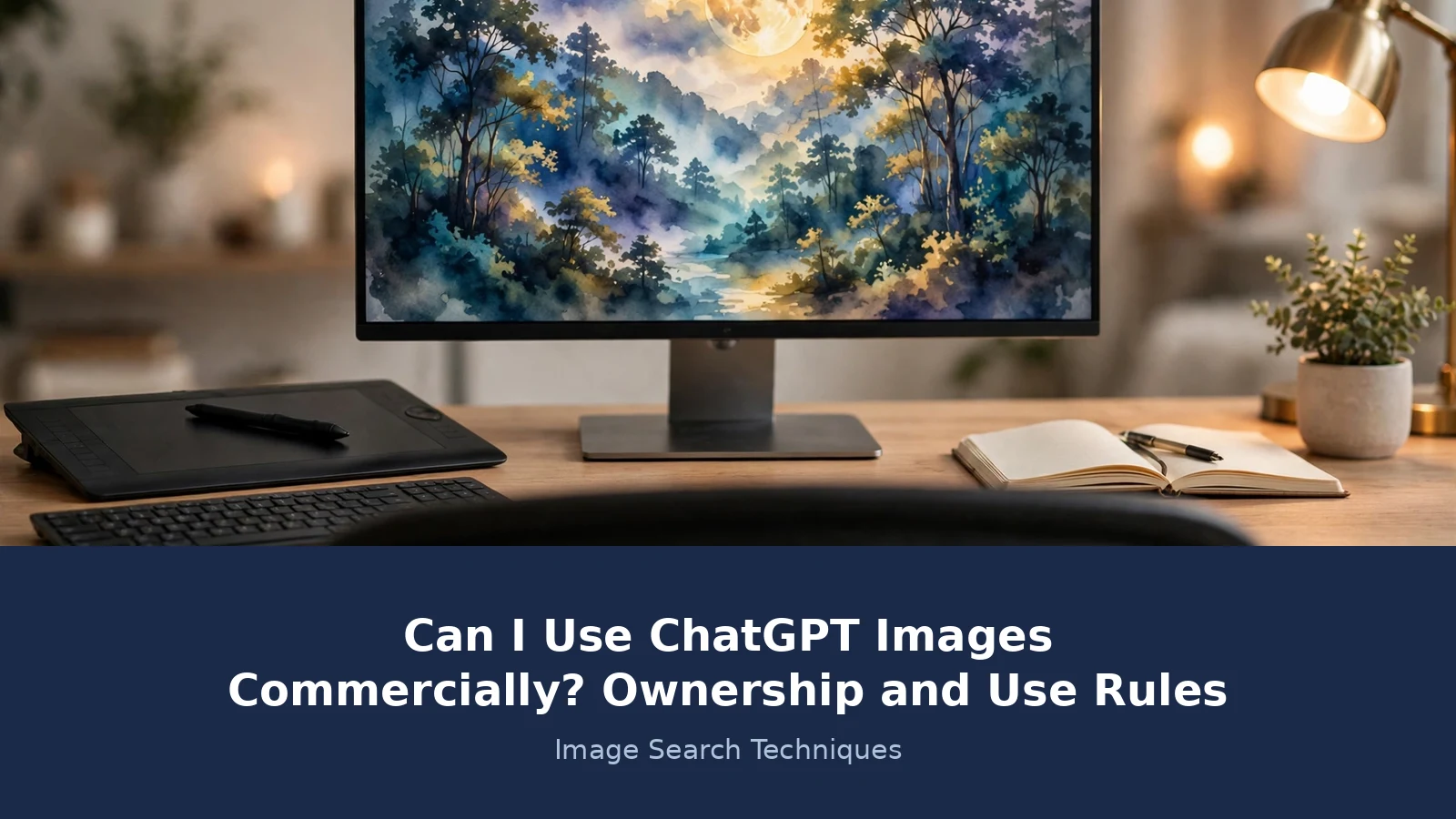
Terms are abstract, so this section tests one real image against everything above. The image is a watercolour style picture of a moonlit forest, with a large glowing moon, tall evergreen trees and a winding rocky stream. It was generated by ChatGPT using the GPT Image 1.5 model, and it is published on Wikimedia Commons as File:ChatGPT image of a moonlit forest.jpg, dated 3 January 2026, at 800 by 1200 pixels. The Commons file page lists the artist as ChatGPT and the licence as public domain, on the ground that the image is the work of a computer algorithm. That file page, in one line, states the whole copyright problem this article is about.
On 26 November 2026 I reverse searched the image on Google Lens and on TinEye, without signing in to either service, to see how findable it is and what the search engines say about it.
Lens returned 8 exact matches. The first was the Wikimedia Commons file page itself. The others were the same image reused on the Portuguese and Ukrainian Wikipedia pages for GPT Image, on a Spanish electronics site, on a Japanese dictionary page, and on a note taking site. Lens also loaded 60 visual matches, but those were other moonlit forest pictures, posters and stock photos, not copies of this image. The result is a useful reminder of how to tell if an image is AI generated: the engine could see the style, but it could not name the tool. Lens showed its own AI Overview on the image, describing it as an AI generated moonlit forest scene in a watercolour style, and citing the Commons file. What the Overview did not do is name ChatGPT or GPT Image 1.5. The pixels told Lens the image was AI made. They did not tell it which tool made it.
TinEye searched over 86.9 billion images and found 0 matches. That is not a contradiction. TinEye had simply not yet crawled any page where the image appears. The service says so itself on the results page. A zero on TinEye means not yet indexed, not that the image is unused, and it is reported here as a zero, not dressed up as a clean bill of health.
Three things follow for commercial use. First, the image is findable: anyone who checks can trace it to a public page that says, in plain words, that it has no human author and no copyright. Second, it is not exclusive. It already appears on Wikipedia pages in three languages, and anyone can download the same file from Commons. Third, the tool that made it is not provable from the pixels. Lens could tell the image was AI generated, but it could not say it was ChatGPT. That is why the terms and the disclosure rules matter more than the pixels: the image carries no visible proof of where it came from, so the honesty has to come from the person using it.
Now test the three commercial routes against this one image. As a blog header, it is fine: the terms allow it, the image shows nothing that belongs to someone else, and the only cost is that a reader could find the same image elsewhere. As a product listing image, it is also fine on these facts, provided the listing does not claim the artwork is original or exclusive. As merchandise, say a poster or a mug, the terms still allow it, but the economics are poor: the same file is free on Commons, so any buyer who searches will find it and any competitor can print the same poster. The terms answer the permission question. They do not answer the business question, and for merchandise the business answer is usually no.
What the terms do not cover: other people’s rights in your image
OpenAI’s assignment covers only OpenAI’s rights. It cannot give you rights that belong to someone else, and this is where ChatGPT images most often get their users into trouble. The terms put the responsibility on you in plain words: you are responsible for your content, including ensuring it does not violate any applicable law or the terms, and you represent that you have all the rights, licences and permissions needed for your input.
The first trap is the input. If you upload someone else’s photograph, illustration or artwork and ask ChatGPT to transform it, the prompt does not create permission. The output is still derived from material you had no right to use, and the terms do not clean that up. The same applies when you ask ChatGPT to restyle a protected character, copy a distinctive product design, or reproduce a logo. Credit does not fix it either. Adding a line that says the original belongs to someone else is not permission, and it never has been. Credit is not permission is a rule this site states in every licence guide, because it is the mistake people make most often.
The second trap is the output. ChatGPT can produce images that contain a recognisable person, a trademark, a logo or a character, even from an innocent prompt. The terms forbid using the visual tools to reproduce someone’s likeness without their consent and the necessary rights, and they forbid presenting output as human generated. If your image shows a real person’s face, a brand’s logo or a film character, you need permission from the person or company concerned, and OpenAI’s terms cannot give it to you. The Google AI Overview makes the same point, and the Reddit discussion in it keeps coming back to it: styles are usually fine, specific characters are not.
The third trap is branding. The Overview also warns against brand misrepresentation, and the terms support it. You may not use OpenAI’s name or logo in a way that implies OpenAI endorses your product, and you may not present the output as human generated. A listing that says an image was made by ChatGPT is honest. A listing that implies OpenAI approved your product, or that hides the AI origin entirely, is not. The distinction is small on the page and large in a dispute.
A short checklist catches most of these problems before publication. Look at the finished image and ask four questions. Does it show a real person, a logo, a trademark or a recognisable character? Was any part of the input someone else’s work? Does the image copy a distinctive design you did not create? And would a buyer think the image is a photograph or a hand drawn original? A yes to any of the first three means you need permission or a different image. A yes to the fourth means you need a disclosure, which is the subject of the next section but one.
Selling ChatGPT images: Etsy, books, stock sites and merchandise
Using an image yourself and selling it to someone else are two different acts, and marketplaces treat them differently. OpenAI’s terms allow both in principle, but the platform where you sell can add rules of its own, and those rules are the ones that get listings removed.
Etsy is the clearest example. To sell ChatGPT images on Etsy, you must follow Etsy’s Seller Policy, which says that if an item is created through the use of artificial intelligence, you must disclose this in your relevant listings. The rule is not a suggestion, and it sits alongside the requirement to give an accurate representation of how the item was made and by whom. An Etsy listing for a ChatGPT image that says nothing about AI is breaking Etsy’s rules even if it breaks none of OpenAI’s. The same policy also requires your own photographs or video content in listings, not stock photos or artistic renderings used by other sellers, which is a second reason a bare ChatGPT download makes a poor Etsy product. Sellers who disclose the AI origin, describe what human work went into the finished item, and sell something more than the raw output are the ones whose listings survive.
Books are similar. Amazon’s Kindle Direct Publishing asks authors to disclose AI generated content, and the community discussion in the Google AI Overview reflects that: sellers in the Amazon KDP Books group agree AI images can be used in books if copyrighted designs and celebrity faces are avoided and the platform disclosure rules are followed. A book cover made with ChatGPT is therefore a disclosure question first and a permission question second. Say it is AI generated, in the place the platform asks, and the cover is fine. Hide it, and the listing is at risk even though OpenAI allowed the image.
Stock sites are stricter still, and they split into two camps. Some accept AI generated images with a label and a check that nothing in the image belongs to someone else. Others refuse them outright, or for editorial use. A stock site’s acceptance is its own decision: OpenAI granting you the output does not oblige any marketplace to list it. Check the contributor terms before uploading, and never upload to a site that asks contributors to confirm the work is wholly their own original creation, because a prompt only image is not that.
Merchandise is where the thin rights matter most. Putting ChatGPT images on merchandise, a mug, a t-shirt or a poster, is allowed by OpenAI’s terms, and many sellers do it. But the buyer is paying for something anyone can reproduce, and the seller has no copyright to enforce if a competitor copies the design. Print on demand services also have their own content rules, and a design that includes a recognisable character or logo will be rejected or taken down. If merchandise is the plan, the honest way to do it is to add real human work: edit the image, combine it with your own design, and sell the finished design rather than the raw output. That human input is also what gives you the best claim to copyright in the finished work under the US Copyright Office’s own guidance.
C2PA and disclosure: where you have to say the image is AI made
ChatGPT images carry C2PA metadata, a technical standard that records the image’s origin and the tool that made it. The metadata travels with the file unless it is stripped, and it is how detection tools and platforms can tell an image is AI generated even when nothing in the pixels gives it away. Our guide to how to tell if an image was made with ChatGPT explains the detection side in detail, including the metadata and the other tells, so this article does not repeat it.
Disclosure is a separate question from detection, and it has three layers. The first is OpenAI’s own terms, which forbid presenting output as human generated. That is a disclosure rule in itself: you may not pass the image off as your own drawing or photograph. The second is the platform, and the examples above show how it works: Etsy requires disclosure in the listing, Amazon KDP requires it for books, and advertising platforms increasingly require disclosure for ChatGPT images in ads. The third is the law. The European Union’s AI Act requires disclosure for certain AI generated content, and the UK government has consulted on similar transparency rules, though no equivalent UK duty is in force for ordinary commercial images at the time of writing. The direction of travel is clear, and disclosing early is cheaper than removing listings later.
A simple disclosure is enough in most cases: a line in the listing or the image caption saying the image was made with ChatGPT, with a note of what you changed, covers Etsy, KDP and most ad platforms. What does not work is disclosing in one place and hiding it in another, or disclosing the AI origin while claiming the image is exclusive or original. The disclosure and the claim have to match.
Five checks before you use a ChatGPT image commercially
Pulling the guide together, here are the five checks to run before any ChatGPT image goes into a commercial use. They take a few minutes, and they catch the problems that actually cause disputes.
1. Check the input. Was any part of what you gave ChatGPT someone else’s work? A photo, an illustration, a logo or a character design that you do not own means the output carries that problem with it. If the input was not yours, start again with your own material.
2. Check the output. Look at the finished image and name everything in it. A real person, a logo, a trademark, a recognisable character or a distinctive product design all need permission from their owner. OpenAI’s terms cannot give you that permission, and credit does not substitute for it.
3. Check the plan. The free plan gives you the same ownership as Pro, so paying does not change the legal position for app generated images. What changes the position is the API, which is the only route with that protection from OpenAI. If the image will carry a client project or a product line, consider generating it through the API under a business account.
4. Check the platform. Read the rules of the place where the image will appear. Etsy wants disclosure in the listing. KDP wants disclosure for books. Ad networks and stock sites have their own rules. OpenAI’s permission does not override any of them.
5. Check the claim. Decide what you are telling the buyer. If you say the image is original, exclusive or protected by copyright, you are promising something a prompt only image cannot deliver. Say what it is: an AI generated image, edited by you, used with OpenAI’s permission. That claim is true, and it is the only one that holds up.
Run those five checks and the answer to the question in the title is yes, with your eyes open. You can use ChatGPT images commercially, on the free plan or a paid one, for a blog, an advert, a book cover or a product. What you cannot do is treat the download as ownership against the world, or as a clearance certificate for other people’s rights. The terms give you the image. The rest of the work, checking the input, the output, the platform and the claim, is yours. If you want a deeper comparison with the other generators, our guides to whether DALL-E images can be used commercially and whether Freepik images can be used commercially apply the same five checks to different licence terms, and our complete guide to protecting your photos online covers what to do when someone else uses your images without permission.
This guide is general information, not legal advice. The terms quoted here were read on 26 November 2026, and OpenAI updates them regularly. If an image will carry your brand, a client contract or a product line, get proper advice before you commit to it.
Can I use ChatGPT images commercially on the free plan?
Yes. OpenAI’s terms give every consumer plan the same ownership sentence, so a free plan image carries the same rights as one made on Plus or Pro. The free plan limits how many images you can create. You still have no copyright in a prompt only image, and you must clear any third party rights in what it shows.
Can I sell ChatGPT images on Etsy?
Yes, if you follow Etsy’s rules. Etsy’s Seller Policy requires you to disclose in the listing that the item was created with AI, and to describe accurately how it was made. Do not claim the image is original or exclusive, because a prompt only image carries no copyright to sell. Adding your own editing and design makes the listing stronger.
Can I copyright a ChatGPT image?
In the United States, probably not for a prompt only image. The Copyright Office says purely AI generated material lacks the human authorship copyright requires. If you add meaningful human creative input, such as substantial editing, selection or transformation, the human authored parts may be protected. In the UK the position is untested under CDPA 1988 s.9(3).
Can I use a ChatGPT image that shows a celebrity or a logo?
No, not without permission from the person or company concerned. OpenAI’s terms give you rights only as between you and OpenAI, and they forbid reproducing someone’s likeness without consent and the necessary rights. A logo, trademark or recognisable character in the image needs its owner’s permission, and crediting them is not a substitute for it.
Do I need to credit OpenAI when I use a ChatGPT image?
No. OpenAI’s terms do not require a credit line, and you own the output as between you and OpenAI. What the terms do require is honesty: you must not present the output as human generated. A short note saying the image was made with ChatGPT satisfies that rule and also meets most platform disclosure requirements.
Can I use ChatGPT images in client work?
Yes, but tell the client what they are getting. The client receives your ownership of the output and no indemnity from OpenAI, because consumer ChatGPT offers none. If the image will carry a brand or a product line, generating through the API under a business account is safer, since Service Terms give API customers indemnity against third party IP claims.