🔎 Reverse Image Search
Image search techniques made simple: upload a photo or paste a URL and search 6 engines at once. 100% free, nothing stored.
🔒 Your image is never stored on our servers longer than 24 hours and is never shared.
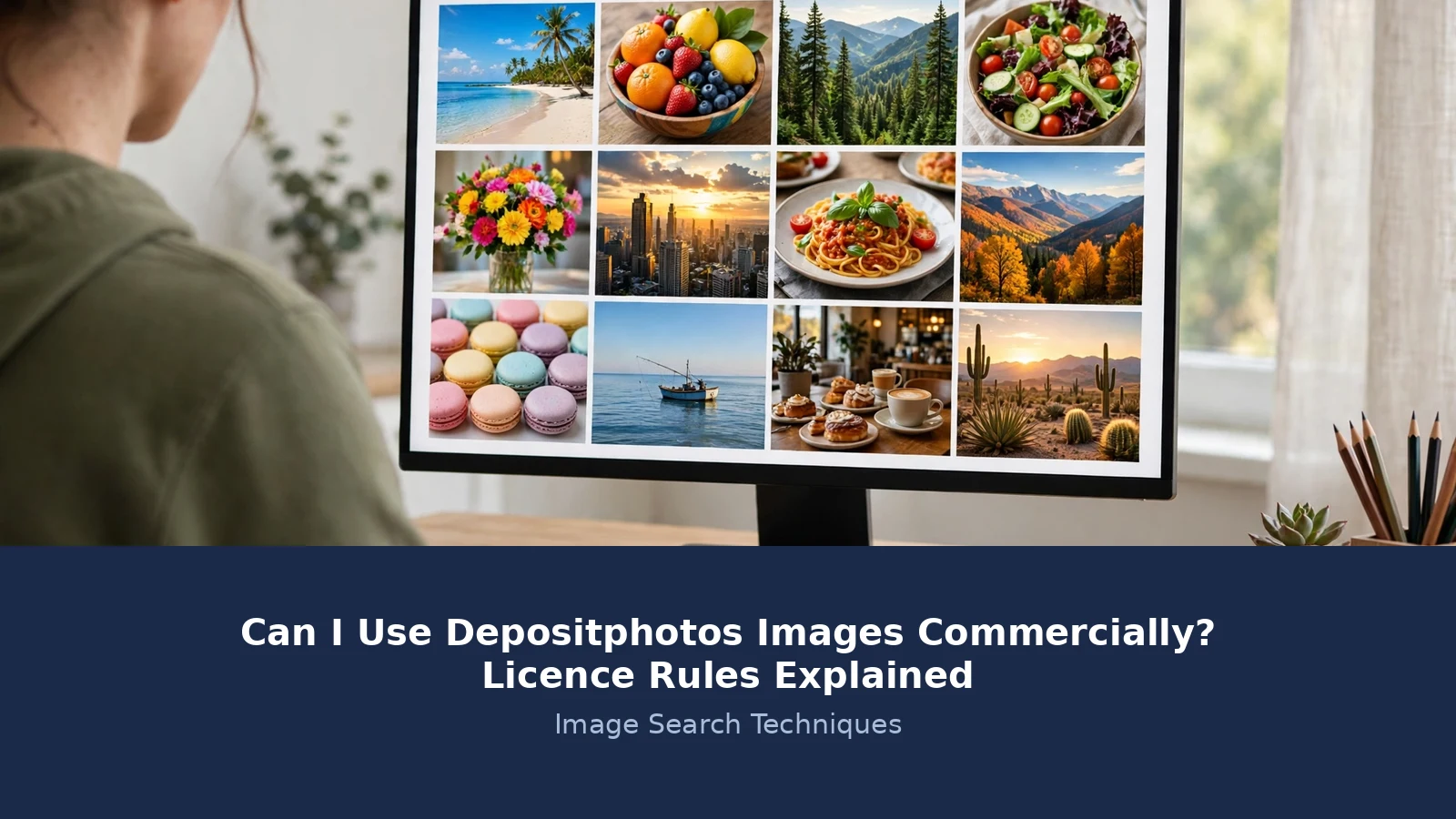
You found the perfect photo on Depositphotos and now you are wondering whether you can put it in an advert, on a product page, or on a T-shirt you plan to sell. The short answer is yes, usually. The longer answer depends on which licence you bought and what the photo will be used for, because Depositphotos sells two different licences and they do not cover the same things.
Direct answer: Can I use Depositphotos images commercially? Yes, under the Standard licence for most everyday uses, up to 500,000 copies. You need the Extended licence for unlimited print runs and for products you sell or give away where the image is the main attraction. Editorial Use Only photos cannot be used commercially at all.
This guide reads the Depositphotos licence agreement, effective 12 September 2025, line by line, and applies it to the three uses bloggers and shop owners actually ask about: a blog header, a product listing and merchandise. It is general information, not legal advice. If a use could cost you real money, check the licence yourself or ask a lawyer before you publish.
What the Standard licence actually allows
Most photos, vectors and illustrations in the Depositphotos library are sold under the Standard licence. It is the default. When you buy a Depositphotos subscription or a pack, this is usually the licence you get, and it covers the most common commercial uses without any extra payment.
Under the Standard licence you can use a downloaded file for adverts, marketing, websites, apps, user interface designs, product packaging, newspapers, magazines, books and ebooks, presentations, social media content and personal projects. That includes Depositphotos images on YouTube thumbnails and social media adverts, which are ordinary commercial uses under the Standard licence. Depositphotos sells royalty-free licences, which means you pay once and do not owe a fee each time the image is shown, but the licence still sets the conditions. The licence is non-exclusive, perpetual, worldwide, non-transferable and non-sublicensable. In plain words, you can keep using the file for as long as you like, anywhere in the world, but you cannot hand the licence itself to someone else, and nobody else can use the same download under your licence.
Three limits matter. First, printed copies are capped at 500,000 copies or impressions. Second, you cannot use the file to create items for resale or free distribution where the file plays a major role in the item. Third, you cannot use Depositphotos images for a logo or trademark, and you cannot register any intellectual property rights in them. The full wording sits in Depositphotos’ Standard and Extended License Agreement, and it is the document that decides any dispute, not a blog summary.
One detail catches freelancers out. The Standard licence is an individual licence, so it authorises one person only. Depositphotos images for client work are covered too: you can use a file for a client’s project, and you can hand the finished design to the client for reproduction, but the licence does not move to the client. If the client wants to download or reuse the file themselves, they need their own licence. Business and Enterprise plans exist for teams, and they are the route when several people need access.
What the Extended licence adds
The Depositphotos Extended licence includes everything the Depositphotos Standard licence allows, then removes the two limits that matter most to sellers. There is no cap on the number of copies, prints or displays, and you can use the file for items for resale or free distribution even when the file plays a major role in the item.
Depositphotos’ own examples of Extended uses include posters, postcards, calendars, mugs and glasses, mousepads, T-shirts and other clothing, charms, stationery, books made wholly or largely of illustrations, and website or document templates for resale. Digital products for resale or free distribution are covered too, such as screensavers and desktop wallpapers.
Extended licences are bought through packs, and they cost more than Standard packs. That is the whole trade. You pay more once, and the two ceilings that would otherwise block a product line disappear. If you never sell anything with the image as the main attraction and never print more than half a million copies, you do not need it.
| Use | Standard licence | Extended licence |
|---|---|---|
| Adverts, websites, apps, packaging, books | Allowed | Allowed |
| Printed copies or impressions | Up to 500,000 | Unlimited |
| Website visitors and electronic displays | Unlimited | Unlimited |
| Items for resale, image plays a minor role | Allowed | Allowed |
| Items for resale, image plays a major role | Not allowed | Allowed |
| Free distribution, image plays a major role | Not allowed | Allowed |
| Templates for resale | Not allowed | Allowed |
| Logo or trademark registration | Not allowed | Not allowed |
| Reselling the file itself | Not allowed | Not allowed |
| Editorial Use Only files, commercial use | Not allowed | Not allowed |
| Duration | Perpetual | Perpetual |
Two rows in that table surprise people. Neither licence lets you register a logo or trademark from a stock file, and neither lets you resell the file itself. The Extended licence widens what you can make with the file. It does not widen what you own.
The 500,000-copy print cap, explained
The 500,000-copy cap is the single number most buyers need to understand, because it is the line between the two licences. Under the Standard licence you may produce up to half a million copies or impressions of printed material featuring the file. That covers books, magazines, newspapers, flyers, brochures, business cards, CD and DVD covers, labels and product packaging.
For most bloggers and small shops the cap is generous. A print run of a few thousand books or a few tens of thousands of flyers sits far below it. The cap starts to matter for national magazine adverts, large catalogue runs, and packaging for a product that sells in volume. Count the total impressions across every print use of that file, not each job separately, because the agreement caps the quantity of copies or impressions of material featuring the file.
Electronic use has no cap under either licence. Website visitors are unlimited, electronic displays are unlimited, and the resolution of the unmodified file for electronic use is unlimited. So a blog header, a social media advert or an ebook cover does not consume any of the 500,000. The cap is a print number only.
If you expect to cross the cap, buy the Extended licence before you print, not after. The agreement lets Depositphotos audit your use and recall a licence used in breach, and an overdue account loses its rights until the balance is paid. Buying the right licence first is cheaper than explaining a print run later.
Minor role vs major role: the test that decides resale
Depositphotos does not decide resale by the type of product. It decides it by the role the file plays in the product. The agreement defines the role by the value the file adds to the item and how much it influences a customer’s decision to choose that particular item over similar ones.
A major role means the file is a primary, defining or important part of the item, increases its intrinsic value, or influences the buyer’s preference. A minor role means the file is an incidental part of the item, adds no significant value, and does not influence the buyer’s choice. That is the whole test, and it is the spine of the licence.
Apply it to real cases. A photo used as a small illustration inside a book is a minor role, so the Standard licence covers it. The same photo printed large on a poster that people buy because of the image is a major role, so it needs the Extended licence. A stock photo on a T-shirt is a major role when the picture is why someone buys the shirt. A stock photo used as a background texture on a product page is a minor role when nobody buys the product for the texture.
Two related definitions matter here. An item for resale is an item distributed to raise commercial revenue, such as web templates, T-shirts or calendars sold for money. An item made at a client’s request is not automatically for resale, but if you then distribute it to raise revenue, it counts as resale. An item for free distribution is one given to a wide audience without raising revenue, such as free web templates, postcards or flyers. The same major-role rule applies to both.
When the role is genuinely unclear, the safe move is to buy the Extended licence or ask Depositphotos support before you download. The agreement itself ends with that advice, and it is the only answer that protects you when a borderline product starts selling well.
Can I sell Depositphotos images on Etsy or on merchandise?
This is the question that causes the most trouble, because the answer changes with the product. You can sell products that contain a Depositphotos image, but only under the right licence and only when you are selling the product, not the image.
On Etsy, a mug, a poster or a T-shirt with a Depositphotos image as the main design needs the Extended licence. The image is the reason the buyer chooses that mug over another one, so it plays a major role. A listing photo used to show a handmade product you made yourself is a different use: the image illustrates your listing rather than being the product, and the Standard licence covers that kind of advertising use. The distinction is the same minor-role test from the section above, applied to your exact listing.
Print-on-demand works the same way. A design where the stock photo is the artwork needs the Extended licence. A design where the stock photo is a small background element behind your own artwork may be a minor role, but that is a judgment call, and the judgment is yours to defend. If the photo is what makes the design sell, treat it as a major role.
What you can never do, under either licence, is sell or give away the file itself. You cannot list the downloaded photo as a digital download, put it in a stock pack, or offer it as a free download on a shared drive. You cannot sublicense it, rent it, donate the rights, or let a third party extract it from your product. The licence covers items you create with the file. It never covers the file as a product.
Editorial Use Only photos: the commercial-use trap
Some files in the Depositphotos library carry an “Editorial Use Only” label. These are sold under a limited Standard licence, and they are prohibited for commercial use or advertising. That single label overrides everything else in this guide.
Editorial photos often show people without a model release, private property, famous trademarks, sports or public events, or recognisable buildings. Depositphotos cannot promise that the people, logos or artwork in them are cleared for commercial use, so it limits them to non-commercial, informational use: newspapers, magazines, blogs, encyclopaedia articles, documentaries, news programmes and non-commercial presentations where the purpose is to educate, inform or entertain.
Using an editorial photo in an advert, a product listing, a sponsored post or any promotion breaks the licence, even if you paid for the download. The same rule applies to free files marked editorial. Check the label on the file page before you download, not after you have built a campaign around the image.
Editorial and free files also carry an attribution rule. When you use them, you must credit the contributor in the form “[Name or Nickname of the Contributor] / depositphotos.com” and link to depositphotos.com where applicable. That credit is a condition of the licence. It is not a substitute for a commercial licence, and it does not turn an editorial photo into a commercial one.
Free Depositphotos images: what the free licence really allows
Depositphotos free images come from a rotating selection of free files. If a preview carries a “Free” label, the contributor has allowed Depositphotos to offer it free for a short time, and you can download and use it in commercial and personal projects. That sounds generous, and for many uses it is, but the free licence is a Standard licence with attribution, not a free-for-all.
The Attributed Free License Agreement allows commercial use with credit, in the same “[nickname] / depositphotos.com” format. It does not allow resale or free distribution of items where the image plays a major role, and the 500,000-copy print cap applies. In other words, a free file can illustrate your blog, your advert or your social media post, but it cannot become the artwork on a T-shirt you sell.
Two practical points follow. First, the free selection changes from month to month, so a file that is free today may not be free tomorrow. Download it while it carries the Free label and keep a record of the licence page as it stood. Second, attribution is not optional for free files. If you do not want to credit the contributor, buy the same file under a paid Standard licence instead. The paid licence removes the attribution requirement, and that alone is worth the price for many commercial designs. In short, Depositphotos images without paying are available, but only as free files with attribution and the same resale limits.
Free stock sites work differently from each other, so do not assume that a rule you learned on one platform applies here. Our guide to using Freepik images commercially shows a similar attribution split, but Freepik’s free tier and Depositphotos’ free files are separate licences with separate conditions.
AI-generated Depositphotos images and copyright
Depositphotos AI generated images, made with its own AI Image Generator, fall under the Standard licence. The licence agreement has a short section on AI-generated files, and it says two things worth knowing. First, each generated file is created for you from your prompt and is not added to a shared library or used by other users. Second, you must use the tool ethically: no defamatory, libellous, hateful, threatening or harassing content, nothing racially or ethnically offensive, no endorsement of political parties, and nothing malicious or fraudulent.
That covers the licence. Copyright is a separate question, and it is where many AI-image guides go wrong. Depositphotos copyright stays with the contributor: a licence to use an image is not ownership of it. Depositphotos’ agreement states plainly that its licences do not transfer the file’s copyright or intellectual property rights. Those stay with Depositphotos or the contributor. The same split applies to AI output: the licence lets you use the image, but it does not make you the copyright owner of it.
Under United States law, purely AI-generated output has no copyright, because copyright needs human authorship. The US Copyright Office AI guidance on copyright and artificial intelligence sets out that human-authorship rule, and its January 2025 report confirms that a purely machine-made image cannot be registered. Human creative choices in selecting, arranging or modifying the output can be protected, but the raw AI output on its own cannot. United Kingdom law is more permissive: section 9(3) of the Copyright, Designs and Patents Act 1988 (CDPA 1988) treats the person who made the arrangements for a computer-generated work as its author. The two doctrines are different, so a use that is safe under one is not automatically safe under the other, and our wider guide to AI image copyright explains the split in full.
Fair use in the United States and fair dealing in the United Kingdom are also different doctrines, and neither one is a licence. Fair use is a broad, factor-based defence in US law. Fair dealing in the UK is a narrow set of named exceptions, such as research, private study, criticism and review. Neither doctrine lets you take a Depositphotos file and use it commercially without a licence. If you paid for the file, you do not need either doctrine, because the licence is your permission. Credit is not permission either: crediting the contributor does not replace a licence, and a licence does not require credit unless the file is editorial or free.
Worked example: one flower photo, 793 matches
To see how far a single Depositphotos image travels, I took the orange dahlia flower photo that Depositphotos itself uses at the top of its own licence guide and reverse-searched it live. The image is the bright orange-red dahlia in full bloom that heads the guide, and it is a real Depositphotos-hosted image, not a picture I generated for this article.
Google Lens found 144 exact matches for the image, plus 60 visual matches. The exact matches include the Depositphotos blog guide itself and a Ukrainian-language version of the same article, Depositphotos stock pages, a Shutterstock flower listing, a Vecteezy dahlia page, a Medium design article, a Wallpaper Abyss download page, and an “Orange flower close up” yoga mat. Lens identified the image in its own summary as a vibrant orange-red dahlia flower in full bloom.
TinEye returned 793 results after searching 86.9 billion images, and it says the underlying stock photo was first indexed on 8 February 2013. Its first page includes Shutterstock and Adobe Stock listings of the same flower, a Depositphotos stock page from July 2019, and the same image reused on other sites. That is a thirteen-year-old stock photo still circulating across competing libraries, marketplaces and blogs.
Three lessons follow from those numbers. First, the same image can be licensed by many buyers on many platforms, so finding it on another site proves nothing about who owns it or which licence covers your use. Second, the yoga mat and the Etsy dahlia art in the results are exactly the major-role resale uses this guide warns about: somebody else’s product, built around this image, needing the right licence. Third, a reverse search is a good way to check where an image came from before you use it, which is the skill this site teaches in our complete guide to protecting your photos online. A visual match is not proof of identity, and a match count is not a licence, so use the search as a starting check, then read the licence. Depositphotos images commercial use is decided by the licence you hold, not by where the image appears.
The five checks before you publish
Run these five checks on every Depositphotos image before it goes live, and most licence problems disappear.
1. Which licence did you buy? Open the file page and confirm whether you hold Standard or Extended. If the use involves resale, free distribution with the image as the main attraction, or more than 500,000 printed copies, Standard is not enough.
2. Is it an editorial-only file? If it is, stop. No commercial use, no advert, no product listing, no sponsored post. Use it only for informational, non-commercial content, with attribution.
3. Does the image carry a person, a logo or a trademark? Stock photos of real people come with model releases for normal commercial use, but the licence still forbids implying that the person endorses your product, showing them in a sensitive scenario, or using the image to promote tobacco, alcohol or medical products. A recognisable trademark in the frame is a separate risk: the licence does not clear third-party rights for you.
4. Are you the only user? An individual licence covers one person. If a client or a colleague needs to download or reuse the file, they need their own licence or a business plan. Handing over the finished design is allowed. Handing over the file is not.
5. Is the file doing the selling? Ask whether the buyer chooses the product because of the image. If yes, the image plays a major role and you need the Extended licence. If the image only illustrates something else, Standard is usually enough. When you cannot decide honestly, buy Extended.
Two more facts belong in the small print. The Depositphotos indemnification cap sits in section 15 of the agreement: Depositphotos’ total liability is limited to $5,000 in aggregate across all claims under one account, which is far lower than the per-image cover some rival libraries offer, so the licence protects you less than you might assume if a claim arrives. And the agreement is governed by the laws of the State of New York, so a dispute would be heard there, not in the UK. Neither fact changes the day-to-day rules above, but both are worth knowing before a licence becomes a legal question.
How Depositphotos compares with other stock libraries
Depositphotos is not the only library with a two-tier licence, and the pattern is familiar once you have seen it twice. Shutterstock splits Standard and Enhanced in a similar way, with its own print and resale limits, and our guide to using Shutterstock images on a blog walks through that split. The numbers differ between libraries, but the shape is the same: a cheap default licence for ordinary commercial use, and a dearer licence for resale and large print runs.
The same logic applies to AI-generated images from other tools. A DALL-E image and a Depositphotos AI image can look identical on screen, but they are governed by different documents, and our guide to using DALL-E images commercially shows how OpenAI’s ownership assignment differs from Depositphotos’ licence model. Check the document for the tool you actually used, not the one you used last time.
What makes Depositphotos distinct is the combination of a generous Standard licence with a low liability cap and a strict one-seat rule. The Standard licence covers more than many buyers expect, including packaging, books and apps, with unlimited electronic use. The 5,000-dollar aggregate cap covers less than many buyers expect. Both facts come from the same agreement, and both deserve a place in your decision.
The bottom line
So can I use Depositphotos images commercially? Yes, with the licence that matches the use. For a blog, an advert, a website or a book, the Standard licence is usually all you need, provided you stay under 500,000 printed copies and the image is not the product you are selling. For merchandise, templates, posters or anything where the image is the reason someone buys, buy the Extended licence first. Never use an editorial-only photo commercially, always credit free files, and remember that a licence is permission to use an image, not ownership of it. Check the label, check the print run, check the role the image plays, and the licence will do the rest.
Can I use a Depositphotos image on my website?
Yes. A website is an ordinary commercial use under the Standard licence, and website visitors and electronic displays are unlimited, so no print cap applies. The file must not be an editorial-only file, and you must not offer the file itself as a download. Buy the image under your own account, because the licence covers one person only.
Can I use Depositphotos images for free?
Yes, through the free files programme, which offers a rotating selection of images you can download without paying. Free files allow commercial use, but you must credit the contributor, and you cannot use them for resale or free distribution where the image is the main attraction. The print limit for paid Standard files also applies to free files.
Can I put a Depositphotos image on a T-shirt and sell it?
Yes, but only with the Extended licence. A T-shirt design where the image is the main attraction is a major-role use, and the Standard licence does not allow items for resale where the file plays a major role. Buy the Extended licence through a pack before you print, and never sell the downloaded file on its own.
Can I use a Depositphotos image as my company logo?
You can use a stock image inside an unofficial logo design, but you cannot register it as a trademark or service mark, and neither the Standard nor the Extended licence allows that. Anyone else can license the same image, so it cannot work as a distinctive brand mark. A logo should be original artwork made for your business.
Do I have to credit Depositphotos when I use an image?
Not for paid files. Images bought under the Standard or Extended licence need no credit, because the fee is the permission. Free files and editorial files are different: both need attribution in the form of the contributor name followed by depositphotos.com. Credit never replaces a licence, and a licence never needs credit unless the file is free or editorial.
What happens if I use a Depositphotos image the wrong way?
Misuse counts as copyright infringement under the agreement, and Depositphotos can recall your licence and suspend your account without notice. You would also be liable for damages from third-party claims. The agreement caps Depositphotos’ own liability at five thousand dollars in total, so do not expect the platform to cover a claim your misuse caused.