


🔎 Reverse Image Search
Image search techniques made simple: upload a photo or paste a URL and search 6 engines at once. 100% free, nothing stored.
🔒 Your image is never stored on our servers longer than 24 hours and is never shared.

To spot a catfish, watch for photos that look too perfect, a refusal to video call, fast declarations of love, constant excuses not to meet, and any request for money. The single most reliable check is a reverse image search of their profile pictures — if the same face shows up under different names or on stock sites, you are being catfished. This guide covers all 11 warning signs, how to catch a catfish step by step, and what to do if it happens to you.
Catfishing has become more convincing in 2026, with scammers now using AI-generated faces and stolen photo sets. The good news: the same free image-search tools that expose reused pictures still work, and the behavioural red flags below rarely change. Learn to combine both and you can unmask almost any fake profile in minutes.
What Is Catfishing?
Catfishing is when someone creates a fake online identity — usually with stolen or AI-generated photos — to deceive another person, most often on dating apps and social media. The motive can be a romance scam for money, emotional manipulation, harassment, or simply hiding who they really are. Because the deception lives entirely in pictures and messages, image verification and a few pointed questions are your strongest defences.
Quick Checklist: Warning Signs of a Catfish
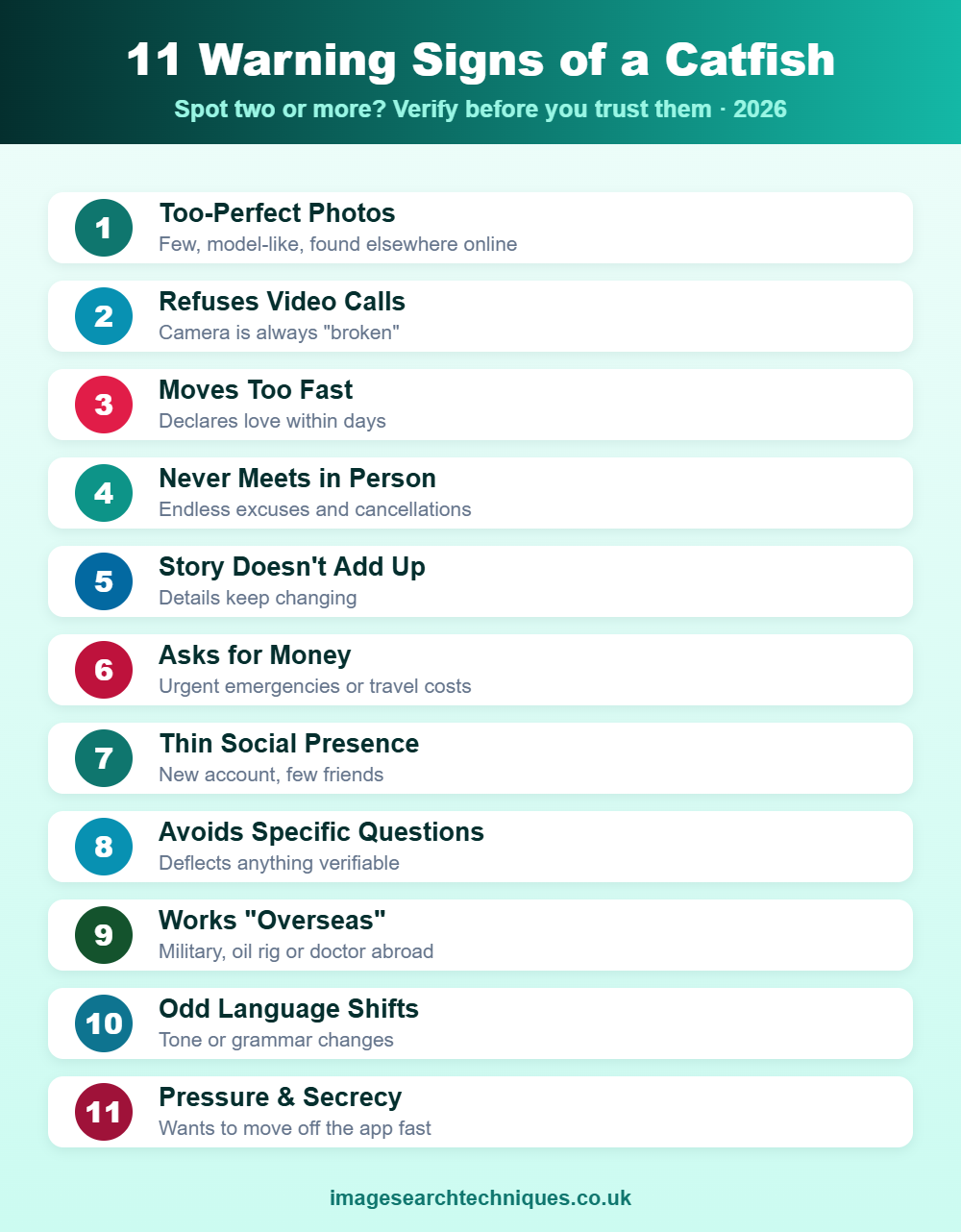
Scan this table first. One sign can be innocent, but two or more together is a strong warning.
| Warning sign | What it looks like |
|---|---|
| Too-perfect photos | Model-like, few in number, or found elsewhere online |
| Refuses video calls | Camera “broken”, always audio-only or texting |
| Moves too fast | Declares love within days (love bombing) |
| Never meets in person | Endless excuses, last-minute cancellations |
| Story doesn’t add up | Details change; vague about job or location |
| Asks for money | Emergencies, travel costs, “stuck abroad” |
| Thin social presence | New account, few friends, little activity |
| Avoids specific questions | Deflects anything that pins down the truth |
| Works “overseas” | Military, oil rig, or doctor abroad is common |
| Odd language shifts | Tone or grammar changes between messages |
| Pressure and secrecy | Wants to move off the app fast and stay private |
1. Their Photos Look Too Perfect
Catfish profiles often use strikingly attractive, model-quality photos — but only a handful of them, with no casual or candid shots. The fastest way to check is a reverse image search: save their pictures and run them through Google Lens, TinEye, or Yandex. If the same face appears under a different name, on a stock-photo site, or across several profiles, it is stolen. Follow our step-by-step reverse image search guide to do this in under a minute.
2. They Refuse Video Calls
This is the clearest test of all. A catfish using someone else’s photos cannot appear live on camera, so they will claim their camera is broken, their connection is bad, or they are “too shy.” A genuine person will happily do a quick video call once trust is building. Persistent refusal, especially after weeks of chatting, is a major red flag.
3. They Fall in Love Too Fast
“Love bombing” — intense affection and talk of a future within days — is a classic manipulation tactic. By creating a strong emotional bond quickly, a scammer lowers your guard before asking for favours or money. Real relationships build over time; a stranger who calls you their soulmate in a week is following a script.
4. They Always Have an Excuse Not to Meet
Catfish keep the relationship online indefinitely. Plans to meet are made and then cancelled at the last minute — a sudden work trip, a family emergency, a visa problem. If every attempt to meet in person or video chat collapses with a convenient excuse, you are almost certainly talking to a fake profile.
5. Their Story Doesn’t Add Up
Pay attention to inconsistencies. A catfish juggling multiple victims will mix up details — the city they live in, their job, their age, or facts they told you earlier. Ask specific follow-up questions and note whether answers stay consistent over time. Vague, shifting stories are a reliable sign of deception.
6. They Ask for Money
This is the point where catfishing becomes a romance scam. The request is always urgent and emotional: a medical emergency, being stranded abroad, a customs fee to send you a gift, or money to finally buy a flight to visit you. Never send money, gift cards, or crypto to someone you have not met in person. For official guidance, see the FTC’s advice on romance scams.
7. Sparse or Brand-New Social Profiles
Check their wider online footprint. Genuine people usually have social accounts with history — years of posts, tagged photos with friends, and real interactions. A catfish often has a recently created profile, very few friends or followers, no tagged photos, and little genuine activity. A thin or brand-new footprint alongside other red flags is telling.
8. They Avoid Specific Questions
Ask something only the real person in the photos could answer easily — about their neighbourhood, workplace, or a detail in one of their pictures. Catfish deflect, change the subject, or give vague answers because they are not who they claim to be. Combined with a refusal to video call, evasive answers all but confirm a fake.
How to Catch a Catfish: Step by Step
If you suspect a catfish, work through these steps in order:
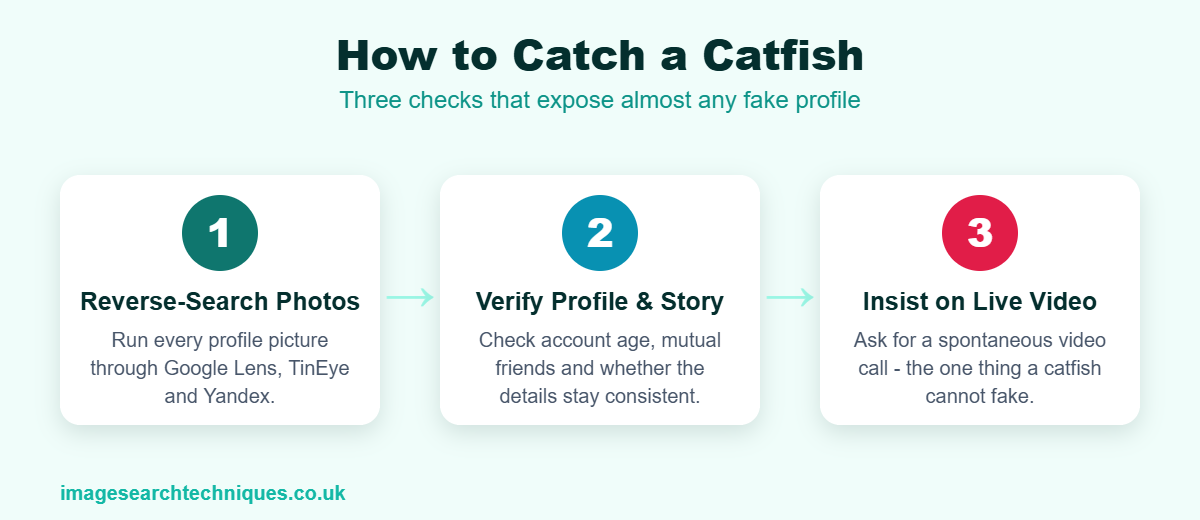
- Reverse-search every photo. Save their pictures and run them through Google Lens, TinEye, and Yandex. Our best reverse image search apps guide shows the quickest tools on mobile.
- Check images sent in chat. Screenshot photos they send on WhatsApp or the dating app and search those too — see reverse image search on WhatsApp.
- Insist on a live video call. A brief, unscheduled video chat is the one thing a catfish cannot fake.
- Verify their social footprint. Look for account age, mutual friends, and tagged photos.
- Ask specific, verifiable questions. Note any inconsistencies in their answers over time.
What to Do If You’ve Been Catfished
If you confirm a catfish, stop all contact and do not send money or more personal information. Report and block the profile on the app or platform — this protects others too. Keep screenshots as evidence. If you sent money or shared sensitive details, contact your bank immediately and report it to your local fraud authority. If your own photos were used to catfish others, read how to find out if someone is using your photos online and request their removal.
Frequently Asked Questions
What is the fastest way to spot a catfish?
Run a reverse image search on their profile photos. If the same face appears under a different name, on a stock-photo site, or across multiple profiles, the pictures are stolen and you are being catfished. Asking for a live video call is an equally fast confirmation.
Can a catfish use video to trick you?
Most cannot do a live, unscripted video call using someone else’s face, which is why they refuse. Be cautious of pre-recorded clips, very short or frozen calls, and deepfake filters — insist on a spontaneous call and ask them to do a simple action live, like waving.
Are catfish always after money?
No. Many want money through romance scams, but others catfish for emotional reasons, attention, revenge, or to hide their real identity. Whatever the motive, the verification steps are the same: check the photos, insist on video, and confirm their story.
How do I reverse image search a dating profile photo?
Save or screenshot the photo, then upload it to Google Lens, TinEye, or Yandex, or paste its link. Each engine shows where else the image appears online. Using two or three engines catches more, since they index different sites.
Is catfishing illegal?
Catfishing itself is not always a crime, but the acts around it often are — fraud, extortion, identity theft, and harassment can all be illegal. If money or threats are involved, keep evidence and report it to the platform and your local authorities.
What should I never do when I suspect a catfish?
Never send money, gift cards, or cryptocurrency, and never share intimate photos, your home address, or financial details. These are exactly what scammers want. Verify first, and if anything feels wrong, stop contact and report the profile.
Suspicious of a profile right now? Use our free reverse image search tool to check their photos in seconds.
