


🔎 Reverse Image Search
Image search techniques made simple: upload a photo or paste a URL and search 6 engines at once. 100% free, nothing stored.
🔒 Your image is never stored on our servers longer than 24 hours and is never shared.
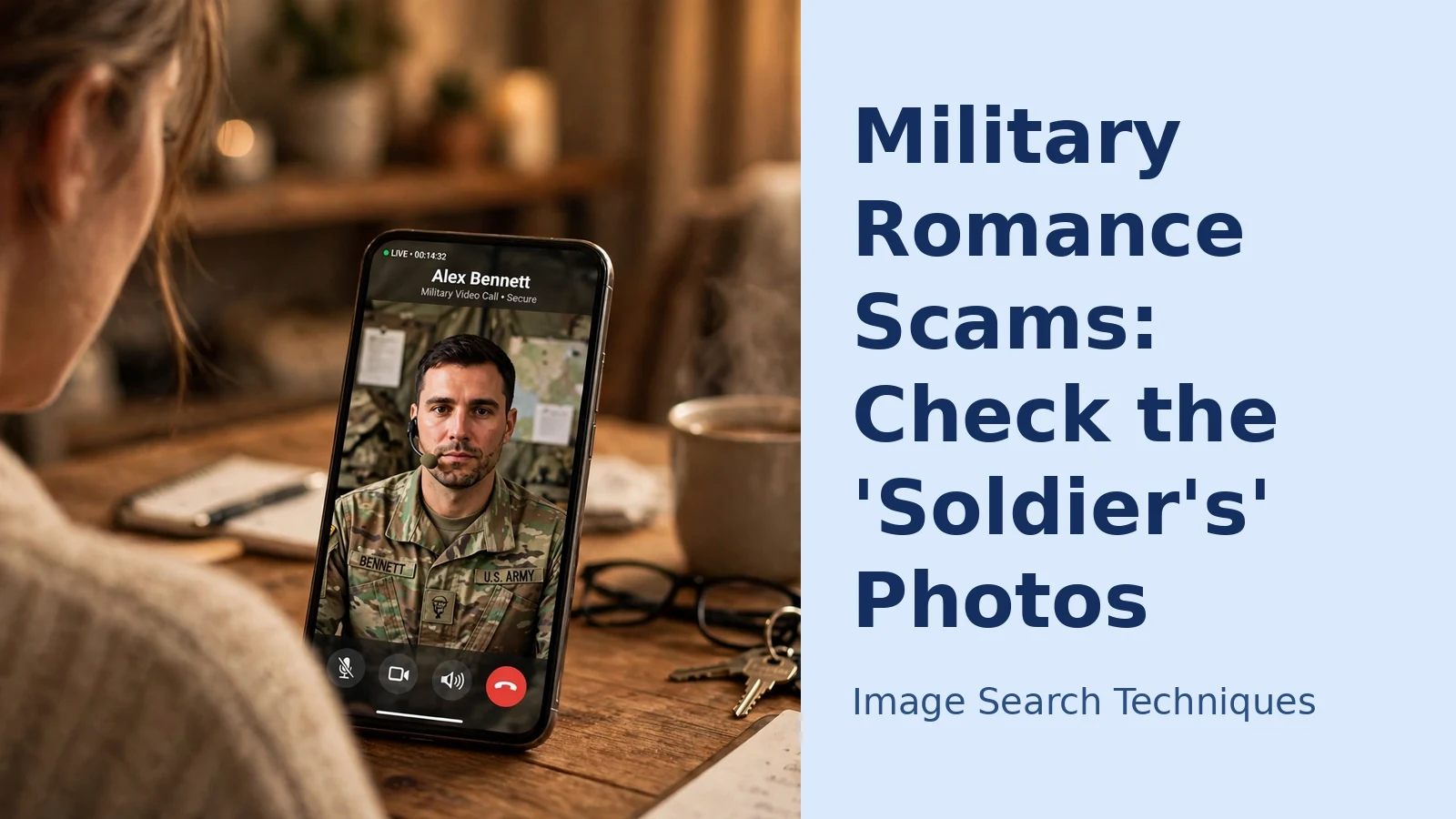
He is a sergeant on deployment, or a special forces officer who cannot say exactly where. He found you on a dating site or social media, writes beautifully, and within weeks is talking about a future together. There is just one problem: the man in the photographs is real — but he is not the person you are talking to. Military romance scams are built on photos stolen from service members — lifted from news articles, unit pages and social media — then wrapped in a script designed to end with your money.
The uniform does much of the scammer’s work: it signals honesty and courage, and explains why he cannot simply fly home or appear on camera. This guide shows you how to test the story where it is weakest — the photographs — before any money moves. The same checks protect a parent, aunt or friend who might ignore a warning but heed evidence.
How the military romance scam works
The pattern is consistent. Contact begins on a dating app, Facebook, Instagram or a games platform, and quickly moves to email or WhatsApp — anywhere the original platform cannot moderate it. The persona is usually a mid-ranking soldier, often American, deployed somewhere dangerous or remote. His wife has died, or betrayed him. He has a child cared for by relatives back home.
Then the deployment becomes the engine of the fraud. Real soldiers never need civilians to pay for leave, flights home, treatment or food — the military covers all of it. The scammer’s version needs money for exactly those things, always urgently, always through channels that cannot be reversed. The photographs make it believable — a real face, in a real uniform, in a real war zone — which is why they are where you start.
Step 1: Save the photos and reverse search them
Save every photo he has sent or posted — profile picture, uniform shots, “deployment” pictures, casual ones supposedly taken on base — in the largest version you can: open each full-screen and save it rather than screenshotting a thumbnail. Then run each one through a reverse image search. Our free reverse image search tool checks one picture across six engines, which matters because a stolen photo may sit in only one or two indexes.
Search the photos one at a time and note what you find — the results are immediate:
- The same face under different names — in other profiles, scam reports or news stories, attached to other units.
- The photo on an official or news page — many come from military public affairs releases, memorial pages or press photography, sometimes of soldiers who are married, senior officers or sadly deceased.
- The photo on the real person’s own social media, where his actual life — family, home town, real partner — looks nothing like the story you have been told.
Comparing results against what you were sent takes care with crops and mirrored copies; our guide to how to check if a photo is stolen walks through it in detail.
If the search finds nothing, do not relax yet
A clean result is not a clearance. Some photos are stolen from private accounts, closed groups or video stills that engines have never indexed, and scammers increasingly crop or filter images to weaken matches. If that happens, work through the steps in our guide to reverse image search with no results: crop tighter to the face, try the flipped version, and search any photo showing a name tape, unit patch or distinctive background — those details often lead where the portrait does not.
Read the uniform, too: a name tape that does not match the name you were given, insignia from the wrong service or country, or a rank that changes between photos are quiet contradictions a real soldier would never make — and a scammer assembling a persona from random images never spots.
The classic script: lines that give it away
Whatever the opening, the requests follow a script refined over years. Treat any of these as the answer, regardless of how convincing the photos looked:
- “I need help paying for my leave.” Leave is granted or refused by the military; it is never sold, and no fee, form or “replacement soldier” payment exists.
- “Pay the fee so my parcel/box can be sent to you.” A valuable box — documents, gold, belongings — is supposedly stuck with a courier or customs, needing release fees. There is no box.
- “Send gift cards / a phone / money for food or medicine.” Deployed soldiers are fed, housed and treated by their service; gift card requests in particular are a signature of fraud, as the FTC’s consumer advice makes clear.
- “My bank account is frozen while I’m deployed.” A prelude to asking you to receive and forward money — making you a money mule in a second crime.
- “Keep this secret — my mission depends on it.” Secrecy is not operational security; it is isolation, meant to stop you asking anyone who would recognise the scam.
The same escalation — a small request, then a more urgent one — drives other photo-based frauds too: it is the deposit-to-shipping-fee ladder in puppy and pet sale scams, and the stolen-photo listing trick behind Facebook Marketplace scams.
Why he can never video call — and other simple tests
The hardest test for this scam is a live video call, because the person typing does not look like the photos. Expect military-flavoured excuses: cameras are banned on base, the connection is classified, his duties forbid it. Yet real deployed personnel routinely video call their families. A thirty-second live call — holding up fingers you name, saying your name — settles it, and a permanent refusal over months of “love” is an answer in itself.
Smaller tests help too. Ask which unit he is in, then check whether that unit is publicly known to be where he claims. Ask a question only the man in the photos could answer about a picture he sent, and note whether the reply is vague. And watch the language: messages swinging between flawless romantic English and oddly broken phrasing often come from a team working shifts, not one lovesick soldier.
If it’s you — or your mum, your aunt, your friend
If you found this page because the results frightened you: stop sending money today, and stop replying. The grief is real even though the man was not — victims describe mourning someone, and that is exactly the injury this scam inflicts. Report the profiles to the platform, and report the fraud through the channels listed by USA.gov’s scams and frauds guidance (US) or Action Fraud (UK). If money went by card or transfer, contact your bank immediately; gift cards and wire transfers are rarely recoverable, which is why they are demanded.
If the person at risk is a family member, lead with the photographs, not with blame. Show them the search results — the same face under three names, the real soldier’s own page — and let the evidence argue. People defend relationships; a picture that demonstrably belongs to somebody else is much harder to defend. And spare a thought for that somebody else: the real service member is a victim too, and reporting the fake profiles helps get his face taken out of circulation.
FAQs
Do real soldiers ask civilians for money for leave or flights?
No. Leave is approved through the chain of command at no cost, flights on deployment are arranged by the military, and food, housing and medical care are provided. Any such request — leave fees, flight money, treatment costs — is a scam, full stop.
His photos didn’t come up in a reverse search. Does that mean he’s genuine?
Not necessarily. Photos taken from private accounts or videos may not be indexed, and edited copies match less reliably. Combine the search with the video call test and the script checks — a genuine soldier can pass all of them; a scammer cannot.
Why won’t he video call if he says he loves me?
Because the person writing to you is not the man in the photos, and a live call would prove it in seconds.
Deployed soldiers video call their real families regularly; a permanent refusal is one of the strongest warning signs there is.
I’ve already sent money. What should I do now?
Stop all contact and payments, save the messages and receipts, and contact your bank straight away — card and some bank payments may be recoverable if you act fast. Then report the fraud to Action Fraud (UK) or the FTC (US), and report the profiles on every platform.
