🔎 Reverse Image Search
Image search techniques made simple: upload a photo or paste a URL and search 6 engines at once. 100% free, nothing stored.
🔒 Your image is never stored on our servers longer than 24 hours and is never shared.
If you are searching for how to remove mugshot from internet results, start here: do not pay the site hosting your booking photo. This guide covers the free removal routes the major mugshot sites publish, Google’s own removal form for pay-to-remove sites, and the state laws that make charging for removal illegal in more than a dozen US states.
Direct answer: To remove a mugshot from the internet, find every site hosting it, then use each site’s free route: Mugshots.com by email with court papers, Arrests.org through its opt-out form, BustedNewspaper and JailBase through their removal forms, MugshotsOnline through its on-page button. Ask Google to remove results from sites that demand payment. Expungement helps, but it does not delete third-party copies.
A mugshot is the booking photograph taken when someone is arrested. In most US states it is a public record, which is why websites can legally publish it. That is the whole business model: the sites scrape booking photos from county jails and sheriff’s departments, publish them under your name, and then charge, or used to charge, to take them down. The National Conference of State Legislatures (NCSL) describes exactly this pattern in its survey of mugshot legislation: arrest photographs obtained from law enforcement websites are re-posted on commercial websites, some of which charge a fee to have them removed.
This guide is general information about free removal routes, not legal advice. If your case is complicated, or a site is ignoring a law that applies to you, speak to a lawyer in your state before you send documents or money to anyone.
Start with the free options
Before paying anyone, work through the free routes. Many mugshot sites have their own removal or opt-out page, and using it costs nothing. If the original booking page or agency site lets you request an update, for example after a dismissal or expungement, ask there too, because copies often trace back to that source. And if a site demands payment to take a mugshot down, know that Google treats that as an exploitative removal practice: you can report the page to Google, which can remove such pages from its search results. Paid removal services exist, but they should be the last resort, not the first step.
Why is your mugshot online, and who put it there?
Your mugshot almost certainly came from a public source: a county jail roster, a sheriff’s booking log, or a court website. Mugshot sites run automated scrapers against those sources, copy the photo and the charge details, and publish a page under your name. That page is then indexed by Google and Bing, which is how an employer, a landlord or a date finds it.
Three things make the problem worse than a single page. First, the sites copy each other, so one booking photo can appear on five or more directories within days. Second, most of them publish the charge and never the outcome, so a case that was dropped, dismissed or ended in a not-guilty verdict still reads like a conviction to anyone searching your name. Third, the sites rarely delete anything on their own, even after your case is cleared, the listing stays up until you ask for it to come down.
That is also why paying is a trap. Paying one site does nothing about the copies on the other sites, and it does not stop the same photo being scraped again. The operators of Mugshots.com were charged by the California Attorney General in May 2018 with alleged extortion, money laundering and identity theft over exactly this pay-to-remove model. The free routes below cost you time and paperwork, not money. In several states the law is on your side.
Step 1: find every copy of your mugshot before you write to anyone
Do not start with the first site you find. Start by mapping the whole problem, because every removal request needs the exact page address, and because a copy you miss will keep ranking after the others come down.
- Search your name in Google and Bing, with and without your middle name, your town, and the word “arrest” or “mugshot”. Note every mugshot-site result.
- Reverse-search the photo itself. A name search finds pages that use your name; a reverse image search finds pages that use your photo under a different name, a misspelling, or no name at all.
- Search the image on Google Images, Bing Visual Search and Yandex Images as well as through our free reverse image search tool, which runs the same photo across several engines at once.
- Check the data brokers too. People-search sites republish arrest records alongside addresses and phone numbers, and they have their own removal routes. Our guide to removing your photo from people-search sites covers them.
- Keep a list. For each copy, record the site name, the page URL, the date you found it, and what the page says about your case. You will need the URL for every request below, and the list is your evidence if a site ignores you.
Worked example: tracing a 1929 mugshot through the site’s own tool
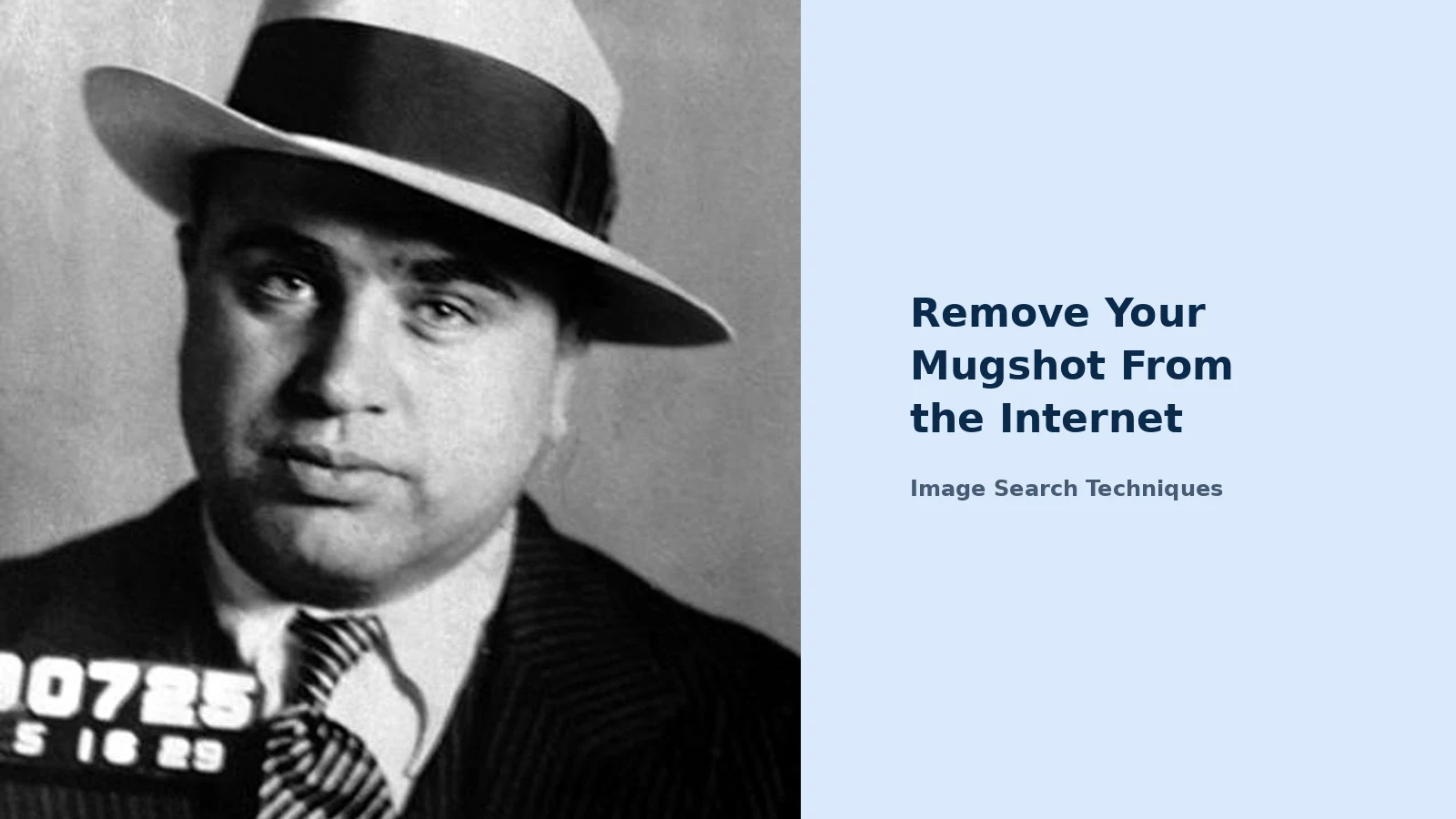
To show what the search actually looks like, I ran a real booking-style photograph through the site’s free reverse image search tool on 12 November 2026: the 1929 police photograph of Al Capone held by Wikimedia Commons, a public-domain FBI photograph. The file is 700 by 910 pixels and has been online since at least 2008, so it is a fair test of what the engines can find, and what they miss.
Google Lens worked best for identification. It named the photo as Capone’s mugshot from 16 May 1929 in Philadelphia, taken after his arrest for carrying a concealed, unlicensed revolver, and listed 60 visual matches before the “See more” button. On the Exact matches tab the Wikimedia Commons source file appeared as the 19th entry. Google’s own search-by-image button opened the same Lens results page, so the two are the same check here, not two independent results.
TinEye worked after one reload. Its Cloudflare check stalled first, then cleared on its own. It reported 2,498 results from 86.7 billion images searched, first indexed on 5 February 2008, and filtering by wikimedia.org surfaced the exact Commons file page. Yandex also worked: it identified the photo as Al Capone, listed 18 sizes and 40 similar images, but the Commons source was not among the 20 sites it showed.
Bing was the mixed result. The tool’s Bing link failed outright. Bing returned a “Page not found” page and redirected to its homepage. Retrying through Bing’s own “Search using an image” with the same link worked: Bing identified the subject as Al Capone and showed 12 visual matches, but the Commons source was not in the roughly 40 pages it listed. Pinterest is not a visual search at all: the tool’s link runs a text search for the image URL and returned 18 pin cards, several showing the exact mugshot, with no link back to the Commons source.
Two lessons carry over to your own mugshot. First, run the photo through more than one engine: Google and TinEye found the original source here, Yandex and Bing did not. Second, the tool’s “Search All” button opened only the Google Lens tab. The other engines need to be run one by one through the tool’s own links.
The removal directory: every major mugshot site, site by site
This is the table to bookmark. Each row is one site’s free route, what it demands, and how long it realistically takes. Routes move and forms get buried, so if a link below has changed, use the site’s own privacy or contact page and search it for “remove”, and never pay a third-party service for a route that is free on the site itself.
| Site | Free route | Documents demanded | Realistic timescale | Cost |
|---|---|---|---|---|
| Mugshots.com | “Record Removals/Updates” on the site; email the removal address with your record number | Court-sealed expungement, sealing or dismissal order; identity-theft proof; death certificate for a deceased person | Up to 10 business days | Free with qualifying papers |
| Arrests.org | Build the removal address yourself: arrests.org/remove/?id= followed by your Record ID | Reason for removal, court papers for the outcome, and a redacted government photo ID | 5 to 30 days | Free, no fee on the form |
| BustedNewspaper | Removal form at bustednewspaper.com/remove-a-listing | Expungement, sealing, dismissal or not-guilty proof | Up to 10 days; no confirmation email guaranteed | Free |
| JailBase | Opt-out form on the site’s privacy or content-removal page | Email address and mobile number; verify by code or link; court papers if charges were dropped | Up to 90 days | Free |
| MugshotsOnline | “Remove This Mugshot” button under your photo | None: fill in the form | Usually instant | Free |
Two warnings apply to every row. First, never send an unredacted ID to any of these sites: black out everything except your name and photo before you attach it, and never send ID documents to a site that is demanding payment. Second, keep a copy of everything you send (screenshots of the form, the email, and the documents) with the date. If a site later claims it never received your request, that paper trail is what a state attorney general’s office will ask for.
How do you get a mugshot removed from Mugshots.com?
Mugshots.com is the biggest name in this niche and the hardest to deal with, because its free removal only applies in specific situations. According to the site’s own Record Maintenance policy, it will remove your mugshot for free if your case was expunged, sealed, dismissed with no information filed, or involved identity theft, or if the person in the photo has died. In those cases you send your court documentation, signed by a judge and sealed by the court, to the site’s removal email address, with your record number from the listing. Send it from your own email address and make sure the documents are legible: the site says it will not tell you if a request is rejected.
If your case ended favourably but does not qualify for removal, for example a not-guilty verdict, a dismissal, a nolle prosequi, or adjudication withheld, the site may update the record instead of deleting it. That update is sent to a separate verification address and shows on your arrest page as a corrected outcome. It is not the same as removal, but a page that says “dismissed” is very different from a page that says nothing.
What Mugshots.com will not do is remove a record tied to a conviction, even years after a sentence has been served. If that is your situation, the honest answer is that source removal is unlikely and your effort is better spent on the Google and Bing routes below, plus suppression: publishing accurate, positive material about yourself so the mugshot page stops being the first thing a search shows. There is no official form and no guaranteed timeline; requests are processed first come, first served.
How do you remove a mugshot from Arrests.org?
Arrests.org has a free removal form, but it is deliberately hard to find: there is no removal link on the record page. You have to build the address yourself by adding your Record ID to the end of arrests.org/remove/?id=, so if your Record ID is 1234567, the page is arrests.org/remove/?id=1234567. The form then asks why you want the listing removed. The options cover sealed or expunged records, dismissed or not-guilty outcomes, and a small set of other cases, including a deceased person, a non-US resident, a law-enforcement officer or government official, and active-duty military. There is also a narrower option that removes only your date of birth and address, which is the only option available if you have no court document showing a favourable outcome.
The site asks for a government photo ID to verify the request is yours. Redact it first: cover the ID number, address and signature, and leave only your name and photo visible. Processing takes 5 to 30 days depending on volume and the reason you selected. If the form fails, the alternative is to email the site directly with the listing URL, your full legal name, your date of birth, the reason, and the same redacted ID. Arrests.org is not obliged to comply, and it sometimes removes only part of a record, so file the Google removal request in the next section in parallel rather than waiting to see whether the site acts.
How do you remove a mugshot from BustedNewspaper, JailBase and MugshotsOnline?
BustedNewspaper offers a documented removal process, but only for cleared cases. Gather your proof first: an expungement order, sealed-record documentation, proof of dismissal or dropped charges, or proof of a not-guilty verdict, or a letter from your lawyer confirming one of those, then fill in the removal form at bustednewspaper.com/remove-a-listing. The site says verification and removal can take up to 10 days, and it does not guarantee a confirmation email, so screenshot your submission and keep it. Without expungement or dismissal papers, the site is unlikely to remove the post at all.
JailBase works differently: its opt-out is a web form on the site’s privacy or content-removal page. You enter your email address and a mobile number, then verify through a code or a link the site sends you, and confirm the removal request on the page. If your charges were dropped, attach the supporting documentation if the form asks for it. The site says most requests are completed within 90 days, which is the slowest of the major sites, so file it early and do not wait for it before you file the Google request. If your mugshot appears again after removal, resubmit the form.
MugshotsOnline is the easiest of the five: click “Remove This Mugshot” under your photo, fill in the form, and deletion is typically instant, with no payment and no documentation required. Do it last, after the slower sites, so you can confirm in one pass that every copy is gone.
Smaller copycat sites follow the same pattern with worse paperwork: look for a “remove”, “opt out” or “privacy” link in the footer, use the contact form if there is no removal page, and include the listing URL, your name, and your court papers. If a site has no contact route at all, skip it and go straight to Google. A search engine can remove the result even when the publisher will not answer.
Which state laws ban charging for mugshot removal?
There is no federal law against mugshot websites, and in states without their own law a site can legally publish your booking photo and charge to remove it. But more than a dozen states have enacted laws that restrict or ban the practice, and NCSL’s legislative survey tracks them year by year. Secondary sources disagree on the exact total (some count 12, others 18 or more) because the laws differ in what they cover, so this guide names the states and the statute rather than printing a count that would be out of date the moment another state acts. Check your own state’s current statute before you rely on it; the table below is a starting point, not legal advice.
| State | Law | What it requires |
|---|---|---|
| California | Civil Code § 1798.91.1 (2014) | Publishers may not charge to remove, correct, modify or withhold a booking photo. |
| Florida | Fla. Stat. § 901.43 (2017) | Covered publishers must remove a photo without charge within 10 calendar days of a compliant written request, sent by registered mail to the registered agent. |
| Georgia | OCGA § 10-1-393.5 (2013) | Free removal within 30 days when the record has been restricted; a 2014 law bars law enforcement from publishing mugshots online for a fee. |
| Illinois | 2013 consumer-protection law | It is an unlawful practice for a publisher of criminal record information to solicit or accept a fee for removal or correction. |
| Texas | Business & Commerce Code § 109.002 | Charging for mugshot removal is illegal; mugshots are confidential by default unless the person was convicted, is a fugitive, or is a public threat. |
| Oregon | ORS §§ 133.875 and 646A.806 | Covered publishers must remove photos free of charge for documented qualifying outcomes; law enforcement may not release booking photos except in specified circumstances. |
| Utah | 2019 and 2021 laws | A publication or website must remove and destroy a booking photograph within a set period when the person requests it; sheriffs may not disclose booking images. |
| South Carolina | 2016 “Mugshot Extortion” law | Sites must remove arrest and booking records without a fee for people whose charges were dismissed or who were found not guilty. |
| New Jersey | 2017 law | Charging a fee to stop publication of a mugshot is prohibited; people who paid can sue in state court. |
| Arkansas | Act 450 (2021) | Privately owned mugshot sites that charge fees must remove a booking photo within five business days of a written request. |
| Louisiana | Code of Criminal Procedure art. 234 (2022) | Covered sites must remove and destroy a booking photo within seven calendar days of a qualifying request, and may not charge for it. |
| Virginia | 2015 law | Anyone who publishes mugshots and solicits or accepts payment to remove them is liable for damages. |
Other states with enacted mugshot laws include Maryland, Vermont, Ohio, Colorado, Wyoming, Kentucky, Missouri, New York and Montana, each with a different scope. Some limit what police can release, some require free removal only after a dismissal or expungement, and some cap fees rather than banning them. The practical point is the same in every state: if your state has one of these laws, name the statute and the deadline in your removal request. A request that cites the law reads very differently from a request that just asks nicely. If a site ignores a valid request, the next step is a complaint to your state attorney general’s consumer-protection division, which is the office that enforces these laws.
How to remove mugshot from internet results when a site refuses or demands payment
When the source site will not cooperate, work on the search results instead. Removing a result from Google does not delete the source page, but it does stop the page appearing when someone searches your name, and for most people, the search result is the actual harm.
Google has a specific form for content on sites with exploitative removal practices. It applies when a website requires people to pay money to it, or to another agency, to get content removed. Google says it will consider the request if the site is not a business-review site and its removal practices require payment, and it aims to preserve access if the content is judged to be of public interest. File it through Google’s personal-content removal form, choosing the exploitative-removal-practices option, and attach a screenshot of the payment demand. That screenshot matters: it is the evidence that the site’s removal route is pay-to-remove rather than free.
If the source page has already been deleted or changed, use Google’s “Remove outdated content” tool instead. Paste the URL, and Google will recrawl it and drop the stale result if the page no longer shows your photo or name. Our guide to removing your photos from Google walks through both tools step by step. Bing has its own content-removal tool for outdated pages and a “Report a Concern” form for other cases; file the same request there, because a Google removal does nothing for Bing results.
Finally, report the payment demand itself. The Federal Trade Commission tracks mugshot extortion schemes and has sued operators over them, so file a report at ReportFraud.ftc.gov with screenshots of the demand, the URL, and the amount asked. The FTC will not remove the listing for you, but the report creates a record. If the site is operating in a state that bans the practice, attach the same evidence to your attorney general complaint.
Does expungement remove your mugshot from the internet?
No. This is the misunderstanding that costs people the most time. Expungement or sealing clears the official record: the court file, the police database, and the background-check databases that pull from them. It does not automatically remove anything from a third-party mugshot website, because those sites hold their own copy of a photo they scraped when it was public. You still have to ask each site, one by one.
What expungement does give you is the strongest document you can send. A sealed or expunged record is the qualifying condition for free removal on Mugshots.com, Arrests.org and BustedNewspaper, and it is the proof that state free-removal laws ask for. So the order of work is: get the record expunged or sealed through the court first, then use the court order as the attachment for every removal request. If your charges were dropped or you were acquitted and expungement is not available in your state, a dismissal letter or the court’s disposition record serves the same purpose.
One caution: do not pay a “mugshot removal service” to get your record expunged. Expungement is a court process, and the firms that sell it as a package are usually just filing the same free removal requests in this guide and charging hundreds of dollars for them. If you need help with the court side, a local criminal-defence lawyer’s consultation is the honest route. In many states, legal-aid organisations help with expungement for free.
How long does mugshot removal take, and what if the photo comes back?
Expect weeks, not days, and plan for the photo to reappear. MugshotsOnline can be instant; BustedNewspaper and Mugshots.com say up to 10 days; Arrests.org says 5 to 30 days; JailBase says up to 90 days. Google’s review of a removal request typically takes one to two weeks. None of those times is guaranteed, and none of the sites promises to tell you when it has acted, so diary a re-check of every URL two weeks after you file, and again at 30 and 90 days.
Reappearance is common, for two reasons. First, a site you cleared may re-scrape the photo from a jail roster that still lists it, or from another mugshot site that still hosts it. Second, search engines cache pages, so a removed page can linger in results for a while after the source is gone. That is what the “Remove outdated content” tool is for. If a photo returns, re-file the same request with the same documents and note that it is a repeat; if a site re-posts a photo it already removed after an expungement, that is worth a fresh complaint to your attorney general, because several state laws treat re-publication after a valid removal as a separate violation.
While you wait, do the slow work that actually protects you: check whether copies survive in the Wayback Machine. Our guide to removing photos from the Wayback Machine covers the exclusion process, and read our complete guide to protecting your photos online for the wider picture, from data brokers to AI training opt-outs. Then ask yourself what a searcher will find instead. A LinkedIn profile, a professional page, or a genuine piece of writing under your name does not remove the mugshot, but it pushes it down the results, and for most searches that is what an employer ever sees. Keep the whole file (requests, screenshots, court papers, confirmation emails) in one folder. If this ever becomes a legal matter, that folder is your case.
This guide is general information about free removal routes, not legal advice. Laws change, and the details matter: check the current statute in your state, or talk to a lawyer, before you rely on any law named here.
Can I get my mugshot removed for free?
Yes, if your case was dismissed, sealed or expunged, or if you live in a state that bans pay-for-removal. Mugshots.com, Arrests.org, BustedNewspaper, JailBase and MugshotsOnline all publish free removal routes, and Google will consider removing results from sites that demand payment. Never pay a site first. Check the free route and your state law before you spend anything.
How long does it take to remove a mugshot from the internet?
It depends on the site. MugshotsOnline is usually instant, BustedNewspaper and Mugshots.com say up to 10 days, Arrests.org says 5 to 30 days, and JailBase says up to 90 days. Google’s review typically takes one to two weeks. None of these times is guaranteed, so re-check every listing after two weeks and again at 90 days.
Will expungement remove my mugshot from Google?
No. Expungement clears the official record, the court file and police databases, but mugshot websites hold their own copies and will not delete them automatically. What expungement gives you is the court order that qualifies you for free removal on Mugshots.com, Arrests.org and BustedNewspaper, so get the record sealed first, then send the order to each site.
Is it illegal for a website to charge to remove my mugshot?
In more than a dozen states, yes. California, Florida, Georgia, Illinois, Texas, Oregon, Utah, South Carolina, New Jersey, Arkansas, Louisiana and Virginia have all enacted laws that restrict or ban charging a fee to remove a booking photo. In states without such a law, a site can legally charge, which is why the free Google route matters.
Can I remove my mugshot for free?
Often, yes. Start with the website’s own removal or opt-out process, then the source agency if your case outcome has changed, and report any site that charges for removal to Google under its exploitative removal practices policy. Free routes do not always work on every site, but they cost nothing to try and they are where paid services start as well.
How long does a mugshot stay on the internet?
There is no automatic expiry. A mugshot stays online until the site holding it removes it, which is why copies can linger for years and why new copies sometimes appear on other sites. Removal is a process of working through each site that shows it, starting with the ones that appear when you search your own name.