🔎 Reverse Image Search
Image search techniques made simple: upload a photo or paste a URL and search 6 engines at once. 100% free, nothing stored.
🔒 Your image is never stored on our servers longer than 24 hours and is never shared.
A competitor removed my watermark. That is how most owners discover it: their own photo, on a rival’s website, with their name cut off the corner. Nobody crops a watermark by accident. They saw your name on the photo, and they removed it so their customers would not.
Short answer: Yes. Using your photo without permission is copyright infringement, and removing your watermark is a second, separate wrong under US and UK law. Gather your originals and screenshots, then work the ladder: a direct message, a platform report, the host, a formal takedown, and small claims if the amount justifies it.
This guide is the after-it-happened route. It does not teach you how to watermark a photo in the first place. That job belongs to our guide to watermarking your photos, which covers placement, opacity and the tools. What follows is what to do when someone has already cropped your mark out: the two wrongs involved, the evidence to gather before you contact anyone, a real reverse-search test we ran on a cropped photo, and the escalation ladder in order.
What does it mean when a competitor crops out your watermark?
A watermark is a name, logo or copyright notice placed on a photo so that copies of the image carry proof of who it belongs to. When a competitor crops it out, they have done two things at once. They have taken your photo without permission, and they have removed the information that identifies you as the owner. The second act matters because the law treats it as a separate wrong, not just part of the theft.
That is the point most guides miss. The main competitor article on this topic, LegalClarity’s guide to watermark removal, explains the US rule well, but it is US only, it has no UK position, no evidence checklist, no escalation steps, and no worked example. This guide covers the ground it leaves out.
Three quick distinctions before the detail. First, a watermark that names you, or carries a copyright notice, is the strongest kind, because it identifies the work, the author and the owner. A bare decorative logo with no name on it is weaker, and the law may not treat it the same way. Second, cropping is not always the competitor’s doing. A platform’s own thumbnail crop can cut a corner mark without anyone intending it, so check whether the crop was theirs or the platform’s before you accuse anyone. Third, the crop does not hide the photo. A cropped copy can still be found with reverse image search, which is exactly what the worked example below shows.
Why is the crop a second wrong, not just part of the theft?
The theft is the first wrong: your photo was copied and used without your permission, which is copyright infringement in both the US and the UK. The crop is the second wrong: the information that identifies you was deliberately removed so the infringement would be harder to spot. The law has a separate name for that information, and separate rules for removing it.
In the US it is called copyright management information, or CMI. Section 1202 of the Digital Millennium Copyright Act makes it unlawful to intentionally remove or alter CMI without the copyright owner’s authority, and unlawful to distribute a work knowing its CMI was removed, when the person knows, or has reasonable grounds to know, that doing so will induce, enable, facilitate or conceal an infringement. CMI covers the title of the work, the name of the author, the name of the copyright owner, the terms and conditions for use, and identifying numbers or symbols. A watermark that carries your name or a copyright notice fits that definition. You can read the full text on the US Copyright Office’s page for Chapter 12 of the Copyright Act.
In the UK the equivalent rule is section 296ZG of the Copyright, Designs and Patents Act 1988. It applies where a person knowingly and without authority removes or alters electronic rights management information, and knows, or has reason to believe, that doing so will induce, enable, facilitate or conceal an infringement of copyright. It also covers distributing copies from which the information was removed. The owner has the same rights against that person as they have for an infringement of copyright. The full text of section 296ZG is on legislation.gov.uk. UK copyright is automatic, so there is no registration step before any of this applies.
| The two wrongs | What happened | US rule | UK rule |
|---|---|---|---|
| Wrong 1: the photo was taken | Your photo was copied and used on a competitor’s site or listing without your permission | Copyright infringement under the Copyright Act | Copyright infringement under the Copyright, Designs and Patents Act 1988 |
| Wrong 2: the watermark was removed | Your name or copyright notice was cropped or erased so buyers would not see whose photo it was | 17 U.S.C. section 1202, removal of copyright management information | Section 296ZG, removal of electronic rights management information |
| What it is worth | The crop is evidence of intent: it shows the competitor knew the photo was yours | Statutory damages of $2,500 to $25,000 per section 1202 violation, plus attorney’s fees | The same rights as for copyright infringement, including damages and an injunction |
The damages figures are worth stating plainly, because they change the conversation with a competitor. Under section 1203 of the US Copyright Act, a court can award actual damages plus the violator’s profits, or statutory damages of $2,500 to $25,000 for each violation of section 1202. If the person repeats the violation within three years of a final judgment against them for another such violation, the court may increase the award up to three times. The court may also award reasonable attorney’s fees to the winning side. There are criminal penalties too, for wilful violations done for commercial advantage or private financial gain, with fines up to $500,000 or up to five years in prison for a first offence, but those cases are brought by prosecutors, not by the photographer, so do not threaten them yourself.
One honest limit. The crop claim needs knowledge and intent. If a competitor can show the watermark came off through a platform’s automatic crop, or that they genuinely believed they had a licence to use the photo, the second wrong is harder to prove than the first. That is why the evidence pack in the next section comes before any accusation.
What evidence should you gather before you contact anyone?
Do nothing public until the evidence is saved. A competitor who is warned first can delete the page, and then your proof is gone. Work through this list the day you find the copy, while the listing is still live.
| Evidence | Why it matters | How to capture it |
|---|---|---|
| Your original file | Proves you made the photo, and when | Keep the master file with its metadata and creation date untouched |
| Your watermarked version | Proves the mark was on the photo you published | Save the exact file you posted, not a re-export |
| Their page, as found | Proves the photo was used, and where | Full-page screenshot showing the URL, the date and the time |
| Their cropped image file | Proves the watermark is gone, and how it was removed | Download the image from their page and note its URL and file details |
| Side by side comparison | Shows the crop clearly to anyone who reads your complaint | Your watermarked original next to their cropped copy, at the same scale |
| Reverse search record | Shows where else the photo appears, and whether other copies still credit you | Run the cropped copy through Google Lens and TinEye and save the results |
| Any messages | Dates the dispute and shows what was said | Keep every email and message, and send your own in writing |
Two notes on this list. First, the side by side comparison is the single most useful item in the pack. A platform moderator or a host’s abuse team decides in seconds, and a pair of images that shows your watermarked original next to their cropped copy needs no explanation. Second, keep your evidence private until you need it. Do not post the comparison publicly to shame the competitor before you have filed anything. A public accusation that gets a fact wrong can become a problem of its own, and a public post warns them to delete the page.
We cropped a watermark out and reverse-searched it. What happened?
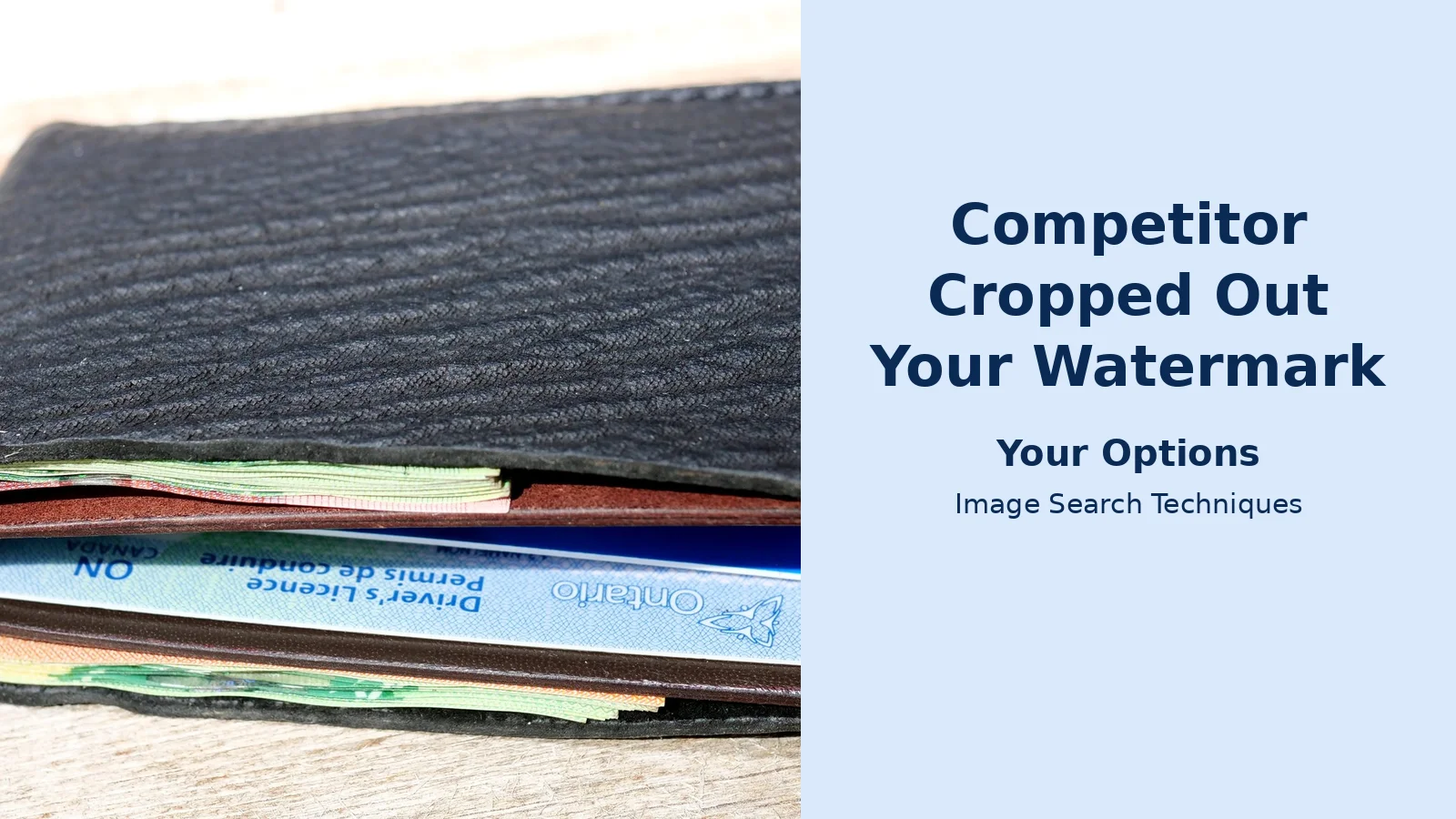
Guides usually describe this problem without testing anything, so we ran a small honest test on 14 November 2026. The photo is a real published image from Wikimedia Commons: a handmade leather bi-fold wallet by Eugene Pik, entered in the 2021 Virtual Competition of the Canadian Society for Creative Leathercraft, licensed CC BY-SA 4.0. It is 2,048 by 1,152 pixels, and it is the kind of product photo a competitor might steal for a listing. The photo is openly licensed, so this is a test, not a real theft case, and the watermark is one we added ourselves.
We added the text “© Eugene Pik” in white at 50 percent opacity in the bottom-right corner, with a 4 percent margin from the edges, the way a seller would mark a product photo. Then we cropped 18 percent off the right and bottom edges, which removed the mark completely. The cropped copy is 1,679 by 944 pixels, and it still looks like a clean product photo. That is the competitor’s move, reproduced exactly.
Then we reverse-searched the cropped copy, with no account signed in anywhere. TinEye found nothing: 0 matches across 86.7 billion images, with the note that it had yet to crawl any pages where the image appears. That is a crawl gap, not a clearance. A zero from TinEye never proves a photo is clean, and this photo had only recently reached the public web in this form. Google Lens did better. It identified the wallet at once, describing it as a textured black leather bifold wallet filled with cash and an Ontario driver’s licence, and it showed three exact matches. None of the three was the Wikimedia Commons file page itself, but all three were pages re-using the same photo, and all three still carried the maker’s name. Fresh Calendars used it in a debt payoff planner article on 4 November 2026, credited it to Eugenepik under CC BY-SA 4.0, and its source link points straight to the Commons file page. An X post from 2 November 2026 used it at 960 by 540 pixels. A note.com article from 6 November 2026 used it at 1,200 by 675 pixels, again credited to Eugenepik.
Two lessons come out of that test. First, cropping the watermark did not hide the photo. Lens still matched the cropped copy to the original, and the pages that used it still carried the credit line. The visible name was gone, but the image’s history was not. Second, all three matches were lawful re-uses with credit, which is the contrast that matters. A lawful re-use keeps the maker’s name attached. A competitor who crops the name out is doing the opposite, and the reverse search is what lets you prove it.
What should you do when a competitor removed my watermark?
Work the ladder in order, and stop at the step that gets the photo taken down. Most cases end at step one or two. The later steps are for competitors who ignore you, and they cost more time and money, so use them only when the value of the photos justifies it.
| Step | What to do | When it fits | Cost |
|---|---|---|---|
| 1. Direct message | Write to the competitor, in writing, with the side by side comparison attached. State that the photo is yours, that the watermark was removed, and what you want: removal, or a licence fee. Give a firm deadline and keep a copy. | First move in most cases | Free |
| 2. Platform report | If the photo is on a marketplace or social platform, use its own reporting route. On eBay that is the VeRO programme, and on Etsy it is the IP Reporting Portal. | The photo is on a marketplace listing or a social page | Free |
| 3. Host report | If it is on the competitor’s own website, find the hosting provider from a WHOIS lookup and send a DMCA takedown notice to the host. A host that ignores a valid notice risks losing its safe harbour protection. | Their own website, after step 1 failed | Free |
| 4. Formal takedown | Send a formal demand letter, either yourself or through a solicitor, asking for removal and a licence fee for the use so far. | They ignored you, or the use is commercial and ongoing | Your time, or a solicitor’s fee |
| 5. Small claims | UK: the Intellectual Property Enterprise Court small claims track, for claims up to £10,000. US: the Copyright Claims Board, for claims up to $30,000 in total, which started hearing claims in June 2022. Both are designed for people without lawyers. | The amount justifies court, and the earlier steps failed | Low court fees |
On the platform step, the marketplace guides on this site walk the two routes in full. Our guide to reporting stolen product photos on eBay with VeRO covers the evidence pack, the filing steps and the reason codes, and our guide to reporting stolen photos on Etsy in the IP Portal covers the portal walkthrough, the counter-notice window and the relisting watch. Both belong to the Brand and Business Image Protection hub, which gathers the whole family of guides for owners whose photos are being used by others.
On the formal step, a demand letter is not a threat, it is a record. Our guide to writing a copyright demand letter for a stolen photo covers what to put in it. Keep the letter factual: what was taken, where it is, what you want, and by when. Do not quote damages figures you cannot back up, and do not promise a lawsuit you do not intend to bring.
On the small claims step, two practical points. In the UK, the IPEC small claims track decides straightforward copyright claims worth up to £10,000, and you can represent yourself. In the US, the Copyright Claims Board is a voluntary tribunal inside the Copyright Office, its total recovery is capped at $30,000, and a respondent can opt out within 60 days of being served, in which case federal court is the remaining route. The Board needs a copyright registration or a pending application, and its filing fees are $40 for the first payment and $60 for the second. In the US generally, registration is not needed to own the copyright or to send a takedown, but it is usually needed before you can claim statutory damages for the underlying infringement in federal court. If the photos matter to your business, register them.
What if they pasted their own watermark over yours?
That is a third wrong, and the US rule names it directly. Section 1202(a) makes it unlawful to knowingly provide false copyright management information with the intent to induce, enable, facilitate or conceal infringement. Putting your own logo over someone else’s name is not just removal, it is a false claim of ownership, and it is treated as a separate violation.
There is also a brand angle that the AI Overview on this topic flags, and it is worth one paragraph. If the competitor uses your logo or brand mark on the photo to make buyers think the product is theirs, that can be trademark infringement or unfair competition in the US, and passing off in the UK. That claim is about the brand, not the photo, so keep it separate from the copyright claim in your complaint, and name it only if their use of your mark actually misleads buyers. A cropped watermark on a plain product photo is a copyright matter. A cropped watermark plus your logo on their storefront is both.
What should you not do?
The mistakes in this situation are all versions of the same error: acting before the evidence is safe, or reaching for a remedy you do not have.
Do not post a public accusation before you have saved the evidence and filed a report. The competitor can delete the page, and a public claim that gets a fact wrong can turn into a defamation problem for you. Do not send a takedown notice for a photo you do not own, or one you only have a licence to use. A takedown is a claim of ownership, and a false one has consequences of its own. Do not pay anyone who offers to fix the problem for a fee, and do not hire a recovery firm that promises to get the photos down. The platform and host routes in the ladder above are free, and they work. Do not threaten criminal action or a lawsuit you do not intend to bring, and do not quote damages figures you cannot back up. An empty threat tells the competitor you are not serious. Do not delete your own originals, and do not overwrite the watermarked versions you published. The original file is the proof, and once it is gone you cannot recreate it. Finally, do not re-upload their cropped copy anywhere to prove your point. Keep the evidence private until the platform, the host or the court asks for it.
How do you make the next watermark harder to crop out?
A corner mark is a signature, not a lock. Our own watermark guide proved that in a test: cutting 18 percent off two edges removed a corner mark completely, while a tiled mark survived the same crop because the pattern repeats across the whole frame. If your photos keep being cropped, move the mark. Put it across the centre of the image on low-resolution proofs, or tile it diagonally across the frame at low opacity, and vary the position slightly between images so an automated tool cannot learn the pattern. The full method, with the tools and the placement rules, is in our guide to watermarking your photos. This article will not repeat it.
Then monitor. A watermark only helps if you find the copies, so run your key product photos through reverse image search every few weeks, and save the results. The test in this article shows what to expect: a cropped copy can still be found, and the pages that used it may still carry your name. The crop removes the visible credit. It does not remove the photo’s history, and it does not remove your rights. Gather the evidence, work the ladder, and stop at the step that gets the photo down.
This article is general information, not legal advice. Copyright rules differ between countries, and the right move depends on where you and the competitor are based and how the photos are being used. If the amount at stake is large, or the competitor is a company with lawyers, get advice from a solicitor before you file anything.
Is it illegal for a competitor to crop out my watermark?
Yes, in most cases. Using your photo without permission is copyright infringement, and removing the watermark is a second wrong on top of it. In the US, section 1202 covers removing copyright management information. In the UK, section 296ZG covers removing electronic rights management information. Both need the removal to be knowing.
Can I sue if a competitor removed my watermark and used my photo?
You can, but a lawsuit is the last step, not the first. Most cases end with a message, a platform report or a host takedown, all free. If those fail, the UK IPEC small claims track hears claims up to £10,000, and the US Copyright Claims Board hears claims up to $30,000. Get advice before you file.
Does cropping a watermark count as copyright infringement on its own?
No. The infringement is copying and using your photo without permission. The crop is a second, separate claim: removing the information that identifies you as the owner. In the US that is a section 1202 violation, with statutory damages of $2,500 to $25,000 per violation. In the UK it is a section 296ZG claim.
What evidence do I need before I report a cropped watermark?
Save four things before you contact anyone: your original file with its metadata, the watermarked version you published, a full-page screenshot of the competitor’s page showing the URL and the date, and the cropped image downloaded from their page. Add a side by side comparison and a reverse search record.
What if the competitor says they did not know the photo was mine?
That is the defence the crop makes hard to run. A watermarked photo carries your name on it, so removing it means they saw the name and took it off. They can still argue they had a licence, or that a platform’s automatic crop removed the mark. Check those two points first, then rely on your screenshots and originals.
How long do I have to act after finding my watermarked photo cropped?
Act the day you find it. The evidence is freshest then, and the listing is still live, which is what a platform or host needs to act. Copyright claims have time limits that run in years, not days, but a report filed months later, after the listing changed or closed, may be one the platform cannot act on.