


🔎 Reverse Image Search
Image search techniques made simple: upload a photo or paste a URL and search 6 engines at once. 100% free, nothing stored.
🔒 Your image is never stored on our servers longer than 24 hours and is never shared.
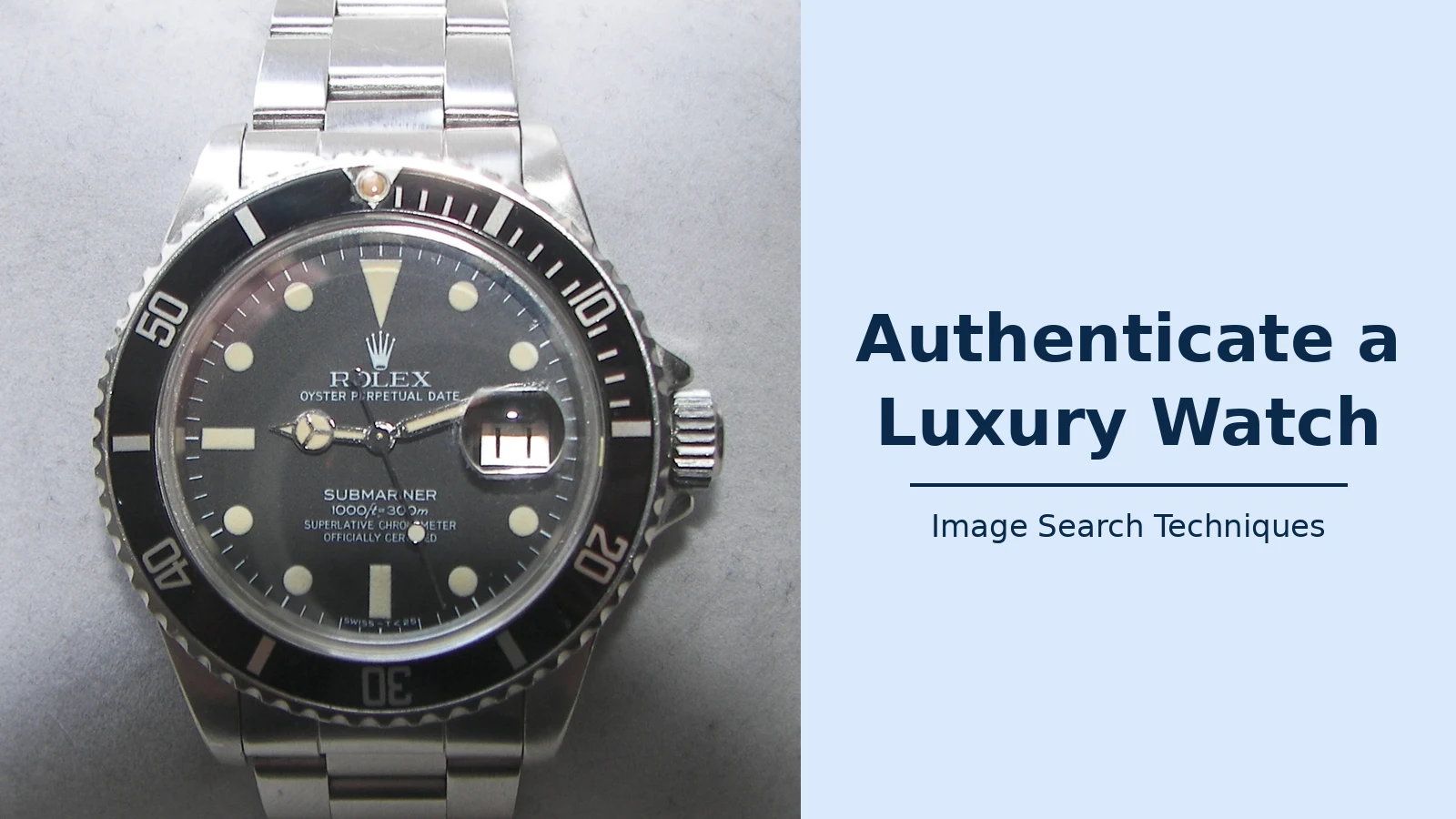
Buying a luxury watch from a listing photo is a leap of trust — and the most counterfeited luxury watch on earth is the Rolex, with the Submariner the most copied model of all, according to the authentication hub WatchScanning. The good news is that you can learn how to authenticate a Rolex from photos well enough to catch most fakes before any money changes hands, using nothing more than the seller’s own pictures, a free reverse image search and a careful eye. This guide gives you the exact photo set to demand from a seller, the six macro tells that survive photography, a worked example, and the honest limits of what pictures can ever prove.
Direct answer: Yes — you can authenticate a Rolex from photos well enough to rule out most fakes before you buy, by checking the laser-etched coronet at 6 o’clock, the rehaut engraving, the 2.5× Cyclops magnification and matching serial numbers. Photos cannot prove a watch is genuine, so treat the result as a strong screen, not a certificate.
Photo authentication means judging a watch’s genuineness from photographs alone, without holding it, opening the case or testing the movement. It is a screening skill, not a guarantee: a photo check can expose a fake with confidence, but it can only raise the probability that a watch is genuine, never prove it outright. That distinction matters, because the best modern replicas — so-called superclones — are built precisely to pass a casual photo glance.
Can You Authenticate a Watch from Photos Alone?
Yes, up to a point — and the point is further than most buyers expect. Several of a Rolex’s hardest-to-copy details are visual and were designed to be checked by eye: a micro-coronet laser-etched inside the sapphire crystal, lettering engraved around the rehaut, and a date window magnified by a Cyclops lens. All three can be judged from a sharp, well-lit photograph, which is why professional photo-authentication services such as LegitGrails exist at all. LegitGrails says its experts authenticate Rolex watches from uploaded photos alone, with prices from $50 for a 12-hour verdict to $105 for a 30-minute one.
But photographs have hard limits. A photo cannot tell you how the movement sounds or feels, whether the case metal is really 904L Oystersteel, or whether the watch keeps time to chronometer standard. A seller’s photos can also be selective: the one angle that would expose a fake is the one angle that is missing. And a photo can be stolen outright — lifted from a genuine listing and attached to a fake watch. That is why this guide pairs the visual checks with a reverse image search of the listing photos themselves, a step neither of the leading Rolex guides covers.
Use photo authentication as a filter, not a verdict. If a watch fails any check below, walk away. If it passes them all, you have earned the right to spend money on a hands-on inspection or a paid photo opinion — not the right to skip one.
What Photos Should You Ask a Watch Seller For?
Never authenticate from the three glossy shots a seller chooses to show you. Ask for the full set below, and treat a refusal to provide any one of them as information in itself. A genuine seller with a genuine watch has nothing to lose by photographing it properly.
- Dial, straight on, in daylight. The whole dial, sharp enough to read every line of text. This is where you check dial printing, the coronet, the minute track and the alignment of the text.
- Crystal at 6 o’clock, tilted under a light. The laser-etched coronet only flashes when the crystal is angled to the light, so ask for a close, angled shot of the 6 o’clock marker — and a second one taken head-on, where the etching should all but disappear.
- Rehaut, all the way round. The inner ring between the dial and the crystal, photographed in sections so you can read the repeating “ROLEXROLEXROLEX” engraving, the coronet at 12 o’clock and the serial number at 6 o’clock.
- Cyclops and date window, close up. A tight macro of the date, taken straight on, so you can judge the magnification and whether the date fills the window.
- Case sides and crown. Both flanks of the case, the crown and the crown guards, showing the finishing where brushed and polished surfaces meet.
- Between the lugs, both sides. With the bracelet removed or pulled aside: the serial number at 6 o’clock and the reference number at 12 o’clock, both deeply and cleanly cut.
- Bracelet and clasp. The end links where they meet the case, the clasp open and closed, and any engraving inside the clasp.
- Case back. Most Rolex watches have a plain, solid case back — a display back showing a movement is, on almost every Rolex, a fake on its own.
Ask for the photos at full resolution, not compressed through a messaging app, and ask the seller to include a handwritten note with today’s date in one frame. That single request defeats most stolen-photo scams, because a thief cannot produce a dated photo of a watch they do not hold. If the seller says the bracelet cannot be removed to show the lugs, that is sometimes true — removing a bracelet needs the right tool — but it is also the oldest excuse in the book, so weigh it against everything else you find.
How to Authenticate a Rolex from Photos: The Six Macro Tells
Work through these six checks in order. They are arranged from the hardest tell to fake down to the supporting details, and any single failure is enough to stop the deal. Before you start, it helps to know which watch you are looking at: if you have not yet pinned down the model, our guide to identify what is in the picture explains the photo-first method, and our companion guide shows you how to identify a watch from a photo — identification first, authentication second.
| Tell | What a genuine Rolex shows | What a fake usually shows |
|---|---|---|
| Laser-etched coronet at 6 o’clock | Tiny, crisp, symmetrical crown etched inside the sapphire, visible only at an angle | Missing, printed on the surface, too large, blurry or off-centre |
| Rehaut engraving | Clean, evenly spaced “ROLEXROLEXROLEX” with coronet at 12 and serial at 6 | Uneven, wobbly or shallow lettering; serial does not match the lugs |
| Cyclops magnification | Date magnified about 2.5×, filling the window edge to edge | Date small and set back, about 1.5×, bubble off-centre or glue at the rim |
| Dial printing | Sharp, flawless text; even spacing; perfectly centred applied coronet | Spelling errors, uneven spacing, soft or misaligned printing |
| Serial and reference | Deeply, cleanly cut numbers that match each other and the papers | Shallow, sandy or acid-etched numbers; mismatched serial and reference |
| Case, crown and bracelet | Sharp bevels, dead-straight brushing, smooth screw-down crown, solid end links | Soft rounded edges, mushy crown coronet, gappy end links, light hollow feel |
1. The laser-etched coronet at 6 o’clock. This is the single most reliable visual check on a modern Rolex. Rolex phased the laser-etched coronet into its sapphire crystals between roughly 2001 and 2002, and by 2003–2004 it was standard across the range, according to WatchScanning. The tiny crown sits centred over the 6 o’clock hour marker, etched into the glass itself rather than printed on it, so it disappears when you look straight down and only glints when you tilt the watch under a light or a loupe. Fakes usually fail in one of four ways: no etching at all, a crown printed on the surface, an etching that is too large and clumsy, or one placed off-centre. One honest exception exists — the green-crystal Milgauss 116400GV genuinely has no etched crown, so its absence there is normal.
2. The rehaut engraving and serial. From around 2005, Rolex began laser-engraving the rehaut — the inner bezel ring between the dial and the crystal — with a repeating “ROLEXROLEXROLEX” that runs the full circle, plus the watch’s serial number at 6 o’clock and a small coronet at 12 o’clock. On a genuine watch the lettering is impossibly clean and evenly spaced, cut at a consistent depth, and the wrap-around alignment is perfect. Reproducing engraving this fine on a curved ring is genuinely hard, so fakes give themselves away with letters that are uneven, too deep or too shallow, or misaligned where the pattern meets. The rehaut serial should also match the serial engraved between the lugs and the number on the papers.
3. The 2.5× Cyclops magnification. On dated models the Cyclops lens over the date window should magnify the date roughly 2.5 times, so the date looks large and bold and fills the window from edge to edge. This is one of the most common places for a fake to fall short: many replicas only manage roughly 1.5×, leaving the date looking small and set back, with the bubble sometimes sitting off-centre, distorting near the edges, or showing a ring of glue. Remember that some models — the Submariner No-Date, Explorer and Milgauss — have no date and therefore no Cyclops at all, so the absence of a Cyclops on those references is correct, not suspicious.
4. Dial printing, serial and finishing. Rolex dial printing is flawless. Spelling errors, uneven letter spacing, text that is not perfectly centred, or a soft, poorly formed applied coronet all signal a fake — and all of them are visible in a sharp straight-on dial photo. Next, read the serial between the lugs at 6 o’clock and the reference at 12 o’clock: both should be deeply and cleanly cut, and the serial should sit in a range that fits the reference’s production years. From about 2008 the serial moved to the rehaut only, so on a newer watch you should find it there and not between the lugs. Finally, look at the finishing: genuine steel Rolex watches are made from Oystersteel, Rolex’s 904L-grade alloy, and feel dense and solid; under a loupe the finishing is flawless, with sharp bevels and dead-straight brushing. A photo cannot convey weight, but it can show soft, rounded edges and sloppy transitions — and a see-through display case back is, on almost every Rolex, a fake on its own.
How Do You Reverse Image Search a Watch Listing?
Knowing how to authenticate a Rolex from photos starts with checking whether the photos are even the seller’s. Stolen listing photos are one of the most common watch scams: a fraudster copies the pictures from a genuine sale, lists the same watch at a tempting price, takes a deposit, and disappears. A reverse image search of the listing photos takes about a minute and catches this outright.
- Save the seller’s best dial photo to your phone or computer, or copy its image address from the listing.
- Open Google Lens at lens.google.com, upload the photo, and look at the “visually similar” and “exact match” results. Repeat with a second photo — the case-back or clasp shot — because a thief sometimes mixes one stolen photo with real ones.
- Run the same photo through TinEye as a second engine, since TinEye indexes different listings and older pages than Lens.
- Read the results like a detective. The same watch appearing in an older sold listing, on a dealer’s site in another country, or in three live listings at three different prices is a hard stop. A genuine private seller’s photos should appear nowhere else.
- Check the serial, not just the watch. Search the serial number itself in quotes. If that exact serial appears in a forum warning, a stolen-watch register or another listing, walk away.
Worked example — the Submariner that failed the photo search. The following scenario is illustrative, built from the checks in this guide rather than a real transaction, to show how the workflow runs in practice. A buyer — call her Sarah — finds a Submariner Date listed at £7,400, roughly £2,000 below the going rate for the reference, with eight clean photos and a story about a quick sale. She asks for the full eight-photo set and the seller sends them promptly, including a tilted crystal shot and a rehaut close-up. The coronet is visible at 6 o’clock, the Cyclops fills the window, and the rehaut lettering looks even. So far, so good. Then she reverse-searches the dial photo on Google Lens. The same photo appears in a dealer listing from 2023, sold, and in a second live listing under a different seller name at £9,800. She asks the seller to retake one photo with today’s date on a handwritten note beside the watch. He refuses, saying the watch is “already boxed for posting”. Sarah walks away. The watch may have been genuine — the photos certainly were, just not his — but the photo search caught what the macro tells could not: the seller did not hold the watch he was selling.
That is the point of the step. The visual tells judge the watch in the photo; the reverse search judges whether the photo belongs to the seller at all. Run both, every time.
What Is a Superclone, and What Can Photos Never Settle?
A superclone is a high-grade replica built to copy a genuine Rolex as closely as possible: correct case shape, a sweeping automatic movement, a plausible serial, and in some cases even a laser-etched coronet and a rehaut engraving. The term is the replica market’s own, and the best examples are good enough that WatchScanning warns plainly that even every check in its guide passing is not absolute proof. The tells that still separate superclones from genuine watches are usually the ones a photograph cannot show: the exact finishing of the movement, the metallurgy of the case, the smoothness of the winding and the feel of the bezel click.
That is the honest limit of this guide. A photo check is excellent at catching the 90% of fakes that are ordinary replicas — wrong Cyclops, printed coronet, sloppy rehaut, mismatched serial — and it is not sufficient for a high-value purchase on its own. For a watch costing several thousand pounds, the gold standard is an in-person inspection by a certified watchmaker who opens the case and confirms the movement and engravings. Short of that, a paid photo opinion is the next best step: LegitGrails charges from $50 for a 12-hour verdict to $105 for 30 minutes and says its accuracy is over 99.89% — its own claim, not an independent test — while WatchScanning offers a first AI scan free and returns a verdict in about 30 seconds. Use a paid opinion as a second pair of eyes on the same photos, not as a replacement for the checks above: if your own reading and the service disagree, believe the disagreement, not the service.
The same photo-first discipline applies to other luxury goods, and the skills transfer directly: our guides to legit-check sneakers from photos and to authenticate a designer handbag from photos use the same pattern — demand the right photos, check the macro tells, reverse-search the listing, then pay for an expert opinion only when the free checks pass. It also applies to signed collectibles. Learn how to authenticate an autograph from photos before paying for a signature, a certificate, or both.
What Should You Check Before You Pay?
Run this final checklist only after the watch has passed every photo check and the reverse image search. If any item fails, the deal is not ready, however good the price looks.
- Serial, reference and papers all agree. The rehaut serial, the between-the-lugs serial, the reference number and the warranty card must describe the same watch, made in the same era. A serial that dates a watch approximately — LegitGrails offers a free serial-number check — but remember that a serial dates a Rolex; it does not prove it is genuine, because counterfeiters engrave plausible serials.
- Price against the market, not against hope. Check sold listings for the same reference on at least two platforms. A price far below the market is not a bargain; it is the most reliable warning sign in watch buying.
- Buy through a protected route. Prefer an authorised dealer or Rolex Certified Pre-Owned, where the watch is inspected by Rolex itself. On the secondary market, use a platform with buyer protection and an authenticity check — eBay Authenticity Guarantee covers eligible luxury watches — and never pay by bank transfer or gift card to a private seller.
- Confirm the return policy in writing before you pay, including who pays for return postage and how many days you have to have the watch inspected.
- Budget for an inspection. For any watch over a few thousand pounds, the cost of a watchmaker opening the case is small next to the cost of buying a superclone. Agree the inspection before you pay, not after the watch arrives.
FAQs
Can you authenticate a watch from photos alone?
You can screen a watch from photos well enough to catch most fakes: check the laser-etched coronet, the rehaut engraving, the 2.5× Cyclops and matching serial numbers. Photos cannot prove a watch is genuine, because superclones copy the visible details. Treat a photo check as a filter — a failure means walk away, while a pass earns a hands-on inspection.
What is the laser-etched coronet at 6 o’clock?
It is a crown laser-etched inside the sapphire crystal above the 6 o’clock marker. Rolex phased it in around 2001–2002; it was standard by 2003–2004. It is invisible head-on and flashes only when you tilt the watch under light. Fakes omit it, print it on the surface, or cut it too large. The green-crystal Milgauss is the one genuine exception.
How much does professional photo authentication cost?
LegitGrails charges from $50 for a 12-hour Rolex verdict to $105 for 30 minutes, and claims accuracy over 99.89%. WatchScanning offers a first AI scan free, with a verdict in about 30 seconds. Use either as a second opinion after your own checks pass — no photo service replaces opening the case on a high-value purchase.
Should I buy a Rolex without papers?
Yes, if the price reflects it and other checks pass. Papers are not proof of genuineness — boxes, cards and certificates can be faked or sold separately, as LegitGrails notes. What matters is that the serial, reference, dial, bezel and case describe one consistent watch for its era. Without papers, a watch should cost less and deserves an inspection first.
