🔎 Reverse Image Search
Image search techniques made simple: upload a photo or paste a URL and search 6 engines at once. 100% free, nothing stored.
🔒 Your image is never stored on our servers longer than 24 hours and is never shared.
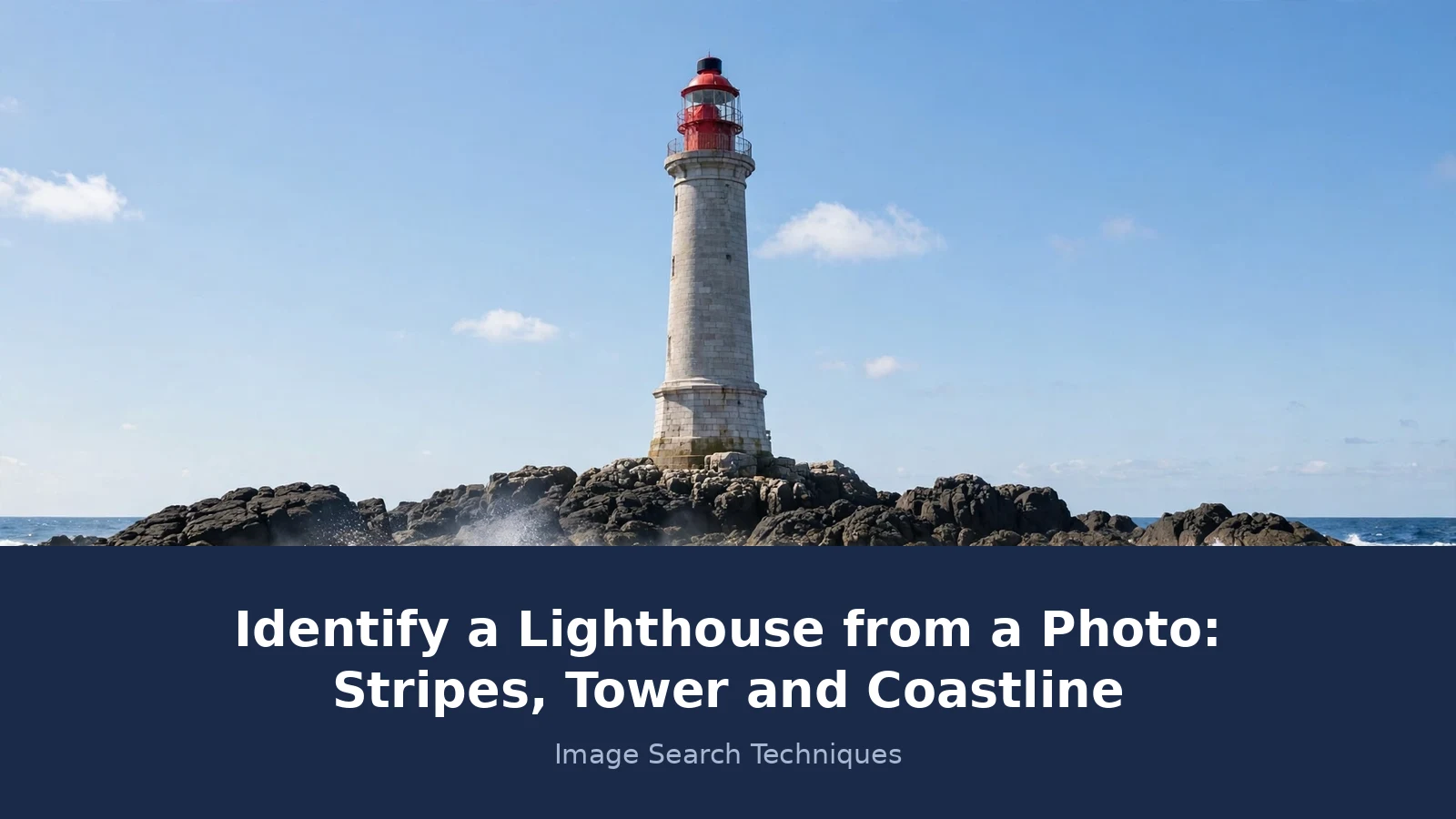
You have a photo of a lighthouse and no name to go with it. Maybe it came from a holiday album, a phone backup, or a post someone shared without a caption. The tower looks familiar, the stripes look familiar, and yet you cannot place it. That is a normal problem. Lighthouses were built to be seen from far away, so many of them share the same shapes and the same paint, and a photo on its own rarely gives you the name.
There is a reliable way to identify a lighthouse from a photo. Run a reverse image search first, then read the tower the way a lighthouse directory reads it. The search often names the lighthouse for you. When it does not, the stripe pattern, the tower shape, the lantern room and the setting around the tower narrow the list to a handful of candidates, and a directory check settles it.
Direct answer: To identify a lighthouse from a photo, run a reverse image search first, then read the tower: stripe pattern and colours, tower shape and height, lantern room, and the coastline or setting. Match those traits against a lighthouse directory. A photo can only suggest a likely name, so check it against the directory before you state it as fact.
What can a photo actually tell you about a lighthouse?
A photo can tell you a lot, but it cannot prove a name. That is the rule this whole method rests on. A reverse image search can match your photo to a captioned copy somewhere on the web, and a directory can confirm that the tower in your photo matches the tower on record. Those two steps together give you a likely name, and usually a confident one. They do not give you proof, because a photo can be cropped, mislabelled, or taken from an angle that hides the very detail that separates one lighthouse from another.
The honest answer is often “this most resembles X”. Say that, and say why. If the stripes, the tower shape, the lantern room and the setting all point the same way, and the directory agrees, you can name the lighthouse and show your working. If two or three lighthouses fit the same description, say so, and list what would separate them. A reader who trusts your method will come back. A reader who catches you guessing will not.
Keep that standard in mind for the rest of this guide. Every step below either adds evidence or warns you where the evidence runs out.
How do you identify a lighthouse from a photo?
Start with a reverse image search, not with a guess. Upload the photo, or paste its link, into a reverse image search engine and see what it returns. If the same photo already exists online with a caption, the engine will often show you the captioned copy, and the name comes with it. That is the fastest route, and it is the route this guide uses in the worked example below. The same method works for any object, and the find it by image guide covers it in full.
Use more than one engine. Google Lens, TinEye and Yandex do not index the same pages, and a photo one engine misses, another may find. Run the same photo through at least two of them before you conclude that the photo is not indexed anywhere. If the first engine returns nothing, that tells you nothing about the photo. It only tells you that engine has no match.
When the search gives you a name, do not stop there. Check the name against a lighthouse directory, such as Trinity House for a UK lighthouse or The Lighthouse Directory for lighthouses worldwide. Look for the tower height, the stripe pattern, the lantern room and the setting, and compare each one with your photo. If they all agree, you have your answer. If one disagrees, trust the disagreement and keep looking.
If the search gives you nothing, switch to the traits method. Read the tower yourself, write down what you see, and search the directory by those traits. The checklist in the next section is built for exactly that step.
What should you look at first in the photo?
Read the tower in a fixed order, so you do not miss the detail that matters. Start with the paint, then the shape, then the top, then the ground around it. Each of these traits cuts the list of candidates down, and together they usually leave only one or two.
The stripe pattern and colours come first, because they are the most visible trait in a photo. Is the tower plain white, plain stone, or painted in bands? If it has bands, count them, note their colours, and note whether they are horizontal or spiral. Many lighthouses share the same band colours, so a band pattern on its own never names a lighthouse. It only tells you which family to look in.
The tower shape and height come next. Is the tower a tapered cylinder, a straight cylinder, a square tower, or a tower on top of a keeper’s house? Is it short and squat or tall and slim? A tower photographed from a boat, with no building beside it for scale, is hard to judge for height, so note the proportions instead: a tower twice as tall as it is wide looks very different from one four times as tall as it is wide.
The lantern room is the glass room at the top, and it is often the most distinctive part of the tower. Note its colour, usually red or black, its shape, and whether there is a helipad above it. A helipad is a strong clue, because only some offshore towers have one. Note also what sits beside the tower: a stump, a keeper’s cottage, a foghorn building, or nothing at all.
The coastline and setting come last, and they are often the clue that settles it. Is the tower on a rock in open sea, on a cliff edge, on a harbour wall, or on a flat beach? Is there land behind it, or only sea? An offshore rock tower with no coastline in the frame is a very different candidate from a tower standing on a headland with cottages behind it.
Use the checklist below to record what you see. If you write the traits down before you search, you will not talk yourself into seeing a stripe that is not there. The statue identification guide uses the same traits method on a different subject, and it shows how far a careful read of one photo can go.
| Trait to record | What to note in the photo | Why it narrows the list |
|---|---|---|
| Stripe pattern and colours | Plain or banded; band colours; horizontal or spiral; how many bands | Many towers share bands, so this picks a family, not a name |
| Tower shape | Tapered cylinder, straight cylinder, square, or tower on a house | Shape separates towers that share the same paint |
| Tower height and proportions | Tall and slim, or short and squat; height against nearby buildings | Proportions survive a cropped photo better than a guessed height |
| Lantern room | Colour of the lantern, usually red or black; shape; helipad above it or not | A helipad or an unusual lantern colour is a strong clue |
| Buildings beside the tower | Keeper’s cottage, foghorn building, old tower stump, or nothing | An old stump or a cottage is often unique to one station |
| Coastline and setting | Open sea rock, cliff edge, harbour wall, flat beach, or headland | Setting separates offshore rock towers from land towers at once |
| Region or state | Any clue to the country or coast, from the photo or its source | Two towers can look identical and sit on different continents |
Work through the table top to bottom, and write down what you actually see, not what you expect to see. A photo that shows a plain tower with a red lantern and no coastline is already a useful description, even before any search engine touches it.
Which lighthouses look alike?
The hardest part of this job is not the towers that look different. It is the towers that look almost the same. Rock lighthouses are the worst for this, because they were built from the same granite, to the same kind of plan, on the same kind of rock, in the same stretch of sea. A photo taken from a boat, with the tower filling the frame and no coastline to anchor it, can match three or four stations at once.
The table below splits a famous lighthouse from its lookalikes, using the worked example in this guide. It shows how small the differences can be, and which detail separates them.
| Lighthouse | What the photo shows | What separates it |
|---|---|---|
| Eddystone, off Plymouth | Plain pale granite tower, red lantern, helipad above the lantern, open sea, dark stump of an older tower beside it | The stump is the remains of Smeaton’s tower, and the helipad dates from 1980 |
| Bishop Rock, Isles of Scilly | Plain granite tower in open sea, similar height and proportions to Eddystone | No old tower stump beside it; the rock is far smaller and the tower stands alone |
| Bell Rock, off Arbroath | Plain granite tower on a reef in open sea, similar pale stone | A much older tower, built 1807 to 1810, with a different lantern and no helipad |
| Wolf Rock, off Land’s End | Plain granite tower in open sea, similar shape and stone | Stands on a smaller rock with a different lantern room and no stump |
Notice what the table does not do. It does not claim that stripes alone would name any of these towers, because none of them is striped today. That matters, because the most common mistake in lighthouse identification is to call a plain granite tower striped, or to describe the current tower using the paint of an older tower that stood on the same rock.
Eddystone is the classic trap. The current tower, built from 1878 to 1881 and first lit in 1882, is a plain pale granite tower with a red lantern. The broad red and white horizontal bands belonged to the tower before it, Smeaton’s tower, which was painted with bands from 1858 and now stands on Plymouth Hoe. A photo of the current Eddystone shows no bands at all. If your photo shows bands, it is either Smeaton’s tower, or a different lighthouse entirely.
When two towers fit your photo, look for the detail that only one of them has. A stump, a helipad, a cottage, a foghorn building, or the shape of the rock itself can break the tie. If nothing breaks the tie, say so, and name both candidates. The bridge identification guide works the same way, and it is the closest cousin to this one, because bridges share the same problem of lookalike structures.
Worked example: the Eddystone Lighthouse photo
This is a real test, run on a real photo, and reported honestly, including the parts that failed. The photo is a Wikimedia Commons image of Eddystone Lighthouse, taken by Andy Talbot in September 2007 and released under a Creative Commons Attribution Share Alike 2.0 licence. The file is called “Eddystone Lighthouse – geograph.org.uk – 1579951.jpg”, and it shows the tower centre right in open sea, with a red lantern, a sail in the left foreground, and the dark stump of the old Smeaton tower to its right. The photo is 640 by 410 pixels.
The photo was reverse searched on 23 November 2026 on three engines, using the direct image link. Here is what each engine did.
Yandex Images named the lighthouse first, and named it correctly. Its heading read “Eddystone Lighthouse”, with the subtitle “Lighthouse in Great Britain”, and a description placing it on the Eddystone Rocks in Devon, 14 km south of Rame Head, sourced to the Russian Wikipedia. Its first image tag was “eddystone lighthouse”, followed by bishop rock, bell rock and wolf rock, which is exactly the lookalike set in the table above. Yandex listed the image in 4 sizes, from 2180 by 1396 down to 218 by 139, and its sites tab showed 6 sites carrying the exact image, including coastradar.com, abandonedspaces.com, the Latin Wikipedia, ybw.com and laputa.it. The search tab showed 20 similar thumbnails, and the similar images tab showed about 85 thumbnails on its first page, most of them Eddystone, with Bishop Rock, Bell Rock and Wolf Rock mixed in. Yandex gives no total match count, so these are counts of items shown, not totals.
Google Lens did not return a result at all. On three attempts, the thumbnail loaded, the page stuck on “Thinking” with an empty heading and a disabled “Expired visual search” button, and clicking “Exact matches” or “Visual matches” gave the error “Something went wrong. No image at the URL. Try again with a different URL or image.” That is a block, not a zero. Lens did not say there were no matches. It never completed the search, so no count can be reported for it.
TinEye also did not return a result. Its Cloudflare human verification would not clear, even after repeated attempts and a move to a fresh browser. The checkbox showed “Verifying” and then “Verification failed”, and the search never ran. That is also a block, not a zero, and no TinEye count can be reported.
So the honest score for this test is one success out of three attempts: Yandex named Eddystone first and correctly, while Lens and TinEye were blocked before they could search. That is a useful result in itself. It shows why you should never rely on one engine, and why a “no results” message from one engine means nothing about the photo.
The name was then checked against the authorities. Trinity House, which operates Eddystone, records the tower at 9 nautical miles south west of Plymouth, built in 1882, 49 metres high, with the light 41 metres above mean high water springs, automated and electrified in 1982, flashing twice every 10 seconds, with a range of 17 nautical miles. The Lighthouse Directory lists the same station with the numbers ARLHS ENG-039, Admiralty A0098 and NGA 0132, and calls it “probably the most famous British lighthouse”. Every trait in the photo, the plain pale tower, the red lantern, the helipad, the open sea setting and the stump beside it, agrees with those records. That is what a verified identification looks like.
How do you check the name against a lighthouse directory?
A directory check is the step that turns a search result into an identification you can stand behind. A search engine can tell you that a photo matches a captioned copy. A directory tells you whether the tower in the photo matches the tower on record, trait by trait.
For a UK lighthouse, start with Trinity House, the authority that operates the lighthouse. Its station pages give the tower height, the height of the light, the light character, the range, and a short history of the towers that stood on the same rock. For Eddystone, that history is what saves you from the stripe trap: Trinity House records four towers on the rocks, Winstanley from 1698 to 1703, Rudyerd from 1709 to 1755, Smeaton from 1759 to 1882, and the current Douglass tower from 1882. Knowing that there were four towers tells you why an old photo of the same rock can show a completely different tower.
For a lighthouse anywhere in the world, use The Lighthouse Directory, which lists stations by country and region with their heights, light characters and reference numbers. Its Eddystone entry gives the same 1882 date, the same 41 metre focal plane, and the ARLHS, Admiralty and NGA numbers, which are useful if you want to cross check the same station in a second source.
Work through the directory entry against your checklist. Check the tower height, the stripe pattern, the lantern colour, and the setting, one by one. If all four agree, name the lighthouse and cite the directory. If one disagrees, stop and look again. A single disagreement, such as a striped tower where the directory says plain, is enough to send you back to the candidates list.
If you want to go further, Wikipedia’s lighthouse pages often carry the same figures with a fuller history, and the Geograph project, where the Eddystone test photo came from, carries thousands of captioned lighthouse photos from across the UK. Both are useful second sources, but the directory is the check that counts.
What if reverse search finds nothing?
Start by checking the photo itself. A reverse search works best on the original file, so use the largest, least compressed copy you have. A screenshot of a photo, or a photo of a printed photo, loses the detail the search engine needs. Crop out borders, captions and other photos in the frame, and search the tower on its own. If the photo came from a phone, check whether the original file is still on the phone or in a cloud backup, rather than the compressed copy that was shared in a chat. Also check the original file for embedded location data. A photo taken on a phone often carries GPS coordinates in the file, which you can view on the phone or read with a free EXIF viewer such as Pic2Map, though copies downloaded from social media usually have that data stripped. A coordinate is a lead, not a verdict: check it against a lighthouse directory before you state a name as fact.
Then describe the photo in words, using the checklist. Google’s own AI Overview for this question suggests the same move: if you cannot upload the photo, describe the tower colour and pattern, whether it is striped, solid white or brick, the shape and material, the nearby buildings or terrain, and the region or state. That description is a search query in itself. Search it as a phrase, and try the forum route too. The World of Lighthouses forum at lightphotos.net has a board where people post a photo and ask the community to identify it, and its threads show the same pattern again and again: a photo, a few traits, and a reply naming the lighthouse. The forum’s own footer warns that its information is unofficial and could not be used in navigation, so treat a forum answer as a lead, not a verdict, and check it against a directory before you repeat it. The same describe-then-search approach works for any fixed structure, and the landmarks reverse search guide covers buildings and places in the same way.
Try a second engine before you give up. In the worked example above, two engines were blocked and the third named the lighthouse at once. The same photo can fail on one engine and succeed on another on the same day, for reasons that have nothing to do with the photo. If all three engines fail, the photo may simply not be indexed anywhere yet, which is common for a private family photo that has never been published online.
When nothing works, say so, and keep the traits list. A reader who finds your article later, with the same photo, may recognise the tower from your description even if no search engine did.
What a photo can never prove
A photo can suggest a lighthouse. It can never prove one, and the cases where it misleads are worth knowing. A cropped photo can hide the stump that would have named the station. A photo taken at dusk can make a pale tower look white and a red lantern look black. A photo of a model, a painting, or a lighthouse shaped building can look exactly like the real station from the one angle the photographer chose.
Two towers can also share every trait you can see. Eddystone, Bishop Rock, Bell Rock and Wolf Rock are all plain granite towers in open sea, and a distant photo of any one of them can look like the others. In that case the honest answer is a shortlist, not a name, and the shortlist is the useful answer. It tells the reader what to check next, and it does not pretend to know more than the photo shows.
Never present a guess as a fact, and never let a confident sounding search result do it for you. A search engine that names a lighthouse is reporting a match to a captioned copy, and the caption could be wrong. Check the name against the directory, check the traits against the photo, and only then write the name down. If the checks disagree, the photo wins over the caption, and the directory wins over both.
That is the whole method: search first, read the traits, check the directory, and say plainly how sure you are. It takes a few minutes, it works on a phone, and it is the difference between naming a lighthouse and guessing one.
Can you identify a lighthouse from one photo alone?
Often, yes, but the answer is a likely name, not proof. A reverse image search may match the photo to a captioned copy, and a directory check can confirm the tower height, stripe pattern and setting. If two towers fit the same description, the honest answer is a shortlist, and the directory is what separates them.
What is the best reverse image search for a lighthouse photo?
There is no single best engine, because each one indexes different pages. Run the same photo through at least two engines, such as Google Lens, TinEye and Yandex. In our worked example, Yandex named Eddystone Lighthouse first, while Lens and TinEye were blocked before they could search, so a second engine is what saved the test.
Why do so many lighthouses look the same in photos?
Rock lighthouses were built from the same granite, to the same kind of plan, on the same kind of rock. A photo taken from a boat, with no coastline to anchor it, can match three or four stations at once. The lantern room, a helipad or an old tower stump are the details that separate them.
How do I tell Eddystone Lighthouse from Bishop Rock?
Look for the old tower stump. Eddystone has the dark remains of Smeaton’s tower beside the current tower, and a helipad above the red lantern. Bishop Rock stands alone on a far smaller rock, with no stump beside it. Both are plain granite towers in open sea, so the stump and the helipad are what separate them in a photo.
Can Google Lens identify a lighthouse?
It can, when it works. Lens matches a photo against indexed copies, and a lighthouse photo that already exists online with a caption can be named in seconds. In our test, Lens was blocked before it could search. Always try a second engine, such as Yandex or TinEye, before you conclude that a photo cannot be identified.
What should I do if no search engine recognises the lighthouse?
Describe the photo in words, using the checklist in this guide: stripe pattern and colours, tower shape and height, lantern room, and the coastline or setting. Search that description as a phrase, and ask on a lighthouse forum. Treat any forum answer as a lead, and check it against a directory before you repeat it as fact.