🔎 Reverse Image Search
Image search techniques made simple: upload a photo or paste a URL and search 6 engines at once. 100% free, nothing stored.
🔒 Your image is never stored on our servers longer than 24 hours and is never shared.
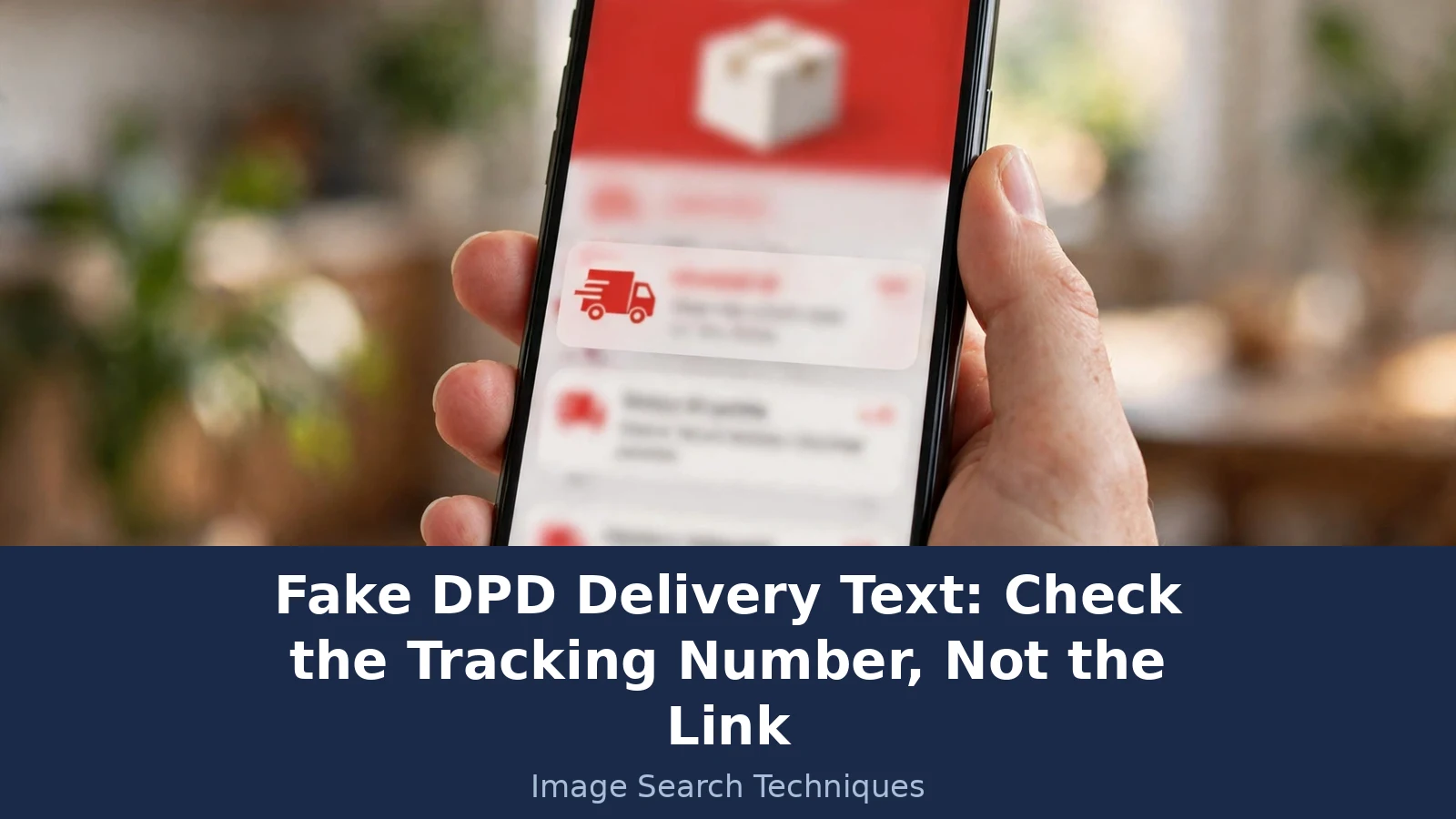
A text arrives saying DPD missed you, and there is a fee to pay before they try again. Your thumb is already over the link when a second thought stops you. Is this DPD, or is someone using DPD’s name to get at your card?
The short answer: the text is fake if it asks you to pay a redelivery fee through a link, arrives as an iMessage, or comes from a random number instead of DPD UK, DPD Local or DPDgroup UK. The safe check is the tracking number in the DPD app or on track.dpd.co.uk, typed in yourself. DPD never asks for a redelivery fee by link, in a text, an email or an iMessage.
This guide reads a real fake DPD text line by line, shows you the 60-second check that settles it, and explains what to do if you already tapped the link. Everything about DPD’s own rules comes from DPD’s cyber-security page, and the worked example at the end is a real reverse image search, run live, with honest results.
What a fake DPD delivery text looks like
Most fake DPD texts follow the same script. The sender name looks right, the wording sounds like a courier, and there is one thing to do: tap a link and pay a small fee, usually described as a redelivery fee. The amount is small on purpose. A pound or two feels too trivial to question, and that is exactly why it works. The fee is not the point. The link leads to a page that looks like DPD’s tracking page and asks for your address and card details, and that is what the scammer wants.
There are two versions doing the rounds. The first is the missed-delivery text: DPD tried to deliver, nobody was in, and you need to book a redelivery through the link. The second adds the fee: the parcel will be returned unless you pay a redelivery fee today. Both versions lean on urgency. Words like today, immediately and returned to sender are there to rush you past the checks you would normally make.
A real example shows the pattern clearly. A DPD text quoted in a scam report from 2021 reads: “DPD: Sorry we missed you. To book your redelivery visit:” followed by a link. The link starts with DPD’s name and then a made-up domain ending, not dpd.co.uk. That is the tell that matters most. DPD says it only uses three web addresses: www.dpd.co.uk, www.dpdlocal.co.uk and www.dpdgroup.co.uk. Any link that points anywhere else is not DPD, however convincing the rest of the message looks.
DPD’s own cyber-security page publishes its own real-world examples, and they are worth studying. They are screenshots of iPhone messages, not ordinary texts, from numbers starting with +63, the country code for the Philippines. One reads “Delivery Attempt Unsuccessful” and says a parcel delivery was attempted that morning, then tells the reader to reply with 1 to activate the link. Another is headed “DPD (UK) Delivery Security Update” and gives a delivery attempt time of 09:09. The links in them end in .cfd and .bond, endings DPD never uses. The screenshots carry red boxes around the sender numbers and the links, marking exactly the parts to check.
One more detail from DPD’s own page: a genuine DPD notification never opens with “Dear Customer” or “Dear Sir/Madam”. If your text starts that way, it did not come from DPD.
The 60-second check: the tracking number, not the link
Forget the link entirely. The tracking number is the one thing the scammer cannot fake, because it lives on DPD’s own system, not in the text. Here is the check, in order.
Step 1. Do not tap the link, and do not reply. Replying tells the scammer your number is live, and the reply itself is part of the trick in the newest DPD fakes: the message tells you to reply with 1 or Y and then close and reopen the message to activate the link. A genuine delivery alert never needs you to activate anything by reply.
Step 2. Open the DPD app, or type track.dpd.co.uk into your browser yourself. Use the app you already have, or type the address. Never follow a link from a message to reach a tracking page. If you are expecting a parcel, the shop you ordered from will also have the tracking number in your order confirmation email.
Step 3. Enter the tracking number from your order, not from the text. The number in the text may be invented, or copied from a real parcel belonging to someone else. Your order confirmation is the reliable source.
Step 4. Read what DPD’s own system says. If DPD is really holding your parcel, or tried to deliver it, the tracking page will say so, with the time and the next step. If it shows no delivery attempt and no fee due, the text is fake and you can delete it.
Step 5. Forward the text to 7726. That is the free UK spam-reporting service, run by the mobile networks. Forwarding takes seconds, it costs nothing, and it helps the networks block the sender for other people. Then delete the message and block the number.
The whole check takes about a minute, and it settles the question completely. A tracking number on DPD’s own site either matches a real delivery problem or it does not, and no wording in a text can argue with that.
Worked example: DPD’s own scam screenshots, reverse-searched live
The image used for this test is DPD’s own published collage of fake delivery texts, taken from DPD’s cyber-security page. It shows three iPhone screenshots of fake DPD messages from numbers starting with +63, with red boxes around the sender numbers and links. The messages say a delivery was attempted, give a time, and tell the reader to reply 1 or Y and close and reopen the message to activate the link. The links end in .cfd and .bond.
I reverse-searched that exact image on Google Lens and TinEye on 25 November 2026, signed out, to see where else it appears online. The results are honest, and they are not what you might expect.
Google Lens found 0 exact matches. Its exact-matches tab states plainly that no exact matches were found, so there is no copy of DPD’s collage in Lens’s exact-match results, not even on DPD’s own page. The visual matches that did load were other scam-warning pages: a Reddit post about a delivery scam, Facebook scam warnings, and guides about USPS text scams. Lens also produced its own summary of the messages as likely DPD smishing, pointing at the +63 numbers, the .bond and .cfd links, and the reply-1 and reply-Y trick.
TinEye found 0 matches after searching over 86.9 billion images. Its message was that it has yet to crawl any pages where this image appears. I ran the same search a second time and got the identical result, 0 matches, so this is a genuine zero and not a failed search.
What does a double zero mean? The image has not been indexed by either engine yet, which is normal for an image that lives on one help page and has not been copied around the web. It proves nothing about whether the image is real or fake. The proof is in the image itself: the iMessage label, the +63 numbers, the .cfd and .bond links, and the reply-to-activate instruction are each enough to call these messages fake under DPD’s own rules.
That is a useful lesson for your own checks. If you reverse-search a screenshot from a suspicious text and get no matches, do not take that as proof the text is genuine. New scam images take time to reach the search indexes, and scammers change their links and numbers constantly. Judge the message by the checks in this guide, and use a reverse search only as supporting evidence.
The delivery-text read table
Read any DPD text against this table. One failed row is a warning. Two failed rows means you should treat the text as fake and run the tracking-number check instead.
| What to check | A genuine DPD text | A fake DPD text |
|---|---|---|
| Sender name | DPD UK, DPD Local or DPDgroup UK | A random mobile number, an email address, or a lookalike name |
| Message type | Ordinary SMS text | iMessage, with an iMessage label or a Report Junk button |
| Greeting | No “Dear Customer” greeting | Opens with “Dear Customer” or “Dear Sir/Madam” |
| Redelivery fee | DPD never asks for one by link | Asks you to pay a small fee through the link |
| The link | Only dpd.co.uk, dpdlocal.co.uk or dpdgroup.co.uk | A lookalike domain, often ending in .cfd, .bond or .link |
| Urgency | States the delivery facts plainly | Threatens return to sender or destruction unless you act now |
| Reply ask | Never asks you to reply to activate a link | Tells you to reply 1 or Y, then close and reopen the message |
| Settler | The tracking number on track.dpd.co.uk or in the DPD app | No matching entry on DPD’s own tracking page |
Why the redelivery fee is the giveaway
DPD’s rule on this point is absolute, and it is printed on DPD’s own cyber-security page: DPD will never ask you to pay a redelivery fee via a link in an email, a text or an iMessage. That single sentence settles most fake DPD texts on its own. If the message asks for a fee through a link, it is not from DPD, whatever else it says.
The fee is usually small, and that is deliberate. Amounts like £1.99 turn up again and again in parcel scam texts, and one recent guide uses £1.99 as its example of a DPD redelivery-fee text. Be careful with that figure, though. It is a constructed example in that guide, not a quoted real scam message, and no source we checked quotes a real DPD text charging exactly £1.99. The amount changes from scam to scam. What does not change is the ask itself: a fee, payable through a link, right now. Judge the message by the ask, not by the amount.
One comparison is worth making, because it stops a real misunderstanding. DHL really does ask for customs duties and taxes by text in some cases, so a fee mention in a DHL text proves nothing either way and the tracking number decides it. DPD has no equivalent exception for redelivery fees, so for DPD the fee ask really is the giveaway. Our Fake DHL Delivery Text guide explains the DHL customs exception in full.
It helps to know why the fee trick works so well. DPD really does redeliver missed parcels, and a missed delivery is a normal, everyday event. The scam borrows a real situation and adds one false step, the payment link. Everything else can be true, including the fact that you really are expecting a parcel. Being genuinely due a parcel does not make a text about it genuine.
iMessage is the fastest tell
If you use an iPhone, there is a check that takes two seconds and needs no tracking number at all. Look at the top of the conversation. Genuine DPD alerts arrive as ordinary SMS texts. DPD says so plainly: its legitimate messages will always be sent by SMS and will never appear as iMessage.
If the message shows an iMessage label in the text input box or at the top of the conversation, it is a scam. DPD’s own page reports that the most recent fake DPD campaigns it has seen have mainly arrived as iMessages, which is why the company spells the rule out. An iPhone may also offer a Report Junk button under the message, which is another sign you are looking at an iMessage from a sender Apple does not recognise.
One caution: a fake can also arrive as an ordinary SMS, so an SMS label does not prove a text is real. The iMessage test only works in one direction. iMessage means fake. SMS means keep checking, starting with the sender name and the tracking number.
There is a second phone-level trick worth knowing. Scammers can spoof a sender name, so a fake text can land in the same message thread as your real DPD texts, underneath genuine delivery updates. A message sitting in a familiar thread is not automatically genuine. Check the message type, the link and the tracking number separately, even when the thread looks right.
What to do if you already tapped the link or paid
If you tapped the link but entered nothing, you are probably fine, but take two precautions. Close the page, delete the message, and keep an eye on your accounts for the next few days. Some fake tracking pages try to download files or ask for notification permission, so if the page asked you to download anything, do not, and run a scan with your phone’s built-in security tools.
If you entered card or bank details, act now, in this order. First, call your bank or card issuer and tell them you entered your details on a phishing page. They can freeze the card and issue a replacement, and they would rather hear from you before money moves than after. In the UK you can also dial 159, which connects you to your bank’s fraud team on a number that cannot be spoofed. Second, forward the text to 7726 if you have not already. Third, report the fraud to Action Fraud’s successor, Report Fraud, at reportfraud.police.uk or on 0300 123 2040, so the crime is recorded and the details can be passed to investigators. If the scam arrived by email rather than text, forward the email to report@phishing.gov.uk, the National Cyber Security Centre’s reporting address.
If you entered a password you reuse elsewhere, change it on the real service straight away, and anywhere else you used it. Start with your email account, because that is the key to resetting everything else. If the scammers have your address and phone number, expect follow-up scam calls and texts. No genuine bank, courier or police service will ever ask you to move money to a safe account or read out a one-time code to a caller.
Keep a screenshot of the text before you delete it, in case your bank or the police need it. Note the sender name, the time it arrived, and the link address as shown, but do not tap the link again to copy it.
What a real DPD text looks like
A genuine DPD text is boring, and that is the point. It comes from DPD UK, DPD Local or DPDgroup UK, never from a random number or an email address. DPD now shows its own name at the top of the message rather than the retailer’s name, so a message headed with a shop name instead of DPD deserves a second look. It arrives as an ordinary SMS, it never opens with “Dear Customer”, and it never asks you to pay a redelivery fee through a link.
A real DPD message points you to DPD’s own tracking, and the link, if there is one, goes to dpd.co.uk, dpdlocal.co.uk or dpdgroup.co.uk and nowhere else. Genuine DPD emails come only from addresses ending in @dpd.co.uk, @dpdlocal.co.uk, @dpdgroup.co.uk or @dpd.uk. Anything else, including a free email address like the random iCloud address DPD quotes as an example of a fake, is not DPD.
The simplest habit to build is this: never reach DPD through a message. If a text says something about your parcel, open the DPD app or type track.dpd.co.uk yourself and check the tracking number there. That one habit makes every fake DPD delivery text fail, including the next one, because scammers can copy DPD’s wording and red branding, but they cannot put a fake delivery onto DPD’s own tracking page. For the wider picture, our Photo Scams Complete Guide covers the courier family together, and our Fake Courier Collection Scam guide covers the related cash-collection trick, where a supposed driver comes to collect money in an envelope. If a delivery photo is part of the dispute, our Delivery Photo Is Not Your House guide explains how to challenge it, and the Fake Royal Mail Delivery Text guide covers the one carrier where a fee text needs more care, because Royal Mail really does charge customs fees in some cases. Evri runs the same missed-delivery script with its own rules, so our Fake Evri Delivery Text guide covers that version, including the reply-Y trap and the evri.link rule.
Is a DPD text asking for a redelivery fee real?
No. DPD says it will never ask you to pay a redelivery fee through a link in a text, an email or an iMessage. A genuine DPD message never asks for a fee that way, so a fee link alone proves the text is fake. Check the tracking number in the DPD app or on track.dpd.co.uk.
Does DPD send delivery texts by iMessage?
No. DPD says its genuine alerts are sent as ordinary SMS texts and will never appear as iMessage. If you see an iMessage label in the text box or at the top of the conversation, or a Report Junk button under the message, the text is a scam. Report it to 7726 and delete it.
How do I check if my DPD parcel is really out for delivery?
Open the DPD app, or type track.dpd.co.uk into your browser yourself, and enter the tracking number from your order confirmation, not from the text. DPD’s own tracking page shows the real status, including any missed delivery. If it shows nothing wrong, the text is fake.
I already paid through a DPD text link. What do I do?
Call your bank or card issuer immediately and tell them you paid on a phishing page, so they can freeze the card and issue a replacement. In the UK you can also dial 159 for your bank’s fraud team. Then forward the text to 7726 and report the fraud to Report Fraud.
What number do I forward a fake DPD text to?
Forward it free to 7726, which spells SPAM on a phone keypad. The service is run by the UK mobile networks and helps them block the sender for other people. If the scam arrived by email instead, forward it to report@phishing.gov.uk, the National Cyber Security Centre’s address.
Can a fake DPD text appear in the same thread as real DPD texts?
Yes. Scammers can spoof a sender name, so a fake message can land in the same thread as genuine DPD updates. A familiar thread proves nothing on its own, so check the message type, the link and the tracking number separately, even when the thread looks right.