🔎 Reverse Image Search
Image search techniques made simple: upload a photo or paste a URL and search 6 engines at once. 100% free, nothing stored.
🔒 Your image is never stored on our servers longer than 24 hours and is never shared.
Yes. Photograph the whole plant from above, one leaf close up where it meets the stem, and any flower or seed head. Run the shot through a reverse image search, then check the suggested name against two features in an extension photo gallery. A name that matches on two features is worth trusting. One that does not is a guess.
That is the whole method for how to identify a weed from a photo, in one paragraph, and it works because a weed is not a botanical category. A weed is any plant growing where you do not want it. A rose in the middle of the lawn is a weed that week. A dandelion in a wildflower strip is a welcome flower. If the bloom is what caught your eye rather than the weed, our guide to identifying a flower from a photo covers blooms on their own. So identifying a weed from a photo is really two jobs: get a name for the plant, then decide what that name means in your garden. If you are starting from a photo of any plant, not just a weed, our guide to working out what is in a picture explains the same method for anything you photograph. This guide does both jobs for weeds, and it keeps them apart. The first half is the photo method. The second half is what to do with the answer, including the one plant where a photo match changes from a garden job into a legal one.
What does “weed” mean here?
A weed is a plant out of place, not a species on a list. Gardeners, farmers and councils all use the word that way, which is why the same plant can be a weed in one garden and a crop in the next. Dandelion leaves go into salads in some kitchens and into the compost in others. White clover was once sold in lawn seed mixes on purpose, because it pulls nitrogen from the air and feeds the grass around it. University of Maryland Extension still notes that history on its clover page.
That matters for photo identification because the app or search engine only answers the first question: what species is this? It cannot answer the second: does it matter? A name on its own tells you nothing about whether the plant spreads by seed, by runners or by roots, whether it comes back next year, or whether it is the kind of plant you should not touch with bare hands. You need the name first, then the plant’s habits, and the habits come from a reliable description, not from the app.
How to identify a weed from a photo: the three shots that matter
Most failed identifications are failed photographs. One blurry leaf against a busy lawn gives an app almost nothing to work with, and the app will still give you an answer. It just will not be a good one. Take three photos instead, in this order.
- The whole plant from above. Stand over it and get the full shape in frame: a flat rosette pressed to the ground, a creeping mat, an upright clump, or a single tall stem. Growth habit is the first thing a botanist looks at, and it is the first thing a photo can show. Put a coin or your hand next to it for scale, and keep the lawn or paving visible so the setting is clear.
- One leaf, close up, where it meets the stem. This is the shot most people skip, and it is the one that separates look-alikes. Show the leaf edge (smooth, toothed, lobed), the veins, and how the leaf joins the stem. A single leaf on a plain background, a sheet of paper or a paving slab, beats a leaf lost in grass every time.
- The flower or seed head, if there is one. Flowers are the most reliable feature a photo can capture. A 2023 test in the journal PLOS ONE found that plant ID apps did better on flowers than on leaves for every app tested. If the plant is in seed, photograph the seed head too. The round white puffball of a dandelion in seed is as distinctive as its yellow flower.
Note two more things before you put the phone away. First, where it grows: a wet low spot, a dry path edge, deep shade under a tree, a crack in the paving. Weeds are fussy about conditions, and the habitat often narrows the list faster than the photo does. Second, whether it is alone or in a patch. A single plant and a creeping colony are different problems, and the answer changes what you do next.
If the plant has no flower and no seed head yet, wait if you can. Young weeds often look alike, and a week of growth can turn a guess into a confident match. If you cannot wait, photograph the youngest and the oldest leaves on the same plant, because the two can look quite different.
Broadleaf, grassy or sedge? The first split
Almost every lawn weed falls into one of three groups, and knowing which one you have narrows the list before you look at anything else. Extension services file their photo galleries this way for a reason: each group grows, spreads and is dealt with differently. Work out the group first, then the species.
If the plant turns out to be a lawn grass rather than a weed, work through our guide to identify a grass type from a photo, which uses the same close-up routine on blade tips and growth habit.
| Group | What it looks like | The one test | Common examples |
|---|---|---|---|
| Broadleaf | Wider, flat leaves, clearly different from grass blades. Often a rosette or a creeping mat. | The leaves are obviously not grass. Flowers are usually visible and often yellow, white or purple. | Dandelion, white clover, daisy, broadleaf plantain, chickweed, ground ivy, creeping buttercup. |
| Grassy | Looks like turf, only wrong. Narrow blades, sometimes a different shade of green, often spreading flat. | Roll a blade between your fingers. It is flat and grass-like, and the stem is round in cross-section. | Crabgrass, annual bluegrass, goosegrass, couch grass, annual meadow grass. |
| Sedge | Looks like grass until you touch it. Often a brighter yellow-green, and it grows faster than the lawn around it, especially in wet spots. | Roll the stem between your fingers. A sedge stem is three-sided, almost triangular. Grass stems are round. The old saying is true: sedges have edges. | Yellow nutsedge, purple nutsedge, field woodrush. |
The stem test is the fastest check you will ever do in a garden. It takes two seconds, and it separates a sedge from a grass with no app at all. If the stem feels triangular, you are looking at a sedge, and the plant is almost certainly yellow nutsedge in a US lawn or field woodrush in a UK one. Both love wet, poorly drained ground, which is itself a clue: a sedge in a dry lawn is unlikely, and a sedge in a soggy corner is almost expected.
The split matters beyond naming. University of Maryland Extension puts it plainly on its weed identification pages: accurate identification and understanding the plant’s life cycle are essential for weed management. The group and the life cycle are the first two things to know. An annual weed that dies at the first frost is a different job from a perennial with a taproot that will be back next spring, and a photo alone will not tell you which one you have. The name will.
The most-photographed lawn and garden weeds: UK and US look-alike tables
The weeds people photograph most are not the same on both sides of the Atlantic. Lawns differ, climates differ, and so do the usual suspects. The two tables below list the weeds that turn up again and again in photo searches, with the features that confirm each one. Check at least two features before you accept a name. One feature is a hint. Two is an identification. These tables cover outdoor lawn and garden weeds. If the plant is in a pot indoors, it is probably a houseplant, and our guide to identifying a houseplant variety from a photo is the right starting point instead.
UK lawn and garden weeds
| Weed | Confirm it by | Often confused with |
|---|---|---|
| Dandelion (Taraxacum officinale), perennial | Rosette of deeply cut leaves, milky sap when a leaf is broken, yellow flowers on hollow leafless stalks, round puffball seed head, fleshy taproot. | Cat’s-ear and hawkweed, which have branched, leafy flower stems where dandelion stems are bare. |
| Daisy (Bellis perennis), perennial | Low rosette of spoon-shaped leaves, small white flowers with a yellow centre, on short stalks. Spreads by seed and by short runners. | Ox-eye daisy, which is much taller and grows in rough grass, not short lawns. |
| White clover (Trifolium repens), perennial | Leaves of three leaflets, most with a pale triangular mark, and small heads of white or pink-tinged flowers. Spreads by creeping runners that root as they go. | Black medic, whose middle leaflet sits on a short stalk and whose flowers are yellow, not white. |
| Creeping buttercup (Ranunculus repens), perennial | Glossy yellow five-petalled flowers, leaves in three lobes with pale blotches, and long runners that root at the nodes. Loves damp ground. | Meadow buttercup, which is upright and does not creep, and bulbous buttercup, which has a swollen stem base. |
| Ground elder (Aegopodium podagraria), perennial | Leaves in threes with toothed, pointed leaflets, white umbrella-shaped flower clusters in summer, and a mass of white underground runners. Very hard to dig out in one go. | Elder seedlings, which have woody stems, and cow parsley, which is taller and has finer leaves. |
| Bindweed (Calystegia sepium and Convolvulus arvensis), perennial | Twining stems that wind round anything upright, arrow-shaped leaves, and white or pink trumpet flowers. The roots go deep and break into pieces that regrow. | Sweet potato vine and morning glory, which are planted on purpose and do not have bindweed’s deep, brittle roots. |
| Common chickweed (Stellaria media), annual | Smooth stems, paired egg-shaped pointed leaves, and small white flowers with five petals so deeply lobed they look like ten. Grows in cool, damp weather. | Mouse-ear chickweed, which has hairy stems and hairy leaves. |
| Annual meadow grass (Poa annua), annual | Pale green tufts in the lawn, fine soft blades, and tiny pale seed heads that appear even when the grass is mown short. Dies back in dry summers. | Other fine lawn grasses, which do not throw up seed heads at mowing height. |
US lawn and garden weeds
| Weed | Confirm it by | Often confused with |
|---|---|---|
| Crabgrass (Digitaria species), summer annual | Low, spreading growth with lower stems that branch out and root at swollen nodes, small hairs on the leaf blades, and a seed head of three to five spikes. Dies at the first autumn frost. | Goosegrass, which has a whitish, flattened stem base and a seed head like a zip, and dallisgrass, which is a perennial with a taller seed head. |
| Yellow nutsedge (Cyperus esculentus), perennial | Shiny, yellow-green, narrow grass-like leaves on three-sided stems, growing faster than the lawn around it in wet spots. Spreads from small underground nutlets on rhizomes. | Ordinary grass, until you roll the stem and feel the three edges, and purple nutsedge, which has reddish-brown seed heads. |
| Dandelion (Taraxacum officinale), perennial | Rosette of leaves 3 to 10 inches long, from deeply cut to almost smooth-edged, milky sap, yellow flowers on leafless hollow stalks, and a fleshy taproot. | Cat’s-ear and false dandelion, which have branched, leafy flower stems. |
| Ground ivy, or creeping Charlie (Glechoma hederacea), perennial | Square stems, rounded to kidney-shaped leaves half an inch to an inch and a half across with scalloped edges, set in pairs, lavender to blue-purple spring flowers, and a minty smell when crushed. Creeps on surface runners. | Henbit and purple deadnettle, which are annuals with upright stems and do not creep. |
| White clover (Trifolium repens), perennial | Three leaflets, most with a pale triangular mark, half-inch heads of white or pink-tinged pea-like flowers, spreading by seed and creeping runners. | Black medic, with yellow flowers and a stalked middle leaflet, and yellow woodsorrel, with five-petalled yellow flowers and no pale leaf mark. |
| Broadleaf plantain (Plantago major), perennial | Flat rosette of broad oval leaves with five to seven prominent, nearly parallel veins, and rigid, leafless, cylindrical flower spikes under a foot tall. | Narrowleaf plantain, whose leaves are long and thin with the same parallel veins, and hosta seedlings in shady beds. |
| Common chickweed (Stellaria media), winter annual | Smooth stems, paired egg-shaped pointed leaves, small white flowers with five deeply lobed petals that look like ten. Germinates in autumn, and its seeds stay viable for up to 10 years, according to University of Maryland Extension. | Mouse-ear chickweed, which is hairy all over. |
| Black medic (Medicago lupulina), annual | Three leaflets like clover, but the centre leaflet sits on a short stalk, small yellow clover-like flower clusters, and wrinkly kidney-shaped seed pods that ripen from green to black. | White clover, which has white flowers and all three leaflets attached directly, and yellow woodsorrel, which has open five-petalled flowers. |
Two of the most useful numbers in those tables come from University of Maryland Extension, and they explain why a name matters more than a pull. One dandelion plant can produce up to 15,000 wind-blown seeds, which is why a single flower left to set seed can restock a whole lawn. Chickweed seed stays viable in the soil for up to 10 years, which is why chickweed comes back in the same beds year after year even when you pull every plant you can see. Knowing the life cycle tells you whether pulling will work, whether you need to catch the plant before it seeds, and whether the job is one afternoon or several seasons.
Worked example: a dandelion photo run through reverse image search
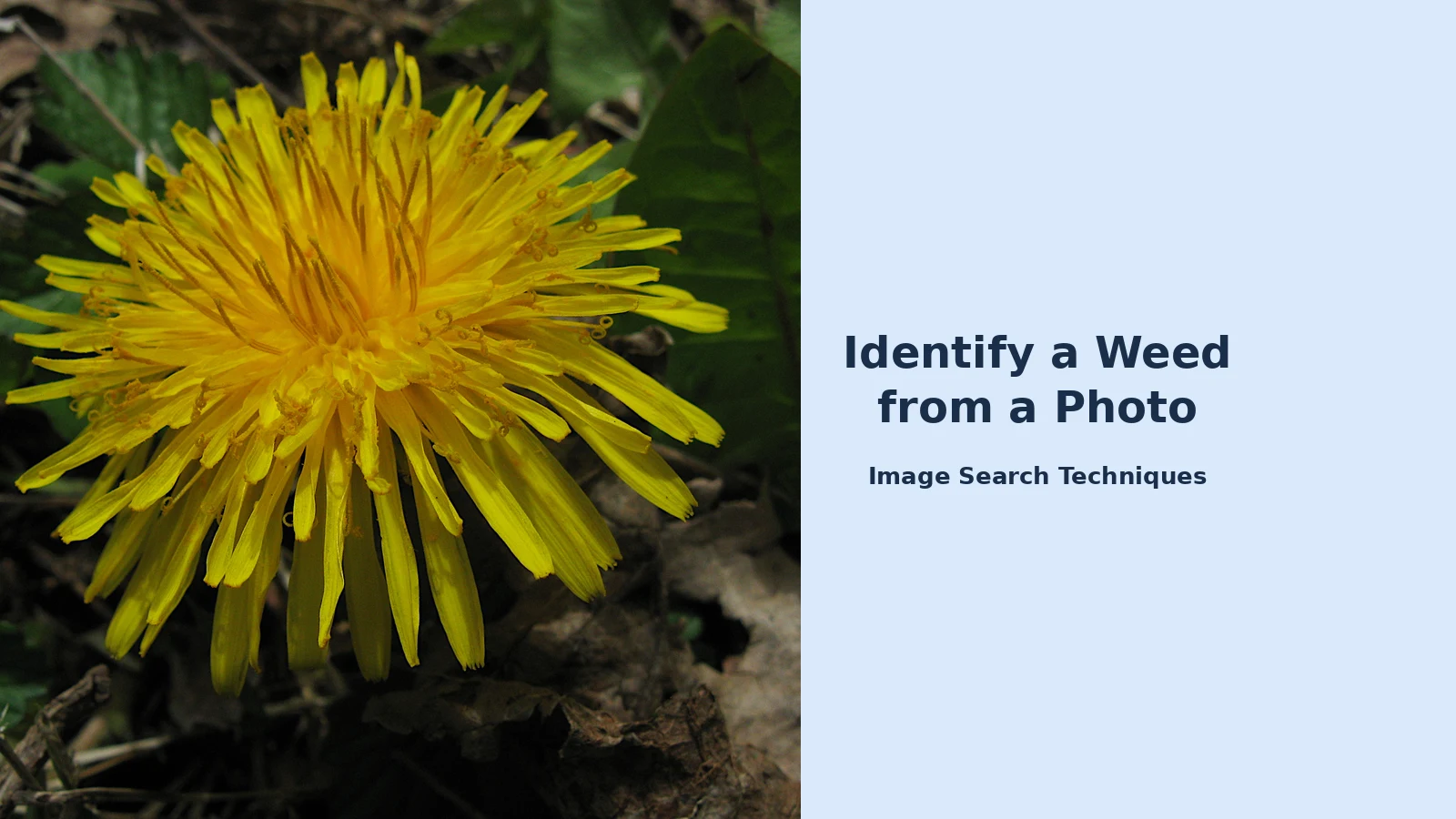
I ran this test on 13 November 2026 with a real photo: a dandelion flower (Taraxacum officinale) photographed on 18 April 2020 in Beechview, published on Wikimedia Commons under a CC0 licence, 3264 by 2448 pixels. I pasted the photo’s direct URL into the reverse image search tool on this site and clicked each engine button separately, because the tool’s “Search All” button opens only the Google tab. Here is what each engine did.
| Engine | What happened |
|---|---|
| Google Search by Image | Failed. “No image at the URL”, 0 results. Google’s AI Mode stayed on “Thinking” and the visual search button showed as expired. |
| Google Lens | Failed the same way. It is the same Google endpoint, so the same error appeared twice. |
| Bing | Failed. The tool’s Bing button opened only the generic Bing Images homepage, with no image passed. Pasting the URL into Bing’s own image search showed an “Image uploaded successfully” message, then returned to the homepage with no results. |
| Yandex | Worked. It named the flower “taraxacum officinale” and showed 20 similar images plus one other size (800 by 800). Its Sites list had only two entries, both from cienciaviva.pt, and the Wikimedia Commons source page was not among them. |
| TinEye | Ran, but found nothing. The first attempt failed with “TinEye is a little busy right now”. After one reload it completed the search: 0 matches of 86.7 billion images, with the note that TinEye has yet to crawl any pages where this image appears. It showed 17 sponsored Shutterstock floral images as related images instead. |
| Not a visual search. The tool’s Pinterest button opens a keyword search for the image’s domain, which returned 30 unrelated pins. The dandelion image was never submitted. |
Only one engine out of six named the flower, and none of them found the original source page. That is the honest result, and it teaches three things. First, a single engine is never enough: if I had only used Google, I would have had no answer at all. Second, a flower photo is the easiest case for an identification tool, and still five of the six buttons failed or found nothing, so a photo that does not match is not proof the plant is rare or unusual. Third, the plant in the photo was a dandelion, one of the most photographed weeds in the world, and the only engine that named it was Yandex. That is why the method in this guide has two steps. The search gives you a lead, and the feature check against an extension gallery gives you the name. If I had stopped at the first engine, I would have had nothing. If I had stopped at the Yandex result without checking the features, I would have had a name with no confirmation. The two steps together are what make the answer worth trusting.
Japanese knotweed: the red-flag panel
One weed on the list above is not like the others, and it is the reason this article exists in its own right rather than as a page inside a general plant guide. Japanese knotweed looks harmless enough in a photo. It is a tall plant with bamboo-like stems, shield-shaped leaves and sprays of small white flowers in late summer, and it dies back in winter to leave brown canes. But a photo match for knotweed is not a garden job. It is a property question, and the rules are different on each side of the Atlantic. If your photo match says knotweed, stop pulling and read this section first.
| Question | United Kingdom | United States |
|---|---|---|
| Is it illegal to have it in your garden? | No. GOV.UK says you do not legally have to remove Japanese knotweed from your land unless it is causing a nuisance. But you must stop it spreading off your property, and you can be prosecuted for causing it to spread into the wild. | There is no single federal rule for homeowners. Duties come from state noxious weed lists, and they differ by state, so check your state’s list before you act. |
| What law applies? | Section 14(2) of the Wildlife and Countryside Act 1981 makes it an offence to plant it, or cause it to grow in the wild. Soil and plant material containing knotweed is controlled waste under the Environmental Protection Act 1990. | State noxious weed laws. In Minnesota, Japanese knotweed is listed as Prohibited Control, which means it must be controlled so it does not spread by seed or vegetative means, and it may not be transported, propagated or sold. In Washington it is a Class B noxious weed. It is reported in 43 states, according to the Minnesota Department of Agriculture. |
| What happens when you sell? | You must declare it. The Law Society’s TA6 property information form asks whether the property is affected by Japanese knotweed, and a false answer can lead to a claim for misrepresentation. Surveyors work to the RICS professional standard from March 2022, which sorts sightings into four management categories and uses a three-metre rule for land near the boundary. | Disclosure rules vary by state and by sale contract. There is no US equivalent of the TA6 question, so ask your agent or attorney what your state requires, and do not assume a clean-looking garden means there is nothing to declare. |
| Can it affect a mortgage? | Yes. Lenders usually want a professional management plan with an insurance-backed guarantee before they lend on a property with knotweed in the higher RICS categories. A neighbour’s knotweed within three metres of the boundary can matter too. | It can affect a sale and an appraisal where the infestation is known, but there is no national lender rule like the UK’s. A local surveyor or appraiser will tell you how it is treated in your market. |
| What should you do first? | Do not dig it up or move soil from the area. A new plant can grow from a rhizome fragment as small as 1cm, GOV.UK says, so digging spreads it. Get a specialist survey, and treat it as controlled waste. GOV.UK also says not to treat knotweed yourself unless you have the appropriate skills and experience, and that treatment usually takes at least three years. | Do not mow it, cut it or move soil from the area. The Minnesota Department of Agriculture says cutting or mowing increases spread and can stimulate growth. Contact your county extension service or state agriculture department for the local rules and for a list of licensed contractors. |
Three things are true in both countries. First, a photo alone cannot confirm knotweed. Giant knotweed and the hybrid Bohemian knotweed look very similar, and GOV.UK lists all four knotweed species together for a reason. A photo match is a reason to get a specialist survey, not a diagnosis. Second, never put knotweed in a compost heap, a green waste bin or a skip with other soil. In the UK it is controlled waste and must go to a licensed facility with a registered waste carrier. In the US, your state or county will have its own disposal rules, and moving soil that may contain rhizome fragments to an uninfested area is exactly how it spreads. Third, if it has crossed a boundary, talk to your neighbour before you act. In England and Wales, knotweed spreading onto a neighbour’s land can be a private nuisance claim, as the Court of Appeal confirmed in Network Rail v Williams in 2018. A photo, a date and a note of where it is growing are worth keeping, because they are the start of any claim or any sale disclosure.
None of this is legal advice. It is a summary of what GOV.UK’s guidance on stopping knotweed from spreading, the legislation and the Minnesota Department of Agriculture say, checked on the day this article was written. If knotweed is on or near your property, a specialist survey and, in the UK, a solicitor are the next steps, not a search result.
What a photo ID cannot tell you
A name is not a safety verdict, and this is where photo identification has a hard limit. Some weeds are irritants, and some are poisonous, and a photo cannot tell you which is which with enough confidence to act on. Poison hemlock is the example extension services keep coming back to. It has smooth, hollow stems covered with purple spots, fern-like leaves and white umbrella-shaped flower clusters, and it is easily mistaken for Queen Anne’s lace or for carrot, celery and parsnip, which are its crop relatives. University of Maryland Extension warns that all parts of the plant are poisonous, that the sap can cause dermatitis, and that people should wear gloves when pulling it and should not burn it. King County in Washington adds that the sap can cause a serious skin reaction in some people and that every part can be fatal if eaten.
So the rule is simple. If an app suggests any carrot-family plant, or any plant you do not already know, wear gloves, keep children and pets away, and confirm the name with your extension service before you touch it or pull it. Do not eat any plant based on a photo ID, and do not use a photo ID to decide whether a plant is safe to touch. If someone has eaten part of a plant, or has a skin or eye reaction after handling one, contact your local poison control centre or a doctor straight away. That advice comes from the extension services, not from an app, and it applies however confident the app looks.
The same limit applies to control. This article gives no herbicide advice, on purpose. A photo-only identification is not a sound basis for choosing a chemical, a dose or a timing, and the right product depends on the plant, the lawn, the soil, the weather and the local rules. If the weed needs more than pulling by hand, your county extension service in the US or a garden centre or specialist in the UK can advise on the options for that plant in that place. A weed that looks sick is a different question from a weed that needs a name: if the leaves are spotted, curled or discoloured, our guide to identifying a plant disease from a photo covers that check. Pulling by hand after rain, when the soil is soft, works for many taprooted weeds like dandelion, as long as you get the whole root. For a creeping perennial with runners, pulling the top off usually leaves the roots behind, and the plant comes back. That is a fact about the plant, not a failure of the method, and it is why the name matters before the pull.
When the app gets it wrong
Apps get weeds wrong more often than they get flowers wrong, and the reason is in the photograph. A flower is distinctive. A leaf often is not. The 2023 PLOS ONE test by Campbell, Peacock and Bacon tested six plant ID apps and found that every one did better on flowers than on leaves. The best of the six, the free app Pl@ntNet, identified 88.21 percent of flowers and 80.36 percent of leaves correctly at species level. The authors concluded that apps should be treated as an aid and not assumed to be correct, particularly where a plant might be toxic. That is the right attitude for a weed photo too.
When an app’s answer does not fit, trust the features, not the app. Check the stem first: round or three-sided. Check the leaf edge and how the leaf meets the stem. Check whether there is a flower or seed head, and whether the plant creeps, clumps or stands upright. If two features disagree with the app’s name, the app was probably wrong. Try a second photo, a closer leaf shot or a flower shot, and run it again. If two different tools give two different names, the plant is probably one of the look-alikes in the tables above, and the features will settle it.
Reverse image search helps here in a way a plant ID app does not. An app gives you one name and a confidence score. A reverse search shows you the pages where the same photo, or photos like it, already appear, and those pages often include extension galleries, forum threads and nursery listings with the plant’s real name attached. Our guide to identifying a plant from a photo covers the general method in detail, and it is worth reading if you identify plants often. For weeds specifically, the extension photo galleries are the check that matters most. The University of Maryland Extension weed identification gallery groups its photos by grassy weeds and sedges, broadleaf weeds, and woody and vining weeds, and lets you browse by season. Compare your photo with the gallery photo for the name the app gave you, feature by feature, before you pull anything.
If the name still will not settle, ask a person. In the US, your county extension office will confirm an ID from a sample, often for free. In the UK, the Royal Horticultural Society runs an identification service for members, and local wildlife trusts and gardening clubs will often help. A photo plus a short note about where it grows and how tall it is will usually be enough for an expert to name it, and an expert’s answer is the one to act on when the plant might be harmful.
How to use this guide next time
Keep the method short and you will use it. Photograph the whole plant, one leaf at the stem, and any flower or seed head. Run the best shot through a reverse image search on our free tool, and note the name it suggests. Work out the group first, broadleaf, grassy or sedge, then check two features in the tables above or in an extension gallery. If the name matches on two features, you have your answer, and you can look up the life cycle before you decide what to do. If it does not match, take a better photo and try again, or ask your extension service.
Most weeds are a small job once they have a name. A dandelion with a taproot comes out cleanly after rain. A patch of clover tells you the lawn is short of nitrogen. A sedge tells you the ground is wet. And a plant that might be knotweed tells you to stop, take a dated photo, and call a specialist. The name comes first. The pull comes second. That order is the whole point of identifying a weed from a photo.
Can I identify a weed from one photo?
Yes, if the photo is good. Photograph the plant from above, one leaf close up where it meets the stem, and any flower or seed head. A flower helps most: in a 2023 PLOS ONE test, plant ID apps did better on flowers than on leaves. Check the name against two features in an extension gallery before you trust it.
What is the best free way to identify a weed by photo?
Use a free plant ID app such as Pl@ntNet, which had the best first-try species accuracy in the 2023 PLOS ONE test, or run the photo through a reverse image search to see where the same image already appears. Confirm the name against extension photos, such as the University of Maryland Extension weed identification gallery, before you pull the plant.
How can I tell if a weed is Japanese knotweed from a photo?
A photo can only suggest knotweed, never confirm it. Look for bamboo-like stems, shield-shaped leaves and sprays of small white flowers in late summer, with brown canes left in winter. Giant and Bohemian knotweed look very similar. If your photo match says knotweed, get a specialist survey and do not dig it up or move soil from the area.
Is it safe to pull a weed I identified from a photo?
Not always. Some weeds irritate skin and some are poisonous, and a photo ID is not a safety verdict. If the app suggests a carrot-family plant or anything you do not know, wear gloves, keep children and pets away, and confirm the name with your extension service. If someone eats part of a plant, contact poison control or a doctor.