🔎 Reverse Image Search
Image search techniques made simple: upload a photo or paste a URL and search 6 engines at once. 100% free, nothing stored.
🔒 Your image is never stored on our servers longer than 24 hours and is never shared.
Someone on Quora asked a question that sounds simple: “Can I use someone’s AI generated character (adopt and not adopt) for free?” The question is about AI art made by someone else, and about characters sold as “adoptables” on sites like DeviantArt. The answers on Quora do not really answer it. One answer talks about what an AI is, and never gets to the character at all. So this guide answers it properly, for the person who found a picture they like and wants to know whether they can just take it.
Short answer: you cannot use someone else’s AI art for free, just because it is AI made. In the United States a purely AI-generated picture has no copyright, because copyright needs a human author. The generator’s terms, the seller’s terms, and the platform’s rules can still forbid taking it. An adoptable is only yours after you adopt it. If you made the art yourself and want to sell it on products instead, our guide to selling AI art on products walks through the generator licences for calendars, book covers and mugs.
This is general information, not legal advice. Copyright law differs between countries, and the rules of each generator and each marketplace change. Where the United States and the United Kingdom differ, this guide says so. If money or a business depends on the answer, speak to a lawyer before you use the image.
What “someone else’s AI art” actually covers
The phrase covers three different things, and the rules are not the same for each. Mixing them up is how people get into trouble.
First, there is art posted in a public gallery. Midjourney, for example, shows most users’ generations in public channels by default. Anyone can see them. Seeing them is not the same as owning them, and it is not the same as having permission to use them.
Second, there is an adoptable. An adoptable is a character design made to be sold to one buyer, who then develops it as their own character. The design usually comes with a small set of terms: what the buyer may do with it, whether they may resell it, and whether they may use it commercially. DeviantArt’s adoptables community defines an adoptable as a design or character made with the intention of letting another person take over its further development. Buying the design is not the same as buying the right to upload the original art to your own gallery. You draw your own versions, and you credit the original creator with a link.
Third, there is art made with a tool that someone else paid for or has access to. The fact that a tool is free, or that a model is open source, does not make every picture made with it free for anyone to take. That is one of the most common mistakes in this area, and it is worth stating plainly: the tool being free and the picture being free are two different things.
So before you use any AI picture you did not make, ask three questions. Who made it? What terms did they make it under? And what does the place you found it say about reuse? If you cannot answer all three, do not use it.
Can you use someone else’s AI art for free?
The honest answer is that copyright law and platform rules point in different directions, and you have to satisfy both.
On the copyright side, the United States position is now clear. The US Copyright Office published its report on the copyrightability of AI material in January 2025, and it concluded that copyright does not extend to purely AI-generated material. Prompts alone do not give the person who typed them enough control to count as the author. A court agreed in Thaler v. Perlmutter in March 2025, holding that the Copyright Act needs a human author. Our guide to AI image copyright covers that position in full, including the United Kingdom position, so this article does not repeat it.
That sounds like a green light. It is not. The Copyright Office ruling is about who can claim copyright. It says nothing about the contract you accept when you use a generator, or the terms a seller sets on their own listing. Those contracts can still forbid what copyright law does not. A picture can be unprotected by copyright and still be off limits to you, because the person who made it never gave you permission, and the platform you found it on says you need it.
There is also a second gap. An AI picture can still contain something that is protected, even if the picture as a whole has no copyright. If the generator copied a recognisable character, a logo, or a living artist’s distinctive style from its training data, the rights in that character or logo still belong to someone. Using the picture can then infringe those rights, even though nobody owns the AI picture itself. The same applies to a real person’s face or voice in an image. The “AI made it” label does not wash those rights away.
And there is a third gap, on the human side. If the person who made the picture then painted over it, composited it with other work, or redrew parts of it by hand, those human additions can be protected. Copying the edited picture without permission can infringe the human part, even if the AI base is free. This is the point Google’s AI Overview makes, and it is correct.
So the short version is this: copyright law alone would often let you copy a purely AI-generated picture. But the generator’s terms, the seller’s terms, the platform’s rules, and the rights in anything recognisable inside the picture can each stop you. Free to copy under copyright does not mean free to take.
What Google’s AI Overview says, and the part it leaves out
Searching “use someone else’s AI art” on Google on 15 November 2026 brings up an AI Overview at the top. It cites eight entries from four sites: Reddit, Facebook, YouTube and metida.com. Its answer makes six points, and this article covers all of them in its own words, plus the parts the Overview does not say.
First, the Overview says purely AI-generated art has no copyright protection in the United States, because it has no human author. That is right, and it matches the Copyright Office report and the Thaler decision above.
Second, it says images made only from prompts fall into the public domain. That follows from the first point, with one caution. “Public domain” here means no one holds copyright in the image. It does not mean the image is free of every other rule. A picture can sit in the public domain for copyright purposes and still be governed by a contract, as the next point shows.
Third, the Overview says others can generally copy, print, or use such art commercially without facing a copyright claim from the person who wrote the prompt. That is broadly true for a pure copyright claim. But “generally” is doing a lot of work. It does not cover a claim based on the generator’s terms, a claim based on a trademark or a character, or a platform takedown. The Overview mentions terms in its next point, but a reader who stops at this one could easily think the answer is simply yes.
Fourth, the Overview says the generator’s terms still matter, and names Midjourney, DALL-E and Stable Diffusion. This is the most important point in the whole answer, and the one most people skip. A generator can limit commercial use, require attribution, or require open sharing, depending on the plan. The terms bind the person who uses the service, and they shape what that person can pass on to you. If the person who made the picture was only allowed to use it personally, they cannot give you a commercial right they never had.
Fifth, the Overview warns about pictures that closely copy an existing protected character, logo, or artist’s style. This is the training-data risk, and it is real. An image generator does not know what is protected. It can produce a character that looks like a film character, or a logo that looks like a brand mark, and the person who typed the prompt may never notice. If you then put that picture on a product, the complaint comes to you, not to the generator.
Sixth, the Overview says human edits change the picture. Painting over it, compositing it, or redrawing it by hand can create something protectable, and copying those human parts without permission is unlawful. That is correct, and it is the reason you should never assume an AI picture you found online is untouched. The version you see may carry hours of human work on top of the AI base.
What the Overview leaves out is the part this guide is really about. It says nothing about adoptables, nothing about what “adopt” actually buys, nothing about how to check where an image came from, and nothing about what to do when someone takes your AI art. Those are the practical questions, and they take up the rest of this article.
Adoptables: what paying buys you, and what taking it free does not
Adoptables are where the Quora question comes from, so they deserve a careful answer. The word “adopt” sounds casual, like taking in a stray. In practice it is a small sale with written terms, and the terms are the whole deal.
On DeviantArt, adoptables are character designs listed for sale, usually as a single image with a price and a set of terms. The buyer pays, and in return they get the character: the right to name it, develop it, draw it, roleplay it, and use it as an avatar or in a story, within the limits the seller set. The seller keeps the original art. The buyer does not get to upload the original art to their own gallery as if they drew it, and they must credit the original creator with a link when they use the design.
The terms vary from seller to seller, and they matter more than the price. One seller’s terms may allow commercial use, another’s may not. One may allow resale at the price paid or less, another may forbid resale on another page without written permission. Some forbid making NFTs from the design, or using the art to train AI. You have to read the page you are buying from. There is no single adoptables licence.
Two live examples show how different the terms can be. PearlyBlume lists AI-generated adoptables at 8 US dollars each, one of a kind, with the buyer receiving full-resolution art and ownership confirmation after full payment, and commercial use allowed unless the listing says otherwise. Rustpetal lists AI-generated adoptable characters at 5 US dollars each, with what the seller calls full commercial rights, and an optional transparent PNG for 2 US dollars more. Both are the sellers’ own terms, not a legal guarantee. A seller saying “full commercial rights” does not change the Copyright Office position: a purely AI-generated picture may carry no copyright for the buyer to enforce, and the buyer still needs to check that the character does not copy someone else’s protected work.
The table below is the decision table for this article. Use it before you take any AI picture made by someone else.
| Where the AI image comes from | Free to use? | What you need first |
|---|---|---|
| Your own generation, on your own account | Yes, within your plan terms | Check your generator’s terms for your plan, and check the image for recognisable characters or logos |
| Midjourney public gallery, someone else’s image | No, not as a general rule | The image stays theirs if you upscale it, and public by default means viewable and remixable inside Midjourney, not free to take anywhere |
| Someone else’s DALL-E output | No | OpenAI assigns each user their own output only. That assignment gives you no right in another user’s output |
| DeviantArt adoptable, adopted and paid for | Yes, within the seller’s terms | Pay in full, read that seller’s terms, credit the original creator with a link, and stay inside the commercial and resale limits |
| DeviantArt adoptable, not adopted | No | The preview image is still the seller’s listing. Taking it, using it as your character, or reposting it is not adoption |
| CC0 gallery or public domain AI image | Yes | Check the licence on the source page itself, and keep a note of where you got it |
| A picture with heavy human edits on top of AI | No, not without permission | The human additions may be protected. Ask the person who edited it, or generate your own version |
The line that matters most in that table is the adoptable row. “Not adopt” is not a discount tier. It means the character is still for sale, and the preview image is an advert for it, not a free sample. Taking the preview and using it as your own character is the same as taking a shop’s display item and walking out with it. The fact that you can right-click and save it does not make it yours.
It is also worth saying what adoption does not buy. It does not buy you the right to claim you drew the original art. It does not buy you the underlying rights in any character the AI copied from its training data. And it does not buy you protection if the seller had no right to sell the design in the first place. If you pay for an adoptable and later find out the character is a copy of a protected character, the seller’s terms are a private agreement between you and the seller. They do not bind the rights holder.
What the big generators actually allow
Each generator writes its own terms, and they are not the same. Here is what the three most asked about services say, checked on their official terms pages on 15 November 2026.
Midjourney’s terms, in force since 27 May 2026, say you own the assets you create with the service, to the fullest extent possible under applicable law, subject to the agreement and to third-party rights. That sounds generous, and for a paying subscriber it mostly is. But the same section carries three limits that matter here. First, a company with more than 1 million US dollars a year in revenue must be on a Pro or Mega plan to own its assets. Second, if you upscale the images of others, those images remain owned by the original creators. Third, you grant Midjourney a perpetual, worldwide, royalty-free licence to reproduce, display and distribute your content. And Midjourney is an open community by default: your content is publicly viewable and remixable when posted in a public setting. Stealth Mode, on Pro and Mega plans, is best efforts only, and anything made in a shared or open Discord channel is viewable there regardless.
The key point for this article is the gap between “remixable inside Midjourney” and “free for anyone to take anywhere”. Those are not the same thing. Remixing inside the service, under Midjourney’s own rules, is one thing. Downloading someone’s image and putting it on your own product, your own site, or your own shop is another, and the terms do not grant it. If you upscale someone else’s Midjourney image, the terms say plainly that it stays theirs.
One claim you will see repeated online should not be repeated here without a fresh check. Several secondary summaries say free Midjourney users only get a Creative Commons non-commercial licence, and that Midjourney owns free-trial images. The current terms page, as opened on 15 November 2026, does not contain a free-tier clause of that kind. Midjourney’s current onboarding is paid plans only. Do not rely on the old free-tier claim unless you have re-checked the live terms on the day you use them.
OpenAI’s terms, in force since 1 January 2026, take a different approach. They say that as between you and OpenAI, you own the output, and OpenAI assigns to you any right it has in that output. But the same section adds a limit that decides this article’s question: the assignment does not extend to other users’ output. OpenAI also warns that output may not be unique, and that other users may receive similar output. So your DALL-E picture is yours, and someone else’s DALL-E picture is theirs. The assignment runs one way only, from OpenAI to the person who generated that particular output. It gives you no right in a picture another user generated, however similar it looks to yours.
Stable Diffusion and the open-source world need a separate warning, because the myth here is the strongest. The CreativeML Open RAIL-M licence governs the model, not the output. The licence text says the licensor claims no rights in the output you generate, and that you are accountable for the output. It also says the use-based restrictions in the licence must be passed on to downstream users. None of that makes every image made with a RAIL model free for anyone to take. The model licence binds the person who runs the model. On top of it, platforms like Civitai let model creators add their own conditions, such as not selling images made with the model, or not using the model on a service that monetises image generation. You have to check the specific model card, not just the fact that the model is open source. “Open source” describes the code. It does not describe the pictures.
DeviantArt’s own generator, DreamUp, sits under the same logic. It is governed by its own terms, which incorporate the CreativeML Open RAIL-M restrictions. DeviantArt also requires art for sale to be correctly labelled as made with AI tools, and it excludes all deviations from third-party training datasets unless the artist explicitly opts in. The label rule matters for adoptables: if a seller lists AI art without the label, the sale can be refunded or the seller disciplined.
If you take one rule from this section, take this one: read the terms of the tool that made the picture, and read the terms of the place you found it. The answer to “can I use it for free” lives in those two documents, not in the fact that AI made it.
The test I ran: reverse-searching an AI character portrait
Guides like this one should test what they claim, so I ran a real test on 15 November 2026. The question I wanted to answer was simple: if you find an AI character portrait online, can a reverse image search trace it back to its source? The answer matters, because tracing is how an artist finds out their work has been taken, and how a buyer checks whether a character they are about to adopt is already in use elsewhere.
For the test I used a fictional character portrait I generated myself for this article: a wood elf archer in a green hooded cloak, in a forest, a fantasy character who does not exist. I generated it rather than taking a random adoptable preview, because taking an adoptable preview without adopting it would be the very reuse this article warns against. The portrait is the asset for this article, and it is embedded below.
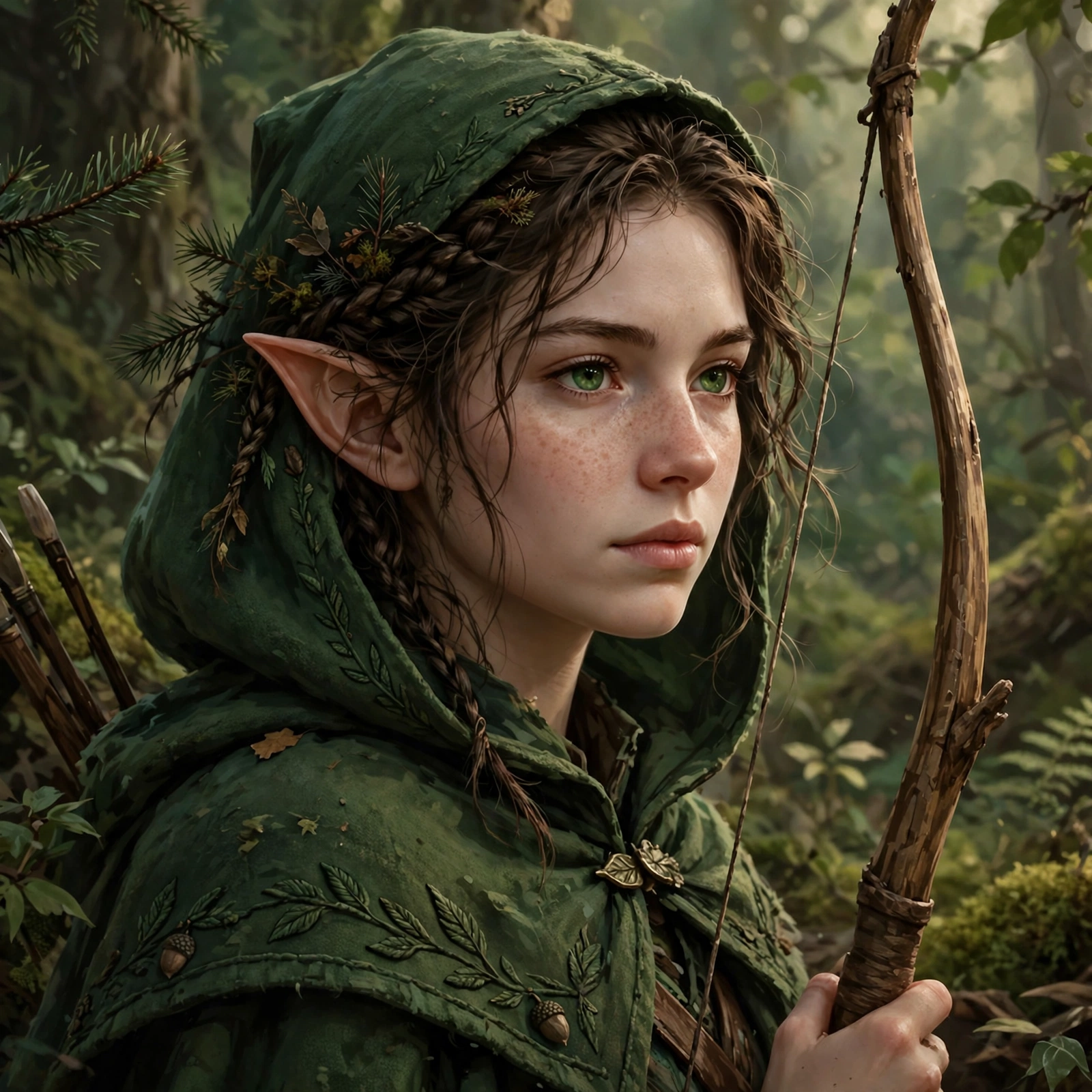
Then I reverse-searched the image, by its public URL, in two engines. Here are the steps, so you can repeat them with any picture you are checking.
- Upload the picture somewhere public, or find its public URL. A reverse search by URL needs a link the engine can fetch.
- Open TinEye and search by that URL. Note the exact match count, and read the sources it lists.
- Open Google Lens the same way, and check the exact matches tab first, then the visual matches.
- Write down what each engine actually found, including failures. A failed search is not a clean result.
- Remember what the result does and does not prove. A match proves the picture has been seen before. No match proves nothing about who owns it.
The results were as follows. TinEye searched over 86.7 billion images and found 0 matches. Its own message was that it had probably not yet crawled any page where the image appears, and that it is always crawling. No matching sources were listed. The only images below the result were a sponsored stock section, which were not matches.
Google Lens found no exact matches either. Its exact matches tab said, in its own words, that no exact matches were found and that the image could be unique or not widely shared yet. Lens showed no numeric match count anywhere on the page, so none is reported here. What Lens did do was identify the picture correctly: a fantasy art portrait of a female wood elf archer with pointed ears, green eyes, freckles and brown braided hair, in a green hooded cloak in a forest. Its closest visual matches were similar fantasy elf images: a Pinterest D and D elf guide, a Pinterest fantasy elf inspiration post, and an elf image generator page, plus stock elf portraits and a wood elf miniature listing. All similar, none the same image.
That result is honest and limited, and the limit is the lesson. The picture is brand new and has never been posted anywhere except on this site, so neither engine had crawled it yet. Zero matches here means “not yet seen”, not “free to use” and not “original”. If the same picture had been posted on DeviantArt a month ago, TinEye might have found it. If it had been posted on Pinterest, Lens might have matched it. A search engine can only find what it has crawled.
So the test supports two practical points. First, a reverse search is a useful check before you adopt a character or use an AI picture, because it can surface the original listing, an earlier sale, or a matching stock image. Our guide to how to reverse image search walks through the method. Second, a clean result is not permission. The licence is what makes an image free to use, not the search result. If you run a reverse search on an adoptable preview and find nothing, that tells you the search engines have not indexed it. It does not tell you the seller has given it away.
When copying AI art can still get you in trouble
People usually ask about copyright first. In practice, the trouble comes from four other directions, and they are worth knowing by name.
The first is the character, logo, or style inside the picture. A generator trained on the internet can produce a character that looks like a film character, a logo that looks like a brand mark, or a picture in a living artist’s unmistakable style. The rights in that character or mark still belong to someone, and the complaint will come to the person who used the picture, not to the generator. This is the risk the AI Overview flags, and it is the one most likely to bite a small seller, because a brand or a studio has lawyers and a takedown process, and a prompt writer does not.
The second is the human work on top. If the person who posted the picture painted over it, composited it, or redrew parts of it, those additions can be protected, and copying the finished picture copies them. You cannot tell from looking at a picture how much human work went into it. The safe assumption is that some went in.
The third is the platform. Even where no law is broken, a platform can remove your post, your listing, or your account. DeviantArt’s copyright policy works on a notice system: on a proper notice it deletes the infringing submission, suspends repeat infringers, and bans anyone who deliberately passes off another person’s work as their own. Midjourney takes takedown requests by form or by email to its takedowns address, and can terminate repeat infringers. A marketplace like Etsy or a social platform like Instagram has its own reporting routes, and a complaint there can take down a listing faster than any court would.
The fourth is the community, and it is the one with the clearest real examples. In July 2026, the DeviantArt artist KaeruneeW posted that people had alerted her to someone uploading AI-generated images that mimicked her art style, including a poorly drawn signature resembling hers. She reported it to DeviantArt, and because it involved generative AI and the signatures had been removed, nothing came of it. The copycat later charged for some images, and those posts were taken down. That is the artist’s own account, not a court ruling, and it should be read as one. The useful lesson is that a style mimic with the signature removed was hard to enforce, even for the artist herself.
A similar warning appeared on Toyhou.se, where an artist reported that characters they had created and sold were fed through AI, uploaded to Pinterest in AI form, and then taken up by a creator who built a whole presence on the AI version. A fursuit was made of another stolen character. The artist’s conclusion was blunt: if your art is uploaded without permission, there is not much you can do. Again, that is a community report, not a legal outcome, and no court case about a reused AI adoptable was found for this article. If there had been one, it would be named here. There was not, so none is invented.
None of this means you cannot use AI art at all. It means the risk does not disappear just because the picture was AI made. The risk moves: from copyright in the picture, to the terms of the tool, to the rights in what is inside the picture, to the platform’s rules. You have to check all four.
The safe ways to get AI art you can actually use
If you want an AI picture and you want to be sure you can use it, there are four routes that work, and they are all straightforward.
Generate your own. This is the simplest route, and it is the one this article’s worked example used. Open a generator you have an account with, read its terms for your plan, and generate the picture yourself. You then own the output under that generator’s terms, to the extent the law allows, and you know exactly what went into it. Keep the prompt and the plan details, so you can show where the picture came from if anyone asks. Our guide to how to tell if an image is AI generated explains what to look for in a generated picture, which helps when you are checking your own output too.
Adopt properly. If the character you want is an adoptable, buy it under the seller’s terms. Pay in full, read the terms on that listing, credit the original creator with a link, and stay inside the commercial and resale limits. Keep the payment receipt and the ownership confirmation the seller sends. That paper trail is your answer if anyone questions the character later. Do not take the preview image and call it adopted. Adoption is a payment and an agreement, not a download.
Use a genuinely free source. Some AI pictures are released under a CC0 licence, which means the creator has given up their rights, or they sit in the public domain because no human author exists and no terms restrict them. Wikimedia Commons carries AI-generated images with a public-domain algorithm tag, and there are CC0 galleries of fictional AI portraits. Check the licence on the source page itself, not on a site that reposted the picture, and keep a note of where you got it. If the licence is unclear, treat the picture as not free.
Ask, and get it in writing. If you want a specific picture someone else made, message them and ask. Many artists will say yes to a personal use, or agree a price for a commercial use. Get the answer in writing, with the use you agreed stated plainly. A short written permission beats a long argument later. And if the person says no, or does not reply, that is your answer. Silence is not permission.
One more route is worth knowing about, because it protects your own pictures rather than someone else’s. If you post your own AI art online and do not want it used to train other generators, DeviantArt excludes all deviations from third-party training datasets unless the artist explicitly opts in. Our guide to opting your photos out of AI training covers the opt-out routes across the main platforms. And if you are worried more generally about your pictures being found and reused, our complete guide to protecting your photos online sets out the controls that actually work, and the honest limits of each one.
The question that started this article has a short answer and a long answer. The short answer is no, you cannot use someone else’s AI art for free just because AI made it. The long answer is that copyright is only one of four checks. The generator’s terms, the seller’s terms, the rights in anything recognisable inside the picture, and the platform’s rules all have to pass. Check all four, and when in doubt, generate your own picture, adopt the character properly, or ask. Those three routes are slower than right-clicking. They are also the only ones that hold up when someone asks where the picture came from.
FAQs
Can I use someone else’s AI-generated image if it has no copyright?
Not freely. In the US a purely AI-generated picture has no copyright, so no one can sue you for copyright alone. But the generator’s terms, the seller’s terms, and the rights in any character or logo inside the picture can still stop you. Check all three before you use it, and get permission in writing if the use is commercial.
What is an AI adoptable, and does buying one make it mine?
An adoptable is a character design sold to one buyer, who then develops it as their own character. Paying under the seller’s terms gives you the character within those terms, including any commercial and resale limits. It does not give you the original art to upload as your own, and you must credit the creator with a link.
Can I take an image from Midjourney’s public gallery?
No, not as a general rule. Midjourney shows most generations publicly by default, and they are remixable inside the service, but that is not permission to download the picture and use it on your own site or product. If you upscale someone else’s image, Midjourney’s terms say it stays theirs. Generate your own version instead.
Does crediting the artist make it legal to use their AI art?
No. Credit is good practice, and many licences require it, but credit alone is not permission. It does not replace the seller’s terms, the generator’s terms, or the rights in a character or logo in the picture. If the terms say you need permission, you need permission, with the credit added on top.
Can I sell a product with someone else’s AI character on it?
Only if you have the right. If you adopted the character under terms that allow commercial use, and it does not copy a protected character or logo, you can sell within those terms. If you took it for free, or the seller’s terms forbid commercial use, selling it can breach the terms and draw a takedown.
How can I check where an AI image came from?
Reverse search it. Upload the picture, or search by its public URL, on TinEye and Google Lens, and read the sources each engine lists. A match can show the original listing or an earlier sale. A clean result proves nothing about ownership, so read the licence on the source page as well.