🔎 Reverse Image Search
Image search techniques made simple: upload a photo or paste a URL and search 6 engines at once. 100% free, nothing stored.
🔒 Your image is never stored on our servers longer than 24 hours and is never shared.
Can you sell AI art on products? That is the question a reader asked on Quora, and it is a good one, because the answer is not a simple yes. The reader wanted to know whether a picture made on an AI site like mage.space can legally go on a calendar, a book cover, or something like that. Two answers came back, and one of them pointed at the right place: the generator’s terms. This guide follows that thread to the end, generator by generator, product by product.
Yes, you can sell AI art on products such as calendars, book covers and mugs, but only if the generator you used allows commercial use. The permission comes from the tool’s terms, not from the fact that you typed the prompt. Check the tool first, then the product, then the marketplace, because each layer can say no.
This is general information, not legal advice. The rules change often, and the terms pages quoted here were read on 15 November 2026. Before you list anything for sale, open the current terms of the tool you actually used and read the commercial use section yourself.
Can you sell AI art on products?
The short answer is yes, with a condition attached. People sell AI art on physical products every day, and the print on demand model makes it easy to start. You upload a design, a customer orders a poster or a mug, and a supplier prints it, packs it and ships it. You never hold stock. That is the model the AI Overview for this question describes, and it is real.
The condition is the licence. Every generator has its own terms, and those terms decide whether the picture you made can be sold at all. A tool that lets you generate for fun may still forbid commercial use. A tool that allows commercial use on a paid plan may forbid it on the free plan. And the same picture can be fine on one tool and off limits on another, because the licence travels with the tool, not with the picture.
Three layers sit between you and a sale. The first is the generator’s licence. The second is the product itself, because a calendar, a book cover and a mug each carry their own traps. The third is the marketplace, because Etsy, Redbubble and Amazon each have their own rules about AI art, and a generator licence does not override them. This guide works through all three, in that order.
One more thing to settle before we start. Selling a picture and owning its copyright are two different things. You can have permission to sell something you do not own the copyright in, and you can own a copyright you still cannot sell because of a contract you signed. Keep those two ideas apart and most of the confusion in this area disappears.
What does a generator licence actually give you?
A licence is permission. When a generator’s terms say you may use an image commercially, they are giving you permission to sell it, use it in advertising, or put it on a product. Copyright is different. Copyright is a legal right you can enforce against other people, and in the United States it only exists where a human author contributed enough creative expression.
The US Copyright Office settled the copyright half of this in its Part 2 report on copyrightability, published on 29 January 2025. Purely AI generated material, made from a prompt alone, is not protected by copyright, because there is no human author. Prompts by themselves do not give you enough control to count as authorship. What can be protected is the human part: your selection, arrangement, or editing of the output, or a human made element you added to it. The Supreme Court declined to hear Thaler v. Perlmutter on 2 March 2026, which left that position standing.
The United Kingdom takes a different route. Under section 9(3) of the Copyright, Designs and Patents Act 1988, a computer generated work has as its author the person who made the arrangements necessary for its creation, and it lasts for 50 years from the end of the year it was made. That sounds generous, but it is untested in the way a seller would need it to be, and it does not help you in the United States, where most marketplaces sit. Do not build a business on the UK rule alone. For the full US and UK comparison, see our guide to AI image copyright.
So the practical rule is this. The generator’s terms decide whether you may sell. Copyright law decides whether you can stop anyone else selling the same thing, or something very like it. In most cases you can sell, and you cannot stop anyone else. That gap is the whole business risk of AI art, and it is why the table in the next section matters more than any single tool’s marketing page.
Which generator lets you sell? The licence table
Here is the comparison that decides the question, read from each tool’s own terms and pricing pages in October and November 2026. Free and paid plans are listed separately, because that is where most sellers get caught.
| Generator | Commercial use | Free plan | Paid plan | Who owns the image | The catch |
|---|---|---|---|---|---|
| Midjourney | Yes, paid plans only | No free plan now | Basic $10 a month and up | You, under the terms | $1M revenue rule needs Pro or Mega |
| DALL-E, in ChatGPT | Yes, all plans | Yes, same terms | Plus and Pro, same terms | You, assigned by OpenAI | Output may not be unique |
| mage.space | Yes, all plans | Yes, but licence unclear | Basic $10 a month, licence listed | Unclear, CC0 dedication | Anyone else can reuse it too |
| Adobe Firefly | Yes, Adobe models | Yes, per Adobe FAQ | Standard and Pro | You, per Adobe terms | Partner models are your call |
| Leonardo AI | Yes, with a licence | Yes, but Leonardo owns it | Essential $12 a month | You, on paid private plans | Free images are public and remixable |
| Ideogram | Yes, all plans | Yes, same terms | Plus $20 a month | You, no ownership claim | Free images are public and remixable |
Three of these rows deserve a closer look, because the headline answer hides the detail that actually decides a sale.
Midjourney’s Terms of Service, effective 27 May 2026, say you own the assets you create, to the fullest extent possible under applicable law, and that ownership survives even if you later cancel. There is one size rule that catches businesses out. If you are a company, or an employee of a company, with more than $1,000,000 a year in revenue, you must be on the Pro or Mega plan to own your assets. The plans run at about $10, $30, $60 and $120 a month. There is no free plan or free trial left to test with, and by default your images are publicly viewable and remixable by other users. Stealth Mode, which keeps them out of the public gallery, is only on Pro and Mega.
OpenAI’s Terms of Use, effective 1 January 2026, are the most generous of the six. They say you own the output, and OpenAI assigns you all its right, title and interest in it, if any. The same clause covers free and paid individual plans, so there is no paid only trap here, and the moneypantry guide that claims DALL-E 3 needs a paid ChatGPT Plus subscription gets this wrong. The limit is uniqueness. OpenAI warns that output may not be unique, and other users may receive similar output, and its assignment does not extend to other users’ output. So you can sell a DALL-E picture on a mug, and another user can sell a near identical one next to it, and neither of you can stop the other.
Adobe Firefly is the careful choice, with one line to watch. Adobe says its own Firefly image models were trained on Adobe Stock, openly licensed content and public domain content, and that outputs from those models are safe for commercial use. Adobe’s FAQ does not split free and paid plans on commercial use, which two independent checks in October and November 2026 both confirmed. The line to watch is the beta label. Outputs from beta features can still be used commercially, but they are not eligible for indemnification while the feature stays in beta, and indemnity itself only goes to eligible enterprise and team customers, capped at $10,000 per output. Partner models inside Firefly, the ones from Google, OpenAI and others, are not Adobe’s, and Adobe tells you to decide for yourself whether their output suits your project. Do not strip the Content Credentials metadata from a Firefly image either, because Adobe’s generative AI guidelines forbid removing it. Adobe’s own generative AI terms set this out in full.
What is the catch with mage.space?
This is the tool the Quora asker named, so it gets its own section. Mage.space is a browser based generator with a large shelf of models, including Stable Diffusion, Flux and GPT Image 2, and memberships from $10 a month. Its FAQ gives the easy answer first. Yes, you can use content created on Mage for commercial purposes, and attribution is appreciated but not required. That is the answer the Quora answers quoted, and it is true as far as it goes.
The terms say something harder. Under mage.space’s terms and conditions, you agree to forfeit intellectual property claims to the images you generate, and the content is dedicated to the public domain under a CC0 1.0 dedication. In plain words, you do not own your output, and neither does anyone else. Anyone may copy, modify and sell your generated image without permission or credit. The same terms also say you retain ownership of content you submit depending on your user package, and the documentation says you own the content you create on Mage. Those two statements do not sit together neatly, and reviewers who read the terms in 2026 flag the contradiction openly.
There is a second wrinkle. The pricing page lists a Commercial License as a membership feature, which sits behind the $10 a month Basic plan, so the free tier’s commercial rights are not unambiguously safe. The cleanest reading is this: commercial use is permitted, but on the free tier you are relying on the FAQ, not on a licence written into your plan. If you are going to sell, the $10 Basic plan is the cheapest place where the licence is explicit.
And there is a third wrinkle that matters for the Quora question. When you generate with a third party model inside mage.space, such as GPT Image 2, Grok or Nano Banana 2, the labs’ own terms also apply. Your mage.space licence does not override OpenAI’s, xAI’s or Google’s terms for those models. Users must also be 18 or older, and creations are private by default, which is a privacy point, not an ownership point. Private does not mean yours alone.
So can you use a mage.space picture for a calendar or a book cover? Yes, you can sell it. But you cannot stop a competitor from selling the exact same picture on their own calendar, because the terms dedicated it to the public domain. For a one off print that is a small risk. For a calendar or a book cover that you hope will become your brand, it is a real one. That is the trap in the Quora question, and it is the reason this article puts mage.space in its own section instead of burying it in the table.
If the picture you want to sell is someone else’s AI art rather than your own, the rules change again. Our guide to using someone else’s AI art covers adoptables, character sales and platform terms, and it is the companion to this one. Do not treat the two as the same question.
Can you put AI art on a calendar, a book cover or a mug?
The licence does not change with the product. A picture that is licensed for commercial use can go on a calendar, a book cover or a mug. What changes is everything around the licence: the print quality, the platform rules, and the way the product is sold. Take each product in turn.
A calendar needs twelve good images, not one. That is twelve chances for a character, a logo, or a piece of text to slip through, and twelve files to check at print size. Generate at the highest resolution the tool offers, then upscale before you print, because a picture that looks sharp on a phone can go soft on a wall calendar page. The months, dates and holidays are your own work, and they are the part of a calendar you can actually own. The pictures are the part you usually cannot, which is why the mage.space warning above matters most for calendars. A calendar is also a product where a buyer can compare yours with a competitor’s side by side, so a picture anyone can reuse is a weak place to build a brand.
A book cover has a rule of its own. Amazon’s Kindle Direct Publishing requires you to disclose AI generated text, images or translations when you publish a new book or republish an edited one, and AI generated images include cover and interior artwork, even if you edited them heavily afterwards. AI assisted content, where you created the work and used AI only to edit, refine or error check it, does not need disclosing. The disclosure goes to Amazon, not to readers, but failing to make it can get the book removed. Check the current KDP content guidelines before every upload, because the wording has tightened through 2025 and 2026. A cover also has to be honest in a second way. A cover that copies the look of a known book, or that uses a recognisable character to sell a different story, is a trademark and copyright risk, not a design choice.
A mug or a t-shirt is the simplest product in one way and the hardest in another. It is simple because the print area is small, so resolution matters less than it does on a poster. It is hard because mugs and shirts are where trademark enforcement is fastest. A mug with a famous character on it will be reported, and marketplaces remove first and ask later. Print on demand suppliers will also refuse a design they think infringes, because they are the ones printing it. If your design is an original fox in a wood, like the worked example below, a mug is a safe product. If it is a fox that looks like a film character, it is not.
Then there is the question of what you are actually selling. Selling a printed mug is not the same as selling the image file. Most generator licences cover both, but the file is the riskier product. A buyer who pays for a digital download can resell it, print it, or post it, and you have no practical way to stop them, because you hold no copyright in a purely AI generated file. Marketplaces know this, and digital AI art packs sell for low prices in a crowded market for exactly that reason. Physical products hold their value better, because the buyer is paying for the object, the print quality and your design sense, not for exclusive rights in the file.
One more product trap, and it is the one sellers most often miss. Nothing about a generator licence makes your design exclusive. Midjourney and OpenAI both warn that output may not be unique. Two sellers can type similar prompts and get similar pictures, and both can list them. If your whole business is one picture on one mug, a competitor can undercut you with a near copy the same week, and no licence will help you. The defence is not legal. It is doing the human work the Overview mentions: real editing, collaging, vectorising, and building a set of designs that hang together as a style, so buyers come for your shop, not for one file.
The fox test: what a reverse search really proves
To test all of this on a real picture, I generated an image for this article on 15 November 2026, using the prompt “a flat watercolour-style illustration of a red fox sitting in an autumn woodland, orange and russet leaves falling, soft morning light, simple clean composition suitable as a wall calendar page image, no text, no letters, no watermark, no people”. The picture below is that image, exactly as generated, with no edits.
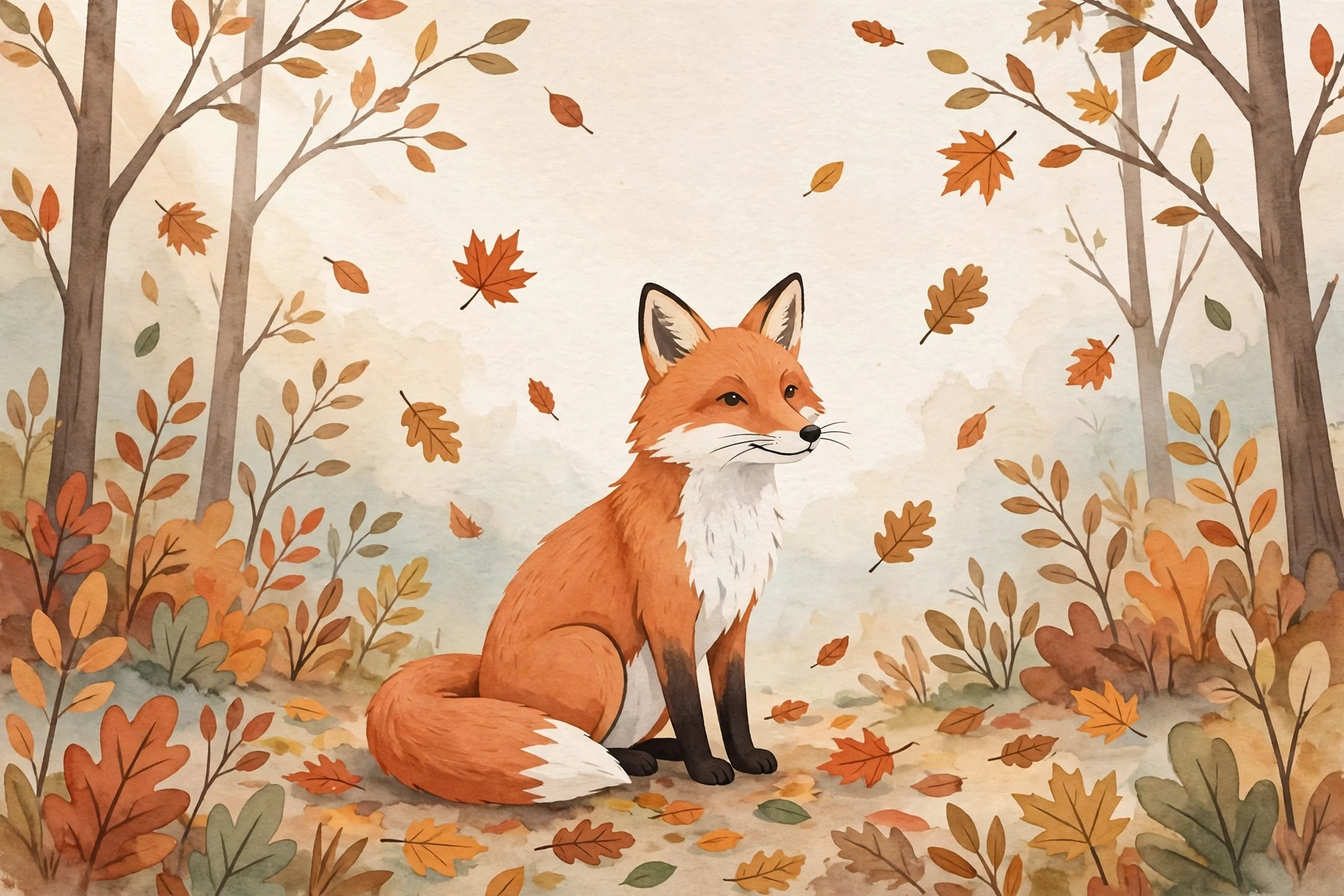
I then reverse searched it live, by its public URL, on both search engines this site is built around. TinEye searched over 86.7 billion images and found 0 matches, which it explained by saying it had yet to crawl any page where the image appears. Google Lens worked, identified it as a fox illustration, and reported no exact matches, adding that this could mean the image is unique or has not been widely shared yet. Its visual matches were only similar fox illustrations and products, including a Fox Calendar result, Fox Wall Art on Amazon, a fox illustration on Dreamstime, and similar fox art on Etsy, Pinterest and Creative Market. No identical copy was found by either service.
Read that result honestly. A zero on TinEye and no exact match on Lens do not prove the fox is free to use, and they do not prove it is yours. They prove the image has not been crawled yet, which is exactly what you would expect for a picture generated minutes earlier. The search is useful for one thing only. It shows whether the picture, or something very like it, is already out there being sold, and it shows what your buyers will find when they search your own listing. The Lens visual matches are the warning here. Fox calendars and fox wall art already exist on Amazon, Etsy and Creative Market, so a fox calendar is a crowded shelf, and a new seller needs more than one fox to stand out.
Now run the licence walk on the fox, because that is the part a reverse search cannot do. The fox is fictional, so there is no real person whose likeness is involved. It is not a character from a film or a game, and it carries no logo, no text and no brand. That part of the check passes on any generator. The part that changes with the tool is ownership. Made on a paid Midjourney plan, the fox would be yours under Midjourney’s terms. Made with DALL-E, it would be yours under OpenAI’s assignment, with the warning that another user could get a similar fox. Made on mage.space, it would be dedicated to the public domain under CC0, so anyone could sell the same fox on their own calendar. Same picture, three different answers, and the only thing that changed was the tool.
What can get your listing taken down?
A generator licence is not a licence for what is inside the picture. That is the sentence most sellers need, and it is the one the moneypantry guide states but never really explains. Here is what it means in practice.
Characters, logos and real faces are the three fastest routes to a takedown. Ask a generator for a famous character and it will often produce one, because the model was trained on pictures of that character. Selling that picture on a mug is copyright and trademark infringement by you, even though the generator made the picture, and even though you paid for the plan. Disney, Universal and Warner Bros. sued Midjourney on 11 June 2025 in the Central District of California, case number 2:25-cv-05275, saying its service generates recognisable images of their characters from prompts as simple as a character’s name. Warner Bros. filed its own suit in September 2025, and the cases were consolidated. Midjourney denies infringement and argues fair use. As of October 2026 there is no ruling on the merits, and no trial date has been set, so the case decides nothing yet. But it shows the direction of travel, and it shows that the studios are watching generated images, not just training data. Under US law, statutory damages for wilful infringement can reach $150,000 per work, which is why a single mug is never worth the risk.
Real people are a separate risk, and a worse one. A face that looks like a real person, even if the generator invented it, can bring a likeness claim, and a face that is a real person brings one faster. Our guide to AI faces in adverts covers the likeness rules in detail, including the state laws that apply when a face is used to sell something. The short version is simple. Do not put a recognisable real person on a product without their consent, and do not trust a generator to know the difference between a invented face and a real one.
Marketplaces enforce all of this faster than any court. Etsy, Redbubble and Amazon all run IP complaint systems, and a rights holder’s complaint will usually take a listing down first, with questions afterwards. Repeated complaints can close a shop. Redbubble runs an automated IP scanner that hunts for registered names, brand marks, familiar characters and famous faces, and strikes stack toward suspension. That is the marketplace layer doing its own enforcement, and no generator licence overrules it. For the brand owner’s side of this, including how businesses protect their own images and chase misuse, see our brand and business image protection guide.
Where can you sell it, and what does each place ask for?
The place you sell matters as much as the tool you generate with, because each marketplace adds its own rules on top of the licence. Here is the short version for the places sellers actually use.
Etsy is the strongest marketplace for AI art, and the strictest about honesty. Etsy requires sellers to say when AI was used in a listing, and our guide to Etsy’s AI photo rules for sellers walks through exactly what to disclose and where. A buyer who discovers the art is AI made after paying for it is a refund and a bad review waiting to happen, so disclose it in the listing, not in the small print.
Redbubble is the easiest place to start, because you upload a design once and it appears on dozens of products, from stickers to t-shirts, with no inventory. It permits AI assisted art as long as the work is genuinely yours, made with your own prompts and creative direction, not a bought pack of someone else’s generated images re-uploaded as originals. Its IP scanner is aggressive, so a design with a character or a logo in it will be flagged, and strikes stack toward suspension.
TeePublic works the same way as Redbubble. It is run by the same parent company, Articore, so the upload-once model and the product range are close cousins. Displate is a different shape of marketplace: it sells the same art as metal posters, printed on demand, which suits bold, graphic work that reads well on a wall.
Print on demand suppliers such as Printful, Printify and Gelato are the quiet layer underneath. They print, pack and ship only after a customer orders, which is why the AI Overview leads with them. They do not check your licence for you, and they will refuse a design they believe infringes, because they are the ones putting ink on the product. Connect them to Etsy or to your own store, and keep the design file at print resolution from the start.
Amazon Merch on Demand has the largest reach and the strictest content policy of the four. It allows AI art, but it rejects trademarked content quickly, and its review process is slower than Etsy’s. If you sell there, keep your designs original and your paperwork in order, because an Amazon account is harder to win back than an Etsy shop.
Your own store, on Shopify, Gumroad or Payhip, gives you the most control and the least protection. Your rules apply, but so do the generator’s terms, the character and trademark rules, and the law. An own store does not remove any of the checks in this guide. It only removes the marketplace that would have caught the mistake for you.
Six checks before you list anything
Run these six checks on every design, every time, before it goes live. They take ten minutes, and they catch the mistakes that close shops.
- Read the generator’s terms on the day you generate. Terms change, and the version that matters is the one in force when you made the image, not the one you read six months ago. Screenshot the commercial use section and keep it with the file.
- Confirm commercial use on your plan, not on the tool in general. Free and paid plans have different rules on Midjourney, Leonardo and mage.space. The plan you are actually on is the only one that counts.
- Look at the picture for characters, logos, real faces and readable text. Zoom in. Generators slip brand names, logos and lookalike faces into backgrounds, and a small logo on a mug is still a logo.
- Upscale and proof it at print size. Generate at the highest resolution the tool offers, upscale with Canva, Photoshop or a specialised upscaler, and print one proof before you list the product. A picture that looks sharp on a phone can go soft on a poster.
- Read the marketplace’s AI rules and disclose where asked. Etsy wants AI use disclosed. Amazon KDP wants it disclosed on a book cover. If a platform asks, answer honestly, because a hidden disclosure found later costs more than an honest one made now.
- Keep a record of the whole chain. Save the prompt, the tool, the plan, the date, and the terms version. If a buyer or a platform ever asks where the picture came from, that record is your answer. Without it, you have only your memory.
That is the whole discipline. The licence is not a formality at the start of the process. It is the process. Check the tool, check the picture, check the product, check the marketplace, and keep the record. Do that, and a calendar, a book cover or a mug made from AI art is a real product with a real licence behind it, not a hope and a prompt.
FAQs
Can I sell AI art on products if I made it on a free plan?
It depends on the tool. DALL-E, Ideogram and Adobe Firefly allow commercial use on their free plans, under the same terms as paid users. Midjourney has no free plan left, and Leonardo and mage.space give free users a commercial licence but keep the images public, with ownership sitting elsewhere. Check your own plan first.
Can I use a mage.space picture on a calendar or a book cover?
Yes, you can sell it, because mage.space permits commercial use and asks for no attribution. But its terms dedicate generated images to the public domain under CC0, so anyone else can sell the same picture too. For a calendar or a cover you hope to build a brand around, that lack of exclusivity is a real weakness.
Do I own the copyright in AI art I sell?
No, not in a purely AI generated picture in the United States. The US Copyright Office said in January 2025 that prompts alone do not make you the author, though your own selection, arrangement or editing can be protected. In the UK, section 9(3) of the 1988 Act gives computer generated works a 50 year term, but untested for sellers.
Can I sell AI art with a famous character on a mug?
No, not safely. A generator licence covers the tool, not the character inside the picture, and studios enforce their characters hard. Disney, Universal and Warner Bros. sued Midjourney in June 2025 over generated images of their characters, and marketplaces remove such listings fast. Use original characters only.
Do I have to tell Etsy buyers the art is AI made?
Yes. Etsy requires sellers to say when AI was used in a listing, and hiding it is the fastest route to a refund and a bad review. Say so in the listing itself, not in the small print. Amazon KDP has the same kind of disclosure rule for an AI generated book cover, so check each platform before you list.
What should I check before I list an AI design?
Check the generator terms on the day you generated, confirm commercial use on your own plan, and look closely for characters, logos, real faces and readable text. Upscale the file and proof it at print size. Read the marketplace AI rules, disclose where asked, and keep the prompt, tool, plan and date on record.