🔎 Reverse Image Search
Image search techniques made simple: upload a photo or paste a URL and search 6 engines at once. 100% free, nothing stored.
🔒 Your image is never stored on our servers longer than 24 hours and is never shared.
A reader on Quora asked a question that sums up a common small-business shortcut: can I use AI generated faces to advertise my products, so I avoid the copyright risk of pictures picked from the internet, and can I do it with FaceApp face swaps? The short answer is no, not the way the question describes it. Swapping a face does not remove the copyright in the photo underneath, and it can add a second problem, the likeness rights of the person whose face you used.
Short answer: AI faces in adverts are not a safe shortcut around photo rights. A face swap keeps the copyright of the original photo, a generated face can still resemble a real person, and new rules now require many AI faces in ads to be labelled. Use a face you have written permission for, or a fully synthetic face. Film stills work the same way: the copyright rules for movie screenshots on Instagram explain why a frame borrowed for an advert needs a licence too.
This guide answers the Quora question in plain words. It is general information, not legal advice. The rules differ by country and by US state, and they are changing fast, so check the current text of each rule before you run a campaign, and ask a lawyer about your own advert.
Three terms to know. A synthetic performer is a digital figure or voice made with generative AI that looks and sounds like a real human performer but is not a real, recognisable person. A face swap takes a face from one photo and puts it on another photo or video. A likeness right, also called a right of publicity in the US, is a person’s right to control commercial use of their face, name or voice. Copyright and likeness are different rights, and an advert can breach either one on its own.
What did the Quora asker actually want to do?
The asker was already using FaceApp to swap faces, and wanted to know whether AI generated faces would keep them clear of copyright trouble from internet pictures. Two of the three direct answers on the Quora page warned against it. One said the law was still unsettled and there were not enough court decisions yet. Another called the face swap theft, and worked through a made up example: take a 2013 Revlon advert featuring Emma Stone, strip out the branding, swap in another model’s face, and relabel it for a fictional cosmetics brand. That answer said a court in most developed countries would still find infringement, because the copyright of Revlon and the photographer survives, and most of what makes the photo good is still in the frame. No direct answer on the page endorsed the FaceApp route as safe.
The instinct behind the question is understandable. Stock photos cost money, a model shoot costs more, and an AI face costs almost nothing. But the saving is the trap. The question treats copyright as the only risk, and treats an AI face as a way around it. In practice there are three separate risks, and the face swap only touches one of them, badly. The first is copyright in the photo you started from. The second is the likeness right of the person whose face appears. The third is the disclosure and advertising rules that now apply to AI faces in several places. This article works through each one.
Does swapping a face remove the copyright in the original photo?
No. A face swap is an edit of an existing photo, not a new photo. Copyright in a photograph usually belongs to the photographer, or to the business that commissioned it, and editing it does not transfer that copyright to you. Changing the face, the colours or the background does not make the rest of the image yours. The lighting, the composition, the pose, the set and the styling all stay in the picture, and they are all part of the copyrighted work.
Think of it the way the Quora answer put it. If you take a professional advert photo, remove the brand text and swap the face, a knowledgeable person can still show that most of what makes the image work came from the original. A court would ask the same question. Small changes do not create a new work, and they do not erase the original owner’s rights. The same logic applies to any photo you pick from the internet, whether it came from a brand, a stock site or a social media account. If you did not take it, did not buy a licence for it, and did not get it from a properly licensed source, swapping the face does not fix the problem. It adds evidence that you knew the photo was not yours, because you deliberately altered it.
There is one more point people miss. FaceApp is a personal photo editor, built for selfies and fun filters. Its terms are written for personal use, and a paid Pro subscription is a subscription to the app, not a licence to use other people’s photos in your advertising. Nothing in the app gives you rights in the photo you upload, or in the face you swap in. If the face comes from a stock photo, the stock licence still governs it. If it comes from a social media profile, you have no licence at all. Always check the current terms of any tool on the day you use it, because tool terms change, but do not expect a face swap app to hand you advertising rights it never promised.
Can you copyright the AI face you made?
Probably not, at least not in the US, and that matters for a business that wants to protect its own adverts. The US Copyright Office published its report on the copyrightability of AI outputs on 29 January 2025, and its position is clear: purely AI generated material is not covered by copyright, because copyright needs a human author. Prompts alone are not enough. Human input can be protected, such as your own selection, arrangement or modification of the image, but the AI generated parts on their own are not. Our sister guide on AI image copyright works through this in detail, including the UK position under the Copyright, Designs and Patents Act 1988, which treats computer generated works differently and gives them 50 years of protection.
For an advertiser, the practical result is simple. You cannot rely on copyright to stop a rival copying your AI face, because you may not own copyright in it at all. And the reverse is also true. If your AI face looks like a real person’s face, that person does not need copyright to object. Their likeness right is a separate claim, and it does not depend on who owns the pixels.
What is a likeness right, and why does it matter more than copyright here?
A likeness right is the right to control commercial use of your face, name or voice. In the US it is mostly state law, and the rules vary widely between states. The US Copyright Office’s July 2024 report on digital replicas found that a majority of states recognise a right of publicity, by statute, court decisions or both. The point that catches most advertisers is that lookalikes count. You do not need to use a real photo of a person, or even name them, to breach their rights. If the face in your advert is recognisable as them, or close enough that customers think they are endorsing your product, that can be enough.
Two old cases still shape this area. In 1984, an advert that used a lookalike of Jacqueline Onassis was found to infringe her rights, in Onassis v. Christian Dior. In another case, a robot that evoked the game show host Vanna White was enough for her claim to go forward, even though no photo of her was used. An AI face that happens to resemble a real person sits in the same territory. The fact that no real photo was involved does not end the question. It starts it.
Ordinary people have these rights too, not only celebrities. A celebrity case is more likely to reach court, because the damages are larger and the person has lawyers, but the right itself is not limited to famous faces. If your AI face resembles a real customer, a neighbour, an employee or a model from a stock photo, that person can object. This is why the standard advice from every serious guide is the same: never name a real person in an image prompt, and have two people check the finished face against people you know before it goes live. If anyone recognises someone, change the face.
Which disclosure rules apply to AI faces in adverts?
This is the part that changed most in 2026, and it is where the top competitor article on this topic is already out of date. The competitor guide, from Overs and checked on 24 September 2026, covers the US state laws and the EU AI Act well, but it does not cover California’s SB 1050, and it does not cover platform rules in any detail. The Google AI Overview for this topic, checked live on 15 November 2026, cites nine publishers plus two more sources in its text, and its points run from consumer backlash to Google Ads bans. Every point it covers is covered in this article, in our own words, plus the worked example and the checks below that the Overview does not have.
The table below is the ranking asset for this article. It sets out the main rules that can apply to an AI face in an advert, what each one requires, and where it bites. Read it as a checklist, not as legal advice, and check the current text of each rule before you rely on it.
| Rule | What it requires | Where it applies | Since when |
|---|---|---|---|
| New York General Business Law section 396-b | Ads showing an AI generated person who is not a real, recognisable performer must say so, conspicuously | New York | 9 June 2026; $1,000 for a first violation, $5,000 after |
| California SB 1050 | Video and audio ads that prominently feature a synthetic performer must carry a clear and conspicuous disclosure, using wording like “this performance features a synthetic performer” or “no human performer is depicted” | California | Signed 16 September 2026; in force 1 January 2027 |
| California Civil Code section 3344 | Written consent before a name, voice, signature, photograph or likeness is used in advertising | California | Long standing; at least $750 or actual damages |
| New York Civil Rights Law sections 50 and 51 | Written consent before a name, portrait, picture, likeness or voice is used for advertising or trade | New York | Long standing; injunction and damages, extra damages if knowing |
| Tennessee ELVIS Act | Consent before using a name, photograph, voice or likeness, including simulated voices, in commercial use | Tennessee | 1 July 2024 |
| EU AI Act, Article 50 | A realistic AI image of a real person in an ad is a deepfake and needs a visible AI label at first exposure; the label does not make an otherwise unlawful image lawful | EU, and ads shown there | 2 August 2026 |
| UK passing off and ASA Code | No general image right in the UK, but an ad that implies a person endorses a product can breach passing off; the ASA said in June 2026 that a realistic AI celebrity endorsement is likely to breach the advertising code | UK | Passing off is long standing; ASA position June 2026 |
| Google Ads policy | Using AI to impersonate a real public figure is banned, even with a disclosure; a disclaimer does not make an illegal impersonation compliant | Google Ads, worldwide | Clarified November 2026 |
| FTC endorsement rules | No AI avatar or fake customer delivering a testimonial or review that implies a real person used and endorsed the product | US | Long standing; fake reviews rule in force |
| NO FAKES Act (federal, US) | Would create a federal right to authorise digital replicas; a living person’s licence would last at most 10 years | US, if passed | Not law; the 2026 bill was reported by the Senate Judiciary Committee on 24 June 2026 with no floor vote shown |
Three things in that table deserve a closer look. First, the disclosure rules and the consent rules are different duties. A label does not replace consent. New York’s disclosure rule applies to synthetic performers, people who are not real. If the face is a real person, or a recognisable lookalike of one, you need their written consent first, and no label fixes the lack of it. Second, the EU rule is about deepfakes, which the AI Act defines as AI generated content that resembles real people, objects, places or events and would falsely appear authentic. A clearly fictional cartoon face is not a deepfake. A photorealistic face that a customer would take for a real model is. Third, the platform rules can bite before any law does. Google Ads can refuse or remove your advert, and YouTube, Meta and TikTok all label realistic synthetic content. A campaign that passes the legal check can still be taken down by the platform it runs on.
The UK position is worth stating plainly, because it surprises people. The UK has no general right to your own image. Rihanna won her case against Topshop not because she owned her image, but under passing off, because buyers were likely to think she had approved a t-shirt bearing her photo. The UK government said in March 2026 that it will consider a new personality right, but that is a plan, not a law. For now, UK advertisers lean on passing off, data protection law, and the ASA Code. A realistic AI face of a real person used to sell a product can breach all three, even without a dedicated image right.
Political adverts are a separate case, and the rules there are moving faster than the commercial ones. In Pennsylvania, a 2026 governor’s race ad used an AI generated version of the sitting governor, and the disclosure that it was AI came only near the end of the video. Pennsylvania has no law against political deepfakes, and lawmakers there are debating bills to restrict them. If your advert is political rather than commercial, check the election rules for your state or country first, because the disclosure duties there are different from the ones in this article.
What about a face that is fully synthetic, with no real person in it?
A fully synthetic face is the safest route, and it is the one every serious guide recommends, but it is not risk free. The safety comes from the input, not from the output. If no real photo went in, and no real person was named in the prompt, there is no underlying photo copyright and no real person’s likeness to infringe. That is a genuine improvement on the FaceApp swap. But two risks remain, and both are easy to miss.
The first is accidental resemblance. Generative tools are trained on vast numbers of real faces, and a face that looks invented to you can look like a real person to someone else. The tools do not check this for you. That is why the two person check matters: show the finished face to two people who were not involved in making it, and ask whether it reminds them of anyone. If it does, change the features and check again. The second risk is disclosure. A fully synthetic face still has to be labelled where the rules require it. In New York, an ad showing an AI generated person who is not a real, recognisable performer must say so. In California, from 1 January 2027, a video or audio ad that prominently features a synthetic performer needs a clear disclosure. In the EU, a photorealistic synthetic face that could pass as a real model is a deepfake and needs a visible label. “Nobody real” is not the same as “no label needed”.
There is also a commercial point that the AI Overview picked up. AI faces often perform well in tests when they do not look overtly artificial, but audiences react badly when they discover a spokesperson was entirely fabricated. Brands including Heineken, Polaroid, Cadbury, Aerie and Apple have publicly promoted human made work in response. A synthetic face that saves money on a shoot can cost more in trust than it saves in fees, especially if customers feel they were misled. Label the face, and let the product do the selling.
The evidence on performance is mixed, and it is worth knowing before you spend. Research from Columbia Business School, working with Taboola ad data, found AI generated ad images beat human made ones on click-through rates, but only when the image did not look like AI. A NielsenIQ study from late 2024 found the other side of the same coin. Viewers spotted most AI generated video ads without being told, and rated them less engaging, more annoying and more confusing than traditional ads, even the polished ones. The two findings point the same way. An AI face can perform, but only if the audience does not notice it, and the moment they do, it can cost you the trust the saving was meant to buy.
How to use AI faces in adverts safely
Follow these steps in order, before the advert goes live. If any step fails, stop and fix it. Do not publish first and check later.
- Start from a clean source. Use a face you made from scratch with a generator, with no real photo as the input and no real person named in the prompt. Or use a real model with a signed release. Never start from a photo picked from the internet.
- Check the tool terms. Read the current terms of the generator you used, on the day you use it. Check whether commercial advertising use is allowed, and whether the tool claims any rights over the output. If the terms are unclear, pick a tool whose terms are clear.
- Run the resemblance check. Show the finished face to two people who did not make it. Ask whether it reminds them of anyone real, including staff, past talent and public figures. Change any feature that triggers a resemblance, and check again.
- Reverse search the face. Run the finished image through a reverse image search, and run the source photo too if you used one. If the search finds the original photo, or a real person who matches the face, stop. Our guide to how to tell if an image is AI generated explains the checks, and the worked example below shows what a search actually returns.
- Get written consent where a real person is involved. The consent must name AI generation and alteration, list the uses, channels, countries, formats and duration, and cover what happens when the person leaves or the licence ends. Verbal agreement is not enough.
- Add the disclosure the rules require. New York, California and the EU each have their own wording and placement rules. Use the wording the rule asks for, put it where customers will see it at first exposure, and do not hide it in small print.
- Check the platform rules. Google Ads bans AI impersonation of real public figures outright. YouTube, Meta and TikTok label realistic synthetic content. Read the ad platform’s current policy before you upload, because a lawful advert can still be refused.
- Keep the records. Save the prompt, the tool, the date, the consent form and the disclosure you used. If someone complains later, those records are your evidence that you checked.
Worked example: the cosmetics advert test
Here is the Quora asker’s idea, tested step by step on a real photo, the way this guide recommends. The scenario is constructed, and it is labelled as such, but every check in it was genuinely performed on 15 November 2026.
Maya sells handmade lip balm from a small online shop. She finds a glossy magazine style photo of a model online, and wants to use it in a Facebook advert. She does not have a licence for the photo, so she plans to swap the model’s face with FaceApp and run the advert. She asks whether the swap makes it safe.
Step 1: the source photo. The photo she found belongs to someone, either the photographer or the brand that commissioned it. Maya has no licence, so the starting point is already a copyright problem. Swapping the face does not change who owns the photo.
Step 2: the face swap. Maya swaps in a face from a stock photo she also has no licence for. Now there are two rights in play, the copyright in the original advert photo and the rights in the stock face. FaceApp does not give her a licence to either one. The swap has made the legal position worse, not better, because it shows she knew the photo was not hers and altered it anyway.
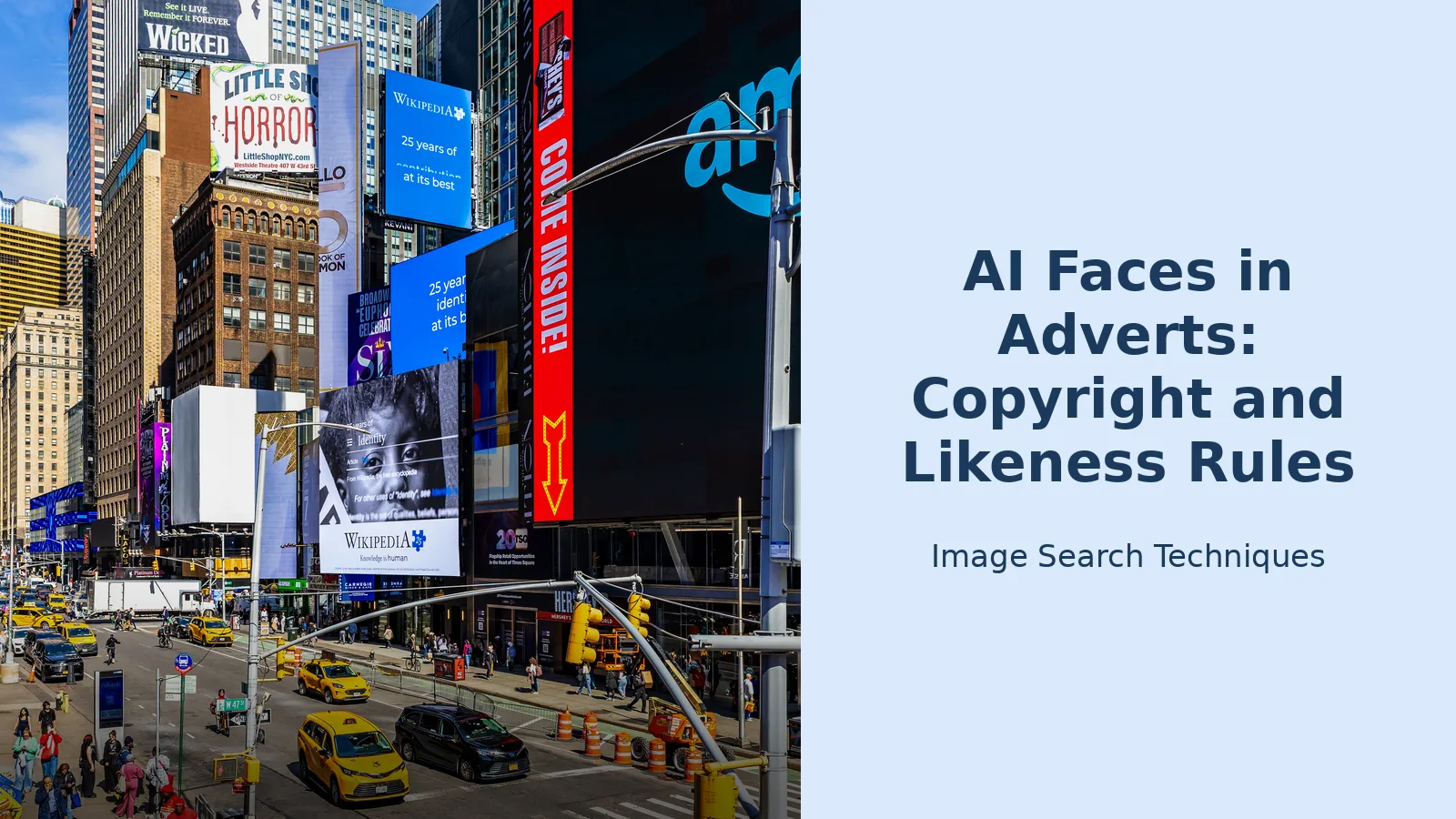
Step 3: the reverse search. To show how traceable a photo is, I reverse searched a real advert style photo live on 15 November 2026: the Times Square billboard photo used as this article’s banner, a real Wikimedia Commons photo (CC BY-SA 4.0, File:Wikipedia Times Square Billboard 10.jpg). TinEye searched over 86.7 billion images and found 0 matches, saying it had yet to crawl any pages where the image appears. Google Lens found no exact match either, and its closest visual match was a different file in the same series, Billboard 14.jpg. That result is honest, and it is also a warning. This photo is a fresh upload from the Wikipedia 25 years series, so zero matches only means the search engines have not crawled it yet. It does not prove the photo is unused, and it never clears a photo. A widely used advert photo, like the one in Maya’s scenario, would be a different story: it has been published, shared and indexed for years, and a reverse search by the photographer or the brand is likely to find it, face swap or not. The search is a useful check, never a clean bill of health.
Step 4: the likeness check. The swapped in face belongs to a real model. Maya has no written consent from that model to use her face in an advert, let alone an AI altered version of it. In California, that alone can breach Civil Code section 3344. In New York, it can breach sections 50 and 51. The model’s consent to appear in a stock photo is not consent to appear in Maya’s lip balm advert.
Step 5: the disclosure check. Maya’s advert would run on Facebook, which labels realistic synthetic content, and if it reached customers in the EU, the AI Act would require a visible label at first exposure. Maya had planned no label at all.
The safe version. Maya drops the found photo entirely. She generates a fully synthetic face with no real person as the input, runs the two person resemblance check, reverse searches the finished image, and adds the disclosure her market requires. Or she books a real model for an afternoon and gets a signed release that names AI alteration and lists the channels and duration. Either route costs more than a face swap. Both are cheaper than a takedown, a platform ban or a legal letter. The brand and business hub, Brand and Business Image Protection, has the wider playbook for protecting product photos, and our guide to checking whether an online shop is real shows the same checks from the customer’s side.
One last check belongs in this guide. If you are the person whose face was used, rather than the advertiser, the route is different. Start with a reverse image search to find where the advert is running, save the evidence, and report it to the platform. Our guide to AI labels on social media explains what the labels mean and where to report, and the removal routes live in the photo privacy guides linked from the hub.
Can I use AI generated faces in adverts without any risk?
No. An AI face removes none of the usual risks. You still need a clean source image, a check that the face does not resemble a real person, written consent where a real person is involved, and the disclosure label your market requires. A synthetic face is the safest route, and even that needs the check and the label.
Does FaceApp give me the right to use a swapped face in an advert?
No. FaceApp is a personal photo editor, and its terms are written for personal use. A Pro subscription pays for the app, not for a licence to use other people’s photos or faces in advertising. The copyright in the photo you started from stays with its owner, and the person whose face you swapped in keeps their likeness rights.
Is a fully synthetic face legal to use in an advert?
A face made with no real photo as the input and no real person named in the prompt is the safest option, because there is no underlying photo copyright and no real person’s likeness to infringe. It is still not risk free. An accidental resemblance can cause trouble, and disclosure rules can still require a label.
Do I need to label an AI face in my advert?
Often, yes. New York requires a disclosure for ads showing an AI generated person who is not a real, recognisable performer. California requires a disclosure for ads featuring a synthetic performer from 1 January 2027. In the EU, a photorealistic AI face that could pass as real needs a visible label. Check the rule for each market you advertise in.
Can someone sue me if my AI face looks like them by accident?
Yes, they can bring a claim. Likeness rights in the US cover lookalikes, not only real photos, and a customer who thinks a real person endorsed your product can be enough to start a claim. That is why the two person resemblance check matters: show the face to two people who did not make it.
Who owns the copyright in an AI generated advert image?
In the US you probably own no copyright in the purely AI generated parts, because the Copyright Office requires a human author and says prompts alone are not enough. Your own selection or modification can be protected, but the AI output on its own is not. In the UK, computer generated works get 50 years of protection.