


🔎 Reverse Image Search
Image search techniques made simple: upload a photo or paste a URL and search 6 engines at once. 100% free, nothing stored.
🔒 Your image is never stored on our servers longer than 24 hours and is never shared.
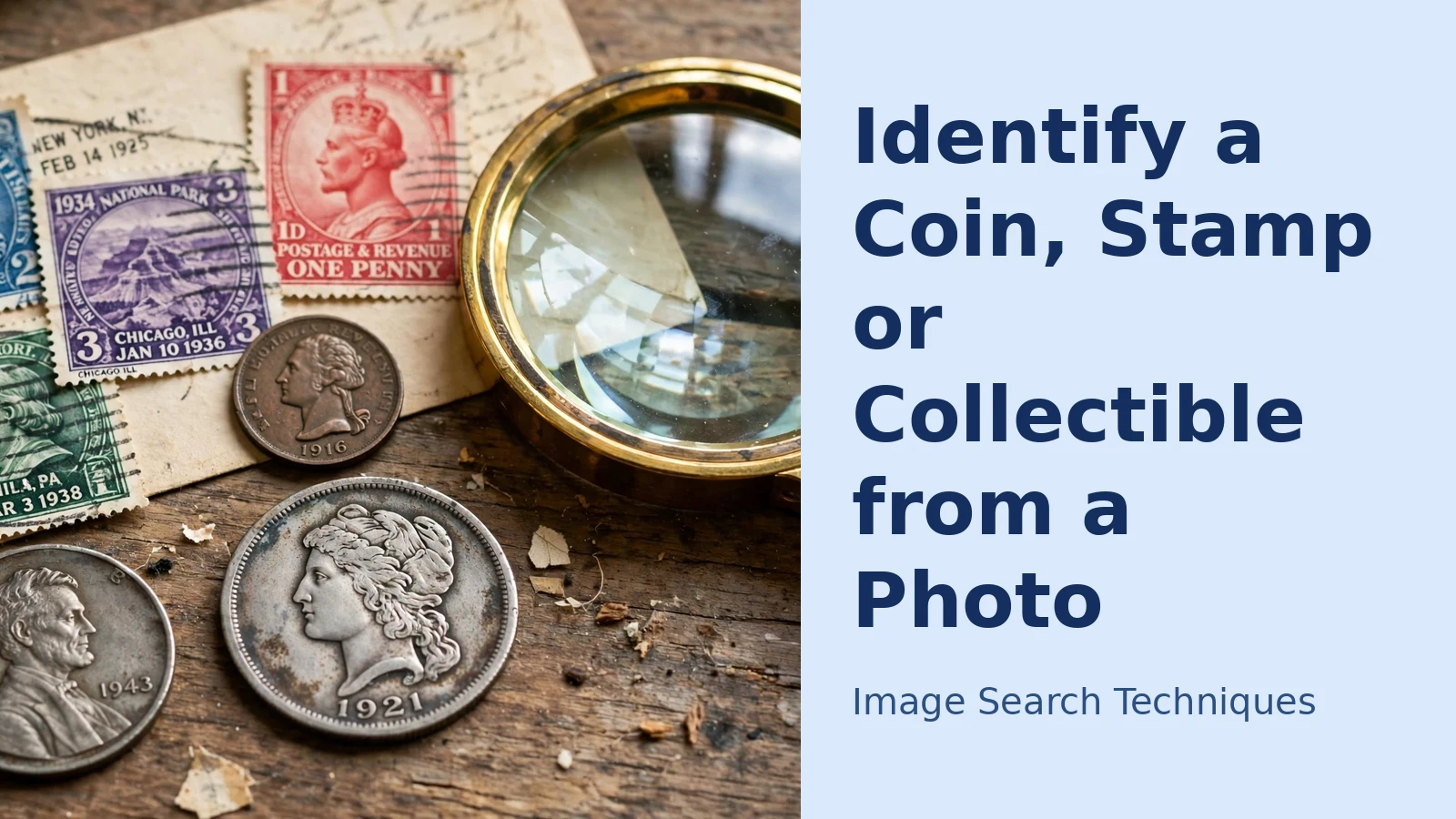
An unfamiliar coin in a change jar, a stamp detached from an old envelope, or a small medal found in a drawer may carry only a portrait, a few words and a date. That is often enough to identify it, provided you treat the photograph as evidence rather than asking one app for a magic answer. The reliable method is to combine a visual search with the fixed details specialists use: issuing country, denomination, date, mint or printer marks, dimensions and design varieties.
This matters because similar-looking pieces can belong to different countries, issues or production periods. A search result that merely resembles your item is a lead, not an identification. Work through both sides, record the small details and confirm the match in a catalogue before relying on it. If value is your eventual question, identification comes first; a dealer or specialist society can assess condition and authenticity in person, which a photograph alone cannot settle.
Photograph both sides — and the edge
Place the item on a plain, contrasting background and photograph it straight-on in diffuse daylight. Avoid flash, which blows out raised lettering and turns metal into a white glare. Capture the front and back separately, then take an angled close-up of any inscription, date or mark. For a coin, include the edge: reeding, lettering or a plain rim can distinguish issues that look identical face-on. Add a ruler or a familiar coin beside it for scale, but take at least one image without the scale object so search engines focus on the piece itself.
Do not clean, polish or peel anything to make it “clearer”. Dirt, toning, hinges and postmarks may be relevant evidence, and cleaning can damage a collectible. If you are starting from a small marketplace image or an old scan, our guide to finding the high resolution version of an image can help you obtain a copy in which the lettering is readable. Keep your own photographs uncropped as masters, and make separate tight crops for searching.
Start with a visual search, then search each side
Upload the clearest front image first. Our free reverse image search tool checks a picture across several engines, while the detailed methods in our Google reverse image search guide cover Lens on a phone or computer. Search the reverse separately rather than using a combined collage: the two faces contain different words and symbols, and a search engine may match one much better than the other. Google explains that Lens can match the selected region of an image, so crop closely around the item and remove the background where possible; its Lens help pages describe how region selection affects results.
If the object is in front of you, a phone camera can sometimes identify it before you save a file, using the approach in our guide to live camera image search. If you are new to searching from a picture at all, our step-by-step introduction to how to reverse image search explains the upload and URL options. Treat the first answer cautiously: type any readable words into a normal web search as well, in quotation marks, together with a denomination or date. Text often resolves what image matching leaves ambiguous.
Coins: read the fixed fields in order
For a coin, write down the country or issuing authority, denomination, ruler or subject, date, and any small letter or symbol near the rim. The date may use a local calendar or regnal year, so do not assume that unfamiliar numerals are decorative. Lettering around the portrait can name the country in an older alphabet or an earlier political form; searching that exact phrase is often faster than describing the design.
Next compare diameter, weight if you can measure it safely, metal colour, portrait direction and the exact reverse design. Two coins may share a monarch and denomination but differ because one was struck for circulation and the other for a colony, a commemoration or a proof set. Mint marks are usually tiny and may sit below the portrait, beside the date or on the reverse. Photograph that area at an angle rather than enlarging a blurry crop indefinitely. Record exactly what you see instead of converting it into a guessed year or country too early.
Stamps and other small collectibles
A stamp should be identified by its country inscription, denomination and currency, subject, colours, dimensions and perforation pattern. A postmark can establish where and when that copy was used, but it is not necessarily the issue date. If the stamp is still on an envelope, photograph the whole cover as well as the stamp: the address, postmark and route are part of its story and may help identify the issue.
For medals, tokens, badges and banknotes, look for the equivalent fixed fields: maker’s marks, hallmarks, serial prefixes, signatures, ribbon or mounting style, and any named recipient or unit. Photograph clasps, reverse fittings and edges rather than only the decorative front. Specialist catalogues use different numbering systems, so note which catalogue a number came from. The same design may also have been reproduced as a souvenir or restrike; construction, weight and finish are therefore as important as the picture on the front.
Separate a common piece from a rare variant
The important differences are frequently measured in millimetres or hidden in one letter. On coins, compare mint-mark position, date size, lettering style, die cracks, portrait details and whether a variety was struck with a different obverse or reverse die. On stamps, specialists check perforation gauge, watermark, paper, gum, shade and printing method. Two catalogue entries can show the same artwork while representing different printings.
Be wary of online listings that call every old or unusual piece “rare”. Age alone does not make an item scarce, and a high asking price is not evidence of market value. Equally, do not dismiss a piece merely because the basic design is common: a mint mark, overprint, error or short-lived variety can change the identification. The honest conclusion may be “the 1938 issue, probably the small-date variety”, with the uncertainty stated, until a specialist can examine it under magnification.
Confirm the answer in a specialist catalogue
Once a visual search gives you candidates, test each one against every recorded field. Numista is useful for coins, banknotes and tokens because entries bring together images, dates, mints, inscriptions, dimensions and catalogue references in one place. For stamps and mixed collections, printed catalogues and Colnect-style databases perform the same role, although numbering and terminology vary. A true match should agree on both faces, size, inscription and production details — not just the main picture.
If two candidates remain, make a small comparison table and mark each point as match, mismatch or unknown. Search for the most distinctive mismatch rather than repeating the original photograph. Should the answer affect insurance, sale or authentication, consult the relevant dealer, auction specialist or collector society and take the item, not just screenshots. That expert check confirms attribution and condition; no responsible identification guide should promise a valuation from a phone photo.
FAQs
What is the best photo to use for identifying a coin?
Use a straight-on, well-lit photograph of each side, plus a close view of the date, mint mark and edge. Search the front and back separately because each face provides different matching evidence.
Can an app identify a stamp from a picture?
It can often point you to the right issue, but confirm the perforation, watermark, paper and printing details in a catalogue. Those features separate otherwise identical-looking printings.
Why does my coin look like several different search results?
The same portrait or national emblem may have been used across years, denominations and territories. Compare the inscription, diameter, reverse, date format and mint mark before choosing a result.
Can a photograph tell me what a collectible is worth?
No. A photograph can support identification, but value also depends on authenticity, condition, provenance and current demand. A specialist or dealer needs to examine the item before giving a meaningful valuation.
