


🔎 Reverse Image Search
Image search techniques made simple: upload a photo or paste a URL and search 6 engines at once. 100% free, nothing stored.
🔒 Your image is never stored on our servers longer than 24 hours and is never shared.
Found a guitar in the loft, inherited one from a relative, or spotted one in a listing with no description? That is exactly when people search for how to identify guitar from photo clues — and in most cases, a few clear photographs, a reverse image search and the serial number are enough to pin down the brand, the model and an approximate year.
To identify a guitar from a photo, photograph the headstock front and back, the full body, the label or serial number and any hardware details, then run the clearest shot through Google Lens. Match the shape, logo and serial number against the maker’s records to pin down the brand, model and approximate year.
This guide walks through the whole photo-first workflow: which angles to shoot, how to read the brand and model from what you can see, how to decode a serial number, and how to spot the red flags that mark a fake vintage guitar. It also includes a worked example using a real headstock photograph, so you can see each step applied to a genuine instrument.
What Can a Photo Actually Tell You About a Guitar?
Photo identification means working out a guitar’s brand, model and approximate year from photographs alone, without handling the instrument.
A good set of photographs can tell you a great deal. The headstock usually carries the brand logo and often the model name. The body shape narrows the model down fast: a double-cutaway body with three pickups points towards a Stratocaster-style guitar, while a single cutaway with two humbuckers and four knobs points towards a Les Paul-style guitar. The label inside an acoustic, the serial number, the bridge, the pickups and the tuners each add another clue, and together they usually settle the identification.
A photo cannot prove everything, though. It cannot prove a guitar is genuine on its own, because logos and serial numbers can be faked. It cannot give you an exact year either: serial numbers usually narrow a guitar to a range of years, not a single date. And it cannot value the guitar — condition, originality and playability all need hands-on checking. What a photo does give you is a confident shortlist, and that is enough to research the guitar properly, ask the right questions of a seller, or decide whether an expert look is worth paying for. The same photo-first approach works for other objects too, as our guide to identify a watch from a photo shows.
How to Identify Guitar from Photo: A Six-Step Workflow
Work through these six steps in order. Each one narrows the possibilities, and by the end you should have a brand, a model and a year range.
- Take the six shots. Photograph the guitar properly before you search anything. The six angles you need are listed just below, and they make every later step easier.
- Start with the headstock. Run your clearest headstock photograph through Google Lens first, because the logo and model name are the strongest visual signals. Google’s own help page explains how Lens matches a photo against visually similar images on the web, which is why a sharp, straight-on headstock shot works far better than a distant full-body picture. See Google’s Lens help page for the current steps on your device.
- Crop tight before you search. If the guitar fills only a corner of the frame, crop the photo so the headstock or body fills most of it. Lens matches what it can see clearly, and background clutter — furniture, other instruments, patterned wallpaper — pulls in irrelevant results. Our reverse image search guide explains cropping and re-searching in more detail.
- Read the results as suggestions, not answers. Lens returns visually similar guitars, not a verified identification. If most results agree on one model, that is a strong lead. If they split between two or three models, note all of them and let the serial number decide.
- Cross-check with the serial number. A visual match plus a serial number in the right range for that model is a solid identification. A visual match with a serial number that belongs to a different decade is a warning sign, not a match.
- Confirm with sold listings. Search completed listings for the model and year you have identified. If guitars that look identical to yours keep appearing under the same model name, your identification is almost certainly right.
Different tools suit different parts of the job, so use more than one:
| Tool | Best for | What it will not do |
|---|---|---|
| Google Lens | Matching a headstock or body photo to the same model | It cannot confirm authenticity or date a guitar exactly |
| TinEye | Finding where the same photo has appeared online before | It cannot identify a model from a new photo you took yourself |
| Sold listings (eBay, Reverb) | Confirming a model and seeing what it actually sells for | Asking prices are not selling prices, so filter to sold items only |
A few photo tips make a real difference. Shoot in daylight near a window rather than under yellow room lights, which shift colours and hide the finish. Hold the phone square to the guitar instead of at an angle, which distorts the body shape. Wipe the lens, fill the frame, and take two shots of anything small — one slightly further back and one close — because serial numbers and labels are often unreadable in a single attempt.
Which photos do you need? The six shots that matter. Take these six photographs before you start searching. If you are buying from a listing and the seller has only posted one blurry picture, ask for these shots; a genuine seller will usually oblige, and a refusal is itself useful information.
- Full front view. The whole guitar, straight on, filling the frame. This shows the body shape, the number and type of pickups, the bridge and the controls.
- Headstock, front. Straight on, close enough to read the logo and any model name. This is the single most useful photograph for identification.
- Headstock, back. Many serial numbers live here, along with tuner stamps and any “Made in” marking.
- The label or neck plate. For an acoustic, look through the soundhole at the paper label on the neck block or the back. For an electric, photograph the metal neck plate on the back of the body.
- Serial number close-up. A sharp, well-lit close-up of the serial number alone. Copy the number down exactly as it appears, watching for lookalike characters such as the letter O and the number 0.
- Hardware details. Close-ups of the bridge, the pickups and the tuners. These parts changed over the decades, so they help date the guitar and expose replaced parts.
Do not remove the neck, the pickguard or any hardware to get a photograph. The date stamped on the neck heel and the codes on the potentiometers are genuinely useful for dating, but reading them means taking the guitar apart, and that is a job for a guitar technician, not a first inspection.
How Do I Read the Brand, Model and Serial Number?
Start with the brand, because it tells you where everything else lives. On most electric guitars the brand is on the front of the headstock. Fender used a thin “spaghetti” script logo in the 1950s and early 1960s and a larger black logo with a gold outline from the late 1960s, so the logo style alone can narrow the decade. Gibson’s script logo, Gretsch’s stylised lettering and Rickenbacker’s straight lettering are equally recognisable. On acoustic guitars, also look inside the body through the soundhole: Martin guitars carry a label reading “C.F. Martin & Co., Nazareth, Pa.” on the neck block, and Gibson acoustics carry an oval or rectangular label on the inside back.
Model names usually follow the brand. Fender’s Stratocaster has three pickups, a contoured double-cutaway body and a tremolo bridge; the Telecaster has two pickups, a single cutaway and a slab body with sharp edges. Gibson’s Les Paul has a single cutaway, an arched top, two humbuckers and four knobs; the SG has a thin double-cutaway body with pointed horns. Martin models use a letter-number code: in a D-28, the D means a dreadnought body and the 28 means rosewood back and sides with herringbone trim, while a D-18 is the same size in mahogany. Gibson’s J-45 and J-50 are the same guitar in different finishes — sunburst and natural — which is why a photograph of the finish matters.
Serial numbers live in different places depending on the maker and the era:
| Maker | Where to find the serial number | What to know |
|---|---|---|
| Fender | Neck plate from the mid-1950s to 1976; headstock front or back from 1976 onwards | Early Stratocasters had the number on the tremolo cover plate |
| Gibson | Back of the headstock, ink-stamped before 1961 and impressed into the wood after | Acoustics also carry the number on the inside label, sometimes with a Factory Order Number |
| Martin | Stamped on the neck block, visible through the soundhole | The model designation is stamped on the same block |
| Gretsch, Guild, Rickenbacker | Varies by era: inside label, headstock back or metal jack plate | Check the label inside a hollow body first |
Once you have the number, check it against the maker’s own records. Gibson publishes a free serial-number search on its own website, and it is the right starting point for any Gibson guitar — see Gibson’s official serial-number search. Martin publishes a serial-number lookup of its own, and Fender publishes dating charts covering its serial schemes from 1950 onwards. Treat every decoder as a guide, not a verdict: makers reused numbers, changed systems and sometimes fitted parts out of order, so always cross-check the serial result against the guitar’s visible features.
How Do I Work Out the Year from the Serial Number?
A serial number gives you a range of years, not an exact date — and understanding why keeps you from being misled. Fender’s own serial-number dating guide states plainly that dating by serial number alone is not an exact science, because Fender’s production was modular: necks and bodies were made in batches, stored, and paired up later, and serial-number schemes overlapped by two to four years through the mid-1980s.
For Fender, the location of the number is your first clue. Numbers on the neck plate belong roughly to the mid-1950s to 1976 era, and numbers on the headstock belong to 1976 onwards. Modern Fender instruments are easier: since around 2010, most US instruments carry a serial starting with US followed by eight digits, and the first two digits are the year — so US16 means 2016. The same pattern applies to Mexican instruments with an MX prefix. For older Fenders, the most reliable date is the one stamped or pencilled on the butt end of the neck heel, but reading it means removing the neck, so leave that to a technician. Potentiometer date codes are another cross-check a technician can read: the code 137 identifies the CTS manufacturer, followed by two digits for the year and two for the week, so 137-6416 means the 16th week of 1964.
Martin’s system is the most straightforward of the big makers. Martin’s published serial charts run sequentially from 1898, so a clear serial number on the neck block usually dates a Martin closely. Gibson is the trickiest: the company changed its serial-number systems several times, and the same number can appear on guitars from different years, which is why Gibson results must always be checked against the guitar’s features — logo style, hardware, construction — rather than trusted on their own.
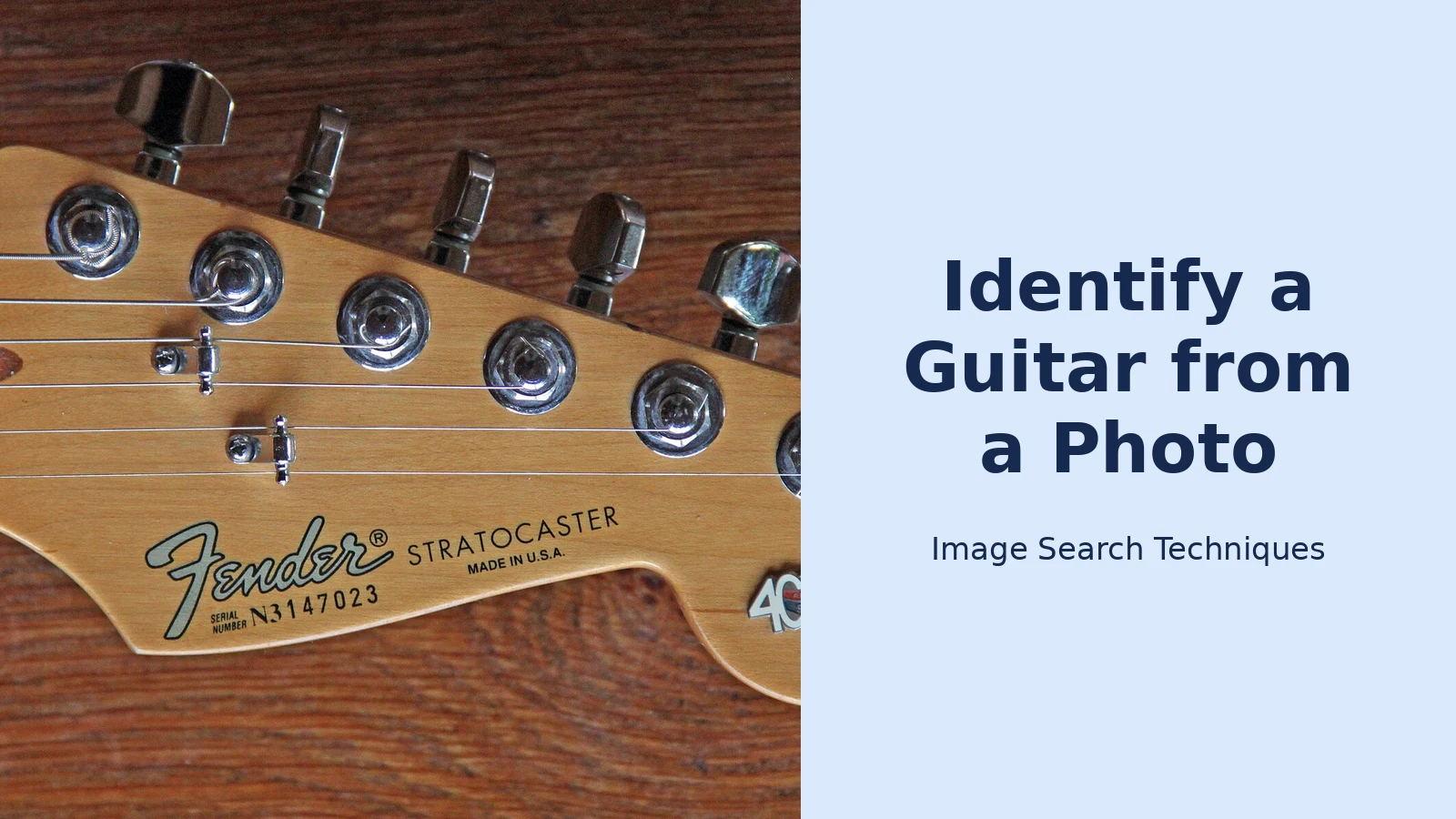
The headstock photograph at the top of this article shows how the cross-checking works in practice. It shows a Fender Stratocaster headstock with the spaghetti-style logo, “Made in U.S.A.” and a serial number reading N3147023, plus a small “40” anniversary badge. Under Fender’s published 1990s scheme, an N3 prefix points to 1993, while the 40th-anniversary badge marks the 1994 model year. The two disagree by a year, and that is normal: the serial gives a range, the badge gives the model year, and together they place this guitar in 1993–94. If a seller claimed this headstock belonged to a 1965 Stratocaster, the serial alone would disprove it.
Worked Example: Identifying a Stratocaster from One Headstock Photo
Imagine you have inherited a sunburst electric guitar with no paperwork, and the only clear photograph you have is the headstock shot at the top of this article. Here is the full workflow, step by step, using that real photograph.
- Read what the photo shows. The headstock carries the Fender script logo and the word “Stratocaster”, so the brand and model family are settled in seconds. “Made in U.S.A.” is printed beneath the model name, and the serial number N3147023 is stamped below the logo. A small “40” badge sits at the tip of the headstock.
- Run the headstock photo through Google Lens. The results come back dominated by Fender Stratocasters, with the closest matches showing the same large headstock, spaghetti logo and anniversary badge. That confirms the visual identification and points you towards the 40th Anniversary Stratocaster, a model Fender produced for its 40th year.
- Decode the serial number. Under Fender’s published 1990s serial scheme, the N3 prefix points to 1993. The 40th-anniversary badge points to the 1994 model year. Neither figure is exact on its own, so the honest conclusion is a 1993–94 American-made Stratocaster — a range, not a single year.
- Check the body to confirm the model. The next photograph to take is a full front view. A genuine 40th Anniversary Stratocaster should show the contoured double-cutaway body, three single-coil pickups, a tremolo bridge and the anniversary badge on the back of the neck plate. If the body instead showed two humbuckers and four knobs, the headstock and body would not belong together, and that mismatch would need explaining before any money changed hands.
- Compare with sold listings. Search completed listings for the same model and year, filtering to sold items only and matching the condition honestly. This tells you whether your identification is consistent with what other sellers describe the same way, and it gives you a realistic sense of value. Listings will show a spread of prices for the same model, because condition and originality vary — so treat the range as a guide, not a valuation.
Notice what this example does not do: it never claims an exact year, it never quotes a price as a fact, and it never treats a Lens result as proof. Each step adds one piece of evidence, and the identification is only as strong as the agreement between them. If the Lens results, the serial number and the body details all point the same way, you have a solid identification. If they disagree, believe the disagreement and dig deeper.
What Are the Fake-Vintage Red Flags You Can Spot in a Photo?
Old guitars attract fakes, and many of the warning signs are visible in photographs if you know what to look for. Run through this checklist before you trust a “vintage” claim in a listing.
- Logo style versus claimed year. A guitar claimed to be from 1962 should not carry the large black Fender logo that appeared in the late 1960s, and a claimed 1950s Gibson should not have hardware that only appeared decades later.
- Modern tuners on an old guitar. Fully sealed, modern tuning machines on a guitar claimed to be from the 1950s or 1960s usually mean the tuners were replaced — or the guitar is newer than claimed. Vintage tuners were usually open-backed, with brand stamps such as Kluson Deluxe.
- A serial number that looks too new. A crisp, clean serial decal on a guitar that is supposed to be sixty years old deserves suspicion, especially if the surrounding finish shows heavy wear. Restamped numbers are a known sign of fakery.
- Hardware that does not belong. A bridge, pickguard or pickup style that does not match the claimed model and year is a red flag. Extra screw holes or routed-out cavities under the pickguard suggest the guitar was modified to look like a different model.
- Finish that does not fit the era. Overspray on the binding or hardware, paint inside screw holes, a modern thick-looking finish on a supposedly vintage instrument, or a colour that the maker never offered in that year all point to a refinish or a fake.
- Parts from different decades. A neck from one era and a body from another is common on assembled “partscaster” guitars. The headstock may be genuine while the body is not, which is why the worked example above checks the body against the headstock.
The same caution applies well beyond guitars: when you identify vintage items from a photo, a single period-correct detail never proves the whole object is genuine. A photograph alone cannot prove authenticity either way, so if real money is involved, get a hands-on inspection from a reputable dealer or luthier before you pay. A dealer will check the neck-heel date, the potentiometer codes and the internal construction — things no photograph can settle.
How Do I Find a Value, and What If Nothing Matches?
For value, use sold listings, never asking prices. Search completed sales for the exact model and year range you identified, then filter by condition: an all-original guitar in excellent condition sits at the top of the range, while one with replaced parts, a refinish or heavy wear sits much lower. Condition is the biggest single driver of value after the model itself, so be honest about scratches, replaced tuners, changed pickups and repairs when you compare. Our guide to find an item by image explains the same sold-listing method for other objects, and the principle is identical: only completed sales show what buyers actually paid.
If photo search finds nothing at all, do not assume the guitar is rare — assume the photograph is the problem. Re-shoot the headstock straight on in daylight, crop tightly, and try again. Then try a Google reverse image search from a desktop browser, which gives you more control over cropping than the app. If the brand is still unreadable, try searching by the features you can see — body shape, pickup layout, bridge type — in a guitar forum, and post your six photographs with the serial number partially covered for privacy. Enthusiast forums identify obscure and unbranded guitars every day, and a dealer or luthier can settle the rest from the same photographs. A guitar with no visible brand at all may be a budget or student model, a factory second, or a guitar whose label fell off decades ago — all common, and all identifiable from construction details rather than a name.
FAQs
Can Google Lens identify a guitar from a photo?
Yes, usually. A sharp, straight-on photograph of the headstock or the full body gives the best results, because Lens matches the logo, body shape and hardware against similar images online. It returns visually similar guitars rather than a verified identification, so always confirm the match with the serial number and the guitar’s visible features before you trust it.
Where is the serial number on a guitar?
It depends on the maker and the era. On Fender electrics it is on the neck plate from the mid-1950s to 1976, then on the headstock. On Gibson guitars it is on the back of the headstock, and on acoustics also on the inside label. On Martin guitars it is stamped on the neck block, visible through the soundhole.
Can you tell the exact year a guitar was made from a photo?
No, not exactly. A serial number narrows a guitar to a range of years, because makers reused numbers and fitted parts out of order. The logo style, hardware and construction narrow the range further. The date stamped on the neck heel is the most reliable figure, but reading it means removing the neck, so leave it to a technician.
How do I know if a vintage guitar in a photo is genuine?
Look for consistency: the logo style, serial number, hardware and finish should all belong to the same era. Modern tuners, a too-crisp serial decal, overspray on the binding or parts from different decades are all warning signs. A photo alone cannot prove authenticity, so get a hands-on inspection from a dealer or luthier before paying.
