


🔎 Reverse Image Search
Image search techniques made simple: upload a photo or paste a URL and search 6 engines at once. 100% free, nothing stored.
🔒 Your image is never stored on our servers longer than 24 hours and is never shared.
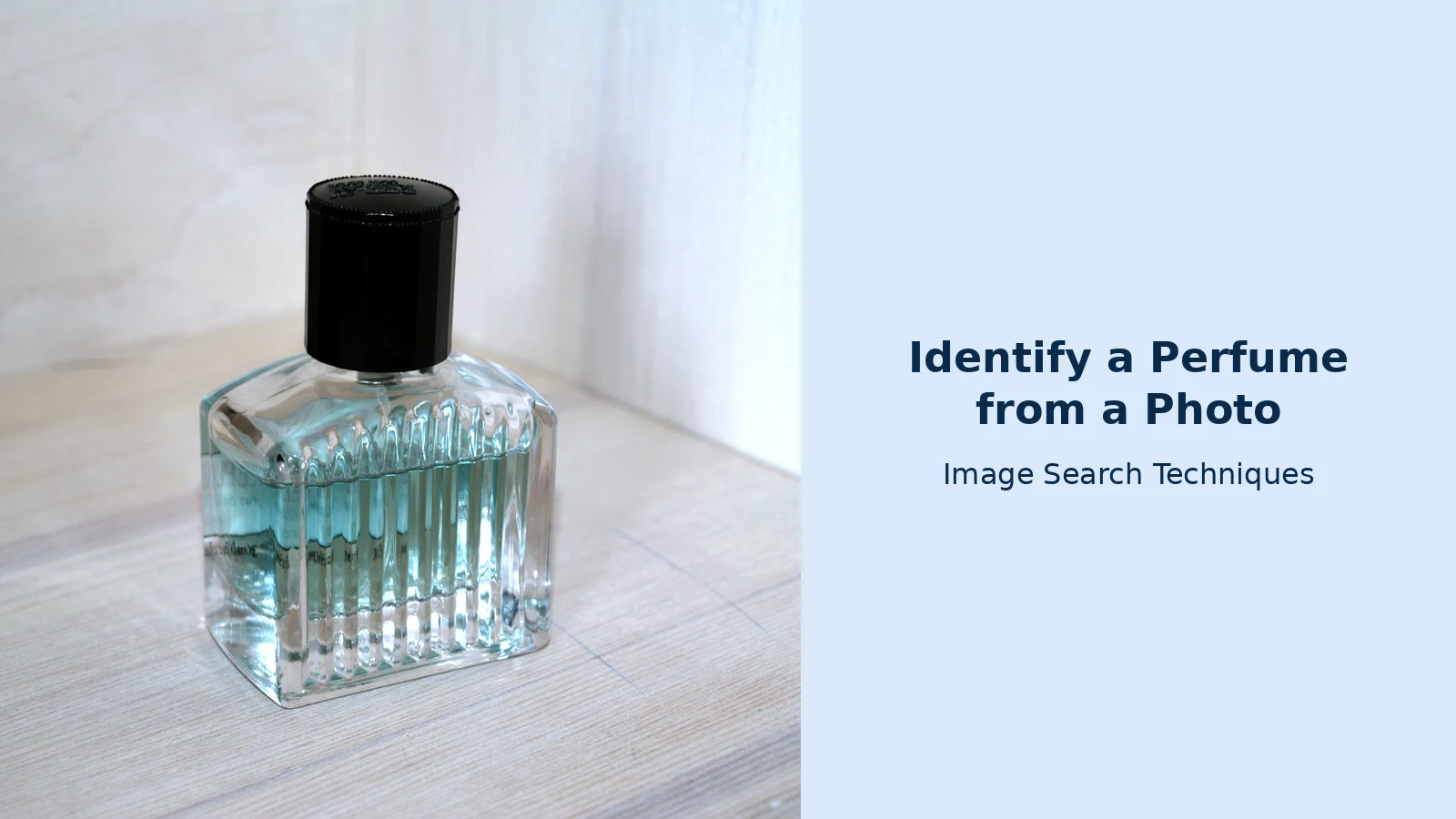
Direct answer: To identify a perfume from a photo, photograph the front, back, base and cap of the bottle, run the front photo through Google Lens for candidate matches, then confirm the match by reading the concentration, batch code and base text and checking them against a fragrance database such as Fragrantica.
A mystery bottle is one of the most common identification puzzles in fragrance. Labels fade, caps get swapped, gift sets lose their boxes, and a bottle bought second-hand may arrive with nothing but a worn sticker and a sprayer. The good news is that you can usually identify a perfume from a photo without smelling it at all, because a bottle carries far more clues than its front label: the shape of the glass, the hardware on the cap, the small print on the base, and the batch code etched underneath. This guide walks through the full method, from the four photos that identify most bottles to the checks that separate a real match from a look-alike flanker.
What Does It Mean to Identify a Perfume from a Photo?
Perfume bottle identification means working out the exact fragrance — brand, line, concentration and, where it matters, the edition — from pictures of the bottle alone. It is not the same as identifying a scent from a description: you are reading physical evidence, not guessing from notes. A complete identification answers four questions: which house made it, which fragrance line it belongs to, whether it is an eau de toilette, eau de parfum or parfum, and whether it is the original release or a later flanker.
That last distinction matters more than most people expect. Many designer lines reuse the same bottle for several scents, changing only the juice colour, the cap finish or a single word on the label. Two bottles can look identical in a front photo and contain completely different fragrances, which is why a single picture is rarely enough. The method in this guide treats the front photo as the starting point, not the answer, and uses the base text and batch code to confirm what the picture search suggests.
It also helps to know what photo identification cannot do. It cannot tell you what the liquid inside smells like, and it cannot prove that the liquid matches the bottle: a genuine bottle can be refilled with something else. What it can do, reliably, is name the bottle, narrow the edition, and give you the checks that catch most fakes and mismatches before you spend money.
The Four Photos That Identify Most Bottles
Before you search anything, take four photographs. Most identifications fail not because the tools are weak but because the photos miss the details that actually separate one bottle from another. Take the pictures in daylight near a window, with the flash off, and wipe the glass first: fingerprints and glare hide exactly the small print you need.
- Front, straight on. Fill the frame with the bottle, keep the label square to the camera, and include the cap. This is the photo a search engine will match against, so it needs to be sharp and free of reflections. Tilt the bottle slightly until any glare moves off the label.
- Back label. Even a scuffed back label matters, because it carries the distributor line, the country of manufacture, the volume and often the concentration. Photograph it close enough that the small print is legible, and take a second shot if the text wraps around a curve.
- Base and batch code. Turn the bottle over and photograph the bottom. This is where the batch code lives — a short mix of letters and numbers printed or etched into the glass — along with the concentration line, the volume and sometimes the manufacturer. The batch code is the single most specific clue on the bottle when the name is gone.
- Cap, collar and atomiser. Photograph the cap from the side and the sprayer with the cap off. Cap geometry, collar engraving, sprayer colour and actuator shape are often unique to a house or an era, and they survive even when the label has worn away completely.
If you still have the outer box, photograph that too: the bottom flap usually repeats the batch code and the barcode, and the box often has the clearest print of any part of the set. A box that matches the bottle is itself a useful authenticity signal, as the fake-check section below explains.
One practical tip from the same method applies to buying as well as identifying. When a seller cannot or will not provide these four angles — front, back, base and cap — treat that as a warning sign, not a minor omission. A genuine seller with the bottle in hand can take these pictures in two minutes, and the Nose Notebook guide to perfume bottle identification makes the same point: listings that avoid the base and cap angles deserve extra caution.
How Do I Identify a Perfume from a Photo with Google Lens?
Google Lens is the free first pass, and for most bottles it is the fastest route to a shortlist of candidates. It matches the shape, label layout and colours of your bottle against images across the web, including retailer listings, review sites and fragrance databases. It is particularly strong on current designer releases, where thousands of matching product photos exist, and weaker on very old or niche bottles with few images online.
To use it, open the Lens app or the Google app, tap the camera icon, and upload your straight-on front photo rather than photographing the bottle live. Uploading the clean front shot gives Lens a sharper image to work with than a live camera view in poor light. If the first result set is vague, crop the photo tightly around the bottle before searching again: background clutter is the most common reason Lens returns generic perfume images instead of your bottle.
Read the results as candidates, not verdicts. Lens will often return two or three similar bottles — the original and its flankers, or the same bottle in different sizes — and it cannot tell you which one you hold. That is expected. Note the names it suggests, then confirm them with the base text and the batch code in the next sections before you settle on an answer. If Lens returns nothing useful, try the back-label photo instead: the small print and distributor line sometimes match a listing that the front photo missed.
For the wider method behind this step, our guide to Google reverse image search explains how to crop, upload and read results, and our general how to reverse image search guide covers the same workflow on desktop and on other engines.
Worked example: a worn label, a gold cap and a batch code
Imagine a bottle found in a drawer: tall and rectangular, a gold cap, a front label worn down to a single readable fragment, “EAU DE PARFUM 50 ml”, and a four-character code etched on the base. This is an illustrative example, not a real bottle, but the steps are exactly the ones to follow with a real one.
First, the front photo goes into Google Lens. It returns a shortlist of two or three rectangular gold-capped bottles from the same house, which is normal: the shape narrows the field to one line, not one scent. Second, the back-label photo is read for the distributor line and country, which rules out one of the candidates, a regional release that was never distributed in that market. Third, the base photo is checked: the concentration line confirms eau de parfum, and the batch code is looked up on a batch-code decoder such as CheckCosmetic, which returns the production date the code corresponds to. If that date falls inside the production window of one candidate and outside the other’s, the identification is effectively settled. Finally, the surviving candidate is checked on Fragrantica for its launch year, bottle description and notes, and the juice colour is compared with the colour shown in the database photos. When all four checks point the same way, the identification is as solid as a photo-based answer gets.
How Do I Read the Batch Code and Base Text When the Label Is Gone?
The batch code on a perfume bottle is a short code, usually three to five characters of letters and numbers, printed or etched on the base of the bottle and repeated on the bottom flap of the box. It is not a serial number for your individual bottle: the same code appears on every bottle from the same production batch. Its value for identification is that it encodes the production date, and that date can rule candidates in or out.
To use it, photograph the base clearly, transcribe the code exactly — including the difference between the letter O and the number 0 — and enter it into a batch-code decoder such as CheckCosmetic, which covers most major houses. The decoder returns the production date the code corresponds to. Compare that date with the launch and discontinuation dates of your candidates on Fragrantica: a bottle whose code dates to 2019 cannot be a flanker launched in 2022, and a code that predates a fragrance’s launch year rules that fragrance out entirely.
The rest of the base text is just as useful. Read the concentration line first: eau de toilette, eau de parfum and parfum are different products even when they share a bottle, and the concentration is usually printed on the base even when the front label is gone. Then read the volume, the manufacturer line (“Made in France” and similar) and any recycling symbols. These details change between releases more often than people realise, so they are strong evidence when they match a candidate and a warning when they do not.
Two cautions apply. First, batch-code formats differ by house and some brands have changed their coding over the years, so a decoder result is a guide, not a certificate: treat a date that contradicts everything else as a reason to double-check the transcription before doubting the identification. Second, a batch code cannot prove authenticity on its own. Counterfeiters copy real codes, so a plausible date is necessary but not sufficient — the print-quality and seller checks in the final section still matter.
How Do I Confirm the Match on Fragrantica?
Once Lens has given you candidates, confirm them on Fragrantica, the large fragrance database and community that lists the concentration, notes, launch year and bottle description for each fragrance. Fragrantica lists 144,443 perfumes in its encyclopaedia, according to its own homepage, which makes it the most complete single reference for checking whether a candidate actually exists in the concentration and bottle you hold. Search the candidate name, open its page, and compare four things against your bottle: the launch year, the listed concentration, the bottle description and the juice colour in the database photos.
The flanker problem is the main trap at this stage. A flanker is a variation on an existing fragrance — same bottle family, a different scent — and houses release them constantly. When Fragrantica shows several entries that share your bottle shape, work through the differences systematically: juice colour, cap finish, label border and the concentration line. The Nose Notebook guide notes the same rule: if a scan returns multiple options, the exact juice colour, label border thickness and cap finish are what separate them. A bottle whose juice is pale gold is not the flanker whose juice is deep amber, however similar the glass.
Also check the “this perfume reminds me of” and review sections with care. They are useful for confirming that a fragrance was sold in your concentration and size, but they are opinions, not evidence. The factual fields — launch year, concentration, bottle and box description — are the ones that confirm or break an identification.
| Tool | Best for | What it cannot do | Cost |
|---|---|---|---|
| Google Lens | Fast candidate shortlist from a front photo | Separate flankers or confirm a match | Free |
| Fragrantica | Confirming launch year, concentration, bottle details | Identify a bottle from a photo alone | Free |
| Nose Notebook scanner | Bottle-shape matching and building a collection vault | Replace base-text and batch-code checks | Free to try |
| Batch-code decoder | Dating a bottle from its base code | Name the fragrance by itself | Free |
The table shows why no single tool finishes the job. Lens finds candidates, Fragrantica confirms the details, a bottle scanner such as the Nose Notebook perfume scanner adds shape matching, and the batch-code decoder dates the bottle. Used together, they cover each other’s gaps; used alone, each one leaves the flanker question open. The same layered approach works for other labelled objects, as our guide to identify a wine from a photo of its label shows: the label gets you close, the small print confirms it.
What If the Bottle Is a Decant or a Discontinued Perfume?
Two cases break the standard method, and both are common enough to plan for. The first is a decant: a small bottle, often unlabelled, filled from a larger bottle. Photo identification cannot work on a decant, because the bottle in the photograph is not the bottle the fragrance was sold in. If you hold a decant, the only useful photograph is of the original bottle it came from, or of any label the seller attached. A decant with no label and no provenance can be described by its scent, but it cannot be identified from a picture, and any guide that claims otherwise is guessing.
The second case is a discontinued perfume. Discontinued does not mean unidentifiable: Fragrantica keeps pages for discontinued fragrances, including their launch years and bottle descriptions, and Lens can still match the bottle shape against old listings and reviews. The identification itself works the same way, but the confirmation step changes: instead of checking a current retailer listing, check the Fragrantica page’s launch and discontinuation dates and compare them with the batch-code date. A bottle whose code dates to 2018 fits a fragrance discontinued in 2020; it does not fit one launched in 2021.
Discontinued perfume identification also has a practical limit worth stating plainly. The older and rarer the bottle, the fewer matching photos exist online, and the more the answer depends on the base text and batch code rather than on the picture search. For very old bottles, the cap and base photographs matter more than the front photo, because the front label is the part most likely to be gone. The same worn-label logic applies to music, incidentally: our guide to find a song or album from its cover art uses the same principle of reading what survives on the packaging when the obvious identifier is missing.
How Do I Check a Perfume Is Genuine Before I Buy It?
Identification and authentication are different jobs, and the photo checks that identify a bottle can also catch many fakes — provided you ask the seller for the right pictures before you pay. Counterfeit fragrance is one of the biggest reasons identification matters, and the Nose Notebook guide lists the same warning signs: listings that avoid the base, cap and box photographs are a risk, not an oversight.
Ask for the four photographs from the earlier section, and check them against the genuine article. On an authentic set, the batch code on the bottle matches the batch code on the box, the micro-text on the back label is sharp, the label sits straight, the crimping around the sprayer collar is even, and the cap fits firmly. Counterfeits most often fail in exactly these details: blurry micro-text, uneven label placement, sloppy crimping, a loose or suspiciously light cap, and a box code that does not match the bottle.
Then apply two common-sense checks that no photograph can replace. First, compare the price with the market: a steep discount on a sealed luxury fragrance is a classic counterfeit tell, even when the photos look right. Second, check the seller: a clear return policy and a consistent selling history matter, and a reputable retailer or a resale platform with an authentication process is safer than an anonymous listing with stock photos. If the seller uses stock photos instead of pictures of the actual bottle, walk away: you cannot identify, let alone authenticate, a bottle you have never seen.
Finally, remember the limit of the whole exercise. A clean photo pass is evidence, not proof: a good fake can pass a photograph, and only an in-person inspection or an official authentication can settle the question for an expensive bottle. Photo checks exist to filter out the obvious fakes cheaply, before money changes hands — and for that job, done carefully, they work well. If you are still unsure what you are looking at, our what is this picture guide covers the same identify-first, verify-second routine for any mystery image.
FAQs
What perfume is this if the label is completely gone?
Start with the four photographs: front, back, base and cap. Run the front photo through Google Lens for candidates, then use the base text and batch code to narrow them down. The concentration, volume and manufacturer text usually survive even when the name is gone, and a batch-code decoder can date the bottle, ruling out later launches.
Can Google Lens identify a perfume bottle on its own?
Lens is a strong first step, not a complete answer. It matches your bottle’s shape and label against images online and usually returns a shortlist, but it cannot reliably separate flankers that share a bottle, and it struggles with very old or niche releases. Treat its results as candidates and confirm the match on Fragrantica.
How do I read a batch code on a perfume bottle?
Find the code on the base of the bottle or the bottom flap of the box: a short mix of letters and numbers, usually three to five characters. Photograph it clearly, transcribe it exactly, and enter it into a batch-code decoder such as CheckCosmetic, which returns the production date. Compare that date with your candidate’s launch year on Fragrantica.
How can I tell if a perfume bottle in a listing is fake?
Ask the seller for front, back, base and cap photos of the actual bottle, not stock images. Check that the batch codes on bottle and box match, that the back-label micro-text is sharp, that the label sits straight, and that the cap fits firmly. Be wary of steep discounts on sealed luxury bottles and sellers with no return policy.
The same compare-before-you-commit habit helps you identify a paint colour from a photo, photographing it in daylight, shortlisting the shades, then proving the match with a sample pot.
