🔎 Reverse Image Search
Image search techniques made simple: upload a photo or paste a URL and search 6 engines at once. 100% free, nothing stored.
🔒 Your image is never stored on our servers longer than 24 hours and is never shared.
A photo of a sheep in a field can tell you a surprising amount, but only if you read it in the right order. Most people start with the wool, because that is what fills the frame. That is the wrong place to start. The face and the legs narrow the field far faster, the wool confirms or challenges that first guess, and the horns and body shape finish the job. Read in that order, face, wool and horns first, and a single photo can usually point you to the most likely breed.
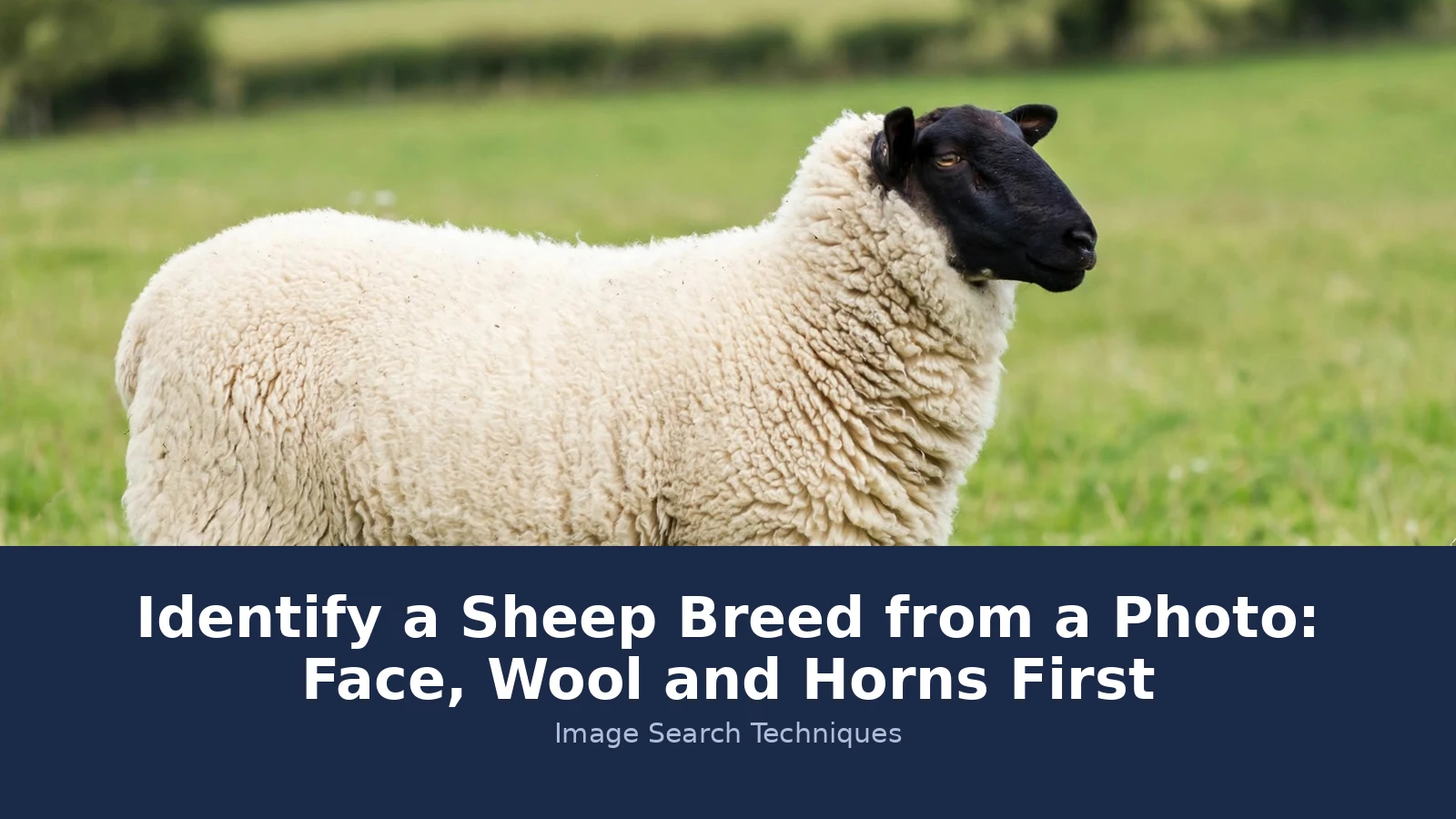
Look at the face and legs first, then the wool, then the horns and body. A black face and legs with a white fleece points to a Suffolk, while a broad white face with a woolly top knot points to a Romney. Crossbreeding blurs these traits, so a photo usually suggests the most likely breed rather than proving pedigree.
There are more than 1,000 sheep breeds in the world, and many of them look alike at a glance. Closely related breeds can share the same wool colour, the same body shape and even the same face markings. That is why a photo alone is often not enough for an exact answer, and why the honest result of a photo check is usually “most resembles” rather than “definitely is”. This guide shows you how to work through a photo step by step, how to run a reverse image search on it, and how to read the result without overclaiming what it proves.
Can a photo really identify a sheep breed?
A photo can suggest a likely breed, but it can never prove pedigree.
That single rule shapes everything else in this guide. A pedigree is a paper record of parentage, kept by a breeder or a breed society. No photo carries that record. What a photo does carry is a set of visible traits, and those traits belong to breeds in patterns that are strong enough to narrow the answer down to one or two candidates in many cases.
Crossbreeding is the main reason a photo check stops short of certainty. A crossbred sheep can inherit the black face of one parent and the long wool of another, or the horns of one breed and the body of a different one. When the traits in a photo point in two directions at once, the right answer is to say so plainly and name the breed the animal most resembles, not to force a single label onto a mixed animal. If you need an exact answer for a sale, a show entry or a breeding decision, you need the pedigree, the breeder or a DNA test. A photo cannot stand in for any of those.
There is one more limit worth stating early. Do not approach or handle an unfamiliar sheep to get a better photo. Sheep in a field belong to someone, and a strange animal can be frightened, protective or simply unpredictable. Work with the photo you already have, or take your picture from a public path at a safe distance. A closer photo is never worth a risk to you or stress to the animal.
What makes a good photo for breed identification?
A clear side view in daylight, with the whole animal in frame, beats ten blurry close ups.
Before you search or compare anything, check the photo itself. The best breed photo shows the sheep standing side on, in natural daylight, with its face, legs, wool, horns and tail all visible. The animal should fill most of the frame, and the background should be plain enough that the fleece colour is easy to read. A photo taken from behind, in deep shade, or through a fence with the face hidden will slow you down, because the two most useful traits are the ones you cannot see.
Ask for a second photo if the first one hides the face or the legs. One extra picture, taken from the side in better light, often settles a question that an hour of searching cannot. If the sheep is a lamb, say so in your notes. Lambs change as they grow, and their adult wool and face markings may look quite different from what you see in the photo. Note the place and the date too. A sheep photographed at a British agricultural show is far more likely to be a recognised British breed than a rare overseas one, and that context helps you weigh the candidates.
How do I identify a sheep breed from a photo step by step?
Work in order: reverse search the photo, read the face and legs, read the wool, then read the horns, body, ears and tail.
Start with a reverse image search. Upload the photo to Google Lens, then try Yandex Images as a second engine. Lens is good at naming what it sees and finding pages that use the same photo, while Yandex is often strong on visual matches and can suggest a breed name even when Lens stalls. Run both, because they index different collections and one often finds what the other misses. TinEye is worth a try too, but it only finds exact copies that it has indexed, so a zero there means nothing more than “no copy found”.
Save the original file if you can, rather than a screenshot of it. A screenshot loses detail and can confuse the search engines, and in our own test below the direct original file failed on Lens while a smaller thumbnail of the same photo worked. If one version of the file fails, try a resized copy before you give up on that engine. Keep a note of what each engine said, including the failures. A failed search is still a result, and it stops you from trusting a single engine too much.
Once the search results are in, read the traits in order with our find an item by image guide, which covers the same photo-first method in detail. Compare what the engines suggest with what you can see in the photo yourself. If Lens says Suffolk and the photo shows a black face, black legs and a white fleece, the two lines of evidence agree. If the engines disagree with each other, trust your own reading of the face, wool and horns over a single search label, and check the breed against an authoritative source before you settle on an answer.
What does the face and leg colour tell me?
Face and leg colour is the fastest clue, because it splits the common British breeds into two clear groups.
Start here, before you look at the wool. A white or cream face and legs suggests a Romney or a Merino. A Romney has a broad white face with a woolly top knot, a tuft of wool on top of the head that is easy to spot in a side photo. A Merino is usually smaller and finer boned, with dense, curly, fine wool and a plain white face. A black or dark face and legs points in a different direction entirely, towards the Suffolk, the Oxford, the Shropshire or the Hampshire Down. Of those, the Suffolk is the most familiar in Britain, with a clean black head and black legs, no wool on the face, and a long body covered in white fleece.
Face shape matters as much as colour. Look for the top knot on a Romney, the long face of a Suffolk, and the short, compact face of a Southdown. Look at the ears too. Long ears suggest a Teeswater, a breed known for its long, drooping ears and long, curly fleece. Short ears tell you less on their own, so treat them as a supporting clue rather than a deciding one. If the face is hidden by wool, shadow or a fence, say so and move on to the wool. Guessing a face colour you cannot see is how a wrong breed name gets attached to a photo.
What does the wool tell me about the breed?
Wool type and length confirm or challenge the face clue, and coloured wool is one of the strongest single signs.
Long, straight, coarse wool suggests a Romney or a Lincoln, both longwool breeds with heavy fleeces. A Romney fleece weighs about 3 to 5 kg, measures 10 to 17 cm long, and sits at 31.5 to 34 micron. A Suffolk fleece is lighter and shorter, about 2.5 to 3 kg and 5 to 10 cm long, at 31 to 34 micron, which fits its shorter, denser coat. Curly, dense, fine wool points towards a Merino, the classic finewool breed, while a very long, curly fleece with a silky look suggests a Wensleydale or a Teeswater.
Not every sheep has wool. A Dorper, for example, has a short coat of wool and hair that sheds in late spring and summer, so it never needs shearing, and its white body and black head are easy to spot. If the coat in your photo looks smooth and hair-like, with no fleece to measure, think hair breed first, not one of the wool breeds above.
Coloured or multicoloured wool is a gift when it appears, because few breeds carry it. A Jacob often shows black and white patches across the body, and that pattern, together with its horns, is hard to mistake for anything else. A white fleece is the hardest case, because so many breeds are white, which is exactly why the face and legs come first. Read the wool after the face, never instead of it, and check what you see against the British Wool breed factsheets, which give fleece weight, length and micron figures breed by breed. The factsheets cover the Romney, Suffolk, Swaledale, Cheviot, Mule, Wensleydale and Jacob, one breed per page, and they are a useful check against a guess made from wool alone.
What do horns, body build, ears and tail tell me?
Horns and build separate breeds that share the same face and wool, so read them last and read them carefully.
Large, curved horns suggest a Jacob, which often carries four horns, two upright and two curving sideways, though some Jacobs have two. Spiral horns point to a Racka, while a polled head, meaning no horns at all, fits a Suffolk, which is naturally hornless. Do not treat the absence of horns as proof of a Suffolk on its own. Ewes of several horned breeds can be polled, and rams and ewes of the same breed can differ, so horns are a clue that needs the face and wool beside it.
Body build is the next check. A larger, stockier build suggests a Suffolk or a Hampshire Down, both heavy meat breeds with long bodies and strong legs. A smaller, compact build suggests a Shetland or a Southdown, neat little sheep that look sturdy rather than tall. The tail is a quieter clue, but it can settle a close call. A short tail suggests a Northern European short-tailed breed, such as the Shetland or the Faeroes sheep. A fat tail points to breeds such as the Awassi. Most British commercial breeds have a medium tail that tells you little, so only lean on the tail when it is clearly short or clearly fat.
| Breed | Face and legs | Wool | Horns and build | Tail and ears |
|---|---|---|---|---|
| Suffolk | Black head and legs, no wool on the face | White fleece, 2.5 to 3 kg, 5 to 10 cm, 31 to 34 micron | Polled, long body, large and stocky | Medium tail, medium ears |
| Romney | Broad white face with a woolly top knot | Heavy white fleece, 3 to 5 kg, 10 to 17 cm, 31.5 to 34 micron | Polled, large frame, longwool type | Medium tail, medium ears |
| Merino | White or cream face and legs | Curly, dense, fine wool | Polled or small horns, smaller and finer boned | Medium tail, short ears |
| Jacob | White face, often with black patches | Coloured or multicoloured wool, black and white patches | Two or four horns, often large and curved, medium build | Medium tail, medium ears |
| Shetland | Small face, varied colours | Fine, soft wool in many colours | Small and compact, rams often horned | Short tail, a Northern European short-tailed breed |
| Teeswater | White face with dark markings | Long, curly, lustrous fleece | Large frame, longwool type | Medium tail, long drooping ears |
| Southdown | Mouse brown or grey face, woolly cheeks | Short, dense, fine wool | Polled, small and compact | Medium tail, short ears |
Use this table as a cross-check, not as a verdict. Find the row that matches most of the traits in your photo, then look for the trait that does not fit. One trait that breaks the pattern is often the sign of a crossbreed, and two traits pointing elsewhere means you should widen the search rather than force the first name that came to mind.
Worked example: a Suffolk sheep at Masham Sheep Fair
A real reverse search named this sheep a Suffolk, but only one of the three engines found the exact source page.
For the worked example I used a real photograph, not a stock image chosen to fit the answer. The file is “Suffolk Sheep.JPG” on Wikimedia Commons, photographed by Jane Cooper Orkney and shared under a CC BY-SA 4.0 licence. It was taken on 25 September 2010 at Masham Sheep Fair, and the file measures 3,648 by 2,736 pixels. The photo shows one Suffolk sheep in left profile, with a black face and black legs and a cream white woolly body. A second sheep and several people stand behind a wooden pen fence in the background. Before running any search, the visible traits already point one way: black face and legs, white fleece, a long body and a polled head with no horns. That is the Suffolk pattern from the table above, and it is worth writing down before the search results can colour your judgement.
Google Lens failed twice on the direct original file. The first attempt returned “Something went wrong, No image at the URL”, and the second returned “Expired visual search”, with zero results in both cases. The same photo worked when I used the 960 pixel thumbnail version of the file instead. That time Lens named the sheep a Suffolk, describing a white fleece, a polled hornless head and a wool-free black face and legs, and citing Wikipedia as its source. Lens reported 11 exact matches, and the first was the exact Commons source page for the photo. The rest reused the same photo on other pages, and all of them were Suffolk. Lens also loaded 60 visual matches, and the first was the exact Commons file. The rest were mostly Suffolk breed pages, with a few off-target items mixed in, including Cholistani, Clun Forest and Oxford sheep. Those off-target matches are a useful reminder that visual matches are suggestions, not identifications, and they need a human reading beside them.
TinEye found nothing at all. It reported zero matches, saying it had searched over 86.9 billion images but did not find any matches, and the exact Commons page was not found. A Cloudflare human check appeared before the result loaded, which is a hurdle worth noting if you run the same test and see a check page first. A zero from TinEye does not mean the photo is new or the sheep is unidentified. It means only that TinEye has not indexed a copy of that image. Treat a TinEye zero as a zero, report it honestly, and move on to the next engine rather than treating it as evidence about the breed.
Yandex Images worked by direct URL, where Lens had failed. It tagged the photo “suffolk sheep” and “black-faced sheep”, and offered Romanov as an alternative breed. It showed 20 similar images, and the exact photo appeared among them on Pinterest and ABC pages and in the French Wikipedia article on the Suffolk sheep. The Sites tab listed 20 sites, but the exact Commons file page was not among them. So Yandex named the breed correctly and found the photo in use, but it did not find the original source page.
The conclusion is plain. Lens, using the thumbnail, was the only engine to find the exact source page and name the Suffolk. Yandex named the Suffolk but missed the exact source. TinEye found nothing. None of that proves pedigree, and I am not claiming it does. What it does show is the value of running more than one engine, trying a resized copy when the original file fails, and reading the traits in the photo yourself. The final step was to read the face, wool and horns checklist against the photo and confirm the breed on the British Wool factsheet and the Suffolk sheep breed page on Wikipedia, which describes the black head and legs, the long body and the breed history back to its recognition in 1810. The photo, the search results and the breed references all agreed, and that agreement is what makes this a Suffolk with confidence, not any single result on its own.
How do I read the breed-traits checklist?
Check each trait against the photo, then count how many traits agree before you name a breed.
This is the ranking asset for this guide: the breed-traits checklist. Work down the rows in order and write a short note for each one. A trait you cannot see gets a dash in your notes, not a guess. When three or more traits point to the same breed and none clearly contradicts it, you have a likely breed. When the traits split between two breeds, you have a likely cross, and the honest answer names both parents as possibilities.
| Trait | What to look for | Likely purebred sign | Likely crossbreed sign |
|---|---|---|---|
| Face colour and shape | Colour of the face and muzzle, wool on the face, top knot, face length | One clear colour and shape that matches a single breed, such as a clean black Suffolk face or a broad white Romney face with a woolly top knot | Two colours mixed on the face, a faint top knot, or a face shape that sits between two breeds |
| Wool type and length | Straight or curly, fine or coarse, short or long, fleece weight if known | Wool that matches the face clue, such as short white fleece with a black face for a Suffolk, or long coarse wool with a white face for a Romney | Wool that contradicts the face clue, such as fine curly wool on a sheep with a Suffolk face, or patchy wool of uneven length |
| Horn shape | Polled or horned, horn size, curve and number | Horns that fit the breed, such as four horns on a Jacob or a clean polled head on a Suffolk | Small or uneven horns on a breed that should be polled, or a single horn shape that matches neither parent breed cleanly |
| Body size | Height, length, stockiness, leg length | Size and build that match the breed, such as large and stocky for a Suffolk or small and compact for a Shetland | A body that is larger than one parent breed and smaller than the other, or long legs with a compact body |
| Tail | Tail length and thickness | A tail that fits the breed, such as a short tail on a Northern European short-tailed breed | A tail of medium length on a breed that should have a clearly short or fat tail |
Run the checklist twice on a difficult photo: once for the breed you suspect, and once for the nearest alternative. If the second pass fits almost as well as the first, the photo alone cannot separate them, and you should say that. A checklist that forces a single answer on a mixed animal is worse than no checklist at all, because it hides the very uncertainty the reader needs to see.
What if the sheep is a crossbreed?
If the traits point in two directions, the honest answer is “most resembles” and the names of both likely parents.
Crossbred sheep are common on commercial farms, where a breeder may cross a Suffolk ram with a Mule ewe to combine fast growth with hardiness and good mothering. The lambs from such a cross can show a Suffolk face with a longer, softer fleece, or a Mule body with darker legs than either parent would show alone. No checklist can unmix that animal from a photo, and no search engine can either. The right way to report it is to list the traits that fit each parent, name the breed it most resembles, and note that only the breeder or a pedigree record can confirm the cross.
Closely related breeds cause the same problem without any crossing at all. A Suffolk and a Hampshire Down share a black face, black legs and a white fleece, and a single side photo may not separate them. In that case the differences are in the details: the Suffolk is usually longer in the body, while the Hampshire Down is stockier with a woollier face. If those details are not visible, say the photo fits both and name the one it most resembles. Readers trust a guide that admits its limits far more than one that pretends every photo has a single certain answer.
What mistakes do people make when identifying sheep from photos?
The most common mistake is naming a breed from one trait, usually the wool, and ignoring the face.
The second mistake is trusting a single search result. A reverse image search can name the wrong breed with confidence, especially when the photo is a common stock image that appears on pages about several breeds. Our worked example showed this clearly: Lens failed twice before it worked, TinEye found nothing, and Yandex offered Romanov as an alternative. Any one of those results, taken alone, would have misled a reader. Run at least two engines, read the traits yourself, and check the answer against a breed reference before you settle on a name.
The third mistake is forgetting that lambs, shearings and seasons change how a sheep looks. A freshly shorn sheep shows its body shape and face clearly but hides its wool type. A sheep in full winter fleece hides its body shape and can look larger than it is. A lamb may not yet show the adult face markings or horn growth. Note the season and the age in your reading, and be slower to name a breed when the photo was taken just after shearing or when the animal is very young.
The fourth mistake is copying a breed name from a social media quiz or a listicle without checking it. British Wool runs a “Guess the Breed” series on Instagram and Facebook, where a photo is posted with three clues and followers guess in the comments. It is a fun quiz, but the caption gives no official answer, no reverse image method, no worked example and no comparison table, so it cannot confirm a breed for you. The Mental Floss list of 11 distinctive breeds, published on 19 February 2015, gives one photo and a short paragraph per breed, covering the Jacob with four horns, the Najdi with long drooping ears, the Balwen Welsh Mountain with a black body and white blaze, the Awassi with a fat tail, the Badger Face Welsh Mountain, the Zwartbles, the Bluefaced Leicester, the Racka with spiral horns, the Faeroes with a short tail, the Manx Loaghtan with four horns and the Wensleydale with long curly fleece. It is a readable introduction, but it includes neither the Suffolk nor the Romney among its 11, and it offers no reverse image method, no worked example and no table. Use those pages for ideas, then do the search and the checklist yourself.
When is a photo not enough?
A photo is not enough when two breeds fit equally well, when the traits are mixed, or when the answer has to be exact.
For a casual question, such as naming the breed of a sheep in a holiday photo, a careful “most resembles” answer is enough, and this guide gives you a sound way to reach it. For anything that depends on the answer, it is not. A show entry, a sale description, a breeding decision and a breed society registration all need proof that a photo cannot give. In those cases, ask the breeder for the pedigree, check the breed society records, or arrange a DNA test. That is not a failure of the photo method. It is the method working as it should, by telling you where its own limit lies.
If you cannot reach the breeder, say so and keep the photo answer as a suggestion only. Do not dress it up as a certainty to make the report sound stronger. A reader who later learns the sheep was a cross will forgive a careful “most resembles Suffolk” far sooner than a confident label that turns out to be wrong.
Can I use the same method for other animals?
Yes, the same photo-first method works for other farm animals, because the order stays the same: search the photo, read the face, then read the coat, horns and body.
Start with a clear side photo, run Lens and Yandex, read the traits in order, and check the result against an authoritative breed reference. The traits change with the animal, but the discipline does not. If you want to practise the method on a different animal, our guides cover how to identify a goat breed from a photo, how to identify a duck breed from a photo, how to identify a horse breed from a photo and how to identify a dog breed from a photo. Each one follows the same steps: a real reverse search, an honest report of what each engine found, and a checklist that admits when a photo can only suggest an answer.
Sheep are a good place to start, because their breed traits are visible and well documented, and because a single photo often narrows the answer to two or three candidates. Work through the checklist slowly, keep your notes, and let the photo speak before the search results do. The breed name matters less than the care you take reaching it, and a careful “most resembles” is always a better answer than a confident guess.
Can a photo identify a sheep breed exactly?
No. A photo can suggest the most likely breed from visible traits such as face colour, wool type, horns and body shape, but it cannot prove pedigree. Crossbreeding mixes traits from two parents, and closely related breeds can look alike. For an exact answer you need the pedigree, the breeder or a DNA test.
What is the first thing to look at in a sheep photo?
Look at the face and legs first. A black face and legs with white fleece points to a Suffolk, Oxford, Shropshire or Hampshire Down, while a white or cream face and legs suggests a Romney or Merino. Face colour splits the common British breeds faster than wool does, so read it before anything else.
How do I tell a Suffolk from a Romney in a photo?
Check the face first. A Suffolk has a black head and black legs, no wool on the face, a long body and a short white fleece. A Romney has a white face with a top knot and a long white fleece. A black face rules out a Romney, and a white face with a top knot rules out a Suffolk.
Why did TinEye find nothing for my sheep photo?
TinEye only finds copies that it has indexed, so a zero means it holds no copy of your image, not that the photo is new or the breed is unknown. In our worked example TinEye reported zero matches for a Suffolk photo that appears on many pages. Run Google Lens and Yandex Images as well before you draw a conclusion.
How can I tell if a sheep is a crossbreed from a photo?
Look for traits that point in two directions at once, such as a Suffolk face with curly wool, or a Jacob pattern with a polled head. One trait that breaks the pattern is often the sign of a cross. Name the breed the animal most resembles, list the traits that do not fit, and confirm the cross with the breeder.
Should I approach a sheep to get a better photo for identification?
No. Do not approach or handle an unfamiliar sheep to get a closer picture. Sheep in a field belong to someone, and an animal can be frightened or unpredictable. Take your photo from a path at a safe distance, or use the photo you already have. A picture is never worth a risk to you or stress to the animal.