🔎 Reverse Image Search
Image search techniques made simple: upload a photo or paste a URL and search 6 engines at once. 100% free, nothing stored.
🔒 Your image is never stored on our servers longer than 24 hours and is never shared.
A photo can tell you a lot about a goat. The ears, the shape of the face, the horns and the coat often point straight at a breed, or at least at a small group of breeds. What a photo cannot do is prove pedigree. That takes papers, and no search engine can supply those.
Short answer: yes, you can usually identify a goat breed from a photo, by reading the ears, facial profile, horns, coat and body size together. Long, drooping ears with a Roman nose point to a Nubian. Tiny ears point to a LaMancha. A white body with a red-brown head points to a Boer. One trait alone is rarely enough, so work through the checklist below, then confirm the guess with a reverse image search.
Can you identify a goat breed from a photo?
You can, within limits. A clear photo of a goat shows the traits breeders selected for: ear shape and length, the curve of the face, horn shape, coat colour and pattern, and the size and build of the animal. Put those together and most goats land in one breed, or in a group of two or three that look alike.
The limit matters more than the method. A photo can only suggest a likely breed. It cannot prove pedigree or registration, because pedigree is a paper trail, not a look. Crossbred goats mix traits from two parents, so the honest answer is often “most resembles a Nubian” rather than “is a Nubian”. That is still a useful answer. It tells you what the goat probably is, what it was bred for, and what to check next.
What “breed” means here. A breed is a group of domestic goats that shares consistent, inherited traits because breeders selected for them over generations. The domestic goat is one species, so breeds are not different animals. They are different looks and purposes within the same animal, which is why a photo works at all.
Wild relatives are a different matter. An ibex or a markhor is a wild species, not a domestic breed, and it will not match any breed standard. If the animal in your photo has the heavy curved horns and coarse coat of a wild goat, it is probably not a farm breed at all. Our guide to identifying a bird from a photo follows the same wild-versus-domestic logic, and it is worth reading if your photo was taken on a hillside rather than in a pen.
Answer capsule: A photo can suggest a breed from visible traits, but it can never prove pedigree, so treat the result as a likely match and check it.
What should you photograph before you start?
Most failed identifications start with a bad photo, not a hard breed. A head shot hides the body. A photo from the front hides the profile. A goat lying down hides the legs. Before you search, take the photos a breed judge would want to see.
- Whole goat, side on. Stand level with the goat and take the full body in profile, head to tail, all four legs visible. This one photo carries the most information: size, build, coat pattern and posture.
- Head in profile. Get close enough to show the nose line clearly. The difference between a Roman nose and a straight profile is the single best clue for several breeds, and it only shows from the side.
- Both ears. Photograph the ears hanging naturally. Note whether they are long and pendulous, upright and alert, or so short they are almost absent. Ear length is the first thing most breed guides ask about.
- Horns, if any. Photograph the horns from the side and the front. Note whether they curve back, sweep out, or are missing entirely. Some goats are naturally polled, meaning hornless, and that is a breed trait in itself.
- Coat and markings. Take a clear shot of the coat in daylight. Record the main colour, any patches, stripes on the face or legs, and whether the hair is short and sleek or long and shaggy.
- Something for scale. A fence post, a bucket or a person standing nearby gives the size away. Without scale, a miniature breed and a standard breed can look identical in a photo.
Take the photos in daylight, with the sun behind you, and keep the goat still if you can. A blurry ear or a shadowed face wastes the whole exercise. And never handle an unfamiliar goat to get a better photo. A strange goat can bite, butt or bolt, and no identification is worth a kick. Photograph from outside the pen if the animal is not yours.
Answer capsule: Photograph the whole goat side on, the head in profile, both ears, the horns and the coat, with something in frame for scale.
Which traits separate goat breeds?
Goat breeds were developed for four jobs: milk, meat, fibre and small-scale keeping. The job shaped the animal, so the traits cluster by group. A dairy goat is usually tall, angular and fine boned. A meat goat is stocky and heavily muscled. A fibre goat carries a long fleece. A miniature breed is simply small in every direction. The table below is the checklist to work through, trait by trait, and it is the heart of this guide.
| Trait | Dairy breeds | Meat breeds | Fibre breeds | Miniature breeds |
|---|---|---|---|---|
| Ears | Long and pendulous (Nubian); upright and alert (Alpine, Toggenburg, Saanen); tiny or near absent (LaMancha) | Long and pendulous (Boer); upright (Kiko) | Drooping, often hidden in fleece (Angora); upright (Cashmere) | Small and upright (Nigerian Dwarf, Pygmy) |
| Facial profile | Strongly Roman, convex nose (Nubian); straight profile (Saanen, Alpine) | Roman nose (Boer); straight to slightly convex (Kiko) | Straight profile, often partly hidden by fleece | Straight profile, short face (Nigerian Dwarf, Pygmy) |
| Coat | Short and sleek; many colours and patterns (Nubian); solid white or cream (Saanen) | Short; white body with red-brown head (Boer); varied (Kiko, Spanish) | Long mohair locks (Angora); soft down undercoat (Cashmere) | Short to medium; many colours and patterns |
| Horns | Usually present; some lines polled | Usually present | Usually present | Usually present, small |
| Body size | Medium to large, tall and angular | Large, stocky and heavily muscled | Medium, hidden under fleece | Small and stocky, clearly shorter than a standard breed |
Work down the rows, not across them. Start with the ears, because they split the field fastest. Then check the face, then the coat, then the size. If three traits agree, you probably have the breed. If they disagree, you probably have a crossbreed, and the next section explains what to do about that.
The breed profiles on the Oklahoma State University Breeds of Livestock goat pages are the best free reference for checking a guess. They list the standard traits for each breed, and they are the source the AI Overview for this question points readers to. Keep the page open while you work through the table.
Answer capsule: Ears split the field fastest, then the face, coat and size confirm the guess, and three traits agreeing is enough to name a likely breed.
How do ears, face and horns point to a breed?
Some traits are louder than others. Three of them do most of the work, so it is worth knowing exactly what to look for in each.
Start with the ears
Ears are the fastest split in goat identification. Long, pendulous ears that hang well below the jaw belong to a small set of breeds: the Nubian, the Boer and the Jamunapari. Upright, alert ears that stand forward belong to another set: the Alpine, the Toggenburg, the Saanen and the Oberhasli. Ears so short they look almost absent belong to exactly one common breed, the LaMancha, whose ears are described as “gopher” (very short, almost no flap) or “elf” (short, upright, with a little cartilage). If you see gopher ears, you are nearly done. Nothing else common looks like that.
Ear length also separates lookalikes. The Nubian and the Boer both have long drooping ears and a Roman nose, so people confuse them. The coat settles it: a Boer is a white body with a red-brown head, while a Nubian comes in many colours and patterns. The Toggenburg and the Alpine both have upright ears, but the Toggenburg wears a brown coat with white stripes on the face, legs and tail, and the Alpine does not.
Read the face in profile
The facial profile is the second big clue, and it only works from the side. A strongly convex, Roman nose belongs to the Nubian, the Boer and the Damascus, whose Roman nose is pronounced. A straight profile belongs to most other breeds, including the Saanen, the Alpine and the Toggenburg. A slightly dished face, curving inward, shows up in some dairy lines but is not a breed marker on its own.
Look at the whole head, not just the nose. Nubians have a long head to match their long ears, and a short, sleek coat. Saanens are white or cream all over, with a straight face and upright ears. The combination matters: a Roman nose plus long ears plus a white body with a red head is a Boer, while a Roman nose plus long ears plus a patterned coat is a Nubian.
Check the horns and the coat
Horns are useful but weaker evidence than ears or face, because horn shape varies within a breed and some goats are naturally polled, meaning hornless. A goat with no horns may be naturally polled or disbudded as a kid, and a breed guide will tell you which is normal for the breed you suspect. Treat horns as a supporting clue, not a deciding one.
Coat is the third check. A long, shaggy fleece means a fibre breed: Angora for mohair locks, Cashmere for soft down. A short, sleek coat in many colours means a dairy breed like the Nubian. A solid white or cream coat with upright ears is very likely a Saanen. A white body with a red-brown head is a Boer until proven otherwise. Brown with white face, leg and tail stripes is a Toggenburg. Bay with black markings is an Oberhasli. Golden all over is a Golden Guernsey.
Size is the last check, and it needs scale in the photo. A Nigerian Dwarf or a Pygmy is small and stocky, clearly shorter than a standard dairy goat. If the goat in your photo is knee high to an adult, it is a miniature breed, whatever its ears look like. If it is waist high, it is a standard breed.
Answer capsule: Ears split the breeds first, the face confirms the split, and horns, coat and size settle the close calls between lookalikes.
Worked example: an Anglo-Nubian photo, reverse-searched live
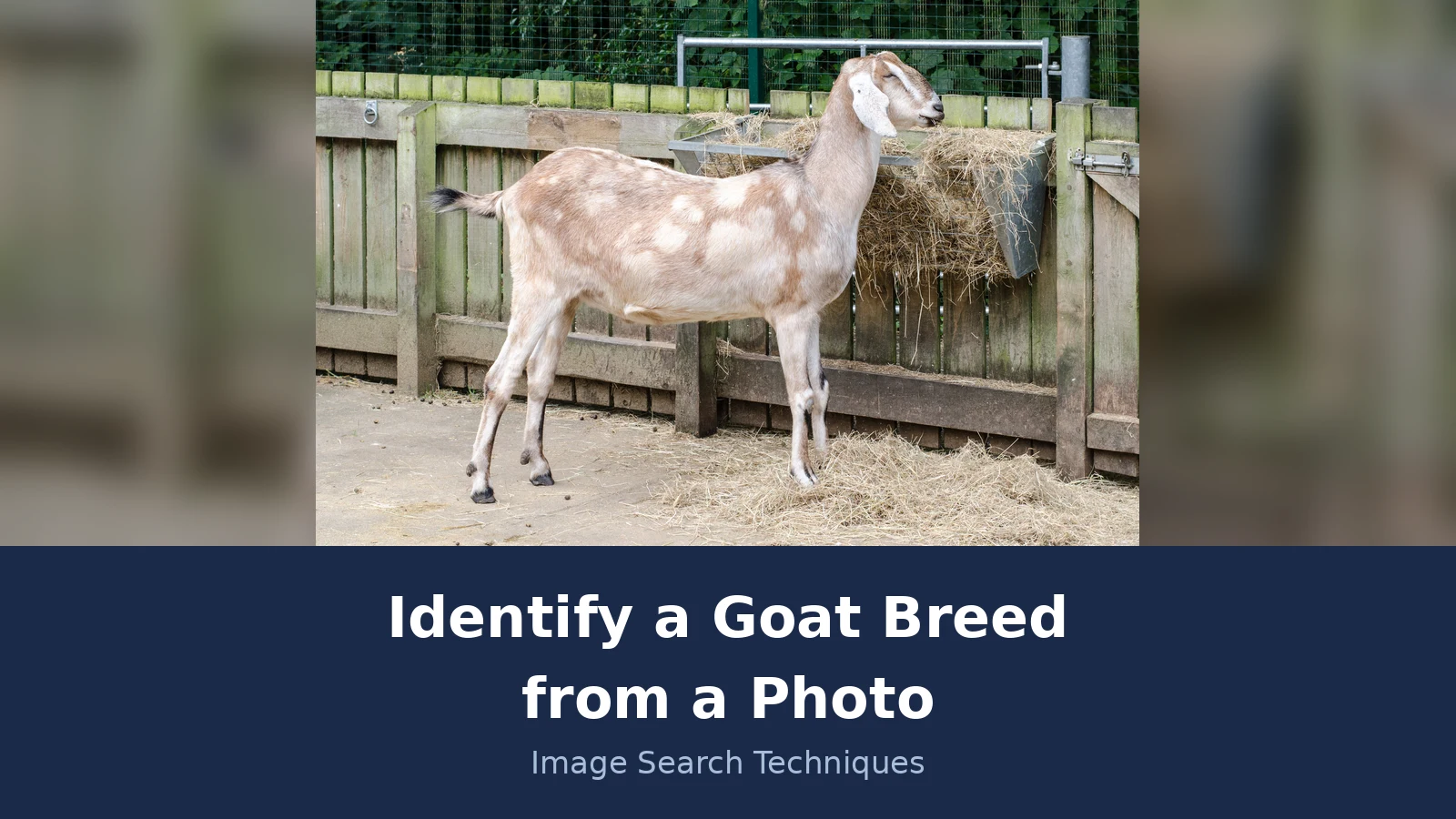
Theory is easy to write and hard to trust, so here is a real photo worked through from start to finish. The photo is “Anglo-Nubian goat.jpg” by Arseni Mourzenko, taken on 17 August 2016 at Jesmond Dene and shared under a Creative Commons Attribution 2.0 licence. It shows a whole Anglo-Nubian goat standing in profile facing right in a pen with hay: light brown and white spotted coat, long pendulous white ears, a Roman nose, a long neck and all four legs visible. It is the kind of photo a smallholder would actually take.
Reading the traits first, before any search: the ears are long and hang well below the jaw, which narrows the field to the Nubian, Boer and Jamunapari group. The face has a clear Roman, convex nose, which keeps the Nubian and Boer in play and rules out the straight-faced dairy breeds. The coat is light brown and white spotted, not the white body with red-brown head of a Boer, which rules the Boer out. The body is medium to large and dairy shaped, not stocky like a meat goat. Three traits agree on Nubian, so the working guess is Anglo-Nubian.
Then the photo was reverse-searched live on 21 November 2026, on Google Lens, TinEye and Yandex Images, to see whether the engines agreed.
| Engine | Result, 21 November 2026 | Named the breed? |
|---|---|---|
| Google Lens | Blocked, not a zero. Four attempts by image URL all failed with “No image at the URL”, after the reCAPTCHA check was cleared. A control test with a Google-hosted image worked fine, so the failure is specific to Wikimedia-hosted URLs in this case. | Not obtainable |
| TinEye | 0 exact matches out of 86.8 billion images searched. No similar images from the index, only sponsored stock photos. | No |
| Yandex Images | Found the photo. First tag “anglo nubian goat”. 20 sites use the image, 15 sizes listed, 78 similar images loaded. | Yes, Anglo-Nubian |
Yandex and the trait reading point the same way, which is the result you want. TinEye finding no copy does not argue against the identification: it only means TinEye has not crawled a page carrying this photo, and its own message says as much. Lens could not run on this photo at all, which is a blocked test, not a zero. If an engine had named a different breed, the trait check would win, because engines match pictures, not pedigrees. A photo can only suggest a breed, and a suggestion that two independent routes agree on is worth far more than either route alone.
Answer capsule: The trait reading says Anglo-Nubian before any search, and the reverse search backs it up, so the identification is as firm as a photo can make it.
What if the goat is a crossbreed or a mix?
Most goats that need identifying are not purebred. A smallholder crosses a Nubian with a Boer for hardiness, or a Nigerian Dwarf with a Pygmy for size, and the kids mix the traits. The photo will show it: long ears from one parent, a straight face from the other, a coat that matches neither standard. When the traits disagree, stop trying to force one breed and say what the photo actually shows.
The honest wording is “most resembles”. Write down which traits match which breed, and name the closest one: “most resembles a Nubian, with Boer colouring” or “a Nigerian Dwarf type, but taller than the standard”. That is a real answer, and it is more useful than a confident wrong breed name. The same caution applies across the other breed guides on this site. Our guide to identifying a chicken breed from a photo and our guide to identifying a rabbit breed from a photo both use the same “most resembles” rule, because crossbreeds are the norm in backyard keeping, not the exception. Dogs are no different, as our guide to identifying a dog breed from a photo explains.
Pedigree is a separate question from appearance, and only papers answer it. If you are buying a goat as a registered pedigree animal, ask for the registration certificate and check it with the breed society before you pay. In the UK that means the British Goat Society, which keeps the herd books for pedigree breeds. A photo match is not a pedigree, and a seller who offers one as proof is selling you a story, not a registered goat.
Answer capsule: When traits disagree, name the closest breed with “most resembles”, list the mixed traits, and check papers, not photos, for pedigree.
How to reverse image search a goat photo, step by step
A reverse image search checks whether your photo, or one like it, already exists online, and what it was called there. It is the fastest way to confirm a trait reading, and it often finds the breed page, the farm or the original photographer. Use it after the trait check, not instead of it.
- Save the best photo. Use the whole-goat side view from the routine above, not a cropped head shot. A full-body photo gives the engines more to match on.
- Open Google Lens. Go to lens.google.com, upload the photo, and read the exact matches first. If Lens names a breed, check that the matching pages actually show the same goat, not just a similar one. Our guide to finding an item by image walks through the Lens upload step in detail.
- Try TinEye. Upload the same photo at tineye.com. TinEye reports how many copies of the exact image it has indexed and when it first saw each one, which tells you whether the photo is an original or a copy that has travelled.
- Try Yandex Images. Upload the photo at yandex.com/images. Yandex is often the strongest of the three on animal photos, and its tags will usually name the breed or the animal type outright.
- Compare the three results. If all three point to the same breed, your identification is as firm as a photo can make it. If they disagree, trust the trait check over the engines, and say so. A zero on one engine is not proof of anything: it only means that engine has not indexed the photo.
- Save the evidence. Keep the original photo, the trait notes and the search results together. If you later ask a breeder or a breed society, that file is what they will want to see.
One warning: do not upload a photo of someone else’s goat to a public search engine without thinking about it. The photo may show a farm, a location or a person in the background. Crop to the goat first, and only search photos you have the right to share.
Answer capsule: Trait check first, then Lens, TinEye and Yandex in turn, and trust the traits over the engines when they disagree.
FAQs
Can a photo prove a goat is a pedigree breed?
No. A photo shows the traits a breed should have, but pedigree is a paper trail, not a look. A crossbred goat can look exactly like a pedigree one. If you are buying a registered animal, ask for the registration certificate and check it with the breed society before you pay. A photo match is never a substitute for papers.
What is the fastest clue in a goat photo?
The ears. Long ears that hang below the jaw narrow the field to the Nubian, Boer and Jamunapari group. Upright, alert ears point to the Alpine, Toggenburg and Saanen group. Ears so short they look almost absent belong to the LaMancha alone. Check the ears first, then let the face and coat confirm the guess.
How do I tell a Nubian from a Boer in a photo?
Both have long drooping ears and a Roman nose, so look at the coat and the build. A Boer has a white body with a red-brown head and a stocky, heavily muscled frame. A Nubian comes in many colours and patterns, with a taller, more angular dairy frame. The coat settles it when the ears and face agree.
Can I identify a goat breed from a head shot only?
Only partly. A head shot shows the ears and the facial profile, which are the two strongest clues, but it hides the body size, the coat pattern and the legs. Take a whole-goat side view as well, with something in frame for scale. One good full-body photo is worth more than five close-ups.
Why did TinEye find no matches for my goat photo?
TinEye only reports copies it has already crawled, so zero matches means no indexed copy exists, not that the breed is wrong. Many farm photos have never been indexed anywhere. Try Yandex Images and Google Lens as well, and trust the trait check in the guide over any single engine result.
Is it safe to approach a goat to photograph it?
Do not handle a goat that is not yours. An unfamiliar goat can bite, butt or bolt, and a startled animal in a pen is dangerous at close range. Photograph from outside the fence, use the zoom on your phone, and ask the owner first if you need a closer shot.