

🔎 Reverse Image Search
Image search techniques made simple: upload a photo or paste a URL and search 6 engines at once. 100% free, nothing stored.
🔒 Your image is never stored on our servers longer than 24 hours and is never shared.
You paid for the photos, you are in them, and now they are on your photographer’s Instagram for the world to see, without anyone asking you first. That search, “can a photographer use my wedding photos without my permission UK”, has a real answer in UK law, and it is not as simple as “they are my photos, take them down”, because your photographer owns the copyright in them. What protects you is a different, lesser-known right: section 85 of the Copyright, Designs and Patents Act 1988.
Direct answer: Your photographer owns the copyright in your wedding photos, but section 85 of the Copyright, Designs and Patents Act 1988 gives you a privacy right over photos commissioned for private and domestic purposes. They must not issue copies to the public or show them in public, unless your contract licensed portfolio use. Read your contract first.
This guide is general information about UK law, not legal advice. If your situation is complicated, a signed contract with a portfolio clause, a dispute over payment, or photos of children, speak to a solicitor before you take formal steps. What follows is the practical route most couples should take, in the right order: understand the two rights at play, read your contract, find every copy online, then work through the ladder from a polite written request to a formal complaint. For the wider picture on photos of you used without consent, see our face search and photo privacy guide.
Who owns your wedding photos: you or the photographer?
Under the Copyright, Designs and Patents Act 1988, copyright in a photograph belongs to the person who took it. Your photographer owns the copyright in your wedding photos from the moment each photo is taken, and that copyright lasts for the photographer’s lifetime plus 70 years under section 12 of the Act. Paying for the shoot does not transfer the copyright to you. What you normally receive instead is a licence: permission to print the photos, share them with family and post them on your own social media for personal, non-commercial use. The exact scope of that licence is whatever your contract says, which is why the contract matters so much in this dispute.
This surprises most couples, and it is the first thing the “page to beat” on this topic, Rocket Lawyer’s guide to who owns wedding photos, gets right: the photographer owns the copyright, and the couple’s rights come from the licence and from section 85, not from ownership. Where that guide stops, this one continues: it does not explain what section 85 actually says, it gives no step-by-step route for getting photos taken down, and it contains no worked example of finding where the photos have been posted. Those gaps are what this guide fills.
Ownership and privacy are two different things, and confusing them is the most common mistake couples make. Owning the copyright lets your photographer stop other people copying the photos. It does not automatically let the photographer publish photos of your private wedding wherever they like. Section 85 exists precisely because Parliament recognised that gap: when you commission photographs for private and domestic purposes, you keep a right to privacy in them even though someone else holds the copyright.
The ownership half of that question has its own guide. Our guide to who owns wedding photos reads a real wedding contract clause by clause and maps what a couple can print, post, share or sell.
What is Section 85, in plain English?
Section 85 of the Copyright, Designs and Patents Act 1988 says that a person who commissions the taking of a photograph for private and domestic purposes has the right not to have copies of the work issued to the public, the work exhibited or shown in public, or the work communicated to the public. In plain English: if you hired a photographer to photograph your wedding for your own private use, the photographer must not put those photos in front of the public without infringing your right, unless an exception applies.
The definition matters. Section 85 is a moral right, and under section 86 it lasts as long as copyright subsists in the work. Three points in the wording do the heavy lifting:
- Commissioned: you hired the photographer. A guest who photographed your wedding on their own phone is not covered by section 85, because you did not commission them.
- Private and domestic purposes: a wedding is the classic example. A commercial shoot, a catalogue, an advertisement, a magazine feature, is not private and domestic, and section 85 does not apply to it.
- Issued to the public, shown in public, communicated to the public: posting your wedding photos on a public Instagram account, a portfolio website or a Facebook business page is showing them in public. Showing them privately to a prospective client in a one-to-one meeting is a different matter.
Section 85 has exceptions. Subsection (2) says the right is not infringed by an act which would not infringe copyright, for example, incidental inclusion under section 31, where your photo appears incidentally in the background of another work. And, crucially, the right does not override a contract: if you signed an agreement that licensed your photographer to use the photos in their portfolio, that licence is the photographer’s answer to a section 85 complaint. That is why this guide starts from “read your contract” and never states that the photographer is breaking the law before that check.
| Question | Short answer |
|---|---|
| Who owns the copyright? | The photographer, from the moment each photo is taken. |
| What does section 85 protect? | Your privacy in photos commissioned for private and domestic purposes. |
| What counts as “in public”? | A public Instagram post, a portfolio website, a Facebook business page. |
| Does it cover guest photos? | No, only photos you commissioned from the photographer. |
| Can a contract override it? | A signed portfolio licence can. Read your contract first. |
| How long does the right last? | As long as copyright subsists in the photos (section 86). |
Read your contract before you do anything else
Before you message your photographer, find your contract and read the clauses about usage, portfolio rights and social media. Most wedding photography contracts contain one of three positions, and which one you signed decides your whole approach.
- No portfolio clause at all. The contract says nothing about the photographer using your photos. This is the strongest position for a section 85 request: nothing in the agreement licensed public use, so the photographer’s posting relies on no permission at all.
- A portfolio clause you signed. The contract says the photographer may use selected images for portfolio, advertising or social media purposes. If you signed it, you licensed that use, and a section 85 complaint will usually fail for the uses the clause covers. Your remaining options are narrower: ask politely anyway (many photographers will agree), check whether the clause is limited, for example, to a portfolio website rather than Instagram, and check whether the photographer has gone beyond what the clause allows.
- A clause you negotiated or crossed out. Some couples strike the portfolio clause or add “no social media use without written consent”. If your copy of the contract shows the clause crossed out and initialled, that is your evidence. Keep the signed copy safe; do not rely on memory.
Also check the clauses about delivery, payment and cancellation. If there is an unpaid balance or an unresolved dispute about the photos themselves, resolve that separately and do not mix it into your removal request, a photographer who feels attacked over payment is far less likely to take photos down quickly. Note the date you signed, the photographer’s business name, and whether the contract names a second photographer or an associate whose photos are also online. And check whether you signed anything else: a model release, a separate social media consent form, or a competition entry that licensed the photos. Any of those can change the answer.
If you cannot find the contract, email the photographer and ask for a copy of the signed agreement, without yet raising the removal. You are entitled to a copy of a contract you signed. Once you have it, you know whether you are making a rights-based request, “you have no licence to publish these”, or a goodwill request, “you have the right, but I am asking you not to use it”. Both can work, but they need different wording, and pretending a goodwill request is a legal demand is the fastest way to lose a photographer’s cooperation.
How to find everywhere your wedding photos have been posted
Your photographer may have posted your photos in more places than the one Instagram post you found. Before you write to them, find every copy, because a removal request that names only one post leaves the rest online. Reverse image search is the tool for this, and it works on your own wedding photos just as it works on any other image.
Start with the photos you already have: your delivered gallery. Pick two or three distinctive images, a wide shot of the ceremony, a portrait with a recognisable background, and one group photo. Run each one through a reverse image search, and save every URL where a copy appears, with the date you found it. If you do not have the original files, save the photo from the photographer’s post itself (a screenshot works, though an original file gives cleaner matches) and search with that. Our guide to how to reverse image search walks through the steps on each engine.
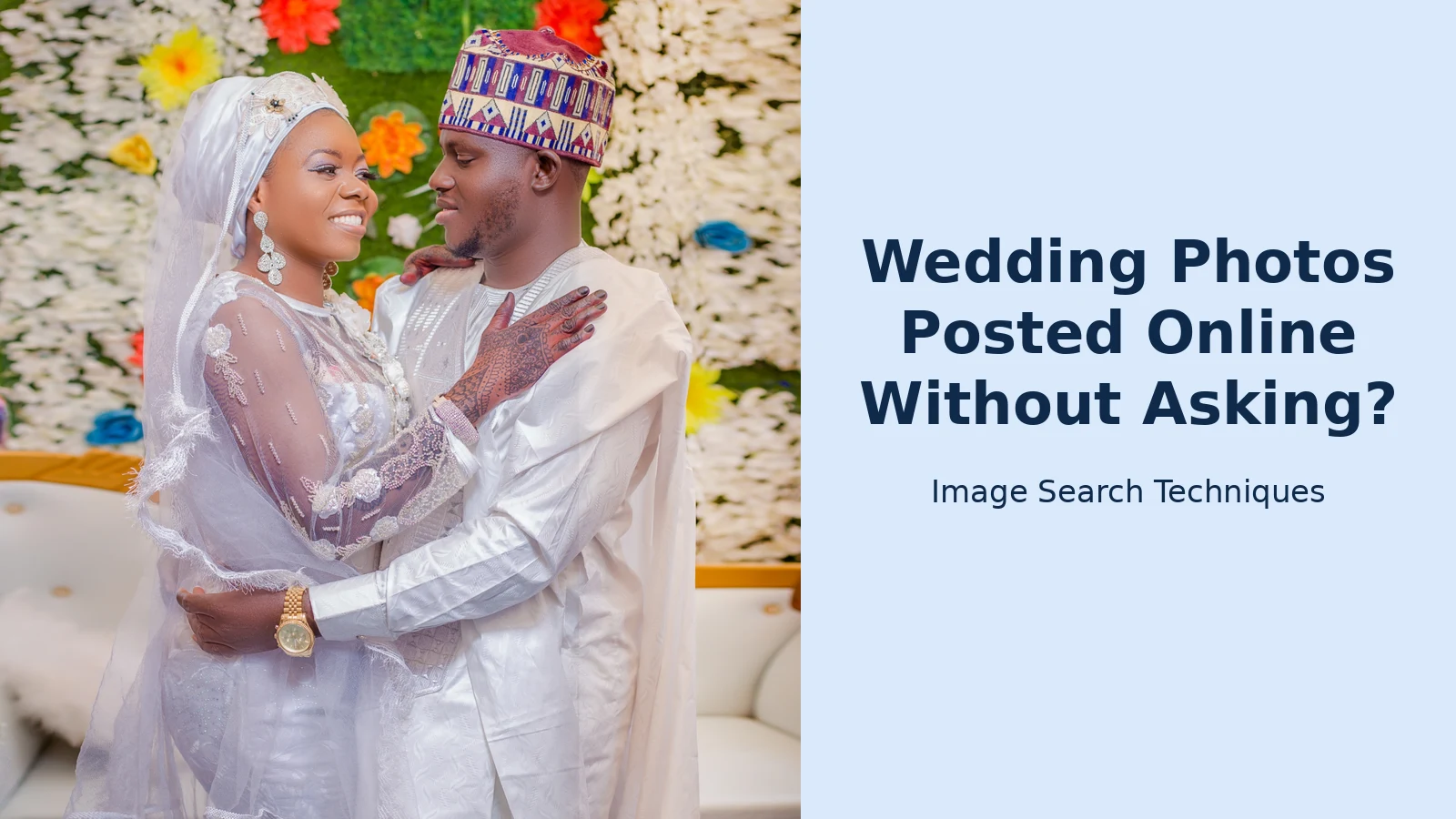
To show what this looks like in practice, I ran a real test on 12 November 2026, signed out, using a public wedding photograph from Wikimedia Commons, “A wedding bride and groom 01.jpg”, licensed CC BY-SA 4.0, as a stand-in for a couple’s delivered photo. The point of the test was to find out which engines actually find copies of a wedding photo, and how honestly they report what they found.
The results were a useful warning about relying on a single engine. Google Lens was blocked first by Google’s “unusual traffic” page, which needed three rounds of reCAPTCHA image grids to clear; once through, Lens returned nothing at all, both its “Exact matches” and “Visual matches” tabs said “Something went wrong: No image at the URL”, and the query thumbnail never loaded. The URL was valid, so this was Lens failing to fetch it, not a bad link. TinEye loaded and accepted the URL, but reported 0 matches over 86.7 billion images, saying it had “yet to crawl any pages where this image appears”, the sponsored Shutterstock wedding photos below that message were related images, not matches. Yandex Images was the only engine that worked: it tagged the photo as a wedding in Igbo traditional wedding attire, listed the original size (1620×2032), and its Sites tab named exactly one site, the original Wikimedia Commons file page, with the same file first among the similar images.
Two practical lessons come out of that test. First, no single engine is enough: one engine can return nothing while another names the original file page, so run at least two. Second, save what you find immediately, screenshot each result with the date visible, and keep a simple list of URLs. If the photographer takes a post down and then re-uploads it, your dated record is what proves the history. If he refuses to delete the photos outright, our guide to what to do when a photographer refuses to delete your photos maps the subject-side routes, from the contract to data protection and harassment law. For a fuller method, see our guide on someone posting a photo of you without permission, which covers the same search-and-record routine for photos of you posted by anyone.
The practical ladder: what to do, step by step
Work through these steps in order. Most cases end at step two, and jumping straight to a formal complaint usually makes the photographer less cooperative, not more.
| Step | Action | What “done” looks like |
|---|---|---|
| 1. Read your contract | Find the portfolio/social media clause and note what it allows. | You know whether this is a rights request or a goodwill request. |
| 2. Find every copy | Reverse-search 2–3 photos; save each URL with the date. | A dated list of every public copy you can find. |
| 3. Write to the photographer | Polite written request citing section 85 and your contract position. | An email or message with a clear deadline (see wording below). |
| 4. Report to the platform | Use Instagram/Facebook’s report tool on each post if the photographer refuses or ignores you. | A report reference for each post, if the platform gives one. |
| 5. Ask Google to remove the result | Use Google’s removal request for the search result if the image still appears in search. | A removal request reference from Google. |
| 6. Complain to the ICO | Object under UK GDPR Article 21 if the photographer is using your personal data without a lawful basis. | A written objection; the ICO expects a reply within one month. |
| 7. Get legal advice | A solicitor’s letter, or a small-claims route, if the photos stay up. | Professional advice on whether a claim is worth pursuing. |
The ladder matters because each step creates a record. A photographer who ignores a polite email may respond to a platform report; a platform that refuses may be followed by a Google removal request; and the ICO will want to see that you asked the photographer first. Keep every message, screenshot every post before it disappears, and keep copies of everything you send. If the matter ever reaches a solicitor, that file is the first thing they will ask for.
What to write in your request to the photographer
Write, do not phone. A written request creates a record, and it lets you be precise about which photos you mean. Keep it short, polite and specific: name the photos, name where they are posted, state your position, and give a deadline. Do not accuse the photographer of breaking the law unless you are sure of your contract position, a wrong accusation hardens the dispute and can be used against you later.
If your contract has no portfolio clause, you can use wording along these lines: “I am writing about the wedding photographs from [date] that are currently published on [Instagram account / website URL]. Our contract does not include permission for you to publish these photographs. Under section 85 of the Copyright, Designs and Patents Act 1988, photographs commissioned for private and domestic purposes must not be issued to the public or shown in public. Please remove the photographs listed below from [platform] within 14 days and confirm once this is done.”
If your contract does contain a portfolio clause, be honest about it and ask anyway: “Our contract allows portfolio use, and I understand that. However, I did not expect the photographs to be published on [Instagram / your public feed], and I would be grateful if you would remove them. I am happy for you to keep them in a private portfolio shown to prospective clients in person.” Photographers depend on word of mouth, and a reasonable request framed this way is very often granted, especially when the alternative is a public dispute.
List the photos individually, “the ceremony wide shot, the portrait by the oak tree, the group photo on the steps”, and include the URLs you found in your reverse image search. Give a 14-day deadline, and say what you will do next if the deadline passes: report the posts to the platform and seek advice. Then stop. Do not send follow-up messages every day, do not post about the dispute publicly, and do not ask friends to message the photographer. Pressure from a crowd turns a private disagreement into a public one, and it rarely helps.
What if the photographer says no?
If the photographer refuses, or does not reply within your deadline, move to step four: report the posts on the platform where they appear. Instagram and Facebook both have report tools on individual posts, use the option for content that shows you without your permission, and include the section 85 point in the free-text field where the form allows it. Platforms apply their own policies, not UK copyright law, so a report does not always succeed, but it is free, it takes minutes, and it creates a second record that you tried.
Next, ask Google to remove the image from its search results. Google’s removal process covers personal information and, in some cases, images; our guide to removing your photos from Google walks through the request step by step. Removing a result from Google does not remove the photo from the photographer’s website, but it stops most people finding it through search, which is where the damage usually happens.
There is also a data protection route. A photograph of you is your personal data, and under UK GDPR Article 21 you have the right to object to its processing where the photographer relies on legitimate interests. The ICO’s guidance on the right to object explains that an objection must be answered without undue delay and within one month, and that the photographer must stop unless it can show compelling legitimate grounds that override your interests. A portfolio is a legitimate interest, but “compelling” is a high bar when the photos are of a private family event, and the ICO’s guidance, updated on 2 November 2026 to reflect the Data (Use and Access) Act 2025, is the authority to cite. If the photographer ignores your objection, you can complain to the ICO, which is the regulator. The same data protection route is the backbone of the advice in our guide for an employer using your photo without permission, where the one-month clock and the ICO escalation ladder are explained in full.
Finally, there is the court route. For copyright and moral-rights disputes, the Intellectual Property Enterprise Court’s small-claims track handles lower-value claims without the costs risk of the High Court, and our site’s guide to suing for photo theft through the IPEC explains how that route works. But be realistic: a court claim costs time and money, and it is worth taking legal advice before you start one. For most couples, the combination of a written section 85 request, a platform report and a Google removal request gets the photos down without ever reaching a courtroom.
Can a photographer use my wedding photos without my permission in the UK?
Section 85 is a narrow right, and knowing its edges stops you making a claim that will not stand up. It does not cover photographs taken by guests, because you did not commission them, if a guest posts your wedding photos, your route is a direct request to the guest and a platform report, not section 85. It does not cover a commercial shoot: if you were paid to model, or the photos were commissioned for advertising, the “private and domestic” condition fails. It does not give you the copyright, so it does not let you sell the photos, licence them to a magazine, or stop the photographer using them in ways your contract already permits.
It also does not cover photos of other people in your wedding party in the same way: each person who commissioned the photos holds the right, so a joint commission, both partners hiring the photographer together, gives both of you the right, and section 86 notes the right lasts as long as copyright subsists. If your partner is happy for the photos to stay up and you are not, that disagreement is between the two of you first; a photographer faced with two commissioners giving opposite instructions will usually wait for you to agree.
One more edge matters: section 85 is a UK right under a UK statute. If your photographer is based overseas, or the photos are hosted on a platform with no UK presence, the practical ladder still works, platforms and Google removal requests are global, but the legal threat behind it is weaker, and you should take advice before relying on it. And if any of the photos are intimate images, or images of children, do not use this guide’s ladder at all: intimate images go to StopNCII and the Revenge Porn Helpline, but section 85 gives you a privacy right over photos commissioned for private and domestic purposes, and a public post without a portfolio licence infringes it. Read your contract first, find every copy with a reverse image search, write a polite request citing section 85, and work up the ladder only if you have to. Most photographers, faced with a calm, specific, written request, will take the photos down.
Can a photographer post my wedding photos on Instagram without asking?
Your photographer owns the copyright, so they can use the photos as your contract allows, but section 85 of the Copyright, Designs and Patents Act 1988 protects photos commissioned for private and domestic purposes. If your contract has no portfolio clause, posting them publicly infringes your privacy right. Read the contract first, then ask in writing for removal.
Do I own the copyright to my wedding photos?
No. Copyright belongs to the photographer who took them, from the moment each photo is taken, and lasts for the photographer’s lifetime plus 70 years. Paying for the shoot buys you a licence to print and share the photos personally, not the copyright itself. Your protection against public posting comes from section 85, not from ownership.
What is Section 85 of the Copyright, Designs and Patents Act?
Section 85 gives a person who commissions a photograph for private and domestic purposes the right not to have copies issued to the public, the work shown in public, or the work communicated to the public. The right lasts as long as copyright subsists, but it does not override a signed contract that licensed portfolio use.
What should I do if my photographer refuses to take my wedding photos down?
Report the posts on the platform where they appear, then ask Google to remove the image from its search results. Object in writing under UK GDPR Article 21 , the photographer must reply within one month, and complain to the ICO if ignored. Keep every message and screenshot as evidence, and take legal advice before starting any court claim.