🔎 Reverse Image Search
Image search techniques made simple: upload a photo or paste a URL and search 6 engines at once. 100% free, nothing stored.
🔒 Your image is never stored on our servers longer than 24 hours and is never shared.
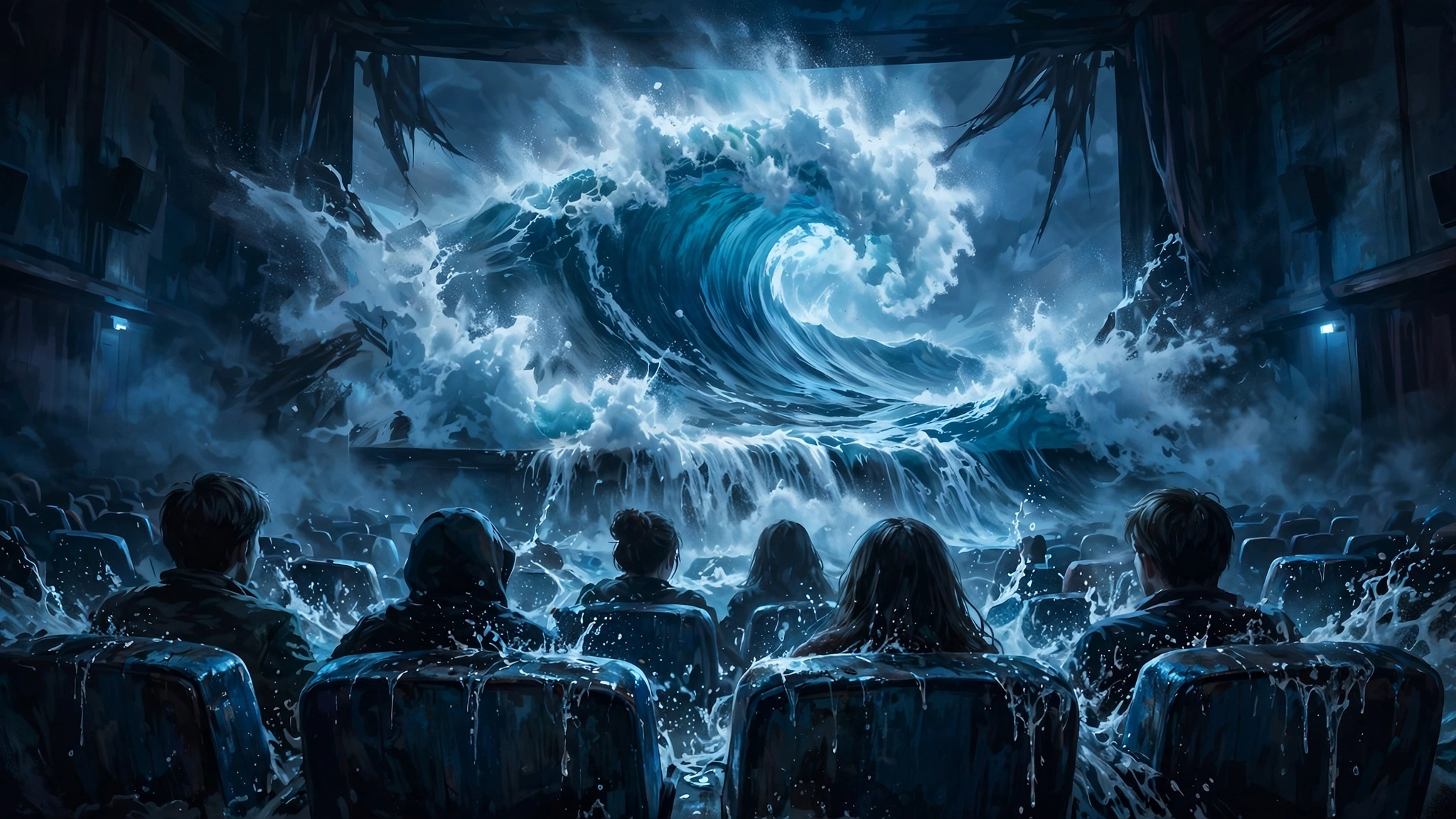
A wave crashes out of a cinema screen and soaks the front row. An old steam train rolls off the screen and down the aisle. A dinosaur bursts through a wall of water while the audience screams and laughs. Clips like these are all over YouTube, TikTok and X, filmed as if someone in the front row grabbed their phone at exactly the right moment. They look like the wildest cinema experience on earth, and viewers keep asking the same question: is any of this real? This guide explains what the trend is, how the clips are made, why they convince, and the checks that prove every one is generated.
Short answer
No. None of the viral 4D cinema clips is real cinema footage. Every one is AI-generated, made with an AI video tool rather than filmed in an actual theatre. Real 4D cinemas exist, with moving seats, wind, mist and scent effects, but no real screen pours a wall of water over the audience or lets a train drive into the seats. The quick proof is in the details: pause any of these clips and look at the water, the faces in the crowd and the edge of the screen. The physics breaks, the faces melt and change, and the screen behaves like a picture frame one second and a hole in the wall the next. The rest of this guide walks through each tell, and shows you how to check the next clip yourself.
What the 4D cinema AI trend is, and how it spread
The 4D cinema AI video is a genre of short clip with a strict formula. The camera sits in a dark cinema, held by someone in the front rows. Then something in the film breaks out of the screen and into the theatre: a huge wave that drenches the front row, an old steam train rolling towards the seats, a dinosaur chase that sends a wall of water over the audience, a glowing sea creature reaching across the seats, or banknotes flying out of the screen during a crashed armoured truck scene. The crowd screams, laughs and ducks, and the clip ends mid-reaction.
The trend moved fast once the formula clicked. The earliest example trend trackers have found was posted on YouTube on 25 June 2026 by the channel AiHustleGame: cash bursting out of a cinema screen. A dinosaur clip that ends with a wall of water hitting the seats followed on X on 29 June, and a giant sea creature clip posted on 30 June picked up about 397,000 views. Within a week, “is it real?” explainer videos had appeared. One explainer, by the channel Mirror Thinks, had passed 3.3 million views when trackers checked on 22 November 2026. By September the clips had attracted professional fact-checkers: the Brazilian site Boatos.org rated a viral cinema clip fake on 11 September 2026.
The genre also leans on a very old story. Legend says audiences panicked when the Lumière brothers showed a train arriving at La Ciotat station in 1896, convinced it was coming at them, although historians have found no report of a panic from the time. The 4D clips recreate that legend with modern tools: a train, a screen, and an audience that flinches.
How the clips are made
The surprising part is how little raw material the current versions need. The standard recipe starts with a single photo of a person. That photo is uploaded to an AI video tool, and the tool builds the clip around it. The face, hair, glasses and clothes of the person in the finished video all come from that one photo, which is why the same recognisable character can appear in clip after clip, sitting in the front row while impossible things happen around them.
The rest of the scene is generated too. The cinema, the screen, the creature or vehicle, the water, and the crowd are all produced by the model from a text prompt. Even the sound is generated: the roar of the sea or the noise of the engine, plus the screams and laughter of the audience, are synthesised along with the pictures. Nothing was filmed anywhere. There is no theatre, no audience and no camera, just a photo, a prompt and a model that is very good at imitating a phone video of a cinema.
That matters for two reasons. First, anyone can make one of these in minutes, which is why endless variations keep appearing. Second, the person in the photo is real, and their likeness is doing the acting. If a clip like this is ever made from your photo without your permission, our guide on how to remove a deepfake of yourself covers the reporting and takedown steps.
Why these clips fool so many people
These videos are engineered, deliberately or not, to slip past the checks your brain runs on footage. Five tricks do most of the work:
- The phone-shot framing. The clip looks like a shaky vertical phone video, with the wobble and imperfect focus of a real recording. Your brain reads that roughness as honesty. A polished, steady shot would invite questions; a wobbly one feels like evidence.
- The front-row point of view. You are placed inside the scene, in a seat, watching other people react. Because you never see the trick from outside, you never get the angle that would expose it.
- The sound of a real crowd. Screams, gasps and laughter are powerful social proof. If twenty people are ducking and shrieking, your instincts say something real is happening, even though the soundtrack was generated too.
- The shake hides the flaws. AI video still struggles with hands, faces and fast-moving water. Constant camera movement, darkness and motion blur keep those weak spots on screen for a fraction of a second at a time.
- The short length. Most of these clips end within seconds of the big moment. The model never has to sustain the illusion, keep the room consistent or show you the aftermath, which is where generated video usually falls apart.
Put together, the clip gives you just enough realism to believe and never enough time to doubt. It is the same basic recipe used in other generated footage, and the same habits that expose a deepfake video call, pausing, zooming and checking the details, expose these clips too.
The tells: how to spot a 4D cinema AI video
Watch any of these clips slowly, with the pause button ready, and the illusion breaks down in predictable places:
- Water and physics behave wrongly. The water pours out in a smooth, curtain-like sheet, hangs in the air too long, or soaks the front row while the people in it stay oddly dry a second later. Splashes move at the wrong speed, objects fall too slowly, and things that should keep moving, like a train, glide instead of juddering over the floor.
- The screen edge keeps changing. In a real cinema the screen is a fixed rectangle. In these clips the boundary between the film and the room is wherever the model needs it to be. The picture bulges, the frame vanishes when something crosses it, and the glow of the screen spills in ways real projection never does.
- Faces and hands in the crowd melt. Background faces blur, swap features or change between cuts. Hands have the wrong number of fingers, merge with armrests, or pass through the person next to them. The crowd is set dressing, and the model renders it carelessly.
- Signage and text are gibberish. Pause on any poster, exit sign, ticket stub or caption inside the scene. AI video still cannot spell reliably, so letters warp, words are almost right, and logos dissolve into shapes that only look like branding from a distance.
- The reactions are too uniform. Real audiences react at different times and in different ways. In these clips the whole row screams, ducks and laughs in near-perfect unison, on cue, like a single character copied across the seats.
- The clips loop or cut at the same length. Many of these videos stop abruptly at a similar short length, or quietly loop back to the start: the signature of a generated clip with a fixed duration, not of a person who stopped filming.
Any one of these can appear in a badly filmed real video. Three or more together, in a clip of something physically impossible, settle the question.
How to check any viral “too real” clip
You do not need specialist software to check the next clip that lands in your feed. The same core image search techniques used for suspicious photos work on video, because a video is just a stack of still frames:
- Screenshot a clear frame and reverse image search it. Pause the clip at its sharpest moment, when the creature, vehicle or wave is fully visible, and run that frame through Google Lens, TinEye or Yandex. The search often surfaces the same scene in earlier uploads, explainer videos or fact-checks, and if the scene was lifted from a real film, you can find the movie from the screenshot and compare. It is the same screenshot-first habit you would use to identify a video game from a screenshot.
- Zoom into the frame and study the details. Do not judge the clip at feed size. Enlarge the screenshot and look closely at the hands, the text and the screen edge. Learning to search inside an image for small details is what turns a vague feeling of “looks off” into specific evidence.
- Check the posting account’s history. Open the poster’s profile. Accounts built on this genre post nothing but impossible cinema moments, one after another, often with the same front-row character. A real once-in-a-lifetime moment does not come from an account with forty of them.
- Look for the platform’s AI label. YouTube, TikTok and Instagram all label some AI-generated content, and creators in this genre sometimes tag their own work as AI in the description. Scroll before you share: the label is often there, just buried.
- Run frames through an AI detector. Save two or three frames from different moments of the clip and check them with a detection tool. Our roundup of the best deepfake video detector tools explains what each one looks for. Treat the result as supporting evidence, not as a verdict on its own. You can also put the frame through the same checks you would use on a fake screenshot, because a generated frame fails in the same places: text, hands and edges.
- Search for fact-checks before sharing. Type the clip’s claim plus the words “fact check” into a search engine. Viral clips in this genre are checked quickly: Boatos.org had rated one of them fake by 11 September 2026. If a clip has been checked, you will usually find the verdict in under a minute.
The whole routine takes about five minutes. The wave, the train and the dinosaur are entertaining, and there is no harm in enjoying them. The harm starts when a generated clip is passed off as real footage and shared onward as proof. A screenshot, a search and a close look at the water are all it takes to stop that chain.
Frequently asked questions
Are the viral 4D cinema videos real?
No. Every viral 4D cinema clip, the wave, the train, the dinosaur and the sea creature, is AI-generated video. Real 4D cinemas use moving seats, wind, mist and scent, but nothing comes out of the screen. The clips are made with AI video tools and dressed up to look like shaky phone footage.
How are 4D cinema AI videos made?
The current versions start with a single photo of a person uploaded to an AI video tool. The face, hair, glasses and clothes in the clip come from that photo, and the cinema, the screen, the creature and the crowd are generated from a prompt. Even the sound, the sea, the engine, the screams and the laughter, is generated.
Why do 4D cinema AI videos look so realistic?
Because of the framing. The clips imitate a shaky phone video shot from the front row, so your brain reads the roughness as honesty. The darkness and constant camera movement hide the flaws in faces, hands and water, the generated crowd noise sounds like proof, and the clip ends before the illusion has to hold up.
How can I check a cinema clip before I share it?
Pause the clip, screenshot a clear frame and reverse image search it. Then check the posting account for a feed full of similar clips, look for the platform AI label, run a frame or two through an AI image detector, and search for a fact-check of the claim. Three or more visual tells, such as wrong water physics, melting faces and gibberish signage, confirm it is generated.
Did audiences really panic at the Lumiere train film in 1896?
That is the famous story, but historians have found no report of a panic from the time; the tale appears to be a legend that grew later. The 4D cinema AI trend knowingly plays on it, right down to the train bursting out of the screen.