🔎 Reverse Image Search
Image search techniques made simple: upload a photo or paste a URL and search 6 engines at once. 100% free, nothing stored.
🔒 Your image is never stored on our servers longer than 24 hours and is never shared.
You have found the perfect photo for your school presentation. It shows exactly what your topic needs. Then the worry starts. Is it legal to put someone else’s photo in your slides? Will your teacher mind? What happens if the deck ends up online?
The short answer: yes, you can usually use photos in a school presentation when the slides stay inside the classroom, because both US and UK law give teaching a special, narrow allowance. The rules change the moment the deck moves to a course site or the open web, and that is where most people get caught out.
This guide walks through the three settings where a school presentation can live, what US and UK law actually say about each one, and how to check any single photo before you use it. It is general information about how the rules work, not legal advice for a specific dispute. If a school, publisher or photographer challenges your use, ask a teacher, librarian or solicitor.
What changes when a photo leaves the classroom?
The answer capsule: the same photo can be fine in class, risky on a course site and wrong on the open web, because each move widens the audience and the market harm.
Most of the confusion about photos in school presentations comes from treating the question as one question. It is really three questions, and they have three different answers. A photo shown once to thirty classmates in a room is a small, private, teaching use. The same photo posted on a course site that stays up all term reaches a wider group for longer. The same photo again, posted on a public website or social media, reaches anyone in the world and can be downloaded, copied and reused by strangers.
Copyright law cares about that journey. The owner of a photo holds the right to copy it, show it in public and share it online. Every time you move a photo to a new setting, you are doing one of those things again. The classroom allowance covers the first step. It does not automatically cover the second and third.
Three other things change the answer. First, what the photo is for: a photo you analyse and discuss is treated very differently from a photo you use as decoration behind a title slide. Second, where the photo came from: your own photo, a Creative Commons photo and a photo lifted from a search results page sit in three different places. Third, who sees it: classmates only, enrolled students only, or the whole internet.
Keep those three questions in mind and the rest of this guide falls into place. Where will the deck be shown? What job is the photo doing? Where did the photo come from?
What does US law actually allow in class?
The answer capsule: in the United States, showing a photo during a face-to-face lesson at a nonprofit school is covered by a specific classroom exemption, and copying for teaching is judged by the four fair use factors.
United States law gives teachers and students two separate routes. The first is the classroom display exemption, Section 110(1) of the Copyright Act. It lets a teacher or student display or perform a copyrighted work during face-to-face teaching at a nonprofit educational institution, in a classroom or a similar place used for teaching. A classroom, a library or a workshop counts. A school assembly in the hall for a general audience does not. There is no limit on the type of work, and no fair use checklist is needed for the display itself.
But the exemption is narrow. It covers showing the photo, not copying it. Photocopying a photo for a handout, or posting the deck to a course website, moves the question to the second route: fair use.
Fair use is the US rule in Section 107 of the Copyright Act. It allows limited use of a copyrighted work without permission for purposes such as criticism, teaching, scholarship and research. A court weighs four factors, and no single factor decides the case on its own.
The four factors are worth knowing by name, because teachers and librarians use them every day.
Purpose and character. Nonprofit teaching is favoured, but the key question is whether your use transforms the photo. A student who analyses the composition of a wartime photograph is doing something new with it. A student who uses the same photograph as a decorative background is not. The photo is just filling space.
Nature of the work. Factual images such as diagrams, charts and maps get less protection than highly creative work such as fine art photography. This factor rarely decides a case alone.
Amount used. With a photo you usually need the whole image to make your point, and courts recognise that. What matters is whether the amount is reasonable for the purpose. A low resolution or cropped version strengthens your position if it would do the job just as well.
Effect on the market. This is often the most important factor. Does your use stand in for the original? A photo shown in a password protected course to 25 students poses almost no market threat. The same photo on a public blog that anyone can download directly competes with the original.
For online teaching there is a third US route, the TEACH Act, Section 110(2). It roughly mirrors the physical classroom for accredited nonprofit institutions running online class sessions. The conditions are strict: access limited to students enrolled in the specific course, access only for a period comparable to a live class session rather than a whole semester, technology that reasonably prevents students keeping or passing on the material, the display forming part of an instructor led session directly related to the course, students told the material may be protected, and the institution keeping a public copyright policy. Textbooks and course packs made for distance learning are excluded. If those conditions are not met, fair use may still apply, but the TEACH Act itself does not.
The practical lesson is simple. Showing a photo while you teach, in the room, is the safest use in US law. Copying it into a deck that lives online needs a fresh look at the four factors, and the market factor gets heavier the wider the audience.
What does UK law actually allow in class?
The answer capsule: in the United Kingdom, fair dealing for illustration for instruction covers a photo used to make a teaching point in a non-commercial lesson, with a proper acknowledgement, but it does not cover publishing the deck online.
UK law works differently from US law, and the two should never be mixed up. The United Kingdom has no fair use rule. It has fair dealing, which is a set of specific exceptions, and each one has its own conditions.
Fair dealing is the UK approach. It has no fixed legal definition. The official guidance puts it as a question: how would a fair-minded and honest person have dealt with the work? A court looks at whether the use harms the market for the original, and whether the amount taken is reasonable and necessary for the purpose.
The exception that matters most for school presentations is Section 32 of the Copyright, Designs and Patents Act 1988, illustration for instruction. It says fair dealing with a work for the sole purpose of illustration for instruction does not infringe copyright, provided three conditions are met: the use is for a non-commercial purpose, it is by a person giving or receiving instruction (or preparing to do so), and it is accompanied by a sufficient acknowledgement unless that would be impossible in practice.
Notice what that covers and what it does not. It covers copying a photo into slides to illustrate a point in a lesson. It does not cover a deck that is then published on the open web, because that is no longer solely to illustrate instruction to your class. It also does not cover a use that undermines sales of teaching materials. A school cannot copy a whole workbook of photos under this exception and stop buying the book.
A second UK rule, Section 34, covers performing, playing or showing a work in the course of activities at an educational establishment, but only where the audience is limited to teachers, pupils and others directly connected with the establishment. The official guidance is clear that it will not generally apply if parents are in the audience. A presentation shown at a parents evening is a different audience from a lesson, and the exception may not stretch that far.
There are also licensing schemes that sit on top of these exceptions. Copying on behalf of a school for non-commercial instruction is generally covered by a Copyright Licensing Agency licence where one is in place, and recording broadcasts generally needs an Educational Recording Agency licence. Your school may already hold these licences. Ask your librarian or teacher before assuming the exception alone covers a large scale copying job.
The UK and US rules agree on the shape of the answer, even though the legal words differ. Classroom use for a real teaching point, with credit, is the safest ground. Publishing the deck online is a new use that needs permission or a licence.
Which setting is your presentation in? The three-setting test
The answer capsule: work out which of the three settings your deck will live in, then read the row for that setting, because the US and UK rules change at each step.
Before you use any photo, ask where the finished presentation will be seen. Most school decks end up in one of three places. The table below is the ranking asset for this guide. It gives the US rule and the UK rule for each setting, and it marks the point where you need permission or a safe licence instead.
| Setting | US rule | UK rule | Permission needed? |
|---|---|---|---|
| In-class projection to classmates only | Section 110(1) classroom display covers showing the photo; fair use supports analysis and discussion | Section 32 illustration for instruction covers it, non-commercial, with acknowledgement | Usually no, if the photo illustrates a teaching point |
| Password protected course site for enrolled students | TEACH Act may cover a live session; otherwise fair use, and the market factor weighs more | Section 32 may cover short term course use; a full term posting stretches it, and a school licence may be needed | Sometimes: check the school licence and keep access limited and time limited |
| Public posting on the web, social media or a competition | Fair use rarely covers it; a public copy competes with the original | Fair dealing for instruction does not cover public publishing | Yes: use your own photo, a CC0 or suitably licensed photo, or get permission |
Read the table from top to bottom and you can see the risk rising. In class, the law is on your side for a genuine teaching use. On a course site, the answer depends on how long the deck stays up, who can see it, and whether your school holds a licence. On the open web, the classroom allowances have run out. The photo needs a licence that allows public use, or it needs to be your own photo.
One common trap sits between the second and third rows. A student finishes a class deck, the teacher likes it, and someone posts it on the school website or enters it in a competition. The deck has just moved settings without anyone re-checking the photos. The classroom protection does not travel with it. If a deck might be posted or entered anywhere public, check every photo for public use before you submit it, not after.
Another trap is time. A course site deck left up all term, or reused every semester, is a harder case than the same deck shown in one live lesson. Reuse and long availability both weigh against you in the US market factor and against fair dealing in the UK. If the deck must stay up, swap the risky photos for licensed ones.
How do I check a photo before I put it in my slides?
The answer capsule: check the source and licence first, then reverse search the photo to confirm the source is real, and only then decide which setting it is safe for.
Checking a photo takes five minutes and it answers the only questions that matter: who made it, what licence it carries, and whether the site you found it on is telling the truth. Here is the worked example, done on a real photo on 21 November 2026.
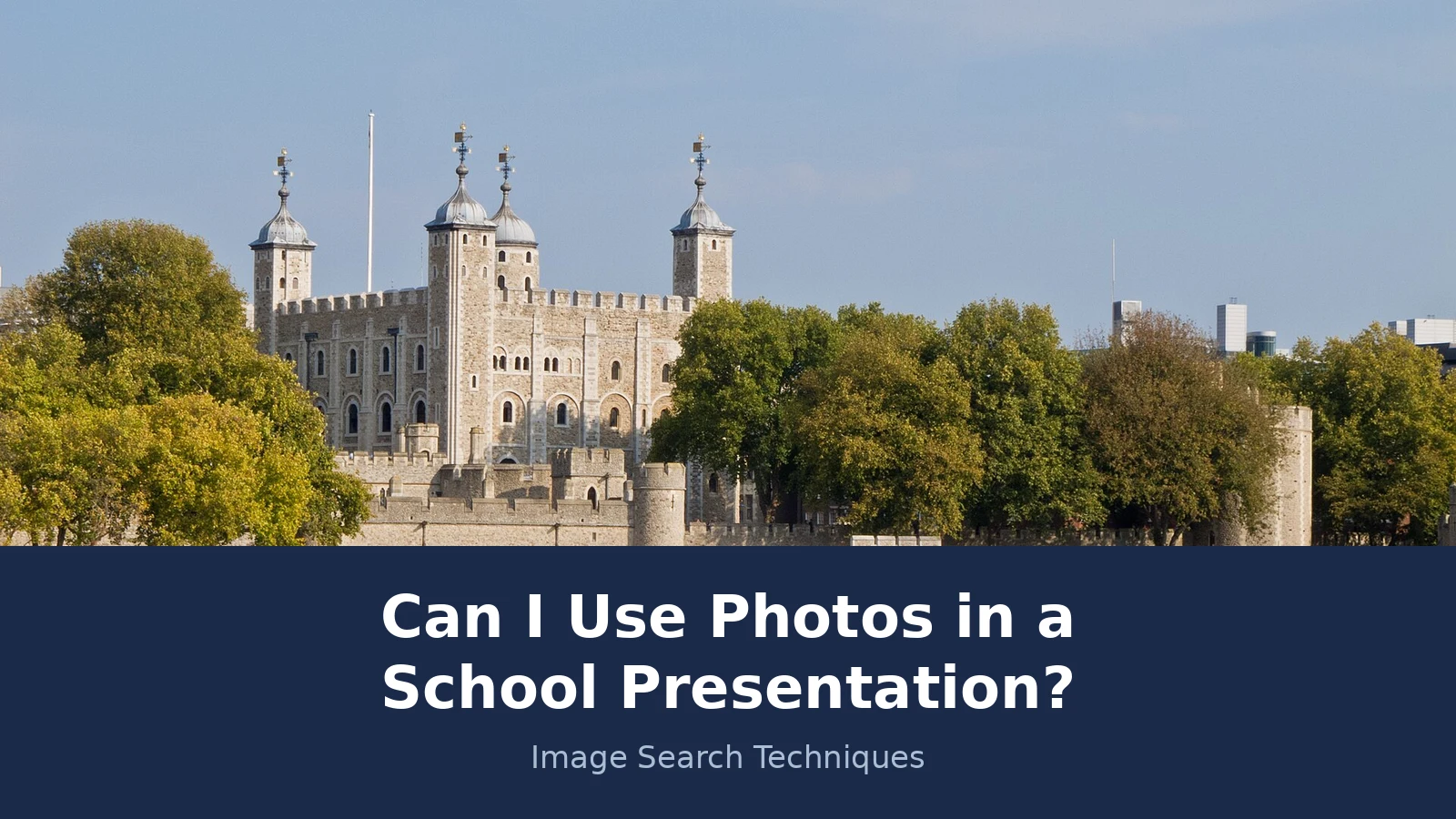
The photo is a Wikimedia Commons image, file name “Tower of London – 01.jpg”, by Carlos Delgado, taken on 16 October 2011. It shows the Tower of London from the far bank of the Thames. The Commons page lists it under a Creative Commons Attribution-ShareAlike licence, and it asks for credit as “Carlos Delgado; CC-BY-SA” near the image. That is a real licence from a named photographer, not a guess. It allows reuse, including in a school presentation, provided you credit the photographer and share any adapted version under the same licence.
Step one was reading the licence on the photo page itself, not on a site that reposted the photo. A repost can strip the licence or attach the wrong one. The Commons page is the source. It names the author, the date and the licence in one place.
Step two was a reverse image search of the photo, to check whether the same image appears under another name somewhere else. A photo that appears on many sites under different names is a warning sign. It may have been taken from its real owner and reposted without permission, and the licence on the repost cannot be trusted.
The results were as follows. Google Lens failed three times, each time with the error “No image at the URL”, even though the same URL worked on the other two engines, so Lens gave no name and no counts at all, and that failure is reported here rather than as a zero. TinEye found 145 results out of 86.8 billion images searched, first indexed on 11 March 2010. Its earliest dated match was a tour site copy filed as tower-1.jpg on that same date, and the first non-sponsored result was the Wikipedia page for the Lieutenant of the Tower of London, using a 300 pixel copy dated 6 November 2016. The top listed results were sponsored stock listings on Shutterstock and Adobe Stock, dated 2019, which shows how the same photo can turn up for sale as well as free. Yandex named the photo correctly with the tag “tower of london”, listed 18 sizes from 3000 by 1500 down to 300 by 150, showed 16 similar images on its search tab and 80 on its similar images tab, and listed 20 sites, the best match being the Wikipedia file page for “Tower of London – 01.jpg”. Yandex did not name the photographer or the licence, which is exactly the gap the licence check fills.
Step three was running the photo through the three settings. In class, this photo is safe twice over: it illustrates a real teaching point about a historic building, and its licence allows the use anyway, with credit. On a password protected course site, it is still safe, because the licence allows sharing and the credit line travels with the photo. On the open web, it is also safe, because the CC BY-SA licence permits public sharing as long as the credit stays attached and any adapted version is shared alike. The credit line belongs on the slide or on a sources slide at the end, with the photographer’s name, the title and a link to the Commons page.
Now compare that with a photo found through a general image search with no licence shown. There is no named photographer, no licence, and no source page to check. A reverse search may show it on a stock site with a watermark, or on a news site with a copyright notice. That photo is usable in class for a genuine teaching point under the rules above, but it is not safe for a course site or the open web. The check, not the search ranking, is what tells you that.
Make the check a habit. For every photo, note four things on a sources slide or in your notes: the photographer, the title, the source link, and the licence. If you cannot fill in all four, treat the photo as classroom only, or find a different photo.
Where can I find photos that are safe to use?
The answer capsule: your own photos are always safest, then public domain and Creative Commons photos from their real source pages, then stock libraries, and a search engine results page is never a source.
The safest photo is one you took yourself. You own the copyright in your own photos, so you can use them in class, on a course site and on the open web. The only extra care is privacy: do not photograph other people without their say so, and follow your school rules about photographing classmates.
Next safest are public domain photos. These are photos whose copyright has expired or that were never under copyright, such as most works of the US federal government. A public domain photo can be used anywhere, though giving credit is still good practice. If you want to be sure a photo really is public domain, read the guide on how to tell if a photo is in the public domain before you use it.
Creative Commons photos are the workhorse for school work. Sites such as Wikimedia Commons and Flickr host millions of them, each with a licence that spells out what you may do. The licence letters matter. CC BY means you must give credit. CC BY-SA means you must give credit and share adaptations under the same licence. CC BY-NC means no commercial use, which is fine for a school deck but not for a deck that will be sold or used in advertising. CC BY-ND means no changes to the photo. Always read the licence on the photo page itself, and check the same photo with a reverse search as in the worked example above. A full walkthrough of that check is in the guide on how to check a photo licence before you use it.
Free stock libraries such as Unsplash and Pixabay are useful, but read their licence pages rather than assuming every photo is free for every use. Some photos in those libraries show recognisable people, trademarks or private property, and the licence on the photo does not cover those. A photo of a branded product or a recognisable person can still cause trouble even when the photo itself is free to use.
Wikipedia images deserve a special mention, because students use them constantly. Wikipedia and Wikimedia Commons photos carry real licences, and most need credit. The guide on using Wikipedia images explains how to read the licence and write the credit line, and the same steps apply to a school deck.
What never counts as a source is a search engine results page. “Found on Google” is not a licence, and a credit line is not a permission. Credit is a condition of some licences, not a substitute for one. If the only source you can name is a search results page, you have not checked the photo yet.
Screenshots need the same care. A screenshot of a website, an app or a video is a copy of what it shows, and the photo inside the screenshot keeps its own copyright. The same fair use and fair dealing test applies, and the same three-setting question applies.
What mistakes catch students and teachers out?
The answer capsule: the common mistakes are all the same mistake in different clothes, treating a classroom allowance as if it covered every setting, every photo and every use.
Using a watermarked stock preview. A stock photo with a watermark across it is a preview, not a free photo. The watermark is there because the photo is not licensed for use. Using it in class might pass the teaching test, but posting it anywhere else is asking for a takedown notice. Buy the licence, or find a different photo.
Decorating instead of illustrating. A photo that only makes a slide look nice is a weaker case than a photo you discuss, compare or analyse. In the US, decoration is rarely transformative. In the UK, a decorative photo is harder to call illustration for instruction. Pick photos that do a job in the lesson, and say on the slide what that job is.
Copying a photo into handouts and course packs. Showing a photo in class is one thing. Copying it into handouts for the whole class is another, and it is governed by different rules and often by your school licence. Check with your librarian before a large handout run.
Posting the deck and forgetting the photos. This is the most common mistake in this guide. A deck made for class ends up on a school website, a video site or a competition entry, and the photos travel with it. Decide the final setting before you choose the photos. If there is any chance the deck will be public, use only photos that are safe for public use.
Trusting a credit line to fix a bad source. Adding “Image: Google” under a photo fixes nothing. A credit line must name the creator and the source, and it only helps where the licence or the exception already allows the use. Where neither allows it, a credit line is just a signed confession.
Assuming AI images are free of rules. An image made by an AI tool from a text prompt has no human author in the US Copyright Office view from 2025, so nobody can claim copyright in the purely AI made image itself. But the tool terms may still restrict how you use it, and a photo the tool was trained on or copied does not become free because it passed through an AI tool. The rules for fair use and fair dealing still apply to the underlying photo.
Forgetting the people in the photo. Copyright is not the only rule. A photo of a classmate, a patient, a child or a private event raises privacy and school policy questions even when the copyright side is clean. Ask before you photograph people, and ask again before you publish a photo of them.
If you are unsure about a single photo, swap it. There are millions of freely licensed photos of almost every school topic. A five minute search for a licensed alternative is cheaper than a takedown notice, an awkward email from a photographer, or a mark lost to a competition disqualification.
For the wider picture on keeping your photos and your work safe online, see the complete guide to protecting your photos online, and for the US side in more depth, the guide on fair use of images. Both cover the same ideas in other settings, and both keep the US and UK rules separate.
FAQs
Can I use any photo I find on Google in a school presentation?
No. A photo found through a search engine is still owned by someone, and “found on Google” is not a licence. In class, a genuine teaching use may be covered, but for a course site or the open web you need your own photo, a freely licensed photo, or permission.
Does giving credit make it legal to use a photo?
No. Credit is a condition of some licences and a requirement of the UK illustration for instruction exception, but it is not a permission on its own. A credit line only helps where the licence or the exception already allows the use.
Can I use a photo in class but not post the deck online?
Yes, and this is the most common safe pattern. Showing a photo to your class for a teaching point is covered in both US and UK law, but posting the same deck publicly is a new use. Use only licensed photos if the deck will go online.
What is the difference between US fair use and UK fair dealing?
US fair use is a flexible four-factor test that weighs purpose, nature, amount and market effect. UK fair dealing is a set of specific exceptions, such as illustration for instruction, each with its own conditions. They are different doctrines, so do not mix them up.
Can I use Creative Commons photos in a school presentation?
Yes, if you follow the licence on the photo page. CC BY needs credit, CC BY-SA needs credit and sharing alike, CC BY-NC bars commercial use, and CC BY-ND bars changes. Always read the licence at the source and reverse search the photo first.
Can my teacher show my presentation to parents?
Not automatically. In the UK, the showing exception covers an audience of teachers, pupils and others directly connected with the school, and official guidance says it will not generally apply if parents are present. Check with your teacher first.