

🔎 Reverse Image Search
Image search techniques made simple: upload a photo or paste a URL and search 6 engines at once. 100% free, nothing stored.
🔒 Your image is never stored on our servers longer than 24 hours and is never shared.
China asks for a photo size almost no other country uses. A China visa photo is 33 mm wide and 48 mm tall, a portrait shape that is taller and narrower than the 35 x 45 mm photo used for a UK passport or a Schengen visa. Get that one number wrong and the online form will refuse the file before a person ever looks at it. This guide works from the official photo sheet itself, the one-page specification published by the Chinese Visa Application Service Centre, and checks the official sample photo against every figure on it.
Short answer: A China visa photo is a recent colour portrait, 33 mm wide by 48 mm high in print. For the COVA online form it must be a JPEG, 354 to 420 pixels wide by 472 to 560 high, and 40 to 120 KB. The background is plain white and your expression is neutral.
One thing comes before the measurements, though. Since February 2026, British and Canadian passport holders may not need a visa at all for a short trip. Read the next section first, because it decides whether you need a photo in the first place.
Do you even need a visa for China?
Answer capsule: If you hold an ordinary British or Canadian passport and your trip is 30 days or less, you can enter China without a visa until 31 December 2026. Anyone travelling for another reason, or staying longer, still needs a visa and still needs this photo.
China widened its visa waiver on 17 February 2026 to include ordinary passport holders from the UK and Canada. The waiver covers business, tourism, visiting family or friends, exchange visits and transit, for stays of up to 30 days. It runs until 24:00 Beijing time on 31 December 2026. That end date matters. The waiver is a trial policy with a fixed expiry, not a permanent change, and no extension had been announced when this article was written in November 2026. Check the position again before you travel, because a policy that ends on 31 December will not help a trip in January.
The waiver has limits that catch people out. Paid work, a long-term assignment and journalism are not covered, so those trips still need a visa. Holders of Emergency Travel Documents cannot enter without a visa either. The GOV.UK travel advice for China states the same 30-day visa-free position for standard British passports where the nationality is listed as British citizen, including Crown Dependency passports with that nationality. The Government of Canada travel advice gives the same dates for Canadian passport holders. Both sources agree the waiver ends on 31 December 2026.
Do you even need a visa? Check this first. Travelling on an ordinary UK or Canadian passport, for 30 days or less, for business, tourism, a family visit, an exchange or transit, before 31 December 2026: no visa, so no visa photo. Travelling for paid work, study, a long stay, or on any other passport: you need a visa, and the photo rules below apply in full. If your trip straddles the 31 December 2026 expiry, ask the visa centre before you rely on the waiver.
If you do need a visa, the photo is part of the COVA online application, the China Online Visa Application form. The form asks you to upload a digital photo, and some visa centres still ask for two printed copies as well. Both versions follow the same official sheet, and the next section gives both sets of figures side by side.
What size is a China visa photo?
Answer capsule: The print is 33 mm wide by 48 mm high, and the digital file is a JPEG between 354 x 472 and 420 x 560 pixels, between 40 and 120 KB. The head inside the photo must measure 15 to 22 mm wide and 28 to 33 mm high in print.
The figures below come from the official photo sheet, “Photo Requirements for Chinese Visa Application”, published by the Chinese Visa Application Service Centre. The sheet has been in force since 1 December 2016, a date confirmed on the Chinese Embassy in Qatar website. Listings sometimes write the print size as 48 x 33 mm, height first. Either way, the photo is portrait: 33 mm across and 48 mm from top to bottom.
| Rule | Print photo | Digital photo (COVA upload) |
|---|---|---|
| Photo size | 33 mm wide x 48 mm high | 354 to 420 px wide x 472 to 560 px high |
| File format | Printed on photo paper | JPEG only, RGB 24-bit true colour |
| File size | Not applicable | 40 KB to 120 KB |
| Head width | 15 to 22 mm | 205 px, plus or minus 14 px, on a 354 x 472 px photo |
| Head height, chin to crown | 28 to 33 mm | Set by the same proportions on the sample |
| Space above the crown | 3 to 5 mm | 10 to 70 px from the top edge |
| Space below the chin | At least 7 mm | Eye line more than 256 px from the bottom edge |
| Space between the eyes | Not stated in mm | More than 60 px |
| Background | White or close to white, no border | White or close to white, no border |
| How recent | Taken within the last 6 months | Taken within the last 6 months |
Two numbers in that table cause most failures. The first is the print size itself. A 35 x 45 mm photo, the size used for a UK passport and a Schengen visa, is the wrong shape for China, and a standard American 2 x 2 inch (51 x 51 mm) passport photo is wrong as well. The Entering China guide, updated in October 2026, puts it bluntly: a valid British or European passport photo will be rejected by COVA automatically, and again at the counter. If you already have a passport photo, do not reuse it. It was made to a different specification.
The second is the head size. The head must fill most of the frame without touching the edges. In print, 28 to 33 mm from chin to crown inside a 48 mm tall photo leaves 3 to 5 mm above the crown and at least 7 mm below the chin. That is a tight window, and it is why a photo taken too far away fails just as surely as one taken too close. The digital rules work the same way in pixels: the face should be 205 pixels wide, give or take 14, on a 354 x 472 pixel photo, the crown 10 to 70 pixels from the top edge, and the line through the centre of the eyes more than 256 pixels from the bottom edge.
Our passport photo rejected fix guide covers the same kind of measurement problem across countries, and it is worth a read if you have had a photo refused before. The China rules are stricter than most, so the worked example in the next section shows exactly how the official sample measures up.
Does the official sample photo actually pass its own test?
Answer capsule: Yes. The sample on the official sheet passes every figure printed on it, and the sheet also shows what failure looks like, with a red cross on each wrong example.
The official sheet opens with two annotated sample photos of the same woman: a digital sample on the left and a paper sample on the right. Both show a front-facing portrait on a plain white background, long dark hair, a red top, a neutral expression and a closed mouth. The figure below is a crop of that section of the official sheet, so you can see the measurements as the visa centre prints them.
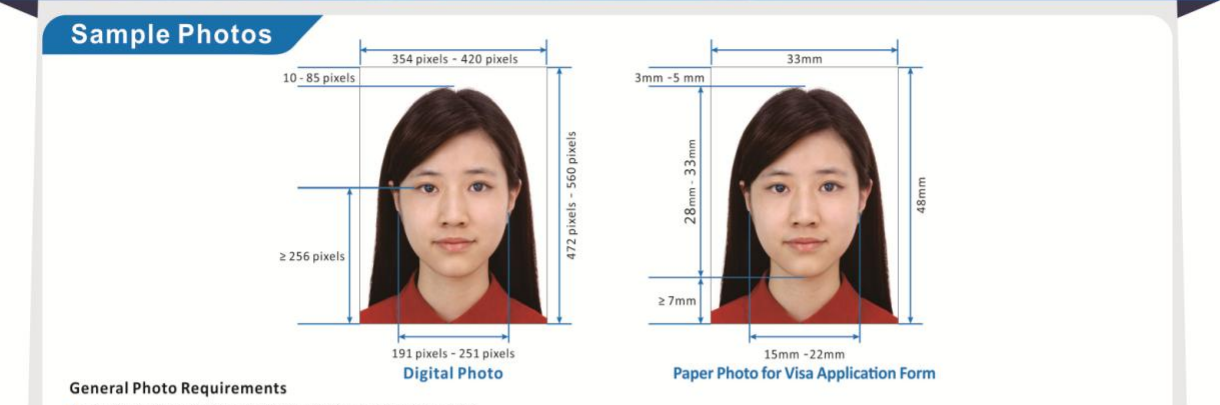
Checking the paper sample against the figures, one by one:
| Figure checked | Official rule | Sample photo | Result |
|---|---|---|---|
| Print width | 33 mm | Labelled 33 mm on the diagram | Pass |
| Print height | 48 mm | Labelled 48 mm on the diagram | Pass |
| Head width | 15 to 22 mm | Labelled 15 to 22 mm on the diagram | Pass |
| Head height, chin to crown | 28 to 33 mm | Labelled 28 to 33 mm on the diagram | Pass |
| Space above the crown | 3 to 5 mm | Labelled 3 to 5 mm on the diagram | Pass |
| Space below the chin | At least 7 mm | Labelled 7 mm or more on the diagram | Pass |
| Background | White or close to white, no border | Plain white, no border | Pass |
| Expression and pose | Frontal, neutral, mouth closed, ears visible | Front facing, neutral, mouth closed, ears visible | Pass |
The digital sample checks out the same way: 354 to 420 pixels wide, 472 to 560 pixels high, and the eye line at least 256 pixels from the bottom edge. Two small details on the sheet deserve a note, because they show why you should follow the written rules rather than the diagram labels alone. The diagram labels the digital crown space as 10 to 85 pixels, while the written rule on the same sheet says 10 to 70 pixels. The diagram also labels the digital face width as 191 to 251 pixels, while the written rule says 205 pixels, plus or minus 14. Aim for the middle of the written ranges, a crown space of about 30 to 40 pixels and a face width close to 205 pixels, and you sit inside both versions.
The second half of the sheet is just as useful as the samples. Under “Photo Examples” it shows one correct photo, marked with a green tick, and a row of wrong ones, each marked with a red cross, grouped under seven headings. The groups are photo quality, head position, expression, pose, eyeglasses, ornaments and background, and obscuring. Reading that grid before you take your photo is the fastest way to avoid a rejection, and the rejection section near the end of this guide walks through each group.
How do you take a China visa photo that passes?
Answer capsule: Stand against a plain white wall in soft daylight, face the camera straight on, keep a neutral expression with your mouth closed, and frame your head so it fills most of the picture without touching the top or bottom edges.
You do not need a studio. A phone camera and a white wall are enough, provided you control four things: the background, the light, your pose, and the framing. Take the photo in colour, within the last 6 months, and do not use a screenshot, a scan of another ID, or a heavily edited image. COVA and the visa centre both refuse those outright.
Background. The background must be plain white or close to white, with no border around the edge of the image. A white wall works. A white sheet pinned flat works too, as long as it has no creases or shadows. Do not stand in front of a door, a curtain or a patterned wall, and do not use a coloured background. The official examples grid marks “background colour” as a fail, and a garment the same colour as the background fails as well, because the head blends into the wall behind it.
Light. Use soft, even light on your face, with no shadows across the face or on the background. Daylight from a window, facing the light rather than standing with your back to it, is the easiest way to get this right. Avoid the phone flash, which creates hot spots and red-eye, and avoid overhead light, which throws shadows under the brows and chin. The sheet refuses photos that are over-exposed or under-exposed, low contrast or blurred, and photos with an unnatural skin tone.
Pose and expression. Face the camera straight on, with your whole head and face visible. Keep a neutral expression, your eyes open and your mouth closed. Do not smile. Your forehead, brows and ears should be clearly visible, with no hair or shadow covering them. Keep your head level: the sheet allows a tilt of up to 20 degrees to the left or right and up to 25 degrees up or down, but a level head is the safest choice. A photo taken from above or below, a portrait-style shot with your head turned, or a shot where you are looking away from the camera will all be refused.
Glasses and head coverings. Glasses are allowed only if the lenses are not tinted and there is no glare, no shadow and no frame covering your eyes. Heavy frames and frames that cover the eyes are both marked as failures on the official grid. If your glasses cause any glare, take them off for the photo. Hats and other head coverings are allowed only when worn for religious reasons, and only if they do not cover any part of your face. The grid shows a face covered by a veil as a failure, and hair covering the eyebrows, eyes or ears as a failure too.
Framing. Frame the shot so your head measures 15 to 22 mm wide and 28 to 33 mm high once printed at 33 x 48 mm. In practice, that means your head should fill roughly two thirds of the frame height, with a small gap above the crown and a larger gap below the chin. Take the photo from about one metre away, at eye level, and crop afterwards rather than standing too close. If you are unsure, compare your shot with the official sample in the previous section before you upload it. The Schengen visa photo requirements use a different size, 35 x 45 mm, so do not copy the framing from a Schengen photo. The Canada visa photo requirements differ again. Each country measures the head its own way.
How do you upload the photo to COVA?
Answer capsule: Save the photo as a JPEG between 40 and 120 KB, sized between 354 x 472 and 420 x 560 pixels, in RGB 24-bit colour, then upload it in the COVA form and check the preview before you submit.
COVA, the China Online Visa Application form, is where most applicants meet the photo rules first, because the form checks the digital file automatically. A file that breaks any of the digital rules will be refused on the spot, so prepare the file before you start the form.
- Start from a good original. Take the photo as described in the previous section, at the highest quality your phone allows. A sharp original gives you room to resize. A blurry original stays blurry.
- Crop to the right shape. Crop the photo to a portrait ratio that matches the digital range, 354 to 420 pixels wide by 472 to 560 pixels high. The simplest target is 420 x 560 pixels, which keeps the 3 to 4 ratio of the print. Do not stretch the photo to fit, because stretching changes the shape of the face.
- Save as JPEG, 40 to 120 KB. Export the cropped photo as a JPEG in RGB 24-bit true colour. If the file is larger than 120 KB, lower the JPEG quality a step at a time until it fits. If it is smaller than 40 KB, the image is probably too compressed, so go back to the original and export at a higher quality.
- Check the head measurements. On a 354 x 472 pixel photo, the face should be about 205 pixels wide, the crown 10 to 70 pixels from the top edge, and the line through the centre of the eyes more than 256 pixels from the bottom edge. The eyes should be more than 60 pixels apart. Most photo apps do not show these numbers, so use the official sample as your visual guide: if your head fills the frame the way the sample head does, the numbers will be close.
- Upload and check the preview. Upload the file in the COVA form and look at the preview. If the form refuses it, read the error message rather than guessing. The usual causes are the wrong file size, the wrong dimensions, or a head that is too large or too small in the frame.
Some visa centres still ask for two printed copies alongside the digital upload. Print them at 33 x 48 mm on photo paper, with the same white background and no border. Do not print the photo at home on plain paper, and do not cut a larger print down to size with scissors and hope the head measurements still work. A photo booth or a print shop can print to the exact size, and you can check the result against the ruler figures in the table above before you hand it in. Our India e-visa photo rejected fix guide covers a similar two-format problem, digital upload plus print, and the same habit helps here: check the file on screen first, then check the print with a ruler.
Why do China visa photos get rejected?
Answer capsule: Most rejections come from three causes: the wrong size, the wrong head size, or a problem the official examples grid shows with a red cross, such as a shadow, a smile, or glasses that hide the eyes.
The official sheet groups its failed examples under seven headings, and each one is a rejection reason you can check for yourself before you apply.
| Rejection group | What fails | How to avoid it |
|---|---|---|
| Photo quality | Low contrast or blurred, under-exposed or over-exposed, unnatural skin tone, shadow across the face or in the background, damaged or smeared, distorted or fish-eye, red-eye | Soft daylight, no flash, sharp focus, no filters |
| Head position | Too close, too far away, not centred, facial features incomplete | Frame the head to the sample, centre it, keep the whole face in shot |
| Expression | Mouth wide open, eyes closed, unnatural expression or crying | Neutral expression, eyes open, mouth closed |
| Pose | Head tilted, head not centred or looking away, portrait style, head lowered or held up | Face the camera straight on, head level, at eye level |
| Eyeglasses | Frames too heavy, frames covering the eyes or reflecting light, tinted lenses | Take glasses off if they cause glare, or use clear lenses with thin frames |
| Ornaments and background | Wearing jewellery or ornaments, a hand or toy in shot, another person in shot, background colour, garment the same colour as the background | Plain white background, no jewellery, no other person, no props |
| Obscuring | Stamps or smears on the photo, hair covering the eyebrows, eyes or ears, face covered | Keep hair back from the face, keep the print clean, no face covering |
On top of those seven groups, two mistakes sit outside the grid and cause just as many refusals. The first is the wrong size: a 35 x 45 mm photo, a 51 x 51 mm photo, or any square crop will be refused, because the shape is wrong before the head is even measured. The second is an old photo. The sheet requires a photo taken within the last 6 months, so a photo from a previous visa application, even if it once passed, can be refused for age alone. A standard American 2 x 2 inch photo fails on both counts at once: it is the wrong shape, and it is usually an old print pulled from a drawer.
One more check is worth doing before you apply, especially if your photo came from a shop or a booth. Run the photo through a reverse image search on Google Lens, TinEye and Yandex and confirm the image is your own photo and not a sample the shop reused. A reused sample photo will not match your face, and a mismatch at the counter is a far worse outcome than a rejected upload.
What should you do if your photo is rejected?
Answer capsule: Read the exact reason, retake the photo against the figure that failed, and check it against the official sample before you upload it again. Do not resubmit the same file and hope for a different result.
A rejection from COVA usually names the problem, such as the file size or the head size. Fix that one thing. If the file is too large, lower the JPEG quality. If the head is too small, crop tighter. If the form gives no reason, work through the seven groups in the table above and compare your photo with the official sample side by side. The difference is usually visible once you know what to look for.
A rejection at the counter is different, because a person has looked at the photo and found a problem with it. Ask which rule it broke, then retake the photo rather than arguing the point. The rules are fixed on the official sheet, and the centre applies them to every applicant. If your photo was taken at a booth, take the sheet with you and ask the operator to match the 33 x 48 mm print, the 15 to 22 mm head width and the 28 to 33 mm head height. A booth that prints passport photos for many countries may default to 35 x 45 mm unless you tell it otherwise.
Keep a copy of the file that passed. If you travel to China again inside the 6-month window, the same photo can be reused, provided it is still recent. After 6 months, take a fresh one. The Japan visa photo requirements follow the same pattern, a recent photo to a fixed national size, so the habit of checking the sheet first transfers directly to the next application.
China visa photo requirements look strict on paper, and they are. But every figure is printed on a single official sheet, the sample photo passes its own test, and the failed examples show exactly what not to do. Check the visa-free position first, then match the print or the digital file to the figures in the table, and compare your photo with the official sample before you submit. That is the whole job.
FAQs
What size photo do I need for a China visa?
The print is 33 mm wide by 48 mm high, with the head 15 to 22 mm wide and 28 to 33 mm high. For COVA, the photo must be a JPEG, 354 to 420 pixels wide by 472 to 560 high, and 40 to 120 KB. The background must be plain white, and the photo must be recent.
Can I use a UK passport photo for a China visa?
No. A UK passport photo measures 35 x 45 mm, which is the wrong shape for China, and the head size differs too. The COVA form checks the digital file and will refuse it. A standard American 2 x 2 inch photo is also wrong, because it is square. Take a fresh photo to the 33 x 48 mm size.
Do British passport holders need a visa for China?
Not for a short trip. Since 17 February 2026, ordinary British passport holders can enter China without a visa for stays of up to 30 days, for business, tourism, family visits, exchange or transit. The waiver ends on 31 December 2026. Paid work, study and longer stays still need a visa, and so does travel on an Emergency Travel Document.
Can I wear glasses in my China visa photo?
Yes, but only if the lenses are clear and there is no glare, no shadow and no frame covering your eyes. Heavy frames and tinted lenses are shown as failures on the official photo sheet. If your glasses cause any glare, take them off. A photo with glare on the lenses will be refused.
How recent must a China visa photo be?
The photo must have been taken within the last 6 months. A photo from an earlier visa application can be refused for age alone, even if it passed before. If you travel to China again inside that window, the same photo can be reused. After 6 months, take a fresh photo and check it against the official sample first.
What happens if my China visa photo is rejected?
Read the exact reason first. COVA usually names the problem, such as the file size or the head size, so fix that one thing and upload again. If the form gives no reason, compare your photo with the official sample and work through the seven rejection groups in this guide. Do not resubmit the same file.