🔎 Reverse Image Search
Image search techniques made simple: upload a photo or paste a URL and search 6 engines at once. 100% free, nothing stored.
🔒 Your image is never stored on our servers longer than 24 hours and is never shared.
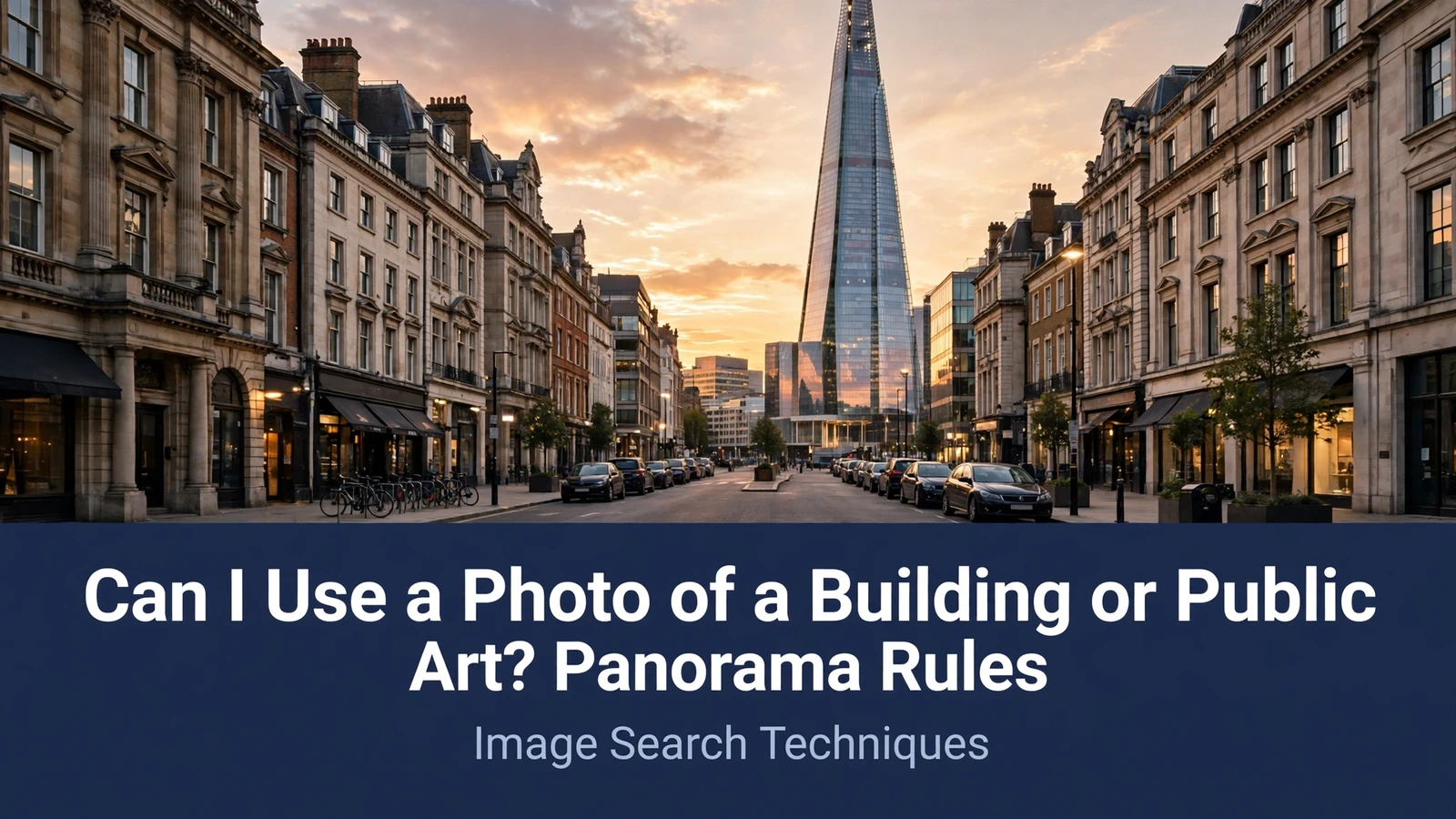
You stand on a London street, phone in hand, and take a photo of The Shard against a sunset sky. Later you ask yourself: can I use a photo of a building or public art on my blog, or sell it as a print? Then you photograph a bright mural on a side street and ask the same question. The answer is not the same for both photos, and the reason sits in one short section of UK copyright law. This is general information, not legal advice.
Yes, in most cases. In the UK you can photograph a building or a sculpture that stands permanently in a public place and publish the photo, under section 62 of the Copyright, Designs and Patents Act 1988. A mural is different, because the law covers three-dimensional works only. In the US, the same freedom covers buildings, not public art.
That short answer hides a lot of detail. The rule changes when you cross a border, when the subject is flat instead of three-dimensional, when the photo is used to sell something, and when a logo fills the frame. This guide works through each of those turns, then tests two real photos against the rules: one of The Shard and one of a street mural in London. Both photos were reverse searched live on 23 November 2026, and the results are reported exactly as they came back.
What does freedom of panorama actually mean?
Freedom of panorama is the name for a copyright exception that lets you photograph, film or draw a building or artwork that stands permanently in a public place, and publish what you made. Without it, the architect or artist could stop you, because the building or artwork is itself a copyright work. The exception takes that right away for photographs and films of the work, within limits that differ from country to country.
The idea is old. It began in Germany in the 19th century, when the Kingdom of Bavaria allowed pictures of works in public places in 1840. Today the exception exists in many countries, but there is no international treaty that sets one rule for all of them. The Berne Convention, the WIPO Copyright Treaty and the TRIPS agreement say nothing direct about it, so each country writes its own version. The European Union leaves it optional for member states, and a 2015 proposal to make one rule for the whole EU was rejected by the European Parliament on 9 July 2015. That is why a photo that is fine to sell in London can be a problem in Paris.
Three words in the definition do most of the work. “Permanently” means the work is meant to stay there for its natural life, not put up for a weekend. “Public place” means somewhere the public can go, and in the UK the law also covers “premises open to the public”, which is wider than a street. And the work itself must be the kind the law lists. In the UK that list is buildings, sculptures, models for buildings and works of artistic craftsmanship. A painting on a wall is not on that list, and that single fact decides the mural question.
Can I use a photo of a building in the UK?
Yes, and the UK rule is one of the widest in Europe. Section 62 of the Copyright, Designs and Patents Act 1988 says the copyright in a building, or in a sculpture, model for a building or work of artistic craftsmanship permanently situated in a public place or in premises open to the public, is not infringed by making a photograph or film of it, or by making a graphic work that represents it, or by broadcasting a visual image of it. The same section adds that issuing copies to the public, or communicating the work to the public, is not an infringement either. In plain words, you can take the photo, print it, put it on your website, and sell it, without asking the architect.
You can read the exact wording on legislation.gov.uk, section 62 of the Copyright, Designs and Patents Act 1988. The law firm Fieldfisher worked through the same question for the London skyline in 2016 and reached the same result: copyright, trade mark and design claims over skyline photographs are weak in the UK, though the position differs abroad.
Two points about the building itself are worth knowing. First, the architect usually owns the copyright in the building, not the person who paid for it or owns it now, unless the architect was employed or assigned the rights away. Copyright in a building lasts for the life of the architect plus 70 years. St Paul’s Cathedral is out of copyright because Christopher Wren died in 1723, while The Shard is still protected because it is a recent building. Section 62 is what lets you photograph both of them anyway.
Second, section 62 covers photographs and films, not copies of the building itself. It does not let you build a copy of a substantial part of a building. That sounds obvious, but it matters for 3D printing and models: a photo is fine, a replica is not.
One more trap sits inside the frame. A building photo can still cause trouble if a trade mark fills the picture. A well known example is a logo or a brand name that covers most of the frame, used in a way that suggests the brand endorses your product. Fieldfisher notes that building shapes and nicknames can be protected as trade marks, the Gherkin being one example, but a skyline image is unlikely to count as use of a trade mark in the course of trade. The risk rises when the logo, not the building, is the subject. If the brand is the point of the photo, the panorama rule is not the rule you need.
House rules still apply too. A museum, a private venue or a building owner can set conditions on photography on their own property, and a contract or a ticket term can bind you even where copyright does not. The panorama rule is a copyright exception. It does not override a “no photography” sign in a private space.
Can I use a photo of a building in the US?
In the US the answer is also yes for buildings, but the law is narrower. Section 120(a) of the US Copyright Act says the copyright in an architectural work that has been constructed does not include the right to prevent the making, distributing or public display of pictures, paintings, photographs or other pictorial representations of the work, if the building is located in or ordinarily visible from a public place. You can read the full text on Cornell Law Institute, 17 USC 120.
The difference from the UK is what the law leaves out. Section 120(a) covers architectural works only. It says nothing about sculptures, murals or any other public art. A photo of a sculpture on the National Mall in Washington can need clearance, because the sculpture is a separate copyright work and the building rule does not reach it. The courts have drawn this line firmly. In Gaylord v. United States, the sculptor of the Korean War Veterans Memorial statues won, because the statues were not architecture and fair use did not save the use; the award in 2013 was 684,844.94 dollars. In Leicester v. Warner Bros. in 2000, the court went the other way for a building, holding that the 801 Tower and its Zanja Madre artwork fell inside section 120(a).
Commercial use of a building photo is often allowed in the US, as the AI Overview on this question also says, but the endorsement point matters. Using a photo of a recognisable building in a way that implies the owner endorses your brand can create legal issues, even when the photograph itself is lawful. An editorial use, a blog post or a news story, sits on safer ground than an advert that leans on the building to sell something.
Where you stand matters in both countries. Photograph from a public place and do not trespass. Copyright law gives building owners some rights over architectural designs, but it does not give them a right over images of exteriors taken lawfully from the street. Climbing a fence or entering private land to get the shot is a different problem, and no panorama rule fixes it.
What about a photo of public art, a mural or a sculpture?
This is where the two photos in this guide part company. A sculpture that stands permanently in a public place is covered in the UK, because section 62 lists sculptures alongside buildings. A mural is not covered, because a mural is a two-dimensional graphic work and section 62 lists three-dimensional works only. A painting or a poster on a wall is in the same position as the mural. Being publicly visible does not bring it inside the exception. The IONOS UK guide on image copyright online, updated on 8 October 2026, puts it plainly: freedom of panorama covers buildings and certain works, not every publicly visible artwork, and paintings and murals are not covered merely because they are publicly visible.
In the US the gap is wider. There is no broad freedom of panorama exception that covers all public art. Section 120(a) covers buildings only, so a mural, a sculpture or a piece of street art keeps its full copyright protection. Commercial use of a photo where the art is the main subject risks infringement. The mural cases show how seriously the courts take this. Artists have sued over murals used in advertising and in video, including Anasagasti v. American Eagle, Falkner v. General Motors and the Detroit mural cases involving Mercedes-Benz. In Gayle v. HBO the use survived only because the graffito was visible for at most three seconds, a de minimis use. Three seconds of background art is a long way from a mural as the main subject of a photo you sell.
Incidental use is the one soft spot. If a mural appears in the background of a photo whose real subject is something else, the risk is lower, in the US and in the UK. The AI Overview on this question makes the same point: incidental or background use is generally lower risk than using the art as the main subject. Lower risk is not no risk, and it is not a licence. It is a judgement about how likely a claim is, and it depends on how prominent the art is in the frame.
Switzerland is the rare exception that proves the rule. It allows photographs of two-dimensional works such as murals or graffiti in public places. Most countries do not. France, Greece and Italy have no freedom of panorama for commercial use at all, and in France the night time illumination of the Eiffel Tower is treated as a separate artwork that needs permission, while a daytime photo is fine.
The panorama table: building or public art, UK or US
The table below is the quick reference for this guide. Read the row that matches your subject and your country, then check the last column before you publish or sell.
| Subject and country | The rule | When permission becomes necessary |
|---|---|---|
| UK building, photographed from a public place | Section 62 CDPA 1988: no infringement to photograph, film or publish it, including commercially | When a trade mark or logo fills the frame and suggests endorsement, or when house rules on private premises forbid photography |
| UK sculpture or 3D public art, permanently in a public place | Section 62 CDPA 1988: same cover as buildings, including commercially | When the work is temporary, not permanent, or when the photo is used to imply the artist endorses a product |
| UK mural, poster or painting on a wall | Not covered by section 62: two-dimensional graphic works are not in the list | Before any publication or sale where the mural is the main subject; the artist’s permission is needed |
| US building, visible from a public place | 17 USC 120(a): no infringement to make, distribute or display pictures of it | When the photo is used in a way that implies the owner endorses a brand, or when the shot was taken by trespassing |
| US sculpture, mural or street art | Not covered by 17 USC 120(a): the work keeps full copyright protection | Before any commercial use where the art is the main subject; permission or a licence is needed, and incidental background use is the only lower risk route |
One row deserves a second look. The UK mural row says permission is needed before publication or sale where the mural is the main subject. That is the rule even when the mural is on a public street and anyone can see it. Visibility is not permission, and a photo of a mural is a copy of someone else’s artwork, not just a photo of a wall.
I tested two real photos: a Shard photo and a mural photo
A rule is only useful if it survives contact with a real photo, so I took two real photos from Wikimedia Commons and ran each of them through a live reverse image search on 23 November 2026, then through the panorama table above. Both photos are published under Creative Commons licences, which means the photographer has already given permission to reuse the photo itself, with credit, under the licence terms. That is a separate question from whether the subject in the photo can be used freely. The two layers of rights are the whole point of this test.
Photo one is a sunset view of The Shard in London, taken on 27 October 2017 by a photographer who signs as Colin, and published on Wikimedia Commons as File:The Shard at sunset 2017-10-27.jpg under a CC BY-SA 4.0 licence. Photo two is a street art mural on Cheshire Street in London, photographed on 23 February 2013 by Loco Steve and published on Wikimedia Commons as File:London Street art Mural @ Cheshire St. London E1 (8519936277).jpg under a CC BY-SA 2.0 licence.


Google Lens was tried first for both photos, by image URL, and it failed on both. The search returned “Something went wrong, no image at the URL” with an “Expired visual search” header, and a fresh retry in a new tab gave the same error. That is a failed search, not a result of zero matches, and it is reported here as a failure. The same image URLs worked on TinEye, so the URLs were not the problem.
TinEye worked on both photos. It searched 86.9 billion images in each case. For the Shard photo it returned 13 results, first indexed on 21 March 2018. The exact source page, the Wikimedia Commons file page, was the second result, and the same photo also appears on the Wikipedia page for The Shard, in a cropped version, and on Wikiwand, vanupied.com, areyaa.com and housely.com. For the mural photo it returned 45 results across five pages, first indexed on 17 July 2013, including seven stock results. The same photo appears on alamy.com, flickrhivemind.net, leblogalupus.com, ldngraffiti.co.uk, monnuage.fr, culturehearts.com and christineestima.wordpress.com. The Wikimedia Commons file page did not appear among the 45 results at all: filtering TinEye’s results by the website commons.wikimedia.org returned no matches.
| Photo | Google Lens | TinEye | Exact source found |
|---|---|---|---|
| The Shard at sunset, 2017 | Blocked, “No image at the URL”, no count | 13 results, first indexed 21 Mar 2018 | Yes, Commons file page is result 2 |
| Cheshire Street mural, 2013 | Blocked, “No image at the URL”, no count | 45 results, first indexed 17 Jul 2013 | No, Commons file page absent from all 45 |
Run through the panorama table, the two photos give opposite answers. The Shard photo is safe to publish in the UK and in the US. Section 62 covers the building in the UK and section 120(a) covers it in the US, and the photographer has licensed the photo itself under CC BY-SA 4.0, so credit to Colin is all that is needed. The reuse trail backs this up: the photo’s appearances are mostly Wikipedia and Commons pages, which is what a freely licensed photo looks like.
The mural photo is different. The photographer’s CC BY-SA 2.0 licence covers the photograph, but the mural in the photo has its own artist and its own copyright, and neither section 62 nor section 120(a) covers a two-dimensional mural. Using this photo commercially with the mural as the main subject needs the mural artist’s permission, not just the photographer’s licence. The TinEye results carry a warning too: the photo appears on Alamy, a stock site, and “found on a stock site” is not a licence. A stock listing can be a photo of someone else’s artwork, and buying or downloading it does not buy the artist’s rights.
The mural result also shows the limit of a reverse search. TinEye found 45 copies of the mural photo and still missed its own source page on Commons. A reverse search is a check, not proof. No matches would not prove a photo is free to use, and a missing source page does not prove the photo has no source. The search tells you where a photo has been, and the law tells you whether you can use it.
Fair use is not fair dealing
Two phrases sound alike and mean different things, and mixing them up is one of the easiest mistakes in this area. US fair use is a broad, flexible defence. A court weighs four factors: the purpose and character of the use, the nature of the work, the amount used, and the effect on the market for the original. Commercial use weighs against you, but it does not end the question on its own.
UK fair dealing is narrower. It allows use only for specific purposes, such as criticism, review, quotation, research or private study, and only where the dealing is fair. News reporting has its own exception, but it expressly excludes photographs under section 30(2) of the CDPA 1988, so you cannot lift a news photo and call it current events reporting. The IONOS UK guide makes the same point: fair dealing for criticism, review and quotation is limited, and it does not turn a photo into fair game.
The practical result is that a US fair use argument that might work in an American court will not carry you in a UK one, and a UK fair dealing argument will not carry you in the US. If your audience and your use are in the UK, work to the UK rule. If they are in the US, work to the US rule. If the photo will be seen in both countries, the stricter rule is the one to satisfy.
If you did not take the photo yourself
Everything above assumes you took the photo. If you did not, there are two layers of rights, not one. The panorama rule, where it applies, deals with the rights in the subject: the building or the artwork. The photographer owns a separate copyright in the photograph itself, and the panorama rule does not give you that. You still need the photographer’s permission or a licence that covers your use.
Credit is not permission. Naming the photographer, linking the source or saying where you found the photo does not create a licence. A Creative Commons licence does create one, but only on its own terms: a CC BY licence needs credit, a CC BY-SA licence needs credit and the same licence on anything you share, and a CC BY-NC licence forbids commercial use. Read the licence line on the page where you found the photo, and check the publication date, because the licence that applies is the one in force when the photo was published. Our guide to using a photo from Wikimedia Commons works through exactly that check, and the same method applies to a photo from Pixabay.
Before you use a photo you found online, check its licence with the same care you would give to the subject. Our guide on how to check a photo licence before you use it sets out the steps, and if you want to use a photo in class, the rules for that use are covered in our guide to using photos in a school presentation. A reverse image search can help here too: search the photo first, find its earliest source, and read the licence there. Google’s usage rights filter can narrow a search to photos labelled for reuse, but a label is a claim, not a guarantee, so verify it on the source page. And if the same photo turns up on a stock site, remember the mural test above: a stock listing is not proof the photo is free, and it says nothing about the rights in the subject.
What about other countries?
The UK and the US are only two versions of this rule, and a photo published online is seen everywhere. A short tour of the rest shows how fast the answer changes. France has had a limited freedom of panorama since 7 October 2016, for works by natural persons and for non-commercial use only, so a commercial photo of a French building or artwork needs permission. The Eiffel Tower in daylight is fine to photograph, but its night time illumination is treated as a separate artwork and needs permission for commercial use. Greece and Italy have no freedom of panorama, and the Philippines and South Africa have no provision for it either.
Denmark allows photographs of buildings only, with no full freedom of panorama for other works. The Little Mermaid statue in Copenhagen is under copyright until 2030, and a Danish newspaper was fined for using a photo of it, though the Danish Supreme Court held in May 2023 that a parody cartoon and photo did not infringe. Belgium introduced freedom of panorama on 27 June 2016, which settled the long argument over photos of the Atomium. Germany allows photos taken from public streets and squares at street level, and a 2024 Federal Court of Justice decision held that drone photographs of copyrighted public art are not covered, only street level images. Australia covers buildings and sculptures under sections 65 to 68 of its Copyright Act, but street art and murals can still infringe. Canada covers architectural works, sculptures and works of artistic craftsmanship. Several countries, including Estonia, Latvia, Romania, Slovenia, South Korea, Taiwan and Vietnam, limit the permission to non-commercial use.
The United Arab Emirates is worth a note because it has no freedom of panorama: its law only permits broadcast exhibition of works in public places, so a photo of the Burj Khalifa or the Burj Al Arab used commercially is not covered by any panorama exception. The rule of thumb for travel photography is simple: check the country where the work stands, not the country where you live.
Before you publish or sell the photo: a checklist
Work through these seven checks before the photo goes live. Each one takes a minute, and together they catch most of the problems in this guide.
- Name the subject. Is it a building, a sculpture, a mural, a poster or a logo? The panorama table above gives a different answer for each one.
- Name the country. Where does the work stand, and where will the photo be published? The UK rule, the US rule and the French rule are three different answers.
- Check permanence. Is the work meant to stay where it is, or is it a temporary installation, an exhibition piece or a poster that will be pasted over next week? Temporary works are not covered.
- Check where you stood. Was the photo taken from a public place, or did you enter private land? A lawful photo starts with lawful access.
- Check the use. Editorial use, a blog post or a news story, is lower risk than an advert. If the photo will sell a product, or imply an endorsement, get advice or get permission.
- Check the photographer’s rights. If you did not take the photo, read the licence on the source page. Credit is not permission, and a stock listing is not a licence for the subject.
- Keep a record. Save the licence, the source page and the date you checked. If a claim arrives, that record is the first thing you will need. Our full guide to protecting your photos online explains how to keep those records in order.
What if someone says you infringed their rights?
Do not ignore the message, and do not admit anything in a hurry. Read it carefully and note exactly which work it names and what use it objects to. Check your records: the licence, the source page and the date you checked it. If the claim is about a building photo taken from a public place in the UK, the panorama rule may well answer it, but that is a judgement for a solicitor, not a guess to make in a reply. If the claim is about a mural or a piece of street art used as the main subject of a commercial photo, take it seriously from the start, because the law in both the UK and the US is on the artist’s side there. Keep the photo live or take it down while you check, and get independent legal advice before you reply in detail. This guide is general information, not legal advice, and a real claim deserves a real solicitor.
The short version is the one in the panorama table. A building photographed from a public street is yours to publish in the UK and the US. A sculpture in a public place is yours in the UK, and needs a second look in the US. A mural is not yours to sell in either country without the artist’s permission, however public the wall is. Learn those three lines and most building and public art photos will sort themselves before you publish them.
Can I use a photo of a building on my blog?
Yes, in most cases. In the UK, section 62 of the Copyright, Designs and Patents Act 1988 lets you photograph a building in a public place and publish the photo, including commercially. In the US, 17 USC 120(a) gives the same cover for buildings visible from a public place. Take the photo from public land and do not trespass.
Can I sell a photo of a public building?
Yes, in the UK and the US, if the photo is yours and the building is the subject. Section 62 in the UK and section 120(a) in the US both allow commercial use of building photos. The risk rises if a trade mark fills the frame, or if the photo implies the owner endorses your product.
Can I use a photo of a mural or street art?
Not freely. A mural is a two-dimensional work, so UK section 62 does not cover it, and US section 120(a) covers buildings only. The mural artist keeps full copyright. Using a photo of a mural commercially, with the mural as the main subject, needs the artist’s permission. Incidental background use is lower risk, not a licence.
Can I photograph a sculpture in a public place?
Yes, in the UK. Section 62 covers sculptures, models for buildings and works of artistic craftsmanship that stand permanently in a public place or in premises open to the public. In the US the position is different, because section 120(a) covers buildings only, so a sculpture photo may need clearance, as the Korean War Veterans Memorial case showed.
Does freedom of panorama cover photos taken by drone?
Not necessarily. In Germany, a 2024 Federal Court of Justice decision held that drone photographs of copyrighted public art are not covered, and only street level images are. In the UK, section 62 does not mention drones, and the photo still has to be taken lawfully. Check the local rule before you fly.
If a photo is on Wikimedia Commons, can I use it freely?
Only on the licence terms shown on its file page. A Creative Commons licence may allow reuse with credit, but it covers the photographer’s rights in the photo, not the rights in the subject. A mural in a freely licensed photo still belongs to the mural artist. Read the licence line on the file page before you use it.