🔎 Reverse Image Search
Image search techniques made simple: upload a photo or paste a URL and search 6 engines at once. 100% free, nothing stored.
🔒 Your image is never stored on our servers longer than 24 hours and is never shared.
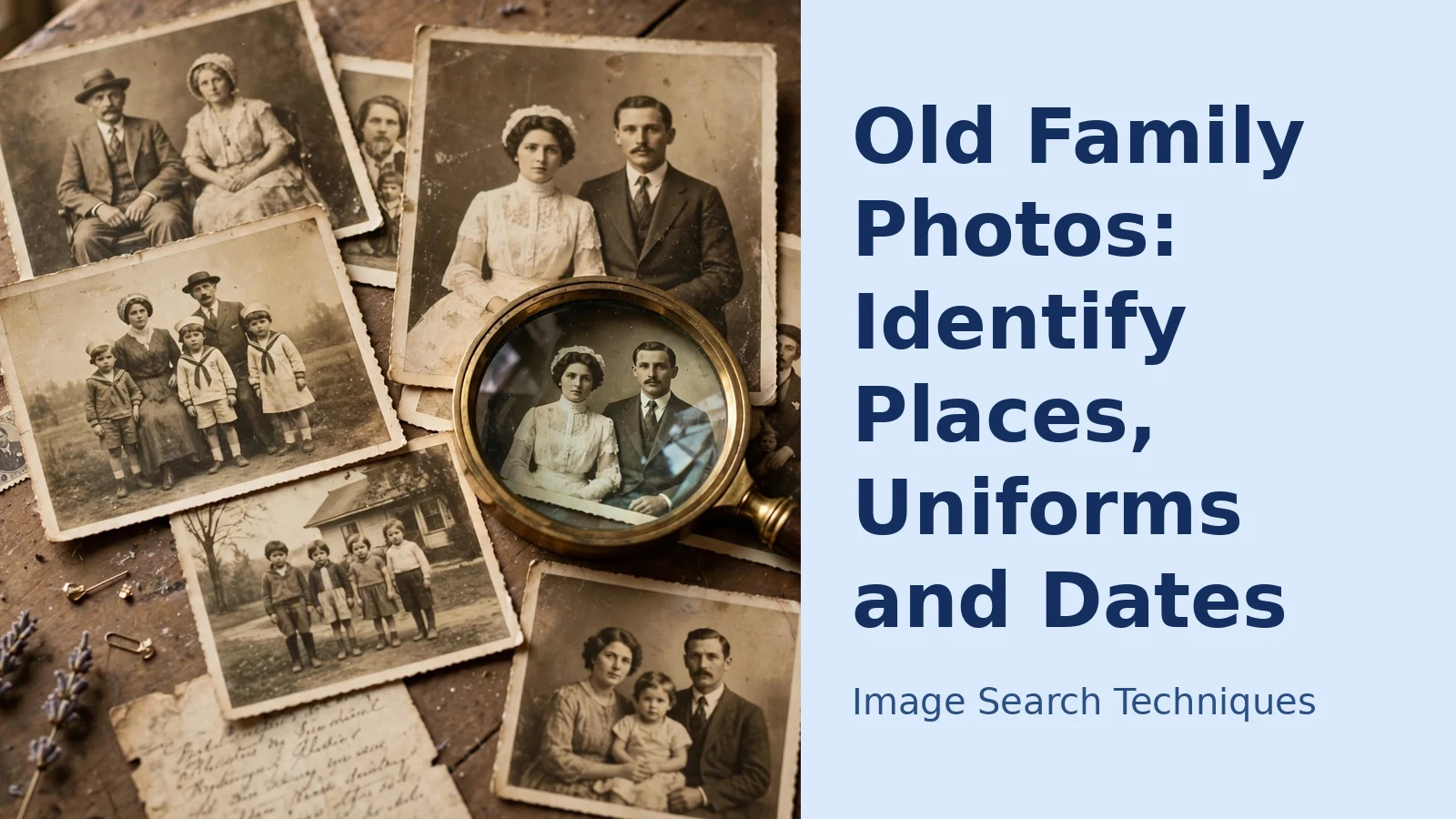
Almost every family has a photograph like it: a soldier nobody can name, a street no one recognises, a wedding group with half the faces unknown, and nothing written on the back. Image search will not put a name to your ancestor, and you should be suspicious of anything that promises it will. What it can do, combined with the physical clues in the picture itself, is answer the three questions that unlock the rest of your research: where was this taken, what uniform is that, and when was the photograph made? Once you can place an ancestor in a town, a regiment and a decade, the paper records start to fall into place.
Start with the relatives, then the photograph itself
Before any technology, ask the family. Older relatives may not recognise a face, yet still remember that “Grandad’s brother was the one who went to Canada” or that a certain print always hung in a particular house. Record those conversations, however fragmentary, and write down who said what, a vague memory attached to a named source is worth far more in five years than a confident guess with no source at all.
Then handle the original like evidence, because it is. Work from a good digital copy wherever possible, keep the print flat and out of strong light, and note everything about the physical object: its size, the thickness and style of the mount, any photographer’s name and address printed on the front or back, pencil handwriting, and its position in the album. Album order matters, photographs were usually pasted in roughly chronological order, so the identified christening on one page can bracket the mystery portrait on the next.
Where was the photograph taken?
Outdoor scenes are the most promising. Upload your digital copy to a search engine and then crop progressively tighter, a shop sign, a church spire, a distinctive terrace, a war memorial, and search each crop separately. Identical or near-identical views often surface in local history collections, postcard archives and museum catalogues, sometimes with the street named and dated. Our step-by-step guide to working out where an image was taken covers the full method, from reading signs and number plates to comparing old and modern street views.
Two warnings from experience. First, studio portraits lie: Victorian and Edwardian photographers posed sitters against painted backdrops of gardens, libraries and classical columns that never existed outside the studio, so a “country house” background may tell you nothing about place, though the photographer’s imprint on the mount tells you the town where the studio traded. Second, seaside and promenade photographers took thousands of near-identical walking pictures; a match for the location does not date the sitter, it only places the pier.
Reading the uniform: regiments, badges and medals
A uniform is effectively a caption written in cloth and brass. The cap badge identifies the regiment or corps; shoulder titles, collar badges and buttons refine it further; chevrons show rank and long service; and medal ribbons, read left to right, record which campaigns a man had served in, and therefore the earliest date the photograph can be. Crop the badge and search it on its own: collectors’ sites, regimental museums and militaria dealers illustrate badges in far sharper detail than any family print, and a clear match gives you a unit to research.
Once you have a regiment, the records open up. In the UK, The National Archives holds soldiers’ service records, medal index cards and unit war diaries, and a known unit plus an approximate date is exactly what you need to search them productively. If the family still owns the actual cap badge, button or medal as an heirloom, you can point your phone at the object itself, our guide to live camera image search explains how, and search results for the real thing are often sharper than anything taken from a faded print.
Dating the photograph from its clues
Dates come from accumulation, not a single clue. Start with the format. Small cartes de visite on thin card belong mostly to the 1860s–1890s; larger cabinet cards run from the 1870s into the early 1900s; real photographic postcards, an image printed on postcard stock, are overwhelmingly a twentieth-century format, and the design of the stamp box on the back can sometimes narrow a card to within a few years. A photographer’s imprint brackets dates too, because studios opened, moved and closed, and trade directories record when.
Then read the scene. Women’s sleeves, hat shapes and hemlines change fast enough to be useful to within a decade; men’s collars and ties move more slowly but still help. Cars are generous clues, a identifiable model gives you a “not before” year, and British registration marks followed datable sequences. Finally, cross-check against life events you already know: a man photographed in uniform with a wedding ring, or a woman in deep mourning dress, ties the sitting to a marriage or a bereavement you may already have on your tree.
Putting image search to work on old pictures
Old photographs match differently from modern ones. The same image may have been sold as a postcard, reproduced in a regimental history, or scanned by a local archive, so search more than one engine and expect partial, cropped or reversed copies, prints were often flipped in reproduction. The workflow in our main reverse image search guide applies, with two adjustments for old material: search details, not just the whole frame, and save every near-match, because a similar group photograph from the same battalion or street can confirm your reading of the original.
For faces and uniforms specifically, Google Lens and Google reverse image search tend to be strongest, because Lens is good at matching objects, badges, vehicles, buildings, inside a busy scene. And if you want several engines checked at once, the free tool on our homepage runs one picture across six engines in a single pass, which is handy when you are working through a whole album.
Record what you find, and how sure you are
Genealogy runs on evidence, so write identifications up properly. Never write on the original print; pencil details on the archival sleeve or keep a numbered log that ties each conclusion to the photograph. Record the reasoning, not just the answer, “cap badge matches the Royal Welch Fusiliers; studio imprint places it in Wrexham; postcard back suggests 1915–18”, and mark honestly what is proven, what is probable and what is still a guess. Free tree-building sites such as FamilySearch let you attach photographs and notes to a person’s record, so the next relative to ask the question inherits your detective work rather than starting again. Once you know where and when a photograph was taken, the next question is usually who is in it, and our guide to identifying people in old photos works through that question step by step.
If the photograph leaves you stuck on what something is, rather than where or when, our guide to how to identify anything in a photo walks through the same image-search steps for any object, place or person in a picture.
FAQs
Can image search tell me who the person in an old photo is?
Not directly. Search engines match pictures, not identities, so they can find the same image published elsewhere with a caption, but an uncaptioned private portrait stays anonymous until the place, uniform and date clues lead you to a record that names someone.
What is the single most useful clue in a military portrait?
The cap badge. It identifies the regiment or corps, which unlocks service records, medal rolls and war diaries. Crop it, search it separately, and confirm the match against a regimental museum or badge reference before relying on it.
How accurately can a photograph be dated?
Usually to within a few years, occasionally better. Format, studio imprints, postcard stamp boxes, clothing and vehicles each give a range; where several ranges overlap, the shared window is your best estimate.
Should I write names on the back of old photographs?
Not on the original. Ink can bleed through and pencil pressure can emboss the surface. Use archival sleeves or a separate numbered index instead, and keep the written record with the album so the two are never separated.
If the medals in the photograph are your next puzzle, learn how to identify a military medal from a photo, reading the ribbons, clasps and inscriptions to name each award before you check the service record.