🔎 Reverse Image Search
Image search techniques made simple: upload a photo or paste a URL and search 6 engines at once. 100% free, nothing stored.
🔒 Your image is never stored on our servers longer than 24 hours and is never shared.
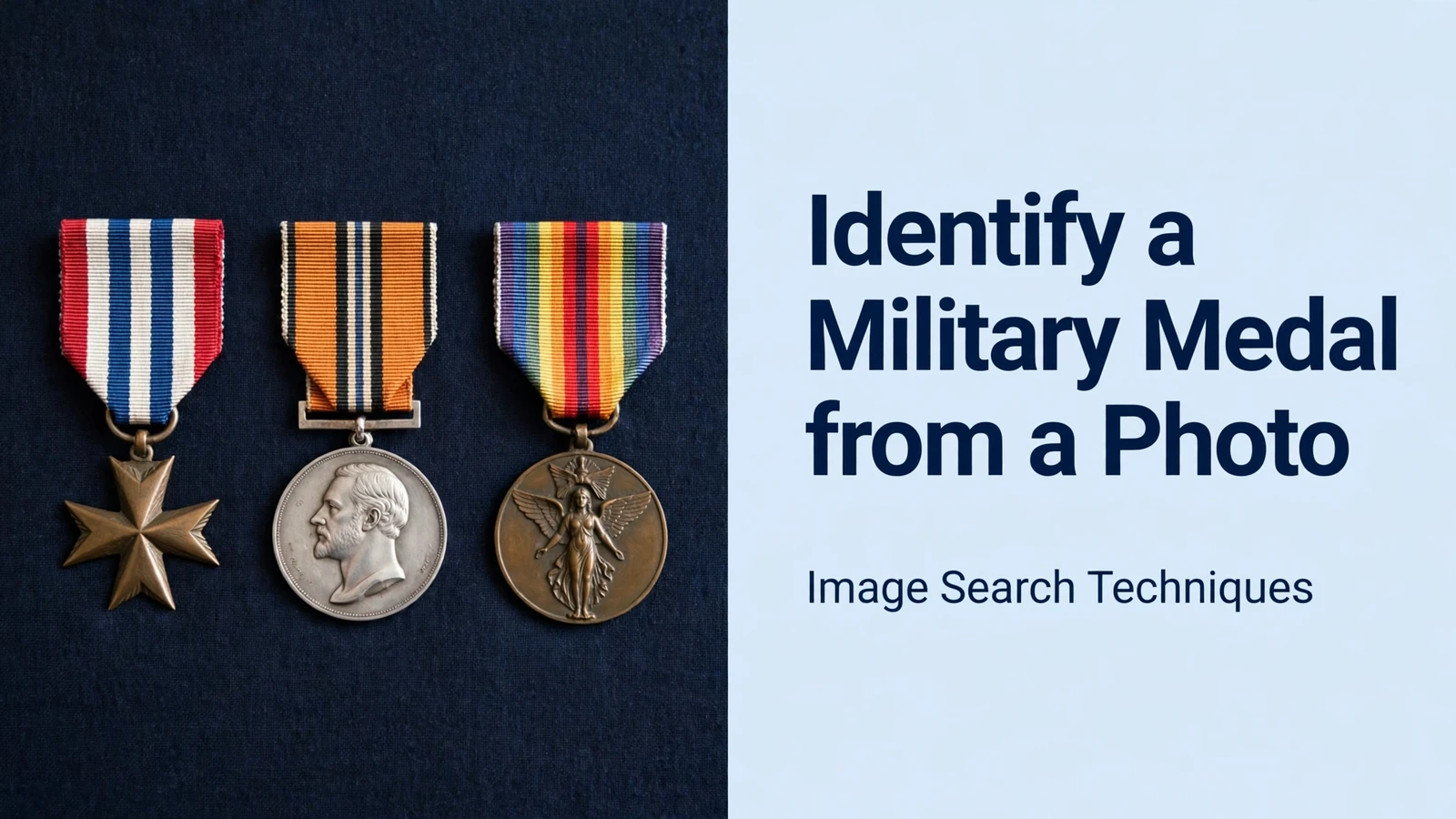
To identify military medal from photo evidence, photograph the front and back of the medal, read the ribbon colours from left to right, note the shape, metal and any inscription, then match the ribbon against a lookup table and confirm the match with a reverse image search before checking the service record.
If you have just inherited a box of medals, or found a ribbon bar in a drawer, that short routine is the whole method in miniature. Searches to identify military medal from photo evidence usually start with a ribbon, a shape or a few words of inscription, and this guide is built around exactly those three clues. This guide works through the method slowly, because the details are where identifications are won or lost: two ribbons can share the same colours in a different order, and two medals can share a name across different wars. A medal ribbon is the strip of coloured silk or grosgrain from which a medal hangs, and its colours and stripe pattern are unique to one award.
One warning belongs at the start, and it applies to everything that follows. Naming a medal from a photograph is not proof that the medal is genuine, and it is not proof that the person in the photograph was entitled to wear it or claim it. Replicas and copy medals are common, and a photograph alone cannot separate an original from a well-made copy. Use this guide to name the medal, then prove entitlement through the service records and regimental museums described at the end. This guide also treats medals and ribbon bars as objects only: if you want to date the family photograph the medals appear in, use our guide to dating old family photographs, which covers uniforms, places and dates and is not repeated here.
What Is a Medal Ribbon, and Why Is It the Fastest Clue?
A medal ribbon is the fastest clue because it is designed to be read at a glance. Each award has its own registered combination of colours, stripe widths and order, so an experienced reader can often name a medal from the ribbon alone, without seeing the metal at all. That is why soldiers wear ribbon bars on everyday uniform instead of the full medals: the strip of colour carries the same information in a smaller form.
It helps to know which object you are looking at before you start naming it. A full medal is the metal disc, star or cross suspended from its ribbon. A ribbon bar is a short, stiffened length of the same ribbon, mounted on a metal backing and worn on the chest when the full medal is not worn. A miniature medal is a half-size copy of the full medal, worn on evening dress. The identification principles are the same for all three, but the ribbon is usually the easiest part to photograph well, so start there.
British full-size ribbons are typically about 32 millimetres wide, while American ribbons are usually 1⅜ inches (about 35 millimetres) wide, according to the ribbon guide published by Owlcation. That small difference is a useful first check when a medal could be British or American. Shape matters too: British campaign awards are often stars, while service awards are usually circular discs, and gallantry decorations may be crosses. The Victoria Cross, for example, is a cross pattée worn from a plain crimson ribbon, while the Military Cross is a cross worn from a ribbon of three equal stripes, white, deep purple and white.
Two habits make ribbon reading reliable. First, always record the colours in the order they appear from the wearer’s left to right, that is, from your right to left as you look at a photograph of the medal being worn. Veterans Affairs Canada, which publishes the official ribbon descriptions for Commonwealth medals, notes that the 1914–15 Star ribbon is worn with the red edge furthest from the left shoulder, so reading the order backwards can point you at the wrong medal. Second, record stripe widths as well as colours: a broad orange centre stripe with thin white, black and blue edges is the British War Medal, while a narrow red centre stripe with broad red edges is the War Medal 1939–45. The colours overlap; the widths do not.
How Do You Photograph a Medal So Image Search Can Read It?
Image search matches shapes, colours and printed text, so a single angled snapshot in a dim room gives it almost nothing to work with. Photograph both sides of every medal, front and back, because the two sides carry different evidence. The front shows the design and the monarch’s portrait; the back often carries the award name, dates or motto; and the rim often carries the recipient’s name, rank, service number and unit. A medal photographed from one side only is half-identified.
Work through these steps for each medal, in this order:
- Photograph the front, straight on. Lay the medal flat on a plain dark or white surface in daylight, stand directly above it, and fill the frame. The whole design, the suspension and the ribbon must be visible.
- Photograph the back, straight on. Turn the medal over and photograph the reverse the same way. Inscriptions such as “THE GREAT WAR FOR CIVILISATION 1914–1919” on the Victory Medal are often the fastest confirmation of all.
- Photograph the rim or edge. British campaign medals were officially named to the recipient, and the naming is usually impressed around the rim. Take a close-up in raking light, because impressed lettering reads best at an angle.
- Photograph the ribbon flat. Lay the ribbon out straight, without folds or twists, and photograph it from directly above so the stripe order and widths are clear.
- Photograph any clasp, bar or device. A small bronze bar sewn across the ribbon, or a tiny oak leaf or rosette on it, changes the meaning of the medal, so give it its own close-up.
- Photograph the group in order. If there are several medals, lay them out in the order they would be worn, left to right, and photograph the whole group as well as each medal on its own.
- Search each photograph separately. The front, the back and the ribbon are three different searches, and one of them usually lands where the others miss.
Two practical points make the difference between a usable set and a wasted afternoon. First, switch the flash off and clean the lens: flash washes out gilt and turns a silver medal into a white blur. Second, crop each photograph tightly around the subject before you search, because a cluttered frame pulls the results off course. This is the same front-and-back routine we use to identify a china pattern from a photo, where the backstamp does the work the rim does here. For the search itself, follow our step-by-step reverse image search guide, which covers uploading, cropping and cross-checking on computer and phone.
Medal Ribbon Identification: The Lookup Table
The table below is the ranking asset of this guide: a ribbon-colour lookup for the medals a family researcher is most likely to meet in a British drawer or photograph, plus one American example. Every row is taken from an official or museum description, Veterans Affairs Canada for the campaign medals, the Royal Museums Greenwich and Veterans Affairs Canada for the Distinguished Service Order, the Australian Department of Defence for the General Service Medal, and the Ministry of Defence for the qualifying service. Read the stripe pattern left to right as the medal is worn, and use the shape and inscription to confirm the match rather than trusting colour alone, because faded ribbons and old photographs shift colours.
| Ribbon pattern (as worn, left to right) | Medal | What it was awarded for |
|---|---|---|
| Red, white and blue shaded watered bands | 1914–15 Star | First World War service in a theatre of war, 5 August 1914 to 31 December 1915 |
| Seven stripes: blue, black, white, orange centre, white, black, blue | British War Medal | First World War service overseas, 5 August 1914 to 11 November 1918 |
| Double rainbow: violet, blue, green, yellow, red centre, yellow, green, blue, violet | Victory Medal | First World War; awarded to those who received a Star or the British War Medal |
| Three equal stripes: dark blue, red, light blue | 1939–45 Star | Second World War operational service, six months, or two months for aircrew |
| Flame-coloured centre, green edges, narrow black stripe on each edge | Defence Medal | Second World War non-operational service, including three years in the UK |
| Narrow central red stripe, white stripes, blue stripes, broad red edges | War Medal 1939–45 | Second World War full-time service of at least 28 days |
| Plain crimson | Victoria Cross | Most conspicuous bravery in the presence of the enemy |
| Three equal stripes: white, deep purple, white | Military Cross | Gallantry in action; for officers in the First World War, open to all ranks since 1993 |
| Red with narrow dark blue edges | Distinguished Service Order | Operational gallantry and leadership in combat |
| Purple with two dark green outer stripes | General Service Medal 1962 | Campaign service 1962–2007, always issued with a clasp naming the campaign |
| Purple with a narrow white stripe at each edge | Purple Heart (USA) | Wounds received in action; a heart-shaped medal with George Washington’s profile |
Three of these rows deserve a second look, because they are the ones most often confused. The 1914–15 Star, the British War Medal and the Victory Medal were awarded together so often that they are known as “Pip, Squeak and Wilfred” after a newspaper cartoon of the time, and the three were never awarded singly, the Star was never issued without the other two, according to The National Archives. If you find one of them, look for the other two. The two rainbow ribbons are another trap: the British Victory Medal of the First World War and the American Victory Medal of the Second World War both use a rainbow ribbon, so check the metal, the British medal is bronze with a winged Victory and the words “THE GREAT WAR FOR CIVILISATION 1914–1919” on the reverse, while the American medal is inscribed for the Second World War. And the two red ribbons are easy to mix up in a faded photograph: the Victoria Cross ribbon is plain crimson with no other colour at all, while the Distinguished Service Order ribbon is red with narrow dark blue edges.
How Do You Identify Military Medal from Photo, Step by Step?
Once the photographs are taken, work through the identification in the same order every time, so nothing gets skipped. Start with the ribbon, because it narrows the field fastest; then use the metal and the inscription to confirm; then use image search to check your reading against reference photographs; and only then turn to the paper records.
- Read the ribbon first. Write down the colours and stripe widths in order, then find the row in the lookup table above. If two rows look close, note both and let the next steps decide between them.
- Read the shape and the metal. A four-pointed bronze star points to the 1914 or 1914–15 Star; a six-pointed star points to the 1939–45 Star and the other Second World War stars; a circular silver medal with St George on horseback is the British War Medal; a cross points to a gallantry decoration.
- Read every word on the medal. Search any inscription in quotation marks as a text search as well as an image search. Dates such as “1914–15” on the central scroll of a star, or “1939–1945” on a campaign star, settle the war at once.
- Run the front photograph through Google Lens. Upload the straight-on front shot, crop tightly around the medal, and read the top matches. Our Google reverse image search guide covers the desktop and phone steps, including how to search just one part of an image.
- Cross-check with TinEye. Run the same photograph through TinEye, which is strongest at exact matches and at finding where an image first appeared. If Lens and TinEye agree on the same medal, you can trust the identification; if they disagree, trust the reference photograph that matches the ribbon, shape and inscription together, not the one with the catchiest title.
- Confirm against an official reference. Compare your medal with the ribbon descriptions published by Veterans Affairs Canada and the medal pages of the Imperial War Museum, and with the descriptions in The National Archives’ medal guides. Match design details, not just general shape.
- Read the group, not just the single medal. Medals are worn in a strict order of precedence, with gallantry awards first, then campaign stars and medals. If you can name one medal in a group with confidence, the order of wear narrows what its neighbours can be.
Different tools suit different parts of the job, so use more than one:
| Tool | Best for | Watch out for |
|---|---|---|
| Google Lens | Naming the medal from a photograph; reading inscriptions; widest index | Can return visually similar but wrong medals when the crop is loose |
| TinEye | Exact matches; finding where the same image appeared before | Smaller index, so a medal never published online may return nothing |
| Bing Visual Search | Similar items and adjustable cropping on part of an image | Weaker on older and less common British medals |
| Yandex Images | Visually similar results when the other engines return nothing | Results can drift into unrelated militaria and dealer listings |
If you are starting from a photograph of an unknown object rather than a medal you hold in your hand, the same routine applies, and our guide to identifying anything in a photo covers the general method, crop tightly, search with Lens, then confirm with a second engine. Medals reward the same discipline, with one difference: the ribbon, the rim naming and the clasp are three separate searches, and each one can confirm or overturn the others.
Worked Test: A Named British War Medal Run Through Lens and TinEye
The worked test for this guide uses a single, clearly captioned freely licensed photograph from Wikimedia Commons: “Medal, campaign (AM 800627-4).jpg”, a British War Medal 1914–20 awarded to 10-3371 Sergeant Robert Poots, MM, of the Wellington Infantry Battalion, New Zealand Expeditionary Force. The Auckland War Memorial Museum photograph, taken by Rohan Mills on 22 December 2016 and released under a Creative Commons Attribution licence, shows the circular silver medal with the coinage head of King George V on the obverse, St George on horseback on the reverse, the dates 1914 and 1918 around the edge, and the ribbon with its broad orange watered centre band bordered with white, black and blue stripes. The medal is named on its edge “10-3371 SJT. R. POOTS. N.Z.E.F.”, and the museum notes that Poots was awarded the Military Medal for bravery during the Messines Offensive in 1917.
This photograph was chosen because it is a hard, fair test: a single named medal with a clear ribbon, a readable inscription and a museum caption to check the answer against. The both-sides protocol was followed as far as a single published photograph allows, the obverse, the reverse design and the ribbon are all visible in the frame, and the edge naming is recorded in the museum caption rather than visible in the shot, which is itself a useful lesson: a photograph of one side can leave the naming unread, and that is why the protocol asks for the rim as its own close-up.
Before running the searches, the expected answer was written down from the lookup table: the orange-centred ribbon with white, black and blue edges is the British War Medal, the silver disc with St George on horseback confirms it, and the 1914–1918 dates on the edge fit the First World War. The test then ran the full-resolution photograph through Google Lens and through TinEye by its direct image URL on 11 November 2026.
Google Lens result: Lens failed to run at all, on two attempts. Its AI overview stayed on “Thinking” and never produced an identification, and both the Exact matches and Visual matches tabs showed the same error: “Something went wrong, No image at the URL. Try again with a different URL or image.” Lens therefore named no medal, showed no matches and gave no count. This is a known Lens-by-URL limitation with some Wikimedia-hosted files, not evidence about the medal: the same URL worked in TinEye, so the file itself was reachable.
TinEye result: TinEye fetched the photograph without difficulty and reported 0 matches after searching over 86.7 billion images: “TinEye searched over 86.7 billion images but didn’t find any matches for your search image. That’s probably because we have yet to crawl any pages where this image appears.” Neither the Auckland Museum page nor the Commons file page appears among the results, and no first-indexed date is shown because there are no matches to date.
The verdict is therefore judged against the museum caption and the lookup table, not against the engines: the orange-centred ribbon, the St George reverse and the 1914–1918 edge dates all name the British War Medal, and the museum caption confirms the recipient and the award. The TinEye result of 0 matches does not contradict that, it means TinEye has not yet crawled a page carrying this image, not that the image is unused elsewhere. And the Lens failure is itself a useful lesson for family researchers: when a search engine cannot fetch the URL, try uploading the saved image file directly instead, and never treat one engine’s silence as a verdict on the medal.
What Do Clasps, Bars and Small Devices on a Ribbon Mean?
A clasp, also called a bar, is a small metal strip fixed across the ribbon, and it always adds information to the medal it sits on. It usually names a specific campaign, battle or period of service within the wider award, so reading the clasp can turn a general campaign medal into a precise service history. A rosette is the small fabric or metal rose worn on the ribbon bar alone to stand for a clasp when the full medal is not being worn, and a bronze oak leaf is a different device altogether: it marks a Mention in Despatches.
Three examples show how much a clasp can tell you. The 1914 Star, the “Mons Star”, carries a clasp inscribed “5th AUG.–22nd NOV. 1914”, instituted in 1919 for those who served under fire or within range of enemy mobile artillery in France or Belgium in that period, and those who qualified for the clasp wore a small silver rose on the ribbon bar when the medal itself was not worn, according to the medal’s published history. The France and Germany Star, awarded for service in France, Belgium, Luxembourg, the Netherlands and Germany from D-Day, 6 June 1944, to 8 May 1945, carries a clasp inscribed “ATLANTIC” for those who also qualified for the Atlantic Star, and the Atlantic Star in turn carries a clasp inscribed “FRANCE AND GERMANY”, so the two clasps mirror each other and a single clasp can tell you which star a sailor or soldier earned first. And the 1939–45 Star has just one clasp, “Battle of Britain”, for the aircrew who fought in that battle.
Devices on the ribbon need the same care. A bronze oak leaf on the ribbon of the War Medal 1939–45 marks a Mention in Despatches, and on the Defence Medal it marks a King’s Commendation, according to Veterans Affairs Canada. A rosette on the ribbon of a Distinguished Service Order marks an additional award of the Order, a Bar, rather than a campaign. And the General Service Medal 1962 is always issued with a clasp naming the campaign, such as “Northern Ireland” or “Borneo”, so a 1962 GSM with no clasp at all is incomplete, and the clasp is the part that says where the recipient served. Always photograph clasps and devices as their own close-up, and read the wording letter by letter: a misread clasp is the commonest way a correct medal identification turns into a wrong service history.
What a Photo ID Cannot Prove: Replicas, Copies and Entitlement
A photograph can name a medal type, and that is all it can do. It cannot prove that the medal in the photograph is an original issue, and it cannot prove that any particular person was entitled to wear it. That distinction matters because replicas and copy medals are common: families bought replacement sets, veterans replaced lost medals, and dealers and collectors have produced copies for more than a century. A copy can carry the right ribbon, the right shape and even a plausible name on the rim, and a photograph will not reveal the difference in weight, metal or striking that an expert would feel in the hand.
Be suspicious of the easy signs, but do not treat any single one as proof. Very shiny medals with laser engraving or obviously modern clutch-back hardware can signal a modern replacement rather than a wartime-manufactured medal, as the Owlcation ribbon guide notes, and cast copies often show slightly soft or rounded detail where a struck original is crisp. But honest replacements exist too: many families bought them openly, and a replacement is not a fake unless someone presents it as an original. Record what you have as “British War Medal, ribbon correct, naming reads 10-3371 SJT. R. POOTS” rather than as “genuine”, and keep the uncertainty in the record.
Entitlement is a separate question from authenticity, and it is answered by paper, not by pictures. A photograph of a man wearing medals proves only that he was photographed wearing them. Whether he was entitled to them is decided by his service record and the medal rolls, which is the next section. Never wear, claim or lend medals on the strength of a photograph alone, and never let a photo identification stand as the final word in a family history: name the medal from the photograph, then prove the entitlement from the records.
How Do You Prove Who Earned the Medal?
The proof lives in the records, and for British First World War medals the best starting point is the medal index card. The National Archives holds over five million First World War medal index cards in series WO 372, created by the Army Medal Office to record the medals that men and women who served were entitled to claim. A card usually records the name, rank, unit, regimental number and medal entitlement, and often the first theatre of war and the date of entry into it. Because so many First World War service records were destroyed in the Blitz, the cards are often the only surviving official list of a soldier’s medals, and they are the document that turns a named medal into a named person.
Search the cards through The National Archives’ guide to British Army medal index cards 1914–1920, which explains the search and what each card contains. You can search by surname and regimental number, and downloads carry a small fee; the cards can also be viewed on the subscription sites Ancestry and Findmypast. The card records entitlement rather than the physical awarding of a medal, so if you want to check whether a person actually received a medal, the medal rolls in series WO 329 behind the cards are the next step, and they should be annotated with pencil ticks. One more fact from the same guide is worth knowing before you write to anyone: it is Ministry of Defence policy not to issue medal replacements for service before 1920, irrespective of entitlement.
For service after the First World War, apply for the record itself. GOV.UK’s guide to getting a copy of military records of service explains how to apply for your own records or for the records of a deceased serviceperson: records of the deceased are held by the Ministry of Defence and The National Archives, there is no fee for requesting records from the Ministry of Defence, and the search can take up to a year. A service record may include the service number, rank and regiment, dates of joining and leaving, and details of good conduct medals and the units served in, the exact facts that confirm or correct a photo identification.
Finally, take the medal itself to the people who handle them every day. The regimental museum of the unit named on the rim or on the medal index card holds collections, rolls and photographs for that regiment, and its staff can usually confirm whether a group of medals is consistent with one man’s service. The Orders and Medals Research Society can also connect you with specialists. Bring the photographs from the both-sides protocol, the ribbon reading from the lookup table, and the name and service number from the rim: that set of evidence lets an expert help you in minutes, where a single blurry photograph would take them hours. And remember the boundary this guide keeps throughout: medals are objects, and this article names the object. Dating the photograph they appear in, reading the uniform around them and placing the sitter in a place and a decade is separate work, covered by the family-photographs guide linked at the start.
FAQs
What medal is this if the ribbon is rainbow-coloured?
A rainbow ribbon usually means a Victory Medal, but check which war: the British First World War Victory Medal is bronze, shows a winged Victory, and reads “THE GREAT WAR FOR CIVILISATION 1914–1919” on the reverse, while the American Second World War Victory Medal is a different design. Match the ribbon with the shape and inscription before deciding.
Can a photo prove a medal is genuine or that someone earned it?
No. A photograph can name the medal type from its ribbon, shape and inscription, but replicas and copy medals are common and a photo cannot show weight, metal or striking. Entitlement is proved by the service record and the medal index card, not by a picture of the medal being worn.
What does a small bronze oak leaf on a ribbon mean?
On the War Medal 1939–45 it marks a Mention in Despatches, and on the Defence Medal it marks a King’s Commendation. On the General Service Medal 1962 it likewise marks a Mention in Despatches or a Queen’s Commendation. Always check which medal the leaf sits on, because the meaning follows the medal.
Where can I check a First World War soldier’s medals without paying a researcher?
Search The National Archives’ medal index cards, series WO 372, by surname and regimental number: there are over five million cards recording name, rank, unit and medal entitlement. Catalogue searches are free and downloads carry a small fee, and the cards are free to view at Kew.