🔎 Reverse Image Search
Image search techniques made simple: upload a photo or paste a URL and search 6 engines at once. 100% free, nothing stored.
🔒 Your image is never stored on our servers longer than 24 hours and is never shared.
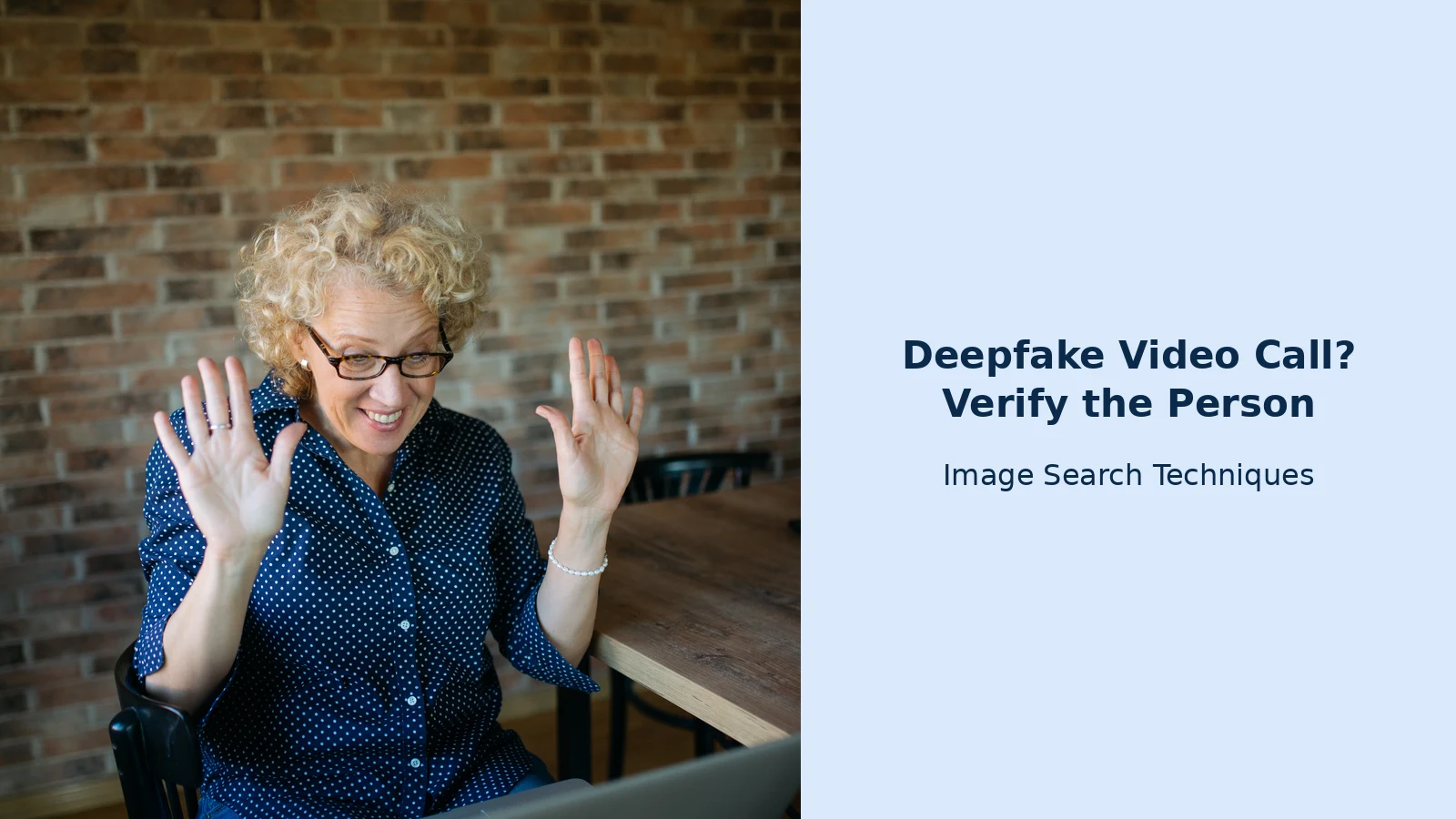
A deepfake video call is a live video call in which artificial intelligence replaces the caller’s face, and often their voice, with a convincing copy of a real person, in real time. The person on your screen can look like your boss, a colleague, or a relative, answer your questions, and react to what you say, while the real person is nowhere near the call. Seeing a familiar face used to be proof of who you were talking to. That proof no longer holds, so the defence has moved from trusting your eyes to verifying the request another way.
Pause the call, ask the person to turn their head sideways and wave a hand across their face, then hang up and call them back on a number you have, or use a pre-agreed code word. If they refuse, cannot be reached another way, or the request involves urgent money, treat the call as fake and send nothing.
This guide is for a call happening right now. If you have a recorded clip to check, use our deepfake detector tools guide instead. Everything below is about live-call behavioural checks, what to do in the moment, while the call is still running. It does not review detector tools, because no tool can help you in the middle of a call, and it never treats a visual tell as proof: a good fake can show none of them, so the checks here are a tripwire, not a verdict.
What Is a Deepfake Video Call, and How Does the Scam Work?
A deepfake video call is a fraud, not a prank. The scammer builds a real-time copy of a real person from photos and video clips that person has posted publicly, then joins a call wearing that face and speaking in that voice. The technology answers back: it reacts to your questions, nods, and holds a conversation, which is what makes it far more persuasive than a fake photo or a written message. Not every fake is even live, though: some calls play a pre-recorded or looped clip of the person instead, which is why asking for something unplanned, like a sideways head turn or a hand waved across the face, is so useful: a recording cannot react to it.
The structure of the scam is consistent, whether the target is a company employee or an individual at home. First comes the impersonation: a boss, a finance chief, a business partner, a relative in crisis, or a romantic interest “proving” they are real on a quick video call. Then the live call itself, which looks right, and in group-call versions, several “colleagues” are present to make the meeting feel normal and to apply social pressure. The same trick also turns up in fake job interviews, where the interviewer is a deepfake and the real aim is the applicant’s personal details or login credentials. Then the urgent, confidential payment request: a time-sensitive transfer, a secret acquisition, an emergency only you can fix, quickly and quietly. Finally, a payment method that is hard to reverse, usually a bank wire or cryptocurrency.
The FBI’s Internet Crime Complaint Center warned in December 2024 that criminals use generative AI to create videos for real-time video chats with alleged company executives, law enforcement officers, or other authority figures, and that the same tools can produce clips to “prove” an online contact is a real person. That warning is the reason this guide exists: the face on the call is now the least reliable part of it.
The best-known form aimed at businesses is the CEO deepfake scam, where a finance worker is told by their apparent chief executive to move money at once. The version aimed at individuals is the family emergency video call scam: a grandchild or a relative appears on screen, distressed, asking for money to be sent immediately. The US Federal Trade Commission has warned that scammers can clone a loved one’s voice from a short audio clip taken from content posted online, so a voice that sounds exactly like your grandson is not evidence either. The request is the tell that never changes, urgency and secrecy exist to stop you verifying, and a genuine executive or relative can tolerate a two-minute check.
Our photo scams guide covers the wider family of image-based frauds, from fake listings to stolen photos. This article stays on the one case where the fraud happens live, on a call, in front of you.
How Can You Tell If a Video Call Is a Deepfake?
If you are wondering how to tell if a video call is a deepfake, start with the small visual faults, but never treat a clean-looking call as proof that the person is real. Deepfakes still struggle with fine detail, and those struggles are worth knowing, but they are a tripwire, not a test that a real person passes and a fake one fails. A good fake can show none of them.
Watch for these signs while the person is speaking:
- Hands and fingers that look distorted, merge together, or move oddly when the person gestures.
- Teeth and eyes that look slightly wrong, teeth too uniform, eyes that do not blink naturally, or a gaze that never quite meets the camera.
- Hair and earrings that flicker, shimmer, or change shape as the person moves their head.
- Lighting and shadows on the face that do not match the room, or a face that looks lit differently from the background.
- Lip-sync lag, where the mouth moves a fraction of a second behind the words you hear.
- Edges of the face that blur, wobble, or smear when the person turns their head quickly or moves a hand across their face.
The FBI’s Internet Crime Complaint Center lists the same imperfections, distorted hands or feet, unrealistic teeth or eyes, indistinct faces, inaccurate shadows, lag time, and voice matching, and in the same warning it says plainly that it can be difficult to identify when content is AI-generated. That is the honest position, and this guide follows it: if you see several of these faults together, treat the call as suspect; if you see none of them, treat the call as unproven, not genuine.
There is one useful after-the-call check. Take a screenshot of a still frame from the call and run it through the steps in our guide to verify a news photo is real, a reverse image search on a still can reveal that the “person” is a stolen photo or a stock image. It is a supporting check, not a live-call defence, and it belongs after you have already hung up.
The In-the-Moment Protocol: Five Checks to Run While You Are Still on the Call
When a video call feels wrong, you do not need to accuse anyone or explain yourself. You need a short, calm routine that a real person passes easily and a fake struggles with. Print this card, or save it on your phone, and run it in order the next time a call carries a money request.
| Step | What to do | What a pass looks like | What a fail means |
|---|---|---|---|
| 1. Pause | Say you need a moment before acting on the request. Do not agree to anything yet. | The person accepts the pause without pressure. | Pushback, guilt, or a new deadline means stop. |
| 2. Head-turn test | Ask them to turn their head fully sideways, then back, slowly. | The face holds together from the side. | Smearing, warping, or a face that “slides” is a strong warning. |
| 3. Hand-in-front-of-face test | Ask them to wave a hand slowly across their face. | The hand passes cleanly in front of a stable face. | The face distorts, flickers, or the hand merges with it. |
| 4. Callback on a known number | Hang up and call the person back on a number you already have. | The real person answers and confirms the request. | They cannot be reached, or they know nothing about it. |
| 5. Code word | Ask for the pre-agreed family or team code word. | They give it at once, without hesitation. | They dodge, guess, or claim they forgot it. |
Run the checks in this order:
- Pause first. Say, “Give me two minutes, I need to check something before I move money.” A real boss or relative accepts that. A scammer will press you, invent a deadline, or tell you not to involve anyone else. Pressure is itself the answer.
- Ask for the head turn. Frame it as a connection problem, not an accusation: “Your video keeps freezing, turn your head to the side slowly so I can see you properly.” A deepfake is built from a mostly front-facing model, so a full sideways turn is where it is most likely to smear or warp.
- Ask for the hand wave. “Wave your hand in front of your face for me, the picture is glitching.” When a real hand passes in front of a real face, the picture stays stable. When a hand passes in front of a generated face, the model often cannot keep the two apart, and the face distorts.
- Hang up and call back. This is the decisive step. Use a number you already have, from your contacts, a company directory, or a card in your wallet, never a number given on the call or in the chat that set it up. A scammer controls only the call in front of you; they cannot answer the real person’s phone.
- Use the code word. A pre-agreed word or phrase that only the real person would know settles identity in seconds. If you have not set one up yet, the last section of this article shows you how, and why it is the single most useful preparation you can make.
One failed check is enough to stop. You do not need three fails, and you do not owe the caller an explanation. “I can’t do this on a call, I’ll ring you back” is a complete sentence, and it ends the scam whether the call was fake or not.
The Arup Case: A Worked Example of the Protocol in Action
The clearest documented example of a deepfake video call scam is the 2024 case at the engineering firm Arup. A finance employee joined a video conference in which the chief financial officer and other colleagues appeared to be present, and, as multiple news outlets reported in 2024, every other participant on the call was an AI-generated deepfake. The employee was instructed to make a series of transfers, and around US$25 million was paid out before the fraud was discovered. The figure is reported, not confirmed by the firm in public detail, but the shape of the case is well documented and it is the case every other guide in this field cites.
Walk the protocol card through that call and the failure points become obvious:
- The pause that never happened. The request arrived as an urgent, confidential instruction from the most senior people in the room. The employee had no habit of pausing a request from the chief financial officer, and no written rule that said they must. A standing rule, “no payment moves on a call alone, whatever the rank of the caller”, would have been the pause.
- The head-turn test nobody ran. A multi-person deepfake call is built to look normal at a glance, with several faces on screen to spread attention and add social pressure. Asking one participant to turn their head fully sideways would have been a natural, low-suspicion request in a glitchy video meeting, and it is exactly the movement a real-time fake handles worst.
- The callback that would have ended it. The decisive step is also the simplest: hang up and ring the chief financial officer on the number in the company directory. A scammer can fake the CFO on the video call. They cannot answer the CFO’s real phone. One callback, on a number the employee already had, defeats the entire fraud regardless of how convincing the fake looked.
- The second person who was never consulted. The call relied on one employee acting alone under secrecy. A rule requiring a second person’s confirmation for any large payment, confirmed through a second channel, closes the gap that the Arup loss fell through.
This reconstruction is honest about what it is: it applies the checks in this guide to a documented case, and it does not claim to know what the employee did or did not try on the day. What it shows is that the protocol does not depend on spotting the fake. It depends on refusing to act on a call alone, and that works even against a flawless deepfake, because the scammer’s power ends at the edge of the call itself.
How Do You Verify a Video Call Before Sending Money?
Verify the request through a second, independent channel before any money moves. That single rule is the whole defence, and every step below is just a way of applying it. A fake video call from a boss and a family emergency call are handled the same way, because the scam works the same way in both: the call is the evidence, and the call is the thing that can be faked.
- Hang up and call back on a number you already have. Not a number from the call, not a number in the chat message that set the call up, and not a number the caller reads out to you. Use your contacts, a company directory, or a number you have used before. If the request is real, the person will confirm it.
- Use your code word. Ask for the pre-agreed family or team code word. A stranger cannot know it, and it cannot be found in the photos and clips the fake was built from. If the person on the call cannot give it, the conversation is over.
- Bring in a second person. Tell a colleague, a manager, or another family member what you have been asked to do, and ask them to verify it independently. Secrecy is the scammer’s tool: “don’t tell anyone” is not a normal instruction from a real boss or a real relative, and it is the clearest warning sign in the whole call.
- Check the request against normal process. Would your boss really ask for a secret wire transfer on a video call, outside the finance system, with no paperwork? Would your grandson really ask you to send cryptocurrency to a stranger’s wallet? If the request breaks every normal rule, the call has to prove itself, not the other way round.
- Never pay by wire, cryptocurrency, or gift cards on a call’s say-so. The FBI’s Internet Crime Complaint Center advises never to send money, gift cards, or cryptocurrency to people you do not know or have met only online, and the deepfake exists precisely to make you believe you do know them. A payment that cannot be reversed should never rest on a face on a screen.
For a family emergency call, the Federal Trade Commission gives the same advice in plainer terms: do not trust the voice, call the person who supposedly contacted you and verify the story, using a phone number you know is theirs, and if you cannot reach them, try another family member or a friend. A grandchild in genuine trouble can wait the two minutes a callback takes; a scammer cannot afford it.
Romance and online-relationship versions of this scam follow the same pattern, a new partner “proving” they are real on a brief, controlled video call, then asking for money. Our guide on how to spot a catfish covers the wider checks for an online identity that only exists on screen, including the reverse image search that can expose a stolen profile photo. And because every deepfake is built from material the victim posted publicly, our face search and photo privacy guide explains how to limit the photos and clips of yourself that are available to build a fake from, the FBI’s warning gives the same advice, recommending that people limit online content of their image or voice and make social media accounts private.
What Should You Do If You Already Paid After a Deepfake Call?
Act fast, keep the evidence, and report it, then expect a second scam. Speed matters most for a bank wire: call your bank’s fraud department immediately and ask for a recall of the transfer. For cryptocurrency, recovery is far harder, so preserve every detail at once: the wallet address you sent to, the transaction reference, screenshots of the call and the chat that arranged it, and the phone numbers and account names involved. The FBI’s Internet Crime Complaint Center asks victims to report with exactly that information, identifying details, transaction information, and a description of how contact was made.
Report the fraud to the police and to your national fraud reporting service, in the UK, Action Fraud; in the US, the FBI’s Internet Crime Complaint Center at ic3.gov. If the call impersonated a company executive, tell your employer’s security or finance team the same day, so the same approach cannot be tried on a colleague. If it impersonated a relative, warn the whole family: the scammer now knows your family is a workable target.
Then watch for the recovery scam. After a fraud, victims are often contacted by someone offering to get the money back for an upfront fee. That is a second fraud, not a rescue, no legitimate recovery service asks for payment in advance, and no one who contacts you out of the blue after a scam should be trusted with more money. The same caution applies to the fake adverts that follow these cases: our guide to fake celebrity endorsement scam ads shows how scammers reuse the same deepfake faces to sell fake investments, and the reporting routes there, Report Fraud, the advertising regulator, and the platform, are the same ones to use here.
Set Up Your Defences Before the Next Call Happens
The protocol card works best when the groundwork is already done. Three preparations take less than an hour between them, and they are worth doing this week, before anyone in your family or team is targeted.
Agree a family code word. Pick a word or short phrase with the people who might call you in an emergency, something ordinary that a stranger could not guess and would not find online, like the name of a childhood pet or a made-up word only your family uses. Write it down somewhere offline, not in a message thread or a shared note. Tell everyone in the family what it is for: if someone calls claiming to be a relative in trouble, the first thing you ask for is the word. A video call verification code word costs nothing, needs no software, and settles identity in seconds, which is why the FBI’s warning lists creating a secret word or phrase with your family as its first tip.
Make verification a written rule at work. Agree, in writing, that any payment above a set amount, or any change to payment details, must be confirmed through a second channel and by a second person, regardless of who appears to be asking. Make it a stated, blameless rule, so no employee feels they are questioning the boss by following it. Some finance teams also put a standing hold on any payment instruction that arrives only by video call, so the transfer cannot move until the request has been confirmed another way. The Arup loss happened inside exactly the gap this rule closes: one employee, one call, no second check.
Reduce the raw material. Every deepfake is built from photos, video clips, and voice recordings the target has posted publicly. Review what is public: set social media accounts to private where you can, remove old videos that show your face clearly, and think twice before posting clips of your voice. It will not stop a determined scammer, but it raises the cost, and combined with a code word and a callback rule, it leaves them with nothing that survives a two-minute check.
Finally, practise once. Run the head-turn and hand-wave tests on a normal call with a family member, so the words feel natural when you need them under pressure. The aim is not to become suspicious of every call. It is to make one habit automatic: no money moves on the strength of a face on a screen, however familiar that face looks.
FAQs
Can scammers really fake a live video call of someone I know?
Yes. Generative AI can place an interactive deepfake of a specific person’s face and voice onto a live call, responding in real time. In a widely reported 2024 case, a finance worker paid out around US$25 million after a video meeting in which the other participants were all deepfakes. A familiar face on screen is no longer proof of identity.
How can I tell if a video call is a deepfake?
Look for distorted hands, unnatural teeth or eyes, odd blinking, flickering hair, mismatched lighting, and lip-sync lag. A head turn or a hand waved across the face can break a weaker fake. But a good fake may show none of these signs, so the surest test is to hang up and call back on a known number.
What is a video call verification code word, and how do I set one up?
It is a word or short phrase agreed in advance with family or colleagues, known only to the real person. Choose something a stranger could not guess or find online, share it offline, and agree that anyone claiming to be a relative in trouble must give it first. If the caller cannot produce it, treat the call as fake.
I already sent money after a fake video call, what should I do now?
Call your bank’s fraud department and ask for a recall if it was a wire transfer. Preserve all evidence, screenshots, call records, account details, wallet addresses. Report the fraud to the police and your national fraud service, such as Action Fraud in the UK or the FBI’s Internet Crime Complaint Center. Ignore anyone offering recovery for a fee.