


🔎 Reverse Image Search
Image search techniques made simple: upload a photo or paste a URL and search 6 engines at once. 100% free, nothing stored.
🔒 Your image is never stored on our servers longer than 24 hours and is never shared.
Photo scams are frauds built around a picture that lies. The dating profile belongs to a stranger whose photos were stolen. The puppy in the advert does not exist. The flat, the designer trainers, the charity appeal, the investment “mentor” — in almost every case, the photograph is the con artist’s main prop, because a convincing image makes the whole story feel real. The good news is that a photo is also the weakest part of the scam: it usually came from somewhere else, and you can check where. This guide brings together every type of photo scam in one place, explains how each one works, and links you to our detailed guide for the exact situation you are facing.
Nearly all photo scams follow the same pattern. A picture is copied from a real person’s social media, a stock library, a genuine listing or — increasingly — generated by AI. It is then attached to a fake identity, a fake product or a fake cause. Everything after that is pressure: a limited-time offer, an emotional emergency, a deposit that must be paid today. If you learn to pause and check the picture before responding to the pressure, most of these frauds fall apart within a minute.
Why do scammers rely on photographs so heavily? Because images bypass our defences in a way text never can. A warning about “too good to be true” prices is easy to ignore when the photograph shows exactly the puppy, flat or handbag you wanted. Professionals selling you caution cannot compete with a picture that feels like evidence. That is precisely why checking the image — not the story around it — is the skill that protects you, and why every detailed guide on this page starts with the photograph and works outwards.
The 60-Second Photo Check (Do This First)
Whatever kind of photo you are suspicious about, start with the same three steps:
- Save the photo (or take a clean screenshot of it) so you can search the image itself, not the page it sits on.
- Run it through a reverse image search. You can search the photo across several engines at once with our free tool — upload the image and see where else it appears online.
- Read the results like a detective. If the “seller’s” product photo appears on five other websites, if the dating profile picture belongs to a model or a soldier with a different name, or if the charity image is years old and from another country, you have your answer.
A reverse image search is not proof on its own — a match is a lead, not a verdict — but combined with the red flags in this guide it is the single most effective check an ordinary person can run. The sections below take each scam type in turn.
Dating and Romance Photo Scams
Romance fraud is the oldest and cruellest photo scam. Criminals build fake profiles on dating apps and social media using photographs stolen from real people — models, influencers, soldiers, ordinary users whose pictures were public. They spend weeks or months building what feels like a genuine relationship, then invent an emergency: a medical bill, a customs fee, a plane ticket, a business deal that has gone wrong. Action Fraud, the UK’s national fraud reporting centre, notes that for almost a third of those targeted, the fraud spans more than a year, which shows how patient these criminals are prepared to be.
The photo is your earliest warning. Our step-by-step guide to spotting a fake dating profile walks you through checking profile pictures before you invest emotionally, while our dedicated guide to how to spot a catfish covers the deeper investigation — searching every photo they have sent you, comparing names and details, and recognising the scripted stories that give them away. For Tinder specifically, learn how to check if a Tinder profile is fake before you trust it.
Some formats deserve their own warning. Soldiers are impersonated so often that there is a specific pattern to learn in our guide to military romance scams and checking the photos: the uniform, the “deployment” story and the request for gift cards or phone credit are a standard script, and the real service member in the photos is usually a victim too. The same stolen-photo technique is used on marriage platforms, where the stakes and family involvement are even higher — see our guide to checking a matrimonial profile photo before any biodata is exchanged or meetings are arranged.
One newer twist needs special care: some “people” you meet online are not using stolen photos at all, because the person does not exist. AI-generated faces and entirely synthetic influencer personas are now used to build audiences and funnel followers into scams. Our guide to AI influencers and fake model profiles explains the visual clues — hands, backgrounds, inconsistent details between posts — that still give generated profiles away.
For Bumble, run our Bumble fake profile check.
Marketplace and Shopping Photo Scams
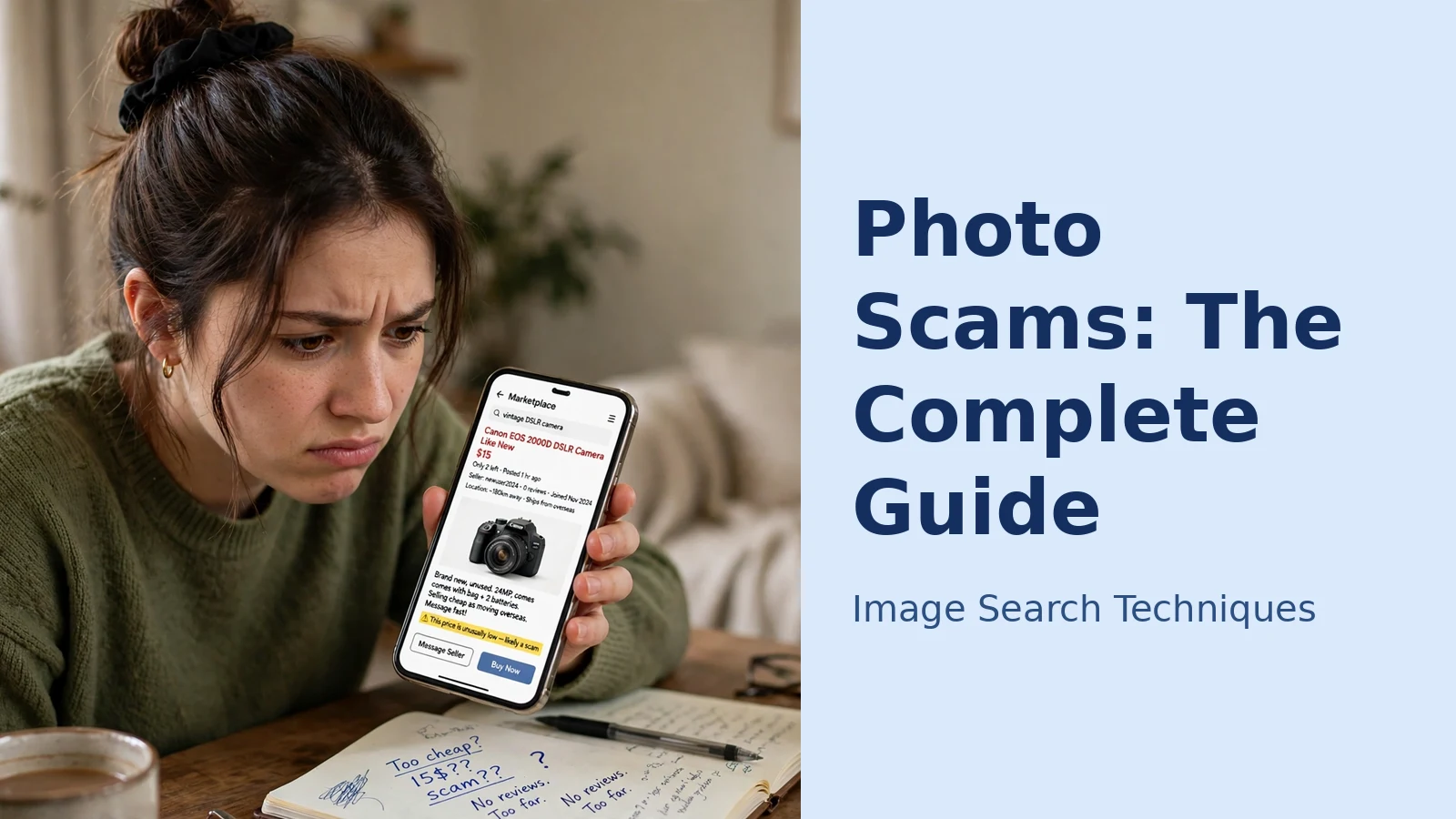
If romance scams steal faces, marketplace scams steal product photos. The method is simple: copy the pictures from a genuine listing, advertise the item yourself at a tempting price, take a deposit or full payment, and disappear. The buyer never had a chance, because the item was never in the seller’s hands — the photographs were doing all the lying.
The busiest hunting ground is Facebook Marketplace, and our guide to checking seller photos on Facebook Marketplace shows you how to run a listing’s images through a search engine and spot the copies in under a minute. Resale apps have the same problem in a different outfit, particularly for branded fashion: our walkthrough of fake listings on Depop and checking a seller’s photos covers the tell-tale signs on clothing resale platforms, where a “rare” jacket at half price is often a screenshot from someone else’s wardrobe.
Pets are the emotional version of the same trick. Adverts for puppies and kittens use irresistible photos — usually stolen from breeders or lifted from social media — and ask for a deposit to “reserve” an animal that does not exist, followed by invented courier and vaccination fees. Read our guide to puppy and pet sale scams before you pay for any animal you have not met, and search the advert’s photos first: stolen litters usually appear in adverts in several towns at once.
Sometimes it is not one listing but a whole fake shop, complete with polished product photography copied from legitimate retailers. Before ordering from an unfamiliar store, use the checks in our guide: is that online shop real? Working through its product photos with a reverse image search quickly reveals whether the “boutique” designed anything itself or simply scraped a catalogue.
Rental and Property Photo Scams
A beautiful flat at a suspiciously low rent is one of the most reliable lures in fraud. Scammers lift photographs and descriptions from genuine listings — sometimes from properties that were let months ago, sometimes from homes for sale in another country — and repost them as rentals. The “landlord” is always abroad, always in a hurry, and always asking for a holding deposit before anyone views the property, because there is no property to view.
Property photos are especially easy to check because they tend to be distinctive: interiors, views from windows and even the arrangement of furniture get indexed when the original advert was published. Our guide to rental listing scams and checking property photos shows you how to trace the images back to the original listing and confirm whether the person advertising is connected to it at all. Combine that with the oldest rule in renting — never transfer a deposit for a home you have not stood inside — and this scam has very little room to work.
Charity and Disaster Appeal Photo Scams
When a disaster dominates the news, fake appeals appear within hours. They pair a powerful photograph — a child in rubble, a flooded street, an injured animal — with an urgent plea and a donation link. The photograph is real, but it is usually old, taken in a different country during a different event, and the money goes to a criminal, not to any relief effort. The same recycling happens with long-running charity campaigns, where a genuine image continues to circulate attached to new, fraudulent appeals.
Because the picture is the entire appeal, checking it is decisive. Our guide to verifying a charity or disaster appeal photo explains how to date an image with a reverse image search, find its original context, and confirm whether the organisation collecting money is the one the photo actually belongs to. If the earliest version of the image predates the disaster it is claimed to show, the appeal is fake, however professional the page around it looks.
Job Offer and Investment Photo Scams
Not every photo scam is after a single payment; some are building a false sense of legitimacy around a person or a company. Fake recruiters use stolen headshots and office photography to pose as hiring managers, then move candidates towards paying for “training”, “equipment” or background checks for jobs that do not exist. Our guide to job offer scams and checking the recruiter’s photos shows how to verify that the person in the profile picture is who they claim to be — and that the company in the photographs is real.
Investment fraud uses the same machinery with higher stakes. So-called mentors and trading experts build profiles around photographs of luxury lifestyles, offices and “successful students” — images that are stolen, staged or AI-generated. Victims are shown screenshots of rising balances and encouraged to deposit more and more into fake platforms, a pattern closely related to romance fraud and sometimes run by the same gangs. Before you trust anyone who is teaching you to invest from a profile page, work through our guide to investment and crypto scam profile photos and search every image they use to sell you the dream.
The rule that covers this whole section is the one the US Federal Trade Commission gives for romance fraud, and it applies to every request for money online: the FTC’s bottom line is to never send money or gifts to a sweetheart you have not met in person — and the same caution should apply to any recruiter, mentor or adviser who exists only in messages and photographs.
Fake Reviews, Screenshots and Social Media Photos
Photos are also used to fake evidence. A product with glowing five-star reviews may be illustrated with photographs the reviewer never took, copied from the manufacturer’s site or from a different buyer’s post. Our guide to spotting fake review photos explains how to check whether review images belong to the product at all — a two-minute search that can save you from buying something the seller has dressed up with borrowed praise.
Screenshots deserve the same scepticism. A screenshot of a payment confirmation, a bank balance or a chat conversation can be fabricated in minutes with free editing tools, and they are routinely used to “prove” that money was sent, won or earned. Our guide to checking a fake screenshot covers the inconsistencies — fonts, spacing, alignment, metadata — that expose edited images, and when to ask for proof that cannot be faked in a graphics editor.
Social media is where most of these photographs circulate, and where most checking starts. Profiles, posts and forwarded images all carry the same risk: the picture may be genuine but decades old, or attached to a completely different story. Our complete walkthrough of reverse image searching social media photos brings the platform-by-platform techniques together — what to capture on Facebook, Instagram, TikTok and X, how to crop out captions and interface clutter, and how to compare dates between the pages you find.
Is the Photo Even Real?
Underneath every scam in this guide sits one question: is this picture what it claims to be? Sometimes the answer comes from a reverse image search (the photo exists elsewhere, with a different story). Sometimes the photo is new but manipulated, or generated entirely by AI. Our practical guide to how to tell if a photo is real works through the checks — context, consistency, details that AI still gets wrong, and metadata — so you can judge an image that has no history to search against. Treat the results honestly: image checking produces strong evidence, not absolute proof, and the more checks a photo fails, the less you should rely on it. The same question applies to video too, so learn how to tell if war footage is from a video game before you share a dramatic combat clip.
Photo Scam Red Flags: The Checklist
Whatever the scam type, the same warning signs recur. Use this checklist whenever a photograph is being used to persuade you:
- ☐ The photo looks too professional for the situation — studio lighting and model looks on a “ordinary person’s” profile.
- ☐ A reverse image search finds the same photo under a different name, in a different town, or on a stock photo site.
- ☐ The person or seller refuses live video, a viewing, or a phone call, and always has a reason why.
- ☐ The story creates urgency: pay today, donate now, reserve before someone else does.
- ☐ Payment is requested by bank transfer, gift cards, vouchers or cryptocurrency — methods that are hard to reverse.
- ☐ Details do not line up: the photo is older than the event, the season or location is wrong, or the same image sells different items in different places.
- ☐ Pressure to move off the platform to private messages, where there is less protection and no evidence trail.
- ☐ The images avoid specifics — no photo of the actual item, animal or property with anything personal or verifiable in frame.
One red flag can have an innocent explanation. Two or three together, attached to a request for money, almost never do.
The Scale of the Problem
Photo-based fraud is not a niche problem. Romance, marketplace and pet scams built on stolen images are reported in large numbers every year, and the losses run from a single deposit to life-changing sums. We keep the figures — what is reported, where the money goes and how the patterns are changing — in one place: our roundup of online photo scam statistics gathers the published numbers from official sources such as Action Fraud and the FTC, so you can see the scale of each scam type and how the official advice is evolving.
What to Do If You Have Been Caught by a Photo Scam
If you have already sent money, act quickly and do not blame yourself — these frauds are engineered by professionals, and embarrassment is one of the tools they rely on.
- Contact your bank immediately. If you paid by transfer, card or a payment app, tell the bank it was fraud; fast reporting gives the best chance of stopping or recovering the payment.
- Keep the evidence. Save the photos, screenshots, profile links, messages and payment references before you block anyone — you will need them for your report, and our guides above explain how to search them while they are still available.
- Report it. In the UK, report fraud to Report Fraud (Action Fraud), the national reporting centre — their romance fraud guidance also explains how victims are targeted again by fake “recovery” agents, so treat any offer to get your money back for a fee as a second scam. In the US, report to the FTC at ReportFraud.ftc.gov. Everywhere else, your national police or consumer protection service is the right destination, and you should also report the profile or listing to the platform it appeared on.
- Warn others. If the photo belongs to a real person, they may not know their pictures are being used; a polite message to the real account can protect the next target.
FAQs
How can I check if a photo is being used in a scam?
Save the image and run it through a reverse image search. If it appears under a different name, in adverts in several towns, on a stock library, or in news reports from years before the story attached to it, treat it as stolen. Combine the search with the red-flag checklist above — a photo match plus pressure to pay quickly is as close to certain as checks get.
What is the most common type of photo scam?
Romance and dating scams are among the most damaging, because they run for months and the financial requests grow over time. Marketplace scams using copied listing photos are probably the most common by volume, simply because they are cheap to set up: copy a genuine advert, undercut the price, collect deposits and vanish.
Can AI-generated photos be detected with a reverse image search?
Only sometimes. A generated image may have no exact match online because it was never photographed, so a search with no results proves nothing either way. Look instead for the visual inconsistencies AI still produces, check the account’s other photos for mismatched details, and treat a brand-new profile with flawless images and no history as a warning sign in itself.
I found my own photos being used in a scam. What should I do?
Report the fake profile or listing to the platform with links to your original posts — platforms act fastest when the real owner complains. Warn your followers that you are being impersonated, keep dated screenshots of the fake use as evidence, and consider tightening the privacy settings on the accounts the photos were taken from.
If the appeal is a personal fundraiser rather than a registered charity, the same photo checks apply — learn how to check if a GoFundMe is legitimate before you donate.
Photo scams are not limited to profiles and listings — a code can be the trap, so learn how to check a QR code before you scan it and spot fake QR code scams before you tap.
