🔎 Reverse Image Search
Image search techniques made simple: upload a photo or paste a URL and search 6 engines at once. 100% free, nothing stored.
🔒 Your image is never stored on our servers longer than 24 hours and is never shared.
Those tiny stamps inside a ring, on the back of a spoon or under a bracelet clasp can tell you where a piece was tested, how pure its metal is and, often, the year it was marked. This guide shows you how to identify a hallmark from a photo: photograph the marks sharply, run a reverse image search to find matching pieces, then decode each punch yourself against the UK hallmark system.
Direct answer: To identify a hallmark from a photo, photograph the full row of marks in raking light, run the photo through Google Lens, TinEye and Bing, then read the punches left to right, sponsor’s mark, standard mark, assay office mark and date letter, against the UK charts. A hallmark reading states what the stamp claims, never genuineness or value.
A hallmark is a set of small punches struck into precious metal after it has been tested at an assay office. In the UK, a modern hallmark must carry three compulsory marks under the Hallmarking Act 1973: the sponsor’s mark (the maker or firm that submitted the piece), a millesimal fineness number such as 925 for sterling silver, and the assay office mark showing where it was tested. Two traditional marks are optional since 1999 but still widely struck: the date letter and the pictorial standard mark, such as the lion passant. That is the whole system in one sentence, and once you can spot those marks, most UK pieces start to give up their story.
What do the stamps on my ring mean?
The stamps on a ring, bracelet or spoon are not decoration and not a brand logo. Each punch answers one question: who submitted it, how pure the metal is, where it was tested, and when. Read them in that order and a row of marks you could not read yesterday becomes a short, checkable statement. The table below covers the marks you will meet on UK silver and gold; the worked decode later in this guide shows the same table applied to one real hallmark photo, punch by punch.
| Mark | What it looks like | What it tells you |
|---|---|---|
| Sponsor’s mark | Initials in a shaped punch, e.g. G&Co Ld | Who submitted the piece for assay, the maker or firm |
| Standard mark (silver) | Lion passant, a lion walking left | Sterling silver, 925 parts per 1,000, in England since 1544 |
| Standard mark (silver, higher) | Seated figure of Britannia | Britannia silver, 958 parts per 1,000; compulsory 1697–1720, optional since |
| Fineness mark (modern) | A number in a shield, e.g. 925, 750, 916 | Metal purity in parts per 1,000, compulsory since 1999 |
| Assay office mark | Leopard’s head, anchor, rose or castle | Which UK assay office tested the piece |
| Date letter | One letter in a shaped shield | The year the piece was hallmarked, only with its office, typeface and shield |
| Duty mark (1784–1890) | A monarch’s head in profile | Tax was paid; its presence alone dates a piece to 1784–1890 |
Two traps catch almost everyone. First, the lion passant and the leopard’s head are different marks that beginners mix up: the lion passant is the standard mark for sterling silver, while the leopard’s head is the assay office mark for London. A London piece carries both, and each does a different job. Second, a bare number such as 925 on its own is not a UK hallmark. Millesimal numbers became the required fineness mark only on 1 January 1999, and antique sterling almost never carries one, a lone 925 stamp is usually a modern or non-UK piece, and it proves nothing about where or when the item was made.
Which assay office tested my piece?
Four assay offices still operate in the UK, London, Birmingham, Sheffield and Edinburgh, and each has its own town mark. Dublin’s Hibernia mark covers Irish pieces separately. Match the town mark first, before you touch the date letter, because before 1975 every office ran its own date-letter cycle, so the same letter can mean different years at different offices. The table below is the one to memorise; the modern date-letter table further down only works once you know the office.
| Town mark | Assay office | Notes |
|---|---|---|
| Leopard’s head | London | Crowned until 1821, uncrowned after; London had no separate town mark of its own, the leopard’s head is it |
| Anchor | Birmingham | The largest assay office by volume today |
| Rose | Sheffield | A crown was Sheffield’s mark before the rose |
| Castle | Edinburgh | Scottish silver 1759–1974 carries a thistle instead of the lion passant as its standard mark |
| Hibernia | Dublin | Irish hallmarking; a harp is the Irish standard mark for sterling |
If your piece shows a leopard’s head and a lion passant but no separate town mark, it was assayed in London at Goldsmiths’ Hall, London is the only office that never needed a town mark of its own, because the leopard’s head was already its sign. That single fact settles the office for a large share of the antique silver people inherit.
How do I photograph a hallmark so a search engine can read it?
Hallmarks are small, shallow and often worn, and a blurry photo is the most common reason a hallmark search fails. A reverse image search can only match what it can see, so the photograph itself is half the work. Photograph the marks before you search, and photograph them as if you were sending the picture to an expert, because in the worked example below, that is effectively what the search engines are doing.
- Clean the piece gently. Wipe the marked area with a soft, dry cloth. Do not polish aggressively, polishing is what rubs fine detail off old punches, and a rubbed lion passant is unreadable for ever.
- Use raking light. Hold a lamp or a torch low and to the side so light falls across the punches, not straight down into them. Shadows inside the punch are what make a shallow mark readable.
- Fill the frame with the marks. Get close enough that the row of punches fills most of the picture. A hallmark that is 5 per cent of the frame is a hallmark no engine can read.
- Take three shots. One straight-on, one with light from the left, one with light from the right. Worn punches appear and disappear as the light moves, and the second or third shot is often the readable one.
- Photograph the whole piece too. One wide shot of the object, one of the marks. The wide shot is what the search engines match first, and it tells you what the object is even when the punches defeat them.
- Do not use a filter or a flash. Direct flash flattens the shadows that define a punch, and filters invent contrast that is not in the metal.
Upload the sharpest of your three mark shots to the search engines, not the wide shot. If the marks are too worn to photograph clearly, say so in your notes and move to the manual decode, a worn punch you can read by eye under a magnifier is worth more than a crisp photo of a different part of the piece.
How do I identify a hallmark from a photo with a reverse image search?
A reverse image search will not read a hallmark for you the way a chart does. What it does well is find the same object, or the same pattern of marks, already photographed and described somewhere else: a museum record, an auction listing, a dealer’s page, a collector’s forum thread. That is often enough to identify the piece, and it is the step most hallmark guides skip. Run the same photo through three engines, because each indexes different corners of the web and each fails differently on tiny, worn punches.
- Start with Google Lens. Open Lens, upload your close-up or paste its image address, and read the exact-match results first. Lens is strongest at finding the same photograph reused elsewhere and at naming the object type.
- Run the same image through TinEye. TinEye reports how many matches it found and when the image was first indexed, which tells you whether the photo is an old catalogue image or a recent listing. It is the best of the three at finding the earliest copy of a picture.
- Finish with Bing visual search. Bing often surfaces pages the other two miss, including non-English listings and image-heavy dealer sites. Check its “pages with this image” list, not just the similar-images grid.
- Compare the three answers. If all three point at the same museum record or auction lot, you have an identification. If they disagree, trust the source page you can open and read, a museum or auction catalogue entry beats an engine’s auto-generated label every time.
- Search the maker’s initials as text as well. Once you can read even two letters of the sponsor’s mark, a text search for those initials plus the town mark often finds the maker faster than any image search.
If you want a fuller walkthrough of the three engines, our guide to how to reverse image search covers the upload-by-URL method used in the worked example below. And if an AI tool offers to read the marks from your photo, treat it the way our identify a photo with ChatGPT and Gemini guide treats AI identification generally: useful for a first guess, never a verdict on its own.
Worked example: decoding a 1608 London spoon hallmark from a photo
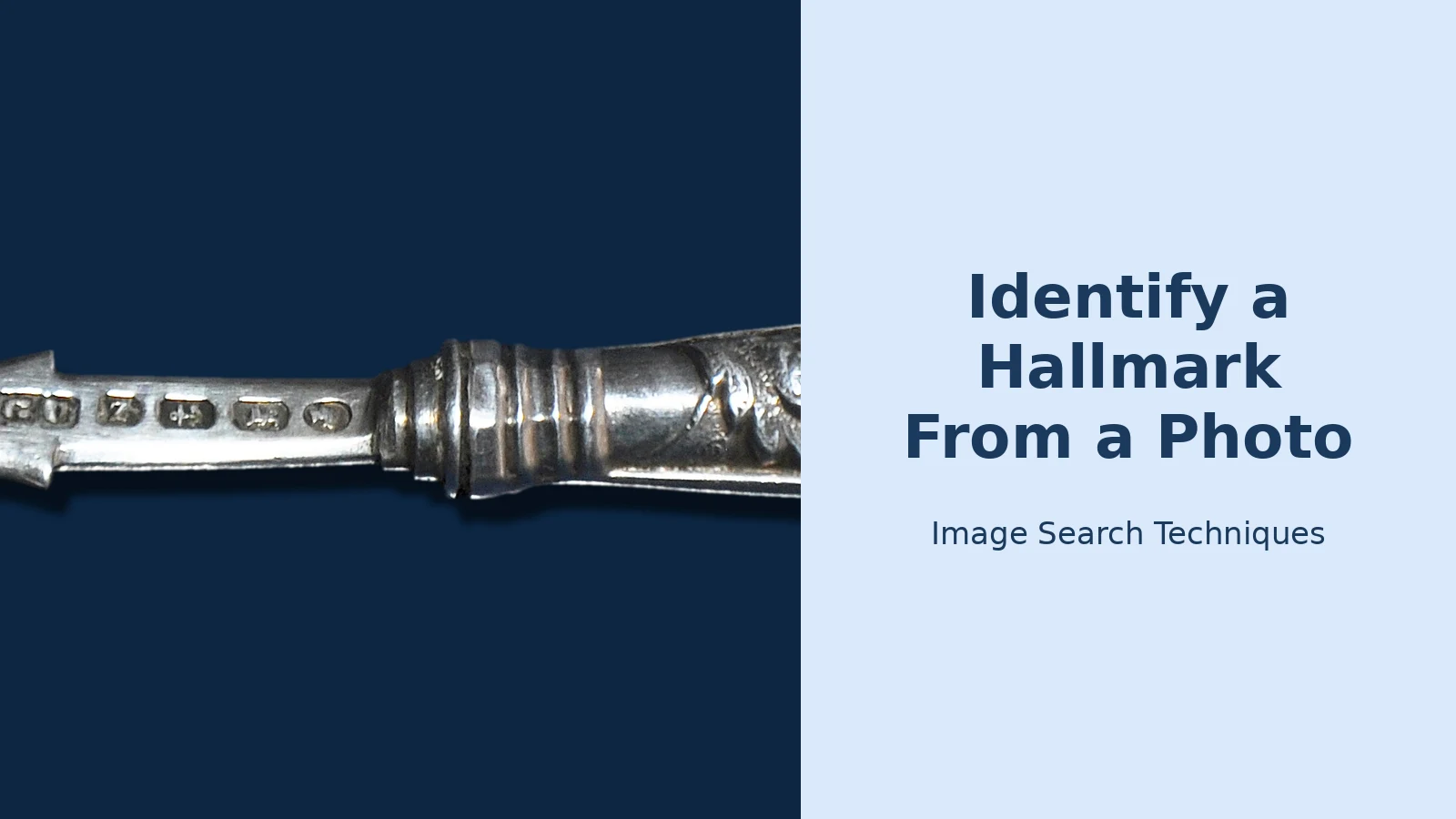
This is a real test, run on 11 November 2026 with no logins. The test photo is a close-up of three hallmark punches on the stem of a silver seal-top spoon, photographed by the Portable Antiquities Scheme and published on Wikimedia Commons (CC BY 2.0, Kent County Council). The Scheme’s record dates the spoon to about 1608 and the marks to London, so this is a genuine decode with a known answer, not a staged one. The punches are worn, which is exactly the condition most inherited pieces are in.
The manual decode, mark by mark:
| Punch (top to bottom) | What it is | What it means |
|---|---|---|
| Top punch, worn initials | Sponsor’s (maker’s) mark | Too worn to read; the Scheme’s record says the maker cannot be narrowed down from the surviving marks. A worn maker’s mark is a dead end, not a failure, it is the normal state of a 400-year-old spoon. |
| Middle punch, capital L with clefts in the upright serifs | Date letter | London 1608. The letter alone would not be enough, it is the letter plus the London office, the typeface and the shield that give the year. |
| Bottom punch, lion passant | Standard mark | Sterling silver, 925 parts per 1,000. Note this is the standard mark, not the town mark: London’s town mark is the leopard’s head, and the Scheme’s own record describes this punch loosely, which is a reminder to check marks against a chart rather than trusting a catalogue description. |
What the three search engines returned for the same photo:
| Engine | Result (11 November 2026) |
|---|---|
| Google Lens | No result, Lens could not fetch the image at all. In four separate sessions it reported “Something went wrong, No image at the URL”, the results area stayed blank on “Thinking / Generating”, and it returned 0 exact matches, no source page and no reading of the marks. The URL itself loads fine, this was a Lens fetch failure, not a bad link. |
| TinEye | 0 matches, “We searched over 86.7 billion images” and found none, so there is no first-indexed date. The Wikimedia Commons source page was not found, even though the image has been published there since 2020. |
| Bing visual search | 0 pages with this image, and an active misidentification. Bing labelled the spoon stem “Antique Bayonet Blade With Engraved Markings” and described it as “the engraved blade of a British 1897 Pattern Infantry Officer’s Sword” (13,500 results for that wrong query, mostly bayonet and sword listings). Its visual matches were unrelated bayonets and swords, and the source page was not found. |
None of the three engines found the source page, and Bing actively misidentified the spoon stem as a bayonet blade. That is the honest result, and it is the point of this guide. A reverse image search is a finding tool for the object, not a reader of punches, and on a worn, 400-year-old hallmark it fails outright. The engines are still worth running: on a clearer photo, or a piece already listed by an auction house, they often find the catalogue record in seconds. But the date itself still comes from reading the letter against the right office’s chart. Use the engines to find the record; use the chart to read the marks.
The lesson of this test is the lesson of the whole guide: the engines are good at finding the object and poor at reading the punches. A reverse image search can take you to the museum record that dates the piece, but the date itself still comes from reading the letter against the right office’s chart. Use the engines to find the record; use the chart to read the marks.
How do I read a UK hallmark date letter?
The date letter is the mark that dates a piece, and the mark most often read wrong. The system began in 1478, and a single letter stands for one assay year, but the letter repeats every twenty years or so in a different typeface and shield, and before 1975 every office ran its own cycle and changed its letter on a different date. So a letter alone never dates a piece. You need four things together: the letter, its case and typeface, the shape of its shield, and the assay office. Match those four against the chart for that office, and the year follows. Match the letter alone, and you can be a century out.
Since 1975 all UK assay offices have shared one date letter, changing on 1 January each year. The current cycle runs:
| Date letter | Assay year |
|---|---|
| A | 2025 |
| B | 2026 |
| C | 2027 |
| D | 2028 |
Two warnings belong here. First, the date letter gives the year the piece was hallmarked, not necessarily the year it was made or sold, a piece can sit unmarked and be hallmarked later, and a hallmarked piece can sit in a shop for years. Second, the date letter has been optional since 1999, so a modern piece may not carry one at all; its absence is not evidence of age, it is evidence of a modern marking choice.
What does 925 stamped on jewellery mean?
A 925 stamp means the metal is 92.5 per cent silver and 7.5 per cent other metals, that is sterling silver, and the number is the millesimal fineness. On its own, though, 925 tells you nothing about where the piece was tested, when, or by whom. It is a fineness claim, not a hallmark, and a lone 925 stamp is usually a modern or non-UK piece: antique British sterling almost never carries a number stamp, because numbers only became the required fineness mark on 1 January 1999. So a ring stamped only 925 is probably sterling, but the stamp alone cannot date it, cannot name its maker and cannot confirm it was ever assayed in the UK.
Gold works the same way, with different numbers: 375 is 9 carat, 585 is 14 carat, 750 is 18 carat and 916 is 22 carat. The same rule applies, a number on its own is a fineness claim, and a full UK hallmark adds the sponsor’s mark and the assay office mark beside it. If you are buying a piece and the seller’s whole case for it rests on a lone 925 or 750 stamp, that is a thin case, and a photo search of the piece itself is worth doing before you pay.
There are also tools that read hallmarks from a photo. The Antique Jewellers hallmark finder covers UK date letters back to 1700 and walks you through town mark, fineness and date letter step by step, and Mozeris offers an AI photo identifier that reads the town, standard, date and maker, but it asks for your email address and privacy consent before it shows any result, so be ready for that. Treat any automated reading as a first guess and check it against the charts above, an app that misreads one worn letter can put you twenty years out, and the correction is always the same: office first, then letter, typeface and shield together.
When should you take a piece to an assay office or a specialist?
A hallmark reading says what the stamp claims, never that a piece is genuine, and never what it is worth. That boundary matters more than any other in this guide. A convincing fake can carry convincing-looking marks, a genuine piece can carry worn or partial marks, and no photo search or chart can settle genuineness or value. If the piece matters, inherited, valuable, or the reason you are reading this guide at all, the next step is a person, not another search.
- Take it to an assay office if you need the metal tested. Only an assay office can confirm fineness by testing; a hallmark is a claim that a test happened, and the office is where the test happens.
- Take it to a specialist dealer or auction-house valuer if you need to know what it is worth or whether it is genuine. Value depends on maker, condition, rarity and demand, none of which a hallmark records.
- Do not use this guide for luxury-brand authentication. Reading a hallmark is not the same as authenticating a branded piece, and a hallmark reading cannot tell you whether a designer item is genuine.
- Photograph the marks before you travel. Your sharp close-ups are the record the specialist will want to see first, and they are your copy if the piece is ever lost or stolen. Our identify a watch from a photo guide and our identify antique furniture style from a photo guide use the same principle: photograph first, identify second, and let an expert settle anything that affects money.
For the law behind all of this, the UK government’s hallmarking guidance for consumers and the Goldsmiths’ Company’s own hallmark explainer are the authoritative sources. If you want to place the whole exercise in context, our what is this picture hub covers identifying unknown objects from a photo generally, of which hallmark reading is one specialist case.
FAQs
Can Google Lens identify a hallmark from a photo?
Google Lens can identify the object and often find the same photograph reused on a museum, auction or dealer page, but it does not reliably read tiny hallmark punches. Use Lens to find the source record, then decode the marks yourself against the assay office and date-letter charts, as the worked example in this guide shows.
What does a lion passant hallmark mean?
A lion passant, a lion walking left, is the standard mark for sterling silver in England, used since 1544. It means the metal is 925 parts silver per 1,000. It is not the London town mark; that is the leopard’s head. A London piece carries both, and confusing the two is the most common beginner error.
How do I find the date of a silver hallmark?
Read the date letter with the assay office, the letter’s typeface and shield shape, then match all four against that office’s chart. Since 1975 all UK offices share one letter: A is 2025, B is 2026, C is 2027, D is 2028. Before 1975 each office ran its own cycle, so the letter alone never dates a piece.
Is a 925 stamp the same as a hallmark?
No. A 925 stamp is a fineness claim meaning 92.5 per cent silver; a full UK hallmark adds a sponsor’s mark and an assay office mark, and usually a date letter. A lone 925 stamp is common on modern or non-UK pieces and cannot date a piece, name its maker or confirm it was assayed in the UK.