🔎 Reverse Image Search
Image search techniques made simple: upload a photo or paste a URL and search 6 engines at once. 100% free, nothing stored.
🔒 Your image is never stored on our servers longer than 24 hours and is never shared.
A chair can look 250 years old and have been made in 1975. The silhouette is the easiest thing to copy, so style alone never settles the question. What does settle it, most of the time, is the combination of four things you can photograph: the legs, the joints, the hardware and the wood. This guide shows you how to identify antique furniture style from a photo, step by step, and how to test your answer with a reverse image search.
Yes, you can identify an antique furniture style from a photo, by photographing the whole piece plus close-ups of the legs, a drawer joint, the hardware and the underside, and comparing those clues with known period features. A photo can name the style, but it cannot prove age, maker or worth, that needs a dealer check.
That last sentence is the whole method in miniature. A photo is a research tool, not a certificate. It is very good at narrowing a piece to one of a handful of styles and periods, and it is very bad at the two things people most want from it: a firm date and a value. This article keeps those two jobs separate throughout. You will learn to read the style from the design, test the date from the construction, and know exactly where the photo stops and an expert starts.
Style is the design language; period is when the piece was actually made. A chair can be Chippendale in style and made in 1910, because makers have copied successful 18th-century designs ever since. The Victoria and Albert Museum puts it plainly in its furniture collection pages: its collection spans over six centuries of British and international furniture production, and the same forms recur across centuries. So when you identify a style from a photo, you are naming the design tradition, and then you use the joints, screws and wear to ask whether the piece itself is old, or simply old-looking.
What photos do you need before you start?
One front view of a chair in a cluttered room is not enough. A useful identification needs a small set of deliberate photographs, taken in daylight, with the piece pulled away from the wall. Work through them in this order, and keep the original files, a reverse image search works best on the unedited photo, not a cropped screenshot.
- Photograph the whole piece straight on. Stand back until the full silhouette fits in the frame, with the legs and feet visible. This is the photo that names the style.
- Photograph it from the side. The side view shows the curve of a cabriole leg, the rake of a back leg and the depth of the seat, details the front view flattens.
- Photograph the back and the underside. Turn the piece around. The back of a chest, the underside of a seat rail and the inside of a drawer are where makers left their real evidence, and where reproductions most often give themselves away.
- Photograph one leg and foot close up. Fill the frame with the knee, the ankle and the foot. The foot shape alone can separate Queen Anne from Chippendale.
- Photograph one drawer joint close up. Pull a drawer out and photograph the corner where the side meets the front. Dovetails are the single most useful dating clue you can photograph.
- Photograph the hardware. One handle, one hinge and one escutcheon, straight on. Note whether the screws look original or replaced.
- Photograph every mark, label and stamp. Check the back, the underside and the inside of drawers for a maker’s stamp, a paper label or a handwritten number. Photograph each mark on its own.
- Photograph the damage. Chips, repairs, replaced parts and uneven wear are evidence, not embarrassment. A repair can change the date of a piece entirely.
Once you have the set, run the best full view through Google Lens. Our guide to reverse image search walks through the upload step, and the Google reverse image search guide covers Lens on phone and desktop. Then run each close-up separately: a tight crop of a leg or a dovetail often finds matches the full photo misses, because Lens matches shapes, not stories. If Lens names a style, treat it as a lead. Confirm it against the clues below before you believe it.
How do the legs narrow the style?
Legs are the fastest style clue in a photograph, because every period had a favourite leg and most makers used it consistently. Start with the leg, then check the foot, the two together narrow the field dramatically.
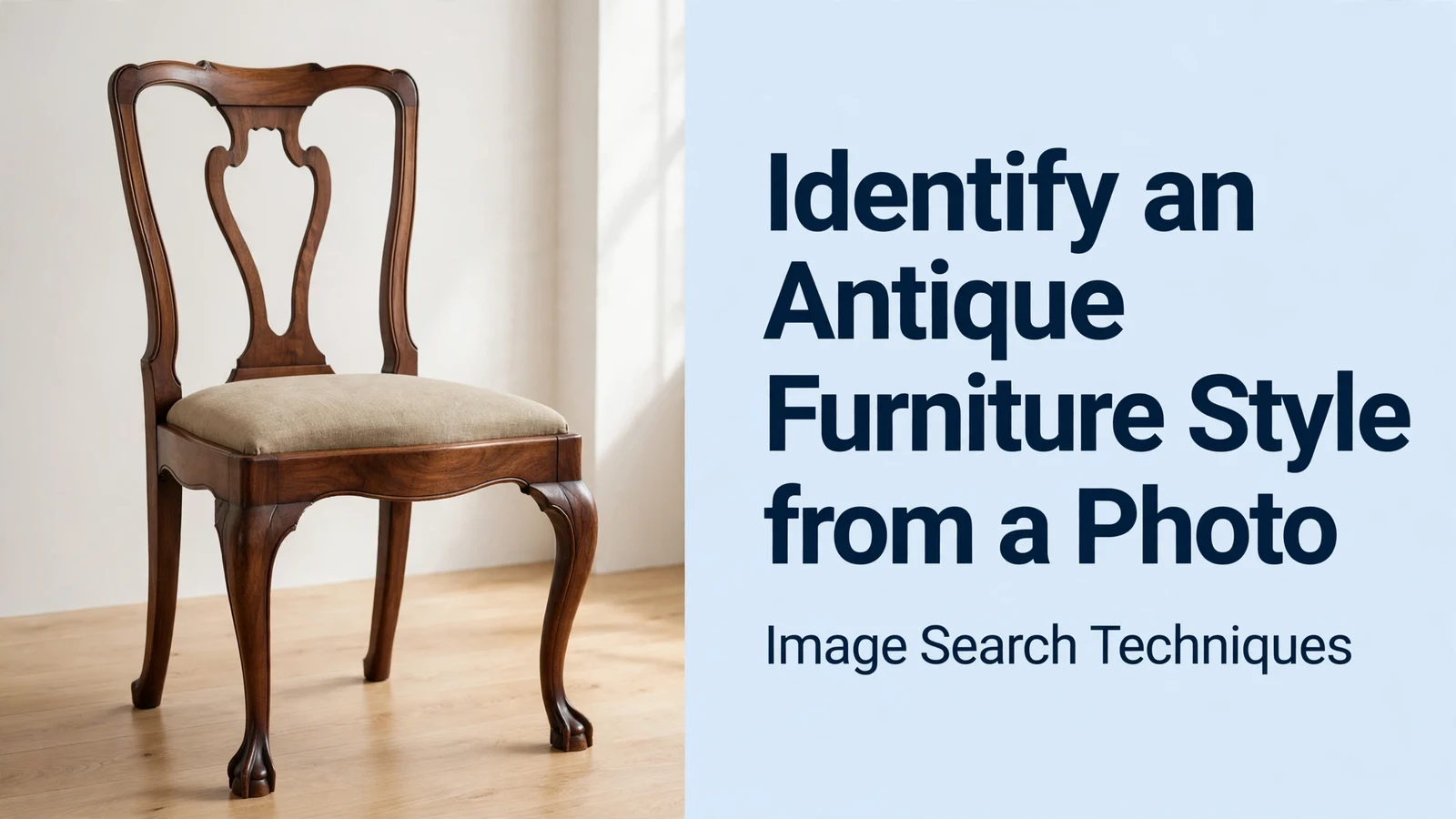
- Cabriole leg, pad or slipper foot: the S-curved leg that bows out at the knee and back in at the ankle, ending in a flat disc (pad foot) or a flattened, elongated pad (slipper foot). This is Queen Anne, roughly 1720 to 1760. Period Queen Anne chairs have no stretchers between the legs, if you see stretchers on a chair sold as 1720, ask why.
- Cabriole leg, ball-and-claw foot: the same S-curve, but the foot is carved as a claw gripping a ball. This is Chippendale, roughly 1755 to 1790, and the carving is usually bolder and deeper than Queen Anne work. A claw-and-ball foot is almost never Queen Anne, whatever a listing says.
- Straight, square, tapered leg: plain, tapering legs with no curve, often with a small brass castor. This is the Hepplewhite and Sheraton manner of the late Georgian period, roughly 1780 to 1810, lighter, straighter and more restrained than Chippendale.
- Turned leg with stretchers: legs shaped on a lathe into rings, bulbs and blocks, tied together with stretchers. This is the earlier William and Mary manner, around 1690 to 1730, and it returns in Victorian revivals, so a turned leg needs a joints check before you date it.
- Heavy turned or carved leg, dark wood: thick, deeply carved legs, often with a balloon-shaped chair back. This is Victorian, 1837 to 1901, when furniture grew heavier and ornament piled up.
- Stepped, geometric leg or a plain slab base: sharp angles, stepped profiles and symmetrical geometric shapes. This is Art Deco, roughly 1920 to 1940.
- Splayed, tapered leg, angled outwards: thin legs that angle away from the body of the piece, usually in teak or walnut. This is Mid-Century Modern, roughly 1945 to 1969.
Two cautions belong here. First, the rear legs of a chair are usually plainer than the front legs, makers spent the carving where it showed, so always judge the leg from the front pair. Second, a single leg never settles a style on its own. A cabriole leg with machine-cut dovetails and cross-head screws is a later copy of a Queen Anne design, not a Queen Anne chair. The leg names the style; the joints date the piece.
What do the joints tell you about the date?
Joints are where style stops lying. A silhouette can be copied in a weekend; hand-cut joinery takes years of practice and leaves marks a camera can see. Pull a drawer out and look at the corner where the drawer side meets the drawer front. That one joint tells you more about the date than the whole front of the piece.
Dovetails are the key. In early to mid-18th-century work, dovetails are hand-cut: chunky, slightly irregular, with visible scribe lines, and no two drawers exactly alike. The pins, the narrow parts of the joint, can be surprisingly wide. From the late 19th century onwards, factory-made dovetails are small, sharp and perfectly even, because a machine cut them. If the dovetails are tiny and identical, the piece is machine-age, however old its silhouette looks.
Other joints carry the same message in different places:
- Mortise-and-tenon joints held chair frames together for centuries and are still used today, so they date nothing on their own, but wooden pegs through the joint point to hand work, while a joint held only by glue and screws does not.
- Wooden pegs and dowels in the frame suggest older, hand-made construction. Staples and chipboard point the other way, to 20th-century factory work.
- Screws are a quiet dating tool. A screw with a hand-filed slot that sits slightly off-centre is old. A cross-head (Phillips) screw is a 20th-century fitting, if you find one holding a drawer together, that joint has been remade or the piece is modern.
- Saw marks on an unseen surface help too. Straight, even marks from a circular saw mean machine work; irregular marks from a hand saw mean earlier work. Photograph the inside of a drawer bottom or the back of a chest, where nobody bothered to finish the surface.
Photograph the joint, then search the close-up on its own. A dovetail close-up searched through Lens will often return furniture-restoration and joinery guides that label the joint type for you, a useful second opinion when you are unsure whether what you are seeing is hand-cut or machine-cut.
What do the handles and hardware reveal?
Hardware is the most replaced part of old furniture, which is exactly why it is worth photographing. A handle can be older than the drawer it sits on, or fifty years younger. Look for consistency: if one handle matches the period and the other three do not, the odd one out was replaced.
- Brass bail pulls, the swinging, U-shaped handles on a backplate, are typical of Queen Anne and early Georgian chests. The earliest backplates are plain; later ones are pierced and shaped.
- Escutcheons, the small brass plate around a keyhole, should match the handles in metal and wear. A bright, sharp escutcheon on a worn drawer front is a replacement.
- Castors, small brass or wooden wheels under legs, were common from the Georgian period onwards, so their presence supports an 18th- or 19th-century date but proves nothing alone.
- Hinges and locks on a chest or cabinet should be hand-forged and slightly irregular in early work. Stamped, identical hinges with modern screws are a later addition.
Photograph the back of one handle if you can remove it safely, and only if you can. The back of a brass pull often shows casting marks, a maker’s stamp or the patina of two centuries, and the screw holes underneath tell you whether the handle has moved. Never force a handle off a piece you do not own, and never strip a screw to satisfy curiosity. A photograph of the front, plus a note of whether the fixings look original, is enough.
Which style is it? The style-feature matrix
Put the clues together in one place. Read across the row: if your piece matches three or four columns, you have a strong candidate style. If it matches the leg column but not the joint column, you are probably looking at a revival or a reproduction, which is useful information, not a failure.
| Style | Period | Leg shape | Joints | Handles and hardware | Typical wood |
|---|---|---|---|---|---|
| Queen Anne | c. 1720–1760 | Cabriole leg, pad or slipper foot, no stretchers | Hand-cut dovetails, pegged mortise-and-tenon | Plain brass bail pulls, simple escutcheons | Walnut, then mahogany |
| Georgian / Chippendale | c. 1755–1790 | Cabriole leg, ball-and-claw foot, pierced splat | Hand-cut dovetails, pegged joints | Pierced brass backplates, fretwork details | Mahogany |
| Hepplewhite / Sheraton | c. 1780–1810 | Straight tapered leg, often reeded, small castor | Hand-cut dovetails, fine inlay work | Delicate brass pulls, oval or shield backplates | Mahogany, satinwood inlay |
| Regency | c. 1800–1830 | Sabre leg, classical motifs, Egyptian and Greek details | Hand-cut dovetails, quality cabinet work | Brass mounts, classical lion and paw details | Mahogany, rosewood |
| Victorian | 1837–1901 | Heavy turned or carved leg, balloon-back chair | Machine-cut dovetails appear late in the period | Pressed brass, ornate cast handles | Dark mahogany, walnut, rosewood |
| Art Deco | c. 1920–1940 | Stepped or geometric leg, slab base | Machine-cut joints, veneered panels | Chrome, Bakelite, geometric handles | Macassar ebony, walnut veneer |
| Mid-Century Modern | c. 1945–1969 | Splayed tapered leg, angled outwards | Factory joints, screws and dowels | Minimal hardware, often none visible | Teak, walnut, rosewood |
The Regency row deserves a note, because it is the easiest to misread. The Victoria and Albert Museum’s account of Thomas Hope and the Regency style explains that Hope, a designer and collector working around 1800, deliberately mixed Greek, Roman, Egyptian and French Empire motifs into furniture, so a Regency piece can carry a sabre leg borrowed from antiquity and an Egyptian detail in the same chair. If your piece mixes classical motifs freely, check Regency before you settle on an earlier style. The V&A’s furniture collection, spanning over six centuries, is the best free reference for comparing your photo against documented pieces.
Worked example: a Queen Anne chair put through Lens and TinEye
To test this method honestly, I ran it on a documented museum piece: the Metropolitan Museum of Art’s “Queen Anne Carved Mahogany Side Chair”, American, dated 1755–75, in mahogany, accession number 2016.797.11. The museum’s own photograph is published on Wikimedia Commons under a CC0 public-domain dedication, so it is a clean, citable test image, a real chair, a real date, and a real museum record to check the answer against.
Step 1, the full photo through Google Lens. Lens identified the chair at once. Its heading read “Queen Anne carved mahogany side chair”, and the first visual match was the Metropolitan Museum’s own collection page for the exact object, the right chair, the right museum, the right date range. Below it came dealer listings for similar 18th-century Queen Anne side chairs. That is the correct behaviour for a well-documented piece: the museum record first, then similar pieces for comparison. What Lens did not do is give an exact-match count. Its “Exact matches” tab failed twice with the error “Something went wrong, No image at the URL”, even on a retry in a fresh tab, and its AI Overview stayed blank. So the honest report is: Lens named the style correctly and found the source, but no exact-match count could be obtained. A failed tab is a failed tab, not a result.
Step 2, the same photo through TinEye. TinEye returned 20 results from 86.7 billion images searched, first indexed on 6 January 2016. The earliest result was the Dallas Museum of Art’s copy of the same image file, followed by the Met’s own collection pages from 2017 and 2018. No auction listing, no dealer page and no social-media post in the results claimed the chair as anything other than the Met’s Queen Anne piece. That matters: when every indexed copy of a photo traces back to the same museum record, the identification is corroborated rather than merely repeated.
Step 3, the clues checked against the matrix. The chair in the photograph has cabriole front legs, a vase-shaped splat and a shaped crest rail, the Queen Anne row of the matrix, exactly. The Met dates it 1755–75, at the late end of the Queen Anne style, when the design was already shading into Chippendale. That is the kind of nuance a photo workflow handles well: the style is Queen Anne, the date is late Queen Anne, and the museum record confirms both. Had the chair been a reproduction, the test would look different, the same silhouette, but dealer listings instead of a museum page at the top, and no single authoritative record behind the image.
Notice what the worked test did not produce: no price, no valuation and no claim about the chair’s condition. The dealer listings Lens surfaced carry asking prices, but an asking price on a different chair is not the value of this one, and a photo cannot show the repairs, replaced parts or refinishing that decide value. That is not a gap in the method. It is the boundary of what a photo can do.
What a photo cannot tell you
A photo can name the style and narrow the date. It cannot do four things, and pretending otherwise is how people lose money.
It cannot prove age. A reproduction made last year can copy a 1750 silhouette perfectly, including the cabriole leg and the vase splat. Only the construction, hand-cut dovetails, pegged joints, old screws, honest wear, separates the two, and even that needs an in-person look. If the joints in your photos contradict the style, believe the joints.
It cannot name the maker. A maker’s stamp or a paper label can, and that is why the marks photograph matters, but most furniture was never stamped. A style match is not an attribution, and a search result that names a famous maker is a suggestion to investigate, not a verdict.
It cannot value the piece. A photo cannot show a replaced leg, a re-glued joint, a refinished top or a worm-damaged rail. Those are the things that decide what a piece is worth, and they are invisible in a photograph. Never buy, sell or insure a piece on the strength of a photo identification alone. Before selling or refinishing anything you believe is old, ask a dealer or an appraiser to see it in person, a wrong guess before a sale can cost far more than the appraisal.
It cannot confirm condition. Veneer lifts, joints loosen and woodworm works from the inside. Photograph the damage you can see, note the damage you cannot check, and say so plainly in any listing or enquiry. If you are buying from a photo, ask the seller for the underside, the drawer joints and the back before you pay, the eight-shot set in this guide is also a buyer’s checklist.
If your piece turns out to be a general thrift-shop or car-boot find rather than a period piece, the wider method still applies. Our guide to identifying vintage and thrift-store finds from a photo covers maker’s marks, labels and materials across furniture, clothing and ceramics, and it is the right next step when the style matrix gives you no clear match. And if you are identifying objects from photos more generally, the what is this picture hub gathers the whole family of identification guides, from china patterns to guitars, in one place.
One last habit is worth building. When a search engine identifies your piece, search the suggested name as text and compare your photo with a museum or reference page before you trust it. The identification is only solid when the search result and the reference page agree, and when the legs, the joints and the hardware in your own photographs agree with them too.
FAQs
Can Google Lens identify antique furniture from a photo?
Yes, usually to style level. Upload a clear, straight-on photo and Lens will match the silhouette against museum pages, dealer listings and reference guides. In our test it named a Met Queen Anne chair correctly and returned the museum page first. Treat the result as a lead, then confirm it against the legs, joints and hardware in your own photos.
How can you tell if a chair is really Queen Anne or a later copy?
Compare the style with the construction. A real Queen Anne chair has cabriole legs with pad or slipper feet, no stretchers, a solid vase-shaped splat and hand-cut dovetails. A later copy usually keeps the silhouette but shows machine-cut dovetails, cross-head screws or perfectly even joints. When the style and the joints disagree, believe the joints, not the silhouette.
What is the most reliable clue in a photo of old furniture?
The drawer joint. Hand-cut dovetails are chunky, slightly irregular and different from drawer to drawer, which points to 18th- or early 19th-century hand work. Small, sharp, perfectly even dovetails point to machine-age production from the late 19th century onwards. Photograph one drawer corner close up and search that close-up separately for a second opinion.
Can a photo tell you what an antique is worth?
No. A photo cannot show a replaced leg, a re-glued joint, a refinished top or hidden worm damage, the very things that decide value. It cannot confirm the maker or age. Use the photo to name the style and narrow the period, then ask a dealer or appraiser to inspect the piece before you buy, sell or refinish it.