🔎 Reverse Image Search
Image search techniques made simple: upload a photo or paste a URL and search 6 engines at once. 100% free, nothing stored.
🔒 Your image is never stored on our servers longer than 24 hours and is never shared.
A photo of a US Treasury cheque can tell you a lot, but it cannot tell you the cheque is real. The features that prove a Treasury cheque is genuine live in the paper and the ink, and a photograph flattens all of them. What a photo can do is catch the lazy fakes, trace a stolen sample image, and show you exactly what to check when the paper is in your hand.
How to tell if a treasury check is real: hold the cheque up to a light and look for the “U.S. TREASURY” watermark, dab the Treasury seal with a wet finger and watch the ink run red, then check the issue details on the Treasury Check Verification System. A photo alone cannot confirm any of this, so never deposit a cheque on the strength of a picture.
This guide uses the British spelling “cheque” throughout, since that is how most of our readers search, but the American term is “check”. The two words mean the same document here. Every security feature described below comes from the Bureau of the Fiscal Service’s own published security-features guide, dated June 2021, and every verification step comes from the Bureau’s own pages. Nothing here comes from a blog or a forum.
What is a US Treasury cheque?
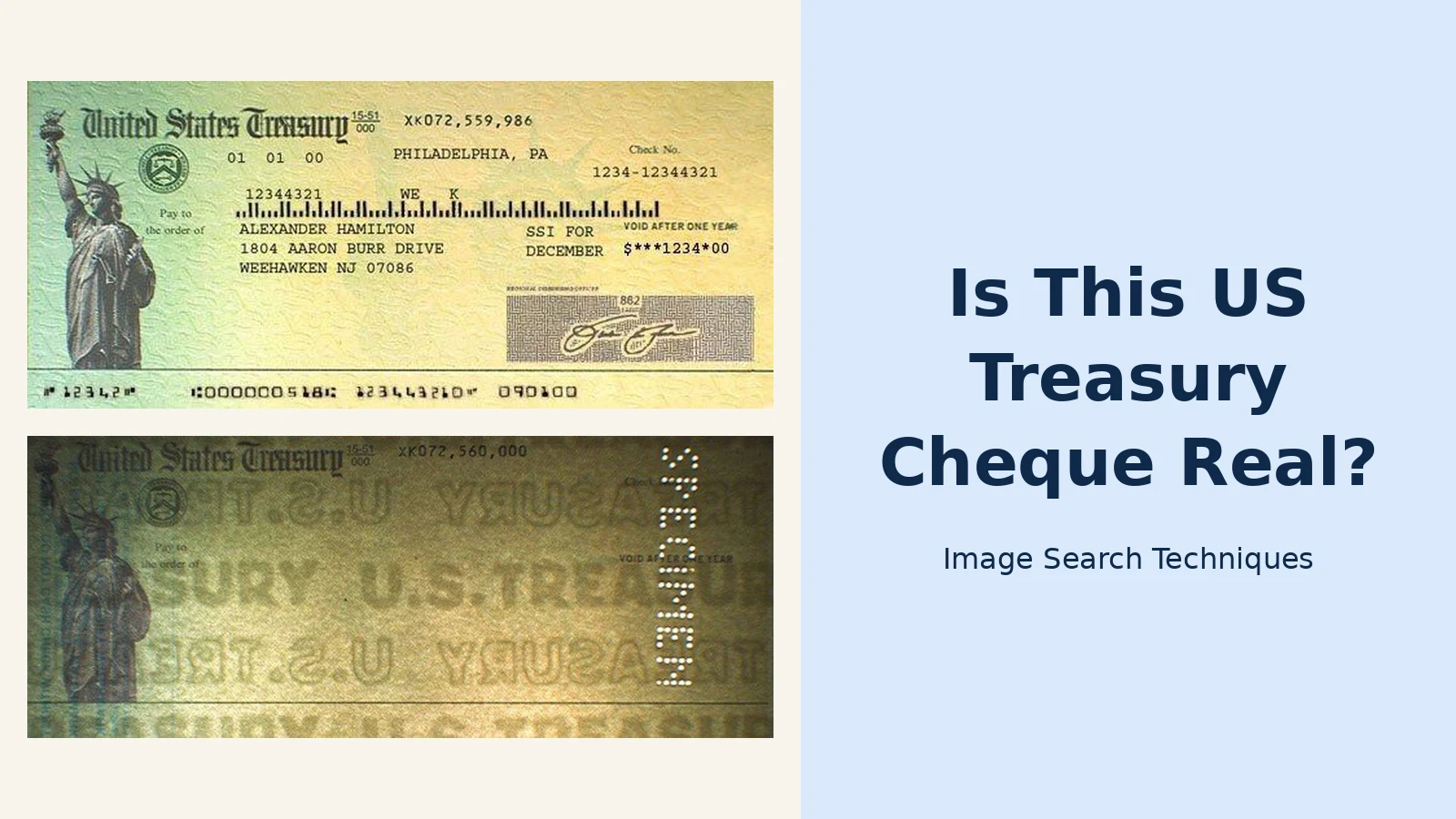
A US Treasury cheque is a paper payment drawn on the United States Treasury, printed and mailed by the Bureau of the Fiscal Service on behalf of a federal agency. Tax refunds, Social Security payments, veterans’ benefits and other federal payments have all arrived this way. The cheque carries the Statue of Liberty on the left, a Treasury seal on the right, and the words “United States Treasury” across the top.
One fact changes the whole picture in 2026. Under Executive Order 14247, signed on 25 March 2025, the federal government stopped issuing paper cheques for most federal payments on 30 September 2025, moving to electronic payments instead. Treasury’s own announcement says paper cheques are over 16 times more likely to be lost, stolen, altered, or delayed than electronic payments. Limited exceptions exist, and cheques issued before the cut-off remain valid for a year, so a real paper cheque can still reach you. But a brand-new paper cheque arriving out of nowhere in late 2026 is now unusual, and unusual is exactly when you should slow down.
That is the honest frame for everything that follows. A photo can start the check. It cannot finish it.
What can a photo verify, and what can it not?
This is the question the whole article turns on, so here is the answer in full before any detail. A photograph shows layout, spelling, numbers and design. It cannot show paper, ink chemistry, or anything hidden in the fibres. The Bureau of the Fiscal Service built its security features to be tested in your hand, not on your screen.
| What you are checking | Can a photo show it? | What it actually proves |
|---|---|---|
| Layout, spelling, payee name, amount, dates | Yes, if the photo is sharp | Only that the image looks right. A scan of a real cheque looks identical. |
| Check symbol and serial number | Yes | That the numbers exist and match each other. Not that the cheque was issued. |
| Watermark reading “U.S. TREASURY” | No | Nothing. The watermark is in the paper. A photo of a photocopy shows the same printed pattern. |
| Bleeding ink on the Treasury seal | No | Nothing. Ink only runs red when moisture touches real security ink. |
| Microprinting, including “USAUSAUSA” | Only with a close, high-resolution shot | A little. Blurry dots suggest a copy, but a sharp photo of a fake can still fool you. |
| Ultraviolet overprint pattern | No | Nothing. The pattern is invisible in normal light and only glows under a black light. |
| Whether the cheque was actually issued | No | Nothing. Only the Treasury Check Verification System or your bank can answer that. |
| Whether the image is a stolen sample | Yes, with reverse image search | A lot. If the same cheque photo appears on scam-warning pages, it is not your cheque. |
The last row is where reverse image search earns its place. It cannot authenticate a cheque. It can expose a copied one. If someone sends you a photo of a cheque and that exact image already exists on the internet, attached to a different name or a different amount, the photo was lifted, not taken. That single check catches more fakes than any amount of squinting at pixels.
What are the security features on a real Treasury cheque?
The Bureau of the Fiscal Service publishes a one-page guide to the security features on every genuine Treasury cheque. It lists five features, and they are the only ones this article describes, because describing unpublished features would help counterfeiters more than readers. Work through them in order when the paper is in your hand.
1. The watermark. Hold the cheque up to a light. You should see the words “U.S. TREASURY” in the paper, readable from both the front and the back. The watermark is light and subtle because it is part of the paper, not printed on it. A copier cannot reproduce it. The Bureau’s guide is blunt about this one: any cheque without the watermark should be suspected of being counterfeit or copied.
2. Bleeding ink. The Treasury seal sits to the right of the Statue of Liberty image. Its black ink contains a security compound. Dab a wet finger on the seal and the ink should run and turn red. Ordinary printer ink stays put. Note the caveat in the Bureau’s own guide: not every genuine cheque carries this exact seal, because older stock printed with the previous “Financial Management Service” seal was still in rotation. A missing seal alone does not prove a cheque is fake. A seal that does not bleed is a much stronger warning.
3. Microprinting. Three areas of the cheque carry text so small it looks like a solid line to the naked eye. Under a magnifying glass the lines resolve into legible words. On the back, the endorsement line reads “USAUSAUSA” when magnified. A copier or a desktop printer cannot reproduce text this small, so on a counterfeit the line shows up as a solid bar or a row of dots. Your phone camera zoomed in close is usually enough to check this.
4. The ultraviolet overprint. Under a black light, a hidden pattern appears beneath the payee information and the dollar amount: four lines reading “FISCAL SERVICE”, or “FMS” on older stock, bracketed by the Fiscal Service seal on the left and the United States seal on the right. The ink glows, and it cannot be photocopied. If someone has shaved or altered the amount box, the pattern shows a gap where the alteration happened.
5. The layout itself. A real cheque follows a fixed format. The check symbol, a four-digit number, and the serial number sit near the top right and also appear in the MICR line, the row of magnetic-ink characters along the bottom edge. The words “VOID AFTER ONE YEAR” are printed above the disbursing officer’s signature. The paper is noticeably heavier than ordinary printer paper. None of these details proves a cheque on their own, but a cheque that gets the layout wrong has already failed.
| Feature | How to test it | What a fake usually shows |
|---|---|---|
| Watermark | Hold the paper up to a light | No watermark, or one visible without light |
| Bleeding ink | Dab the black seal with a wet finger | Ink stays black and dry |
| Microprinting | Magnifying glass on the endorsement line | Solid line or dotted line, no readable words |
| Ultraviolet pattern | Black light over the payee and amount area | No pattern, or a gap where the amount was changed |
| Layout and MICR line | Compare symbol and serial number top and bottom | Mismatched numbers, smeared or uneven print |
| One-year validity | Read the issue date and the “VOID AFTER ONE YEAR” line | A cheque presented more than a year after issue |
Two cautions belong here. First, older cheques still in circulation may show the old “Financial Management Service” name instead of “Bureau of the Fiscal Service”, and that is normal. The Bureau says the old seal will be seen in rotation until that check stock runs out. Second, never test the bleeding ink by soaking the cheque. A damp fingertip on the seal is enough, and you want the cheque readable afterwards, whatever the result.
How do you verify a Treasury cheque with TCVS?
The Treasury Check Verification System, or TCVS, is the Bureau of the Fiscal Service’s own lookup tool. It checks whether a cheque with a given routing number, check number and dollar amount was actually issued. Here is the part most guides get wrong: the public TCVS website is open to anyone. The Bureau’s own FAQ page says so plainly, in one sentence: “Financial institutions can use the Treasury Check Verification System (TCVS) which is publicly available.”
That sentence needs a practical footnote. To run a lookup you need your financial institution’s routing transit number, the check number, and the exact dollar amount. An individual can visit the site and enter those details, but the routing number is your bank’s number, not a number printed for you on the cheque in a form you can just copy. In practice, the smoothest route is to take the cheque to your bank and ask them to run the check through TCVS before you deposit it. Banks have every reason to do this, because they carry the loss if a cheque bounces after they have paid out on it.
- Read the numbers off the cheque. Note the check symbol and serial number from the top right, the routing transit number from the MICR line along the bottom, and the exact amount down to the cent. One cent out and the system will not match.
- Check the date first. Treasury cheques are valid for one year from the issue date. The Bureau’s FAQ is direct: you should not accept a Treasury cheque that is older than one year. TCVS only holds records for cheques issued within the past 13 months, so an old cheque will not appear at all.
- Run the lookup, or ask your bank to. Go to the TCVS website and enter the routing number, check number and amount, or hand the cheque to your bank and ask them to verify it through TCVS before depositing. Do not deposit first and ask questions later.
- Read the result carefully. A match means Treasury’s records show a cheque was issued with those details. No match does not automatically mean the cheque is fake. The Bureau’s own guidance notes that a missing record can simply mean the issuing agency has not yet sent the data. Treat a no-match as a reason to wait and let the bank investigate, not as proof either way.
- Know what TCVS cannot tell you. The public website cannot confirm the payee’s name. That check, payee-name validation, is available only through the TCVS API, and the API is for financial institutions. A bank applies for API keys by completing the Bureau’s terms and conditions and emailing them to the Fiscal Service. As an individual, you cannot get that access, and anyone offering to run it for you is not doing you a favour.
If the cheque passes the physical checks and TCVS finds a match, you have done everything a careful person can do. Deposit it through your bank, in person, and keep the receipt. Under federal Regulation CC, funds from a US Treasury cheque must generally be available by the next business day when you deposit it in person into an account in your name. An ATM or mailed deposit gets until the second business day. But available is not the same as cleared, and that distinction matters more here than with any other cheque, as our guide to emailed cheque photos and the mobile-deposit trap explains in detail.
How to tell if a treasury check is real from a photo: a worked example
To test what a photo check can actually do, I ran a real Treasury cheque image through our own reverse image search tool on 12 November 2026. The image was the official sample cheque from the Bureau of the Fiscal Service’s own security-features poster: a cheque payable to Alexander Hamilton, issued in Philadelphia, PA, for $***1234*00. It is the genuine article, published by the Treasury itself, so it is the perfect test. If the engines cannot trace this one to its source, they will not trace yours either.
One note on the tool first. Clicking “Search All Selected Engines” opened only one tab, Google Lens, so each engine was tested individually. That is a quirk of the tool, not of the engines, and it is worth knowing before you rely on the button.
| Engine | Result | What it found |
|---|---|---|
| Google Lens | Worked, found the source | Top visual match and first web result was the Fiscal Service security-features poster itself. About 55 visual matches and 9 web results, with an exact-size 576 by 253 match among roughly 251 exact matches. |
| Bing | Worked, no source | Identified the image as a US Treasury check to Alexander Hamilton, dated 1 January 2000, Weehawken NJ, but with garbled context. It did not surface the Fiscal Service poster. It did surface the TCVS site and other official resources. |
| Yandex | Worked, misidentified it | Called the image a “Refund anticipation loan” from Wikipedia, though its text reading picked up the cheque’s printed words. Thirteen similar images, twenty sites, no Fiscal Service source. |
| TinEye | Worked, no source | 294 results across 30 pages, from 86.7 billion images searched, first indexed 6 November 2009. Filtering by fiscal.treasury.gov returned no matches. Most results were other cheques of the same template, not this one. |
| Failed as an image search | The tool’s Pinterest link does not run a visual search at all. It opens a keyword search for pins from the site’s own domain. Zero matches for the cheque, because the image was never searched. |
Three lessons came out of the test, and all three matter for anyone holding a cheque photo. First, only Google Lens traced the image to the authoritative source, the Fiscal Service poster that lists the genuine security features. If your cheque photo traces back to a sample image, a stock photo, or a scam-warning page, stop there. The photo was lifted, not taken.
Second, the engines disagree, and the disagreement is the point. Yandex misnamed an official Treasury sample as a loan product. Bing got the payee and the date right but invented context around them. TinEye found nearly 300 lookalikes and still missed the source. None of them can tell you whether the paper in your hand is real, because none of them can see the paper.
Third, do not trust the AI summary. Lens’s own AI Overview correctly identified the image as a US Treasury check, then wrongly called it a “satirical or meme edit”. It was neither. It was the Treasury’s own sample. If the summary can mislabel the official sample, it can mislabel yours too. Read the results, not the summary.
The practical takeaway is narrow and useful. Reverse image search answers one question well: has this exact cheque photo appeared before, somewhere it should not have? If the answer is yes, the photo is not evidence of anything. If the answer is no, you have learned nothing about the paper, and the physical checks and TCVS are still waiting.
What are the red flags that the cheque is part of a scam?
The paper and the numbers are only half the story. The other half is the story that arrived with the cheque. The Federal Trade Commission warns that fake cheque scams follow a predictable pattern, and the pattern is worth memorising because it shows up in every version of this fraud.
- You were not expecting the cheque. A tax refund you never filed for, a prize you never entered, a job you never applied for. Real federal payments follow an application, a claim, or a tax return you actually made.
- Someone wants money back. The classic shape is an overpayment: the cheque is for more than the price, and you are asked to refund the difference. Or a “processing fee” or “tax” must be paid before you can collect. A real federal agency will never ask you to return part of a Treasury cheque by wire transfer, gift card, or cryptocurrency.
- There is a deadline and pressure. Deposit it today, send the money back tonight, do not tell your bank what it is for. Pressure is the tell. A genuine payment has no reason to rush you.
- The cheque arrived with a story, not a letter. Real Treasury cheques come with agency correspondence you can verify independently. A cheque that arrives by email as a photo, or through a messaging app from a stranger, has already broken the pattern.
- The amount does not match anything you are owed. Check the figure against your own records. A refund for a tax year you never filed, or a benefit you never claimed, is not a windfall. It is a prop.
Two more flags belong to 2026 specifically. First, the paper-cheque phase-out means a new Treasury cheque is now rare. If someone tells you a fresh federal payment arrived by post in late 2026, ask which agency sent it and why it was not paid electronically. Second, the cheque-photo scam and the Treasury-cheque scam are cousins, not twins. A photo of a cheque sent by email, asking you to deposit it from your phone, is the mobile-deposit trap our cheque-photo guide covers. A paper cheque in your hand is a different problem, and this article covers that one.
Our complete photo scams guide collects the patterns across every version of this fraud, and the same pressure tactics appear in almost all of them. If the story feels rushed, the cheque is almost certainly not the only thing being faked.
What should you do if the cheque fails a check?
Stop, and do not deposit it. That is the whole answer in one sentence, and the rest of this section is the detail.
- Do not deposit it, and do not send anything back. Depositing a fake cheque is what the scam needs from you. The money the bank shows as available will be clawed back when the cheque bounces, weeks later, and anything you sent onward is gone. If someone is pressing you to deposit and wire money back, that pressure is itself the answer.
- Keep the cheque as evidence. Do not destroy it and do not return it to whoever sent it. Put it somewhere safe. If the matter goes to the police or the Secret Service, the paper itself is the evidence.
- Call your bank. Tell them you have a Treasury cheque you believe may be counterfeit and ask them to verify it through TCVS. They can also tell you whether the routing number on the cheque belongs to a Treasury disbursement at all.
- Report it. Counterfeit Treasury cheques are investigated by the US Secret Service, which has explicit authority over fictitious government obligations. Report the matter to your local police or the nearest Secret Service field office, and report the scam to the FTC at ReportFraud.ftc.gov. The FTC’s own guidance on fake cheque scams is the clearest public description of the pattern, and it is worth reading before you talk to anyone about the cheque.
- If you already deposited it, tell your bank immediately. The sooner the bank knows, the sooner it can limit the damage. Do not try to fix it by sending more money anywhere.
If the cheque is genuine but expired, the route is different. A Treasury cheque more than a year old cannot be deposited. Contact the agency that issued the payment and ask for a reissue. For a tax refund, that means the IRS, which uses Form 3911 to trace a missing refund. For a Social Security payment, call the Social Security Administration. The Bureau cancels uncashed cheques and returns the funds to the issuing agency, so the money is not lost, but you have to ask for it again.
If the cheque never arrived at all, the same agencies handle the trace. File a claim of non-receipt, and do it within a year of the issue date. After that window, the process gets slower and harder, so do not leave it in a drawer.
How do you photograph a cheque safely if you need a record?
Sometimes you do need a photo: for your own records, to send to your bank, or to show a family member. Do it in a way that does not hand a stranger a usable copy of your payment.
- Photograph it for yourself, not for a stranger. Never send a photo of a Treasury cheque to someone who contacted you first, and never post one on social media. A sharp photo of a real cheque is exactly what a scammer needs to build a convincing fake.
- Cover the numbers you do not need to share. If your bank asks for a photo, ask which fields they need and mask the rest. The full MICR line, the complete serial number and your address together are enough to attempt fraud.
- Reverse search any cheque photo you receive. This is the one place a photo check genuinely helps. Run the image through reverse image search before you do anything else. A match to a stock image, a sample, or a scam-warning page ends the conversation immediately. Our guide to fake payment screenshots shows the same principle at work on a different kind of payment image, and the catfish checks use the same method on profile photos.
- Keep the original. A photo is a record, not a replacement. The physical tests in this guide need the paper, and the bank needs it too.
The rule is simple enough to remember: a photo of a cheque is a claim, not proof. Treat it as a claim, check it against the paper and the official system, and let the bank have the last word.
Can a photo prove a US Treasury cheque is real?
No. A photo shows layout, spelling and numbers, but the features that prove a Treasury cheque is genuine live in the paper and the ink: the watermark, the bleeding ink, the microprinting and the ultraviolet pattern. None of these can be confirmed from a photograph, so a photo is only the start of the check, never the end.
Is the Treasury Check Verification System free and open to the public?
Yes. The Bureau of the Fiscal Service says the Treasury Check Verification System is publicly available. You need the routing transit number, the check number and the exact amount. The public site cannot confirm the payee name, which is available only to banks through the TCVS API. In practice, asking your bank to run it is the smoothest route.
Why would a Treasury cheque arrive in late 2026 if paper cheques stopped?
Under Executive Order 14247, the federal government stopped issuing paper cheques for most payments on 30 September 2025, with limited exceptions. Cheques issued before that date stay valid for a year. A paper cheque arriving now is therefore unusual, which does not make it fake by itself, but it is a good reason to check it carefully before depositing.
What should I do with a Treasury cheque that looks fake?
Do not deposit it and do not send any money back to whoever sent it. Keep the cheque as evidence, ask your bank to verify it through the Treasury Check Verification System, and report it to your police or the US Secret Service field office, plus the FTC at ReportFraud.ftc.gov. If you already deposited it, tell your bank at once.
This guide is general information, not legal advice. If your case involves a large sum or a possible crime, speak to your bank and to the authorities named above before you act.