


🔎 Reverse Image Search
Image search techniques made simple: upload a photo or paste a URL and search 6 engines at once. 100% free, nothing stored.
🔒 Your image is never stored on our servers longer than 24 hours and is never shared.
Short answer: take three photos of the same bloom, a face-on shot, a side view and the leaves with the whole plant, then run the clearest one through a reverse image search and check the name against petal count, symmetry and the flower centre before you trust it. One close-up of a pretty bloom is rarely enough on its own. The three photos together are what turn a guess into an identification you can rely on.
Most attempts to identify a flower from a photo fail for the same reason. The picture shows the bloom and nothing else. A peony, a ranunculus, a camellia and a double begonia can all look like the same pink ball of petals from the front, and colour alone will not separate them. What separates them is structure: how many petals there are, whether they are arranged in a flat spiral or a loose ruffle, what sits in the middle, and what the leaves look like. None of that is visible in a single tight close-up.
This guide is about blooms only. It does not re-teach general plant identification, and it does not cover houseplant varieties. If the plant in your photo has no flowers at all, our reverse image search for plants guide is the right starting point instead. If the flower is on a houseplant, see our guide to identifying a houseplant variety from a photo.
A quick definition before we start. An identification key is a short list of visible features, checked in order, that narrows a flower down step by step. This article gives you one for blooms, and you can run it on any photo you already have.
How do you identify a flower from a photo?
You work through three stages. First you photograph the flower properly, or you check that the photo you already have shows enough. Then you get a suggested name from a tool. Then you verify that name against the features in your own photos. Skipping the third stage is how wrong names stick. A tool that names a flower in two seconds is giving you a suggestion, not a verdict.
The three-photo method is the backbone of the whole process. iNaturalist, the citizen science platform, gives the same advice in its Educator’s Guide: many plants cannot be identified from a single photo, so take multiple photos from different angles, and for plants the photos of flowers or fruit and leaves are the most helpful. That advice holds whether you submit to iNaturalist or run a reverse image search.
Here is the method in full.
- Photo one: the flower face-on. Fill the frame with one open bloom, shot straight at its face. Petal count, symmetry and the centre must all be sharp. Tap the flower on your phone screen to focus, then check the picture before you move on.
- Photo two: the same flower from the side. Include where the bloom joins its stalk and the green sepals or bracts behind the petals. This view shows whether the petals sit in a flat disc, a cup or a loose ruffle, and it often separates look-alikes that look identical from the front.
- Photo three: the leaves and the whole plant. Photograph a leaf still attached to its stem, showing its edge and how it joins the stem, then step back and show the whole plant. Is it a low rosette, an upright stem, a shrub or a climber? That one fact rules out whole families at once.
Then add the notes no photo can carry. Roughly how wide was the bloom? Use a coin or your hand for scale in one shot. Where was it growing, a garden bed, a pot, a hedgerow, a meadow? What month is it? A flower in bloom in February and the same flower in July are rarely the same plant, and a tool that does not know the season will guess anyway.
What makes a flower photo good enough to identify?
Four things matter, and they are all easy to get wrong.
Light. Soft, even daylight is best. Harsh midday sun bleaches pale petals white and turns deep reds black in the photo. A colour filter does the same damage in a different way. If the photo was taken under warm indoor light, say so when you check the result, because the colour you see may not be the colour the plant has.
Focus. The centre of the flower must be sharp. That is where the stamens, the central disc or the hidden middle sit, and those features decide more identifications than the petals do. If the centre is a soft blur, take the photo again rather than hoping the tool can guess through it.
One flower at a time. A bed full of blooms confuses every tool, because it cannot tell which flower you mean. Pick one open flower and make it the subject. A second photo of the cluster is useful context, but it is not the identification photo.
Fresh, not faded. A bloom past its best has lost petals, changed colour and often lost its centre altogether. If the only photo you have is of a wilting flower, treat any answer as tentative. The same goes for a photo of a photo, or a screenshot, where compression has already eaten the fine detail.
How do you read a bloom: petals, symmetry and the centre?
This is the identification key. Work through it in order, on your face-on photo, and write down what you see before you run any tool. A name that disagrees with what you wrote down needs a second look.
| Feature to check | What to look for | What it tells you |
|---|---|---|
| Petal count | Count the petals, or estimate: 3, 4, 5, 6, or many | Three or six parts points to lilies, tulips and irises. Five points to roses, buttercups and most wildflowers. Many layered petals points to peonies, ranunculus and camellias. |
| Symmetry | Is the flower the same in every direction, like a daisy, or does it have a clear top and bottom, like a snapdragon? | Radially symmetrical blooms are the common case. Irregular blooms, with a distinct top and bottom, narrow the field fast, to pea flowers, orchids and snapdragons. |
| Petal edges | Are the petals separate or fused? Smooth, ruffled, notched or fringed? | Fused petals that form a tube or bell point to a different family from free petals. Ruffled edges are typical of peonies and carnations. |
| The centre | What sits in the middle: a flat disc, a ring of stamens, a raised cone, a hidden centre buried under petals? | A daisy has a flat disc centre. A peony in full bloom hides its centre completely. A ranunculus has a tight round centre you can barely see. |
| How the blooms sit | One flower per stem, or a cluster? A flat-topped spray, a spike, or a ball? | Single large blooms on long stems are typical of garden peonies and roses. Clusters and spikes point to lilac, hydrangea and lavender. |
| Leaves | Shape, edge and arrangement: opposite pairs, alternating up the stem, or all at the base? | Leaves often decide the match when the flowers look alike. Glossy evergreen leaves with a camellia, feathery cut leaves with a ranunculus, lobed leaves with a peony. |
Colour goes last in the key, on purpose. It is the feature people trust most and the one that misleads most. The same cultivar can be pink in one garden and white in another, and a phone camera under warm light can turn a pale pink bloom white. Use colour as a supporting clue, never as the deciding one.
Peony, ranunculus, camellia or double begonia: which one is it?
These four are the classic confusion set. All four produce big, many-petalled, bowl-shaped blooms in pink, white and red, and all four turn up in bouquets and garden photos. This table is the ranking asset for this article, built from the features above. Check your photo against it before you accept a tool’s answer.
| Feature | Peony | Ranunculus | Camellia | Double begonia |
|---|---|---|---|---|
| Bloom size | Large, often 10 to 25 cm across | Small, usually 5 to 10 cm across | Medium, 5 to 12 cm across | Medium, 5 to 15 cm across |
| Petals | Loose, ruffled, uneven, with gaps you can see through | Tightly layered, paper-thin, in a neat spiral | Firm and waxy, with a sheen, in a regular spiral | Soft and full, like a small rose, often with a ragged edge |
| Centre | Hidden under petals when fully open, or a ring of yellow stamens in single forms | Tight and round, barely visible | A clear boss of yellow stamens in the middle | Often hidden, sometimes a small yellow centre |
| Leaves | Dark green, glossy, deeply lobed | Feathery and finely cut | Glossy, dark green, evergreen, leathery | Asymmetrical, one side larger than the other, often with a waxy surface |
| Stem and habit | Herbaceous clump or woody shrub, smooth stems, no thorns | Low and compact, grown from corms | Evergreen shrub or small tree, woody stems | Fleshy stems, grown from tubers, often in pots |
| Season | Late spring to early summer | Spring, often as a cut flower | Late winter to spring | Summer into autumn |
Two checks settle most cases. First, look at the leaves. If the leaves are glossy, leathery and evergreen, it is almost certainly a camellia. If they are lopsided, with one side clearly larger than the other, it is a begonia. Second, look at the petal texture. Paper-thin petals packed in a perfect spiral mean ranunculus. Loose, ruffled petals with visible gaps mean peony.
Note what this table does not do. It will not name a cultivar. A peony called Sarah Bernhardt and a peony called Bowl of Beauty are different plants with the same species name, and no photo of the bloom alone will separate them reliably. If a tool gives you a cultivar name from one photo, treat it as a guess, not a fact.
How do you identify a flower in a bouquet?
Bouquets are the hardest case, because the three-photo method breaks. The flowers have been cut, the leaves are often stripped off, the stems are wrapped, and you cannot see the plant they came from. You have one photo, sometimes two, and no second chance.
Start with the same key, but accept a lower level of certainty. Run the face-on shot through a reverse image search first, because bouquets are photographed and sold online, so the same arrangement often appears on florist and stock sites. Then check the answer against the table above. A florist will also mix in filler flowers, greenery and buds, so identify one bloom at a time and ignore the rest of the arrangement while you do it.
Three bouquet-specific clues help. First, the stem. Florists leave peony and rose stems long and woody, while ranunculus stems are thin and green. Second, the buds. A tight, round, green-tinged bud that unfurls over days is a ranunculus. Third, the season. A bouquet photographed in December is unlikely to hold fresh garden peonies, which bloom in late spring, so a December answer of peony deserves a second look, even if the petals match.
If the bouquet came from a shop, the receipt or the order confirmation sometimes names the flowers. That is a better source than any app. And if the flowers were a gift and you want to know what you received, photograph each type separately rather than the whole bouquet at once. One clear bloom per photo, as always.
Which tool should you use: reverse image search or a plant ID app?
Both work, and they work in different ways. A reverse image search finds other pages that use the same or a similar photo, which is useful when the flower is a common garden plant or a florist’s bloom. A plant ID app compares your photo against a trained model and suggests a name, which is useful for wildflowers and unusual plants that few people photograph.
| Tool | Best for | What it needs | Watch out for |
|---|---|---|---|
| Reverse image search (Google Lens, TinEye, Bing, Yandex) | Garden flowers, bouquets, named cultivars, flowers already photographed online | One clear photo, no account needed for a basic search | It finds pages that used the photo, not the plant, so a mislabelled page gives you a wrong name |
| PlantNet | Wildflowers and garden plants, with a community-checked database | Free app or website, one photo at a time | Results are suggestions, and it is stronger on wild plants than on florist cultivars |
| iNaturalist and Seek | Wild plants, with human experts checking the suggestion | Free app, an account for iNaturalist, none for Seek | Cultivated garden plants get less attention from the community, so answers can be slow |
| PictureThis | Quick garden-plant answers with care advice | Free to try, subscription for full use | The free tier pushes hard toward a paid plan, and care advice is not identification evidence |
| Google Lens | A fast first suggestion, especially for common flowers | Free, built into Google and Android phones | It answers with a name and a set of similar images, but it does not explain why, so you still have to check |
Use two tools, not one. If a reverse image search and a plant ID app agree, and both agree with the features you wrote down from the key, you have a solid identification. If they disagree, trust the features, not the tools. And remember the numbers. A 2023 study in People and Nature tested five free plant identification apps on 857 professionally identified photos of 277 species. Across all five apps, 69% of photos were identified correctly with the first suggestion, and 85% had the right answer in the top five. That is good, and it is also a reminder that roughly one photo in three gets a wrong first answer.
Worked example: a white peony, run through five search engines
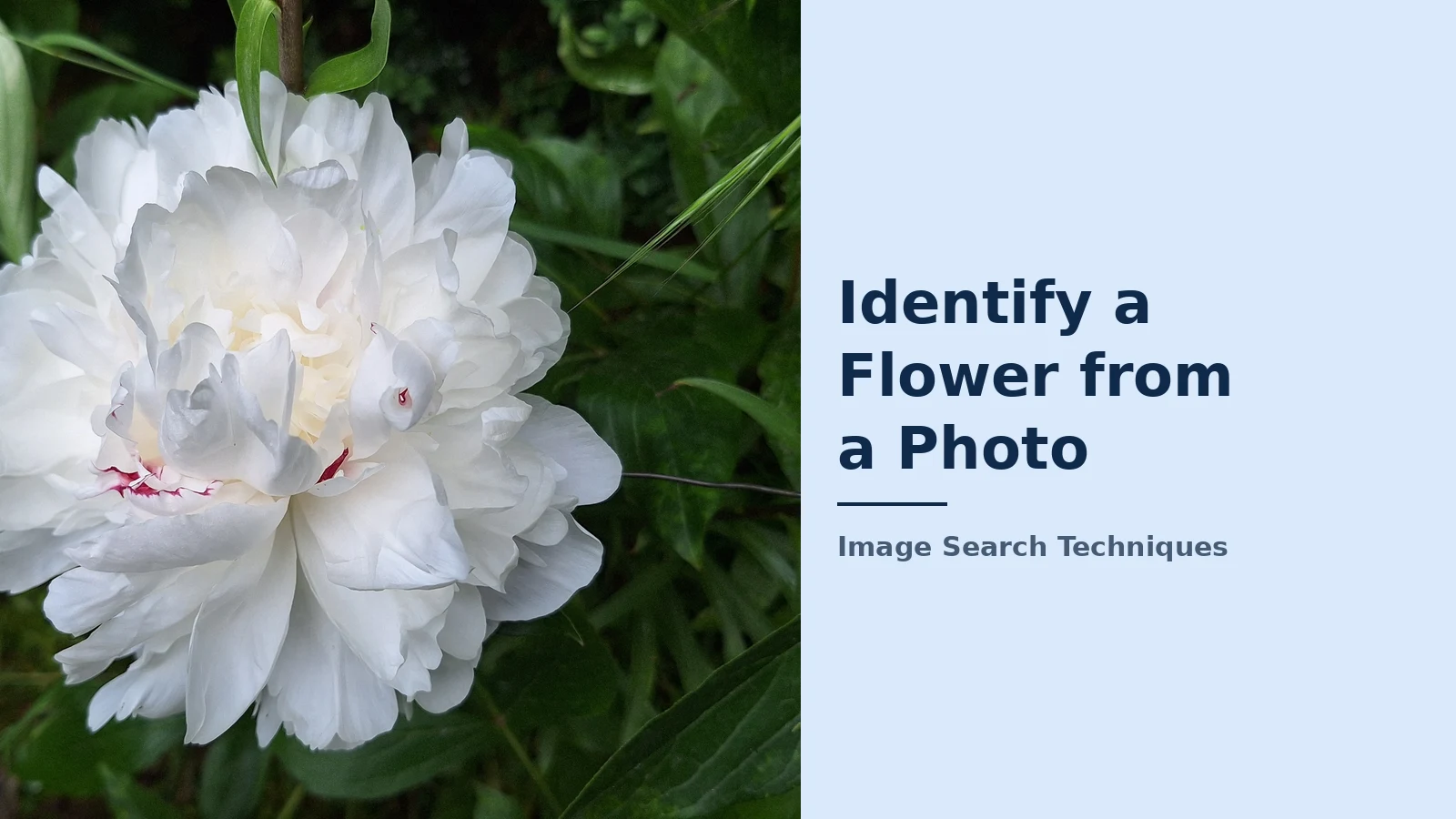
Here is the method above, run for real on 13 November 2026. The test photo is a real one: a close-up of a white peony with a red tint, taken on 12 May 2024 in Radovanu, Romania, on a Samsung Galaxy A54 5G. It is a CC0 photo on Wikimedia Commons, 4,080 by 2,296 pixels, by a photographer who goes by Spring’s Flowers. I pasted its direct upload.wikimedia.org link into the reverse image search tool on this site and ran every engine it offers, one by one.
One thing to note first. The tool’s “Search All” button did not open all six engines. With every engine checked, it opened a single tab, Google Lens, and nothing else. So each engine below was tested with its own button, and the results are what each engine actually returned that morning.
| Engine | Result | Did it name the flower? | Did it find the Commons source? |
|---|---|---|---|
| Google Lens | Failed. “No image at the URL”, 0 results, after about 30 seconds of “Thinking”. | No | No |
| Google Search by Image | Failed identically. Google and Lens open the same Lens endpoint here, so this is one failure, not two. | No | No |
| Bing | Ran. Labelled it “White Peony Flower” and “Festiva Maxima Peony”, and described it as a white peony, Paeonia lactiflora. Three pages with this image, none of them the Commons file page. | Yes | No |
| Yandex | Ran, and the only engine to find the source. Labelled it “a white peony” and listed 12 sizes including the exact 4,080 by 2,296. Its Sites tab put the Wikipedia file page first, which confirms the photo is a Commons file, dated 12 May 2024, by Spring’s Flowers, CC0. | Yes | Yes |
| TinEye | Ran, 0 matches out of 86.7 billion images. Its own words: it has “yet to crawl any pages where this image appears”. | No | No |
| Not a reverse search at all. The tool opens a keyword search for the image host’s domain, which returned 31 unrelated pins and no peony. | No | No |
Score: two engines out of five named the flower correctly, and only one found where the photo actually came from. Google, the engine most people try first, failed outright on this photo, which is a reminder that a failed search says nothing about the flower. It says the engine could not fetch that URL that day.
There is a second lesson in the table. Both Bing and Yandex suggested a cultivar name, Festiva Maxima, a white peony with red flecks. That is plausible, and it matches the red tint in this photo. But it is still a suggestion from a single close-up, and this article’s own rule says a cultivar name from one photo is a guess. The safe identification is white peony, Paeonia lactiflora. The file page Yandex found is the proof that matters: it gives the date, the place, the photographer and the licence, which is more than any search engine label can offer.
Notice what the test photo itself could not do. It is a single close-up, with no side view and no leaves. That is exactly the weakness the three-photo method is meant to fix. The engines still named it, because a white peony is a common garden flower with thousands of photos online. A rarer flower, or a bouquet bloom with no leaves attached, would have been a much harder test, and the honest result then might have been a genus, or no answer at all.
When can a photo alone not name the flower?
Sometimes the honest answer is that the photo is not enough. Knowing when to stop is part of identifying flowers well.
Cultivars. As the table above says, a single bloom photo will not reliably separate one named cultivar from another. Growers distinguish them by growth habit, bloom time and leaf shape over a season, not by one picture.
Flowers that need a closer look. Some species differ only in features a phone photo cannot show: the hairs on a stem, the shape of a seed, or the number of stamens. If two tools give you two different species in the same genus, the genus may be the right answer, and forcing a species name would be guessing.
Toxicity and edibility. Never decide whether a flower is safe to eat, safe to touch or safe for a pet from a photo identification alone. Some flowers are irritants, and some look-alikes are poisonous while their twins are not. If the question matters for health, take your photos to a local extension service or a poison control centre and say plainly that the identification is unconfirmed. This article gives no toxicity or edibility verdicts, on purpose.
Detached blooms with no context. A single cut flower with no leaves, no stem and no location is often unidentifiable to species level. The three-photo method exists because the extra photos carry the evidence. Without them, the best you can say is the genus, or the group it belongs to.
If your identification stays uncertain after two tools and a check against the key, ask a human. Your local extension service, a botanical garden or the iNaturalist community will all take a set of three clear photos and a location, and they will tell you when the evidence is not enough. That is a better outcome than a confident wrong name.
How to keep your flower photos useful
One last habit makes every future identification easier. When you photograph a flower you cannot name, save the three photos together, with the date and place in the file name or a note. A photo taken in May in a garden bed in Kent is a different piece of evidence from the same photo with no date and no place, and a year later you will not remember either one. The same three-photo approach works for almost anything you can photograph, which is why our what is this picture guide starts from the same idea: show the whole thing, show the detail, then check what you found.
Do not strip the location data from the photo before you submit it to an identification app, because the location is part of the evidence. If you are posting the photo publicly, that is a different decision, and our guide to protecting your photos online covers what to remove and when. For an identification, the date and place help, and the apps use them.
And if you found this flower while weeding, our weed identification guide uses the same three-photo approach for the plants you are about to pull, with a starter key for broadleaf, grassy and sedge weeds and a Japanese knotweed red-flag panel.
FAQs
Can I identify a flower from a photo?
Yes, if the photo shows enough. Take three pictures of the same bloom: face-on, from the side, and the leaves with the whole plant. Run the clearest one through a reverse image search or a plant ID app, then check the suggested name against petal count, symmetry and the flower centre before you trust it.
Why do plant ID apps give different answers for the same flower?
The apps were trained on different photo sets, and some are stronger on wild plants than on garden cultivars. A cultivar can also look different from the species the app knows. When two tools disagree, check the features yourself with the key in this guide, and treat the genus as the answer if the species cannot be settled.
Can I identify a flower from a bouquet photo?
Often, yes, but with less certainty. Cut flowers have no leaves or roots to check, so work from the bloom alone and use the peony, ranunculus, camellia and begonia table to narrow it down. Photograph each flower type separately rather than the whole bouquet. A florist receipt that names the flowers beats any app.
Is a flower safe to eat or touch based on a photo identification?
No, never decide that from a photo alone. Some flowers are irritants, and some poisonous look-alikes are nearly identical to harmless ones in a picture. If the question matters for health, take your photos to a local extension service or a poison control centre and say plainly that the identification is unconfirmed.