🔎 Reverse Image Search
Image search techniques made simple: upload a photo or paste a URL and search 6 engines at once. 100% free, nothing stored.
🔒 Your image is never stored on our servers longer than 24 hours and is never shared.
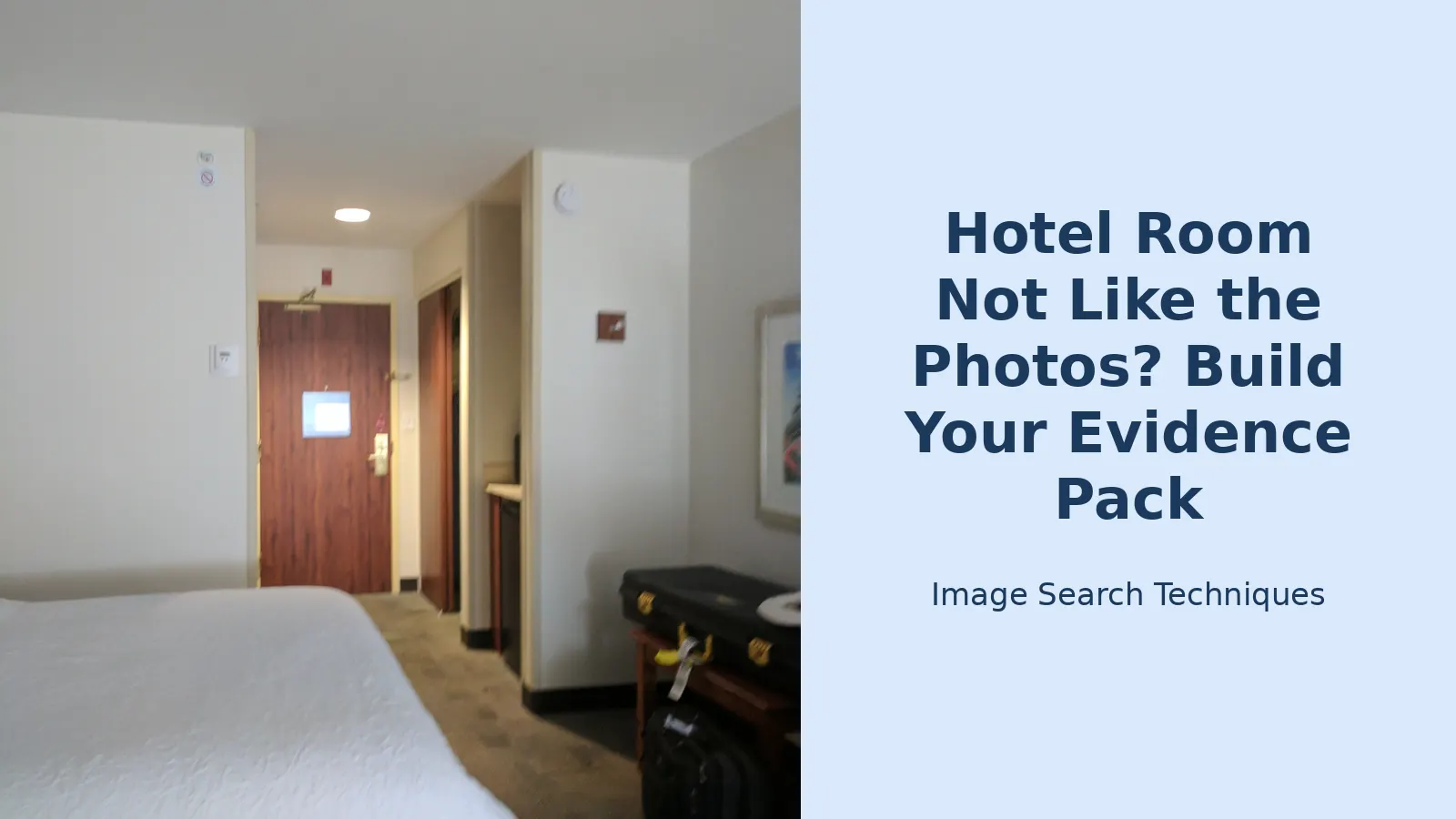
You walk in, bags in hand, and the room in front of you is not the room in the photos. The bed is smaller, the view is a brick wall, and the bathroom looks ten years older than the gallery. Your first instinct is to complain. Your second should be to photograph. A complaint on its own is one person’s word against a listing. A complaint backed by a dated, organised evidence pack is much harder to brush off, and that gap between the photos and the room is exactly what a hotel room not as pictured evidence pack is built to prove.
The short answer: if your hotel room is not as pictured, photograph everything before you unpack: wide shots, close-ups of each problem, the room number and the view. Pair each arrival photo with the matching listing photo, save the confirmation, report the problem in writing the same day, and send the pack to the hotel, then the platform, then your card issuer.
This guide is the after-arrival half of the hotel photo check. If you are still choosing a hotel, our guide to checking hotel photos before you book covers the gallery read, the traveller-photo comparison and the reverse search to run first. What follows here starts the moment you open the door and find the room does not match. It is part of our wider photo scams guide, and it works for a hotel booked direct, through Booking.com, or as an Airbnb stay, with the platform steps spelled out separately where they differ.
What is a hotel room not as pictured evidence pack?
An evidence pack is a dated file that ties four things together: what the listing promised, what you paid, what you actually got, and what you asked the hotel to do about it. That is the whole idea, and every photo, screenshot and message in the pack exists to answer one of those four questions. A single striking photo of a stain will not carry a refund on its own. A pack that connects the listing photo, your arrival photo, the confirmation and a written complaint made the same day is far harder for a hotel, a platform or a card issuer to dismiss.
Build the pack in the first hour after arrival, while the room is exactly as you found it. Do not tidy up first, do not move the furniture into place, and do not wait until checkout to start. Photos taken after you have lived in the room for three days prove much less than photos taken in the first thirty minutes, and a hotel can fairly say the mess in a day-three photo is yours. The pack is also your memory. Six weeks later, when the platform asks for the details, you will not remember the room number, the name of the person at the desk, or the exact words in the listing. The pack remembers for you.
Keep the original files. Send copies, never the only copy. Keep the originals on your phone and back them up to cloud storage the same evening, because a lost phone is a lost case. Do not edit the photos, do not add filters, and do not crop out the context that shows where the photo was taken. If you send a photo through a messaging app or post it on social media, the app will often strip the date, time and location data from the file, so always send the original file from your gallery or camera roll, not a re-saved copy.
What should you photograph in the first 30 minutes?
Photograph the room before you unpack, in this order, and let the phone record the date and time on every file. Start wide, then move in close, and finish with the details people always forget. The wide shots set the scene. The close-ups prove the specific problem. The forgotten details are the ones that tie the photos to your booking.
- One wide shot of the whole room from the door. Stand in the doorway and take the room as you found it, bed, windows, floor and all. Take a second wide shot from the opposite corner. These two photos are the baseline everything else is measured against.
- The bed, with something for scale. Photograph the bed from the foot, then from the side. If the listing promised a queen or a king, put a tape measure across the mattress and photograph the reading. A standard US queen is 60 inches wide and a full is 54 inches, so a tape measure turns an argument about size into a number nobody can dispute.
- Close-ups of every problem, one photo each. Stains, hair, damage, dirt, a broken fitting, a missing item. One clear photo per problem, close enough to see the detail and wide enough to show where in the room it sits. Take two of each if the light is poor.
- The view from the window, with the curtains open. If the listing promised a sea view, a city view or a garden view, photograph exactly what you see. A photo of a brick wall or a car park is the whole case in one frame, and it is the photo hotels find hardest to argue with.
- The room number. Photograph the number on the door, and the corridor outside it if you can do so without photographing other guests. This ties every other photo to the room you were given, not just to the hotel in general.
- Missing amenities, one photo each. No pool where the listing showed one, no breakfast room, no gym, no parking. Photograph the locked door, the empty space, or the sign that says closed. A missing amenity is easy for a hotel to deny later, and a photo taken on arrival stops that.
- A short video if a photo cannot show it. A leaking tap, a rattling air conditioner, noise from the road or building work next door. Walk slowly, narrate the date and the room number as you film, and keep it under a minute. Video also captures the size of a room better than a still photo, because you can see the walls move past.
Photograph the room as it is, not as you wish it looked. Do not move the stained sheets, do not wipe the surface, and do not rearrange the furniture to make the problem look worse than it is. An honest pack is a strong pack. The moment a hotel can show you staged a photo, everything else in the file loses trust.
How do you pair your photos with the listing photos?
Pairing is the step that turns a pile of photos into proof. A photo of a small bed proves little on its own. The same photo next to the listing photo that promised a king bed proves the gap, and the gap is what you are asking to be paid for. Build the pairs before you write the complaint, one pair for each promise that failed.
For each pair, put the listing photo on the left and your arrival photo on the right, and write one line under each pair that states the promise and the reality in plain words. Do not write a paragraph under each pair. One line is enough, and it keeps the reviewer reading. The table below shows the five pairs that win most hotel room cases, with the line to write under each.
| Listing photo promises | Your arrival photo shows | What the pair proves |
|---|---|---|
| King bed, bright room | Full-size bed, tape measure reading about 50 inches across | The bed is not the size you paid for |
| Sea view from the window | A brick wall, or a car park, from the same window | The view that sold the room does not exist |
| Newly refurbished bathroom | Stained tiles, dated fittings, a cracked basin | The room is not the refurbished room in the gallery |
| Pool, gym or breakfast room | A locked door, an empty shell, or a closed sign | An advertised amenity was not available |
| Clean, made-up room | Stained sheets, hair, dirt on arrival | The room was not in the condition promised |
Three rules keep the pairs honest. First, pair the same thing: the bed in the listing with the bed in your room, the view in the listing with the view from your window, not a listing photo of the suite with a photo of your standard room. Second, use the listing photo as it appeared when you booked, not as it appears now. Listings change, and the hotel may have quietly swapped the photo since you complained. Third, keep the file names plain and numbered, such as 01-listing-bed.jpg and 01-arrival-bed.jpg, so the reviewer can match each pair without guessing. A reviewer who has to hunt through thirty unlabelled files will stop reading, and a pack that is not read is a pack that does not win.
Virtual staging deserves one pair of its own. If the listing photo shows furniture, light or space that the real room cannot hold, that is a staging tell, and our guide to checking virtually staged property photos explains the signs to look for, from impossible light to warped straight lines and furniture that does not fit the floor plan. A staged photo in a hotel listing is not proof of a scam on its own, but paired with your arrival photo it shows the listing was selling a room that does not exist in that form.
What else goes in the pack besides photos?
Photos are the heart of the pack, but they are not the whole pack. A reviewer needs to see what you paid, what the terms said, and what you asked for, and each of those needs a document. Gather these while the details are fresh, and save the originals as files, not as screenshots of screenshots.
- The booking confirmation. The email or PDF with the property name, the room type, the dates, the price and the booking or confirmation number. Save the original email and download the PDF if the platform offers one.
- The listing as it appeared when you booked. Screenshot the full listing page, including the room description, the photos, the amenity list, the price and the web address, with the date visible. Do this before you complain, because listings can change. A cropped screenshot of one photo proves nothing. A full-page capture with the address and the date proves what you were sold.
- The terms shown at checkout. Cancellation, refund, no-show and modification terms as they appeared when you paid. Save them the same way, as a full capture with the address and date.
- The payment record. The receipt, the invoice, and the line on your card or bank statement. Note the name of the company that actually took the payment, because it is often not the hotel and not the platform. The name on your statement tells you who to chase, and it is often a different company from the one in the advert.
- Your written report, made during the stay. The message or email you sent to the hotel and the platform, with the date and time, and any reply you received. If you spoke to someone at the desk, write down the date, the time, the person’s name and what was said, then email that note to yourself the same day so it carries a timestamp.
- Receipts for extra costs. If the room was unusable and you booked somewhere else, keep the receipt for the replacement stay and any transport you paid for because of the move. Explain in one line why each cost was needed. Do not assume every extra cost is refundable, but do not leave money on the table by failing to record it.
- A short written statement from anyone travelling with you. One paragraph, dated, saying what they saw. A second person who saw the same room carries weight, and it costs nothing to ask.
Name the files clearly, in the order a stranger would want to read them: 01-confirmation.pdf, 02-listing-screenshots.pdf, 03-arrival-photos, 04-written-report.pdf, 05-receipts.pdf. Put a one-page index at the front of the pack that lists each file and the point it proves. A reviewer should be able to understand the whole dispute from the index and the pairs, without opening every file. Redact your full card number, security code, account passwords and government ID number from anything you send, and never send an unredacted bank statement.
The same discipline works beyond hotels. If a hire company sends you a damage claim with photos, the same file structure applies, and our guide to checking hire car damage claim photos shows how to read a claim photo set the same way: timestamps, angles that hide context, and markers of damage that was already there.
How do you prove what the listing actually promised?
Prove the promise with the listing itself, and with a reverse search of the listing photo. The listing screenshot is your first proof, and it is usually enough. The reverse search is your second proof, and it answers the two things a hotel says when a complaint lands: that the photo was only ever meant to be illustrative, and that the room has since been refurbished. A reverse search shows where else on the web that exact photo has appeared, and when, so it pins the photo to a place and a date.
Run the search on the two or three listing photos that sold you the booking, usually the main room photo, the view photo and the exterior. Save the photo first, or open the image itself in a new tab, then upload it to Google Lens and to TinEye, and read the exact matches before the similar ones. An exact match on the hotel’s own website or its booking pages is the normal result. An exact match on a stock-photo site means the hotel used a generic image to stand in for its rooms. An exact match on a different named hotel is the strongest warning of all, and it is worth reporting in your complaint, because it shows the photo was borrowed.
To test the method rather than just describe it, I ran a live reverse search on 15 November 2026 on a real hotel room photo: a CC0 photo of a queen bed in a hotel room, taken on 4 August 2017 and published on Wikimedia Commons. The search itself failed, and the failure is worth reporting honestly. TinEye’s human-verification check failed repeatedly across two browsers, and Google Lens sent the request to an “unusual traffic” page whose verification expired before it could be completed. A direct check of TinEye’s search page returned a 403 Cloudflare block. No match count was obtained from either engine, so no count is reported here and none is guessed. A blocked search is not a result, and it is not a clean bill of health for the photo either.
If the same thing happens to you, try the other engine first, then try again later or from a different network, because these checks often clear on a fresh connection. And do not let a blocked search stall the pack. The listing screenshot and your arrival photos are the primary proof, and the reverse search is only the backup that pins the photo to a place and a date.
Two honest limits apply. First, a search that returns no matches does not clear a photo. A new listing may not have been crawled yet, and a photo that has never been indexed anywhere can still be misleading. Say so in your complaint if you mention the search at all, and lean on the listing screenshot and your arrival photos instead. Second, the reverse search proves what the photo is, not what the room is. It is one piece of the pack, not the pack itself. The pairs do the heavy work, and the search result is the backup that stops the hotel from rewriting history.
Screenshots are evidence too, and they need the same care as photos. A screenshot of the listing should show the full page, the web address and the date, and it should be the original file from your phone or computer, not a photo of a screen. Our guide to checking a fake screenshot explains how to read a screenshot for signs of editing, and the same checks apply in reverse: keep your own screenshots clean, complete and unedited, so nobody can question them.
Who do you send the pack to, and in what order?
Send the pack in order, one party at a time, and give each one a short written request with a specific remedy and a date for a reply. Do not send the same message to everyone at once and hope somebody acts. Each party has a different job, and the order matters, because a card issuer will ask whether you tried the hotel and the platform first.
- The hotel, at the front desk, then in writing. Report the problem before you check out, in person if you can, and ask for the room you booked, a move to a room that matches the listing, or a refund for the nights you cannot use. Get the name of the person you spoke to and ask for a case or reference number. Then put the same request in writing the same day, by email or through the hotel’s own contact form, and attach the pairs. If the hotel offers a move, take it if the new room matches the listing, and photograph the new room too. If the hotel offers a small credit or a free breakfast, you do not have to accept it as a final answer, and saying so in writing keeps the claim open.
- The booking platform, through its own help route. On Booking.com, open the booking in the app under Trips and tap Help, or on the website go to My Bookings and choose Help with this booking. Do not waste time hunting for a public email address or phone number for guest complaints, because Booking.com’s own contact page is a corporate page that points guests back to My Bookings and the Help Centre. Log the problem with the platform before you check out if you can, attach the same pack, and ask the platform to confirm in writing who is responsible for the refund, the hotel or the platform. On Airbnb, the route is different and the deadline is strict, and it is covered in the deadlines section below.
- Your card issuer, as a dispute, not as a complaint. If the hotel and the platform will not refund you, ask your card issuer to review the charge. This is a separate process from the hotel refund, with its own forms and its own deadlines, and it needs the same pack: the confirmation, the listing, the pairs, the written complaint and the replies. Describe the charge accurately. If you paid a real hotel for a room that was not as described, say that. Do not call the payment unauthorised when you authorised it, because a wrong label can sink an otherwise sound dispute.
- A consumer body, if the first three say no. In the UK, Citizens Advice can tell you where a misleading listing stands and Trading Standards can take a report, and a report to Report Fraud fits only if the listing was a scam or a fake hotel, not a disappointing real one. In the US, your state consumer protection agency and the Federal Trade Commission take reports of deceptive marketing. A regulatory report is not a refund, but it creates a record, and it can move a company that ignored a private complaint.
Keep one timeline for the whole sequence: the date you booked, the date you arrived, the time you reported the problem, what each party offered or refused, and the date you escalated. Put that timeline on the first page of the pack, under the index. When a support agent asks what happened, you read from the timeline instead of reconstructing it from memory, and when a card issuer asks what you did first, the timeline answers in one look.
What deadlines can kill your claim?
Deadlines are the quiet part of a hotel dispute, and they are the part that ends more claims than any argument about the photos. The hotel and the platform will wait. Your rights will not. Three clocks run at once, and the shortest one is usually the platform’s, so learn it before you travel, not after you are home.
On Airbnb, report the problem within 72 hours of finding it. That is the rule in Airbnb’s own Help Centre: start a request to cancel or to ask for a refund within 72 hours of finding the problem, or you lose the right to a refund under its Rebooking and Refund Policy. The request goes through the Resolution Center, and you have up to 60 days after checkout to open a Resolution Center request. If the host says no or does not reply, you can ask Airbnb to step in, and if Airbnb asks you to respond in mediation, you have only one hour. The 72-hour clock starts when you find the problem, not when you check out, so report it from the room, with the photos attached, on the first night. Airbnb’s Help Centre page on cancelling during your stay states the 72-hour rule plainly, and it is the page to read before you book an Airbnb stay.
On Booking.com, there is no published 72-hour rule of the same kind, but the same logic applies: report the problem through the app or the website before you check out, while the hotel can still fix it or move you. A complaint made after checkout is weaker, because the hotel can say you accepted the room by staying in it. If you leave early because the room is unusable, say so in writing at the time you leave, and keep the receipt for the replacement stay.
For a US credit card, the Federal Trade Commission sets out the billing-error process in plain terms. Send the issuer a written dispute so that it reaches them within 60 days after the first statement containing the error was sent to you. The issuer must acknowledge the complaint in writing within 30 days, and must resolve the dispute within 90 days. That process covers billing errors, and a separate FTC rule covers quality disputes: if the goods or services cost more than $50, you bought in your home state or within 100 miles of your billing address, and you tried to resolve the problem with the seller first, you can take the same legal action against the card issuer as against the seller. The 60-day clock runs from the statement date, not the travel date, so check your statements while you travel.
For a UK credit card, Section 75 of the Consumer Credit Act covers purchases costing more than £100 and up to £30,000, and the card company is jointly liable with the seller if the service is not as described or not supplied. The protection applies even if you only paid the deposit by credit card, and you can claim the whole amount, not just the deposit. You have up to six years to make a Section 75 claim in England, Wales and Northern Ireland, and five years in Scotland, according to Experian’s guide to the rule. For a debit card, or for a credit card purchase under £100, the route is chargeback, which is a card scheme agreement rather than a legal right. MoneyHelper, the UK government’s money guidance service, explains both routes on its Section 75 and chargeback page: you must claim within 120 days of the purchase, or from the date the service was due if you paid for something in the future, such as a hotel stay. Chargeback works for debit, credit and prepaid cards, and if your card company refuses a Section 75 claim, you can ask the Financial Ombudsman Service to look at it.
Write the deadlines on the first page of your pack, next to the timeline. The Airbnb 72 hours, the FTC 60 days, the chargeback 120 days, and the Section 75 limit are the four numbers that decide whether your evidence ever gets read. A perfect pack sent a week late is worth less than a good pack sent on the night.
Worked example: the $922 room that was not as advertised
The method above is only useful if it actually works on a real case, so this section works through one that is fully documented. In July 2026, Rebekah Singleton from Alexandria, Virginia, booked a room with two queen beds at a Brooklyn hotel through Booking.com. She needed the queen beds, and the room was clearly advertised as such. When she checked in, the beds were obviously smaller. She later measured them at about 50 inches wide. A standard US queen is 60 inches wide and a full is 54 inches, so the beds she was given were not even full-size, let alone queen. The room was also filthy, with grease stains and hair on the sheets and what looked like red stains. She asked for a new room. The second one was worse, with a clear splatter of red stains across the floor. She did not feel safe, left that night, and booked somewhere else. The whole case, including the outcome, is published by Elliott Advocacy, the consumer advice site run by Christopher Elliott, on 8 July 2026.
Her evidence pack, as far as the published case shows it, was strong on the facts that matter. She photographed the room and the stains. She measured the beds, which turned a complaint about size into a number. She left the same night, which showed she had not accepted the room. She contacted the hotel and Booking.com at once, and she kept a paper trail of long phone calls and messages. What she was missing was the part this guide is built around: a single organised file that tied the listing photo to her arrival photo, the confirmation, the written complaint and the replies, in one order, with the pairs doing the talking. Instead she had to argue the case three times over, once with the hotel, once with the platform, and once with her card issuer, and each time the other side picked the weakest part of her story to answer.
The hotel denied her photo evidence and refused a full refund. Booking.com gave her the runaround for weeks and offered a $106 goodwill credit on a $922 charge. She disputed the charge with her card issuer, Capital One. The issuer first credited the $922, then took it back after the merchant responded to the chargeback, saying she had used the services. That reversal is the trap this guide warns about. A chargeback framed as a cleanliness complaint is easy for a merchant to call a matter of opinion. A chargeback framed as a clear contract violation, the wrong bed size in a room sold as two queens, is much harder to answer, and that is exactly the point Elliott makes in his answer to her case: lead with the fact that cannot be disputed, and let the cleanliness evidence support it, not carry it.
She chose the escalation route, and Elliott Advocacy contacted Booking.com on her behalf. After a full review, Booking.com issued a full refund of the $922. The hotel was not removed from the platform, and Booking.com said it would work directly with the property to make improvements. The case ended well, but it took weeks, a consumer advocate, and a second chargeback fight to get there. A pack built on the first night, sent in the order this guide sets out, with the bed-size pair on the first page and the written complaint logged with the platform before checkout, would have given her the same facts in a form the first person who read them could act on, without the advocate.
Three lessons from her case belong in every pack. First, measure what you can measure, because a number beats an adjective. Second, leave promptly if the room is unusable, and say in writing at the time why you are leaving, because staying the night hands the merchant its best argument. Third, never accept a small goodwill credit as the final answer without saying so in writing, and never let a chargeback rest on cleanliness alone when a contract fact like the bed size is sitting in the same pack.
What mistakes weaken an evidence pack?
Most packs fail on small, avoidable mistakes, not on the strength of the case. The common ones are all easy to prevent if you know them before you arrive.
- Waiting until after checkout to document the room. Photos taken at checkout prove what the room looked like after you lived in it, not what you were given. Photograph on arrival, before you unpack.
- Sending a cropped screenshot with no address, price or date. A cropped image of one listing photo proves nothing about what you were sold. Capture the full page, with the web address and the date.
- Editing or filtering the photos. A filter changes the colours and the light, and a crop can remove the context that shows where the photo was taken. Send the original files, unedited.
- Complaining only by phone, or only in a review. A phone call leaves no record unless you follow it up in writing. A public review is not a complaint, and no refund has ever come from a review alone. Report in writing, to the hotel and the platform, and keep the replies.
- Claiming the payment was unauthorised when you authorised it. A payment to a real hotel that gave you the wrong room is a dispute about what was delivered, not an unauthorised transaction. The wrong label gives the card issuer a reason to refuse.
- Asking for a round percentage with no calculation. A request for a 50 percent refund with no reason attached is easy to refuse. Ask for the nights you could not use, or the difference between the room you booked and the room you got, and show the maths in one line.
- Sending every document you have. A pack with forty files and no index does not get read. Send the confirmation, the listing, the pairs, the written complaint and the receipts, with an index on the first page, and keep the rest in reserve.
- Deleting messages or photos after sending them. Keep the originals and the message history. A hotel that deletes or changes its listing is counting on you having nothing to show, and your saved copy is the answer to that.
A room that does not match its photos is a common travel frustration, and most of the time it is carelessness or flattery rather than a scam. The evidence pack does not assume the worst of the hotel. It simply records what was promised and what was delivered, in a form that a stranger can follow in five minutes, and it gives the hotel, the platform and the card issuer the same facts in the same order. Build it on the first night, send it in writing, and keep the originals. That is the whole method, and it is the difference between a complaint that gets a goodwill credit and a complaint that gets your money back.
FAQs
Can I get a refund if the hotel room is smaller than the photos showed?
Yes, and a smaller room is one of the strongest cases because size can be measured. Photograph the bed with a tape measure, pair it with the listing photo that promised the larger bed, and report it in writing before you check out. Ask for the nights you could not use, or the price difference between the two rooms.
Should I check out early or stay and complain later?
If the room is unusable or unsafe, leave and say so in writing at the time, then keep the receipt for the replacement stay. Staying the night hands the hotel its best argument, that you accepted the room. If the problem is minor, stay, report it in writing the same day, and ask for a move or a partial refund.
Do I need the original photo files, or are screenshots enough?
Keep the original photo files. They carry the date, time and location data that prove when and where they were taken, and messaging apps and social media often strip that data when you send a copy. Screenshots of the listing are different: they are evidence of what you were sold, so capture the full page with the address and date.
What if the hotel changes its listing photos after I complain?
That is exactly why you screenshot the listing before you complain, with the full page, the web address and the date. Your saved copy proves what the listing showed when you booked, even if the hotel swaps the photos later. A reverse search of the listing photo can also show where else it appeared, and when.
Can I dispute the charge if I paid by debit card?
Yes, through chargeback, which works for debit, credit and prepaid cards. MoneyHelper says you must claim within 120 days of the purchase, or from the date the service was due for a future booking. Try the hotel and the platform first, then ask your bank to reverse the transaction, and send the same evidence pack.
What if the platform only offers a small goodwill credit?
You do not have to accept it as the final answer. Say so in writing, restate the refund you are asking for and why, then escalate: ask for a supervisor or a case review at the platform, then take the same pack to your card issuer. A token credit is an offer, not a ruling.