🔎 Reverse Image Search
Image search techniques made simple: upload a photo or paste a URL and search 6 engines at once. 100% free, nothing stored.
🔒 Your image is never stored on our servers longer than 24 hours and is never shared.
A dripping tap usually means one small part has worn out. The hard part is not changing it. The hard part is buying the right one first time, because cartridges that look identical can differ by a millimetre, and a wrong one will not seal. This guide shows how to identify a tap cartridge from a photo before you order, using the photo, four measurements and the brand tools that check your match.
Yes, if the photo shows the right details. Photograph the cartridge out of the tap, standing next to a coin, with close-ups of the splines and the base. Then add four measurements: spline count, total length, thread diameter and base diameter. With those, a maker tool or a specialist can name the part.
A tap cartridge is the replaceable valve inside a tap that controls water flow. In a quarter-turn tap it is a brass body holding two ceramic discs that slide across each other as you turn the handle. In a single-lever mixer it is a plastic and brass cylinder, usually 35 mm or 40 mm across, that mixes hot and cold as you lift and swing the lever. Older pillar taps have a different part, a long brass stem with a rubber washer, which is not a cartridge at all. Knowing which of the three you hold is the first step, and a photo settles it in seconds if you know what to look for.
Why does this matter? Because guessing costs more than the part. Your Local Plumber puts a typical cartridge at £10 to £20 from a merchant, against £45 to £200 for a tradesperson to fix a dripping mixer tap, a range taken from a Which? survey of Trusted Traders in November 2025. A wrong order means a second trip, a second delivery charge and a tap still dripping. Ten minutes with a camera and a ruler is the cheapest part of the job.
What does a tap cartridge look like in a photo?
Answer capsule: a quarter-turn cartridge is a short brass body with a splined spindle on top and two lugs at the base, a mixer cartridge is a wider plastic cylinder with a flat stem, and an old compression stem is a long brass rod with a washer at the bottom.
Start with the tap, not the part. If the handle turns a quarter or a half turn from off to on, or lifts and swings as a lever, you almost certainly have a cartridge. If the handle turns several times, you have an older compression tap with a washer, and this guide will not help you order the right part. Photograph the tap first, handle on, from the front and the side, so the maker tools and the merchant can see the style.
Once the cartridge is out, it falls into one of three shapes. A quarter-turn ceramic disc cartridge is brass, about the length of your thumb, with a splined spindle sticking out of the top where the handle grips, a threaded middle section and two small lugs or a flat base at the bottom. The splines are the fine teeth around the spindle. They are the single most useful feature in a photo, because the handle only fits a matching count.
A single-lever mixer cartridge is fatter and shorter. Its body is usually white, grey or blue plastic around a brass core, 35 mm or 40 mm across, with a flat rectangular stem on top instead of a round splined spindle. Grohe’s ceramic mixing cartridges for single-lever taps are typically 35 mm or 46 mm, according to Grohe cartridge guides, and the size is stamped on the body of many models. If your cartridge looks like this, the diameter is the number that matters most.
A compression stem is the odd one out. It is a long brass rod with a threaded section, a hex nut in the middle and a rubber washer screwed to the bottom. It has splines at the top too, but its length gives it away. If you are holding one of these, order a stem or a washer, not a ceramic cartridge, and check the washer size before you buy.
Colour helps, but it never settles the question. Makers use white, blue, grey, black and beige plastic for different part lines, and brass darkens with age and limescale. Use colour as a supporting clue, never as the identification. The shape, the spline count and the measurements are what count.
What photos should you take before you order?
Answer capsule: take five photos, cartridge out and on a plain surface, with a coin beside it for scale, and you will have everything a maker tool or a merchant needs.
Isolate the water first. Close the isolation valves under the tap, then open the tap to release the pressure. If there are no isolation valves, turn off the stopcock and drain the tap the same way. Do not start pulling a tap apart with the water live. If the tap body moves when you touch it, or the retaining nut will not shift, stop and call a plumber. A soaked ceiling costs more than any cartridge.
Take the handle off, undo the retaining nut and lift the cartridge straight out. Photograph it before you clean it, because limescale can hide markings and a clean part photographs better, but a photo of the part as it came out shows the wear honestly. Then take these five shots, in this order:
- The full cartridge standing upright next to a coin. Stand it on a plain surface with a £1 coin beside it. The 12-sided £1 coin measures 23.4 mm across, so it gives every later reader a scale. A ruler or tape measure works too, and a tape is better if you have one. This is the shot the AI Overview for this question asks for first, and it is right to do so.
- A close-up of the splines, from above. Shoot straight down onto the top of the spindle so every tooth is visible. A side shot shows only half the teeth, which is not enough to count from. Hold the phone steady and use the tap to focus on the teeth.
- A side view of the whole cartridge. Lay it flat with the coin alongside it so the full length is visible in one frame, from the tip of the spindle to the base.
- The base and underside. Turn it over and photograph the bottom face: the water inlet holes, the O-rings, the thread and the locating lugs. Two cartridges can share a body and differ only here.
- Any markings, plus the tap itself. Photograph every stamped number, letter or logo on the cartridge body, however faint, and one shot of the tap with the handle off, so the body shape is on record.
Keep the old cartridge until the new one is fitted and tested. It is your reference if the new part leaks or the handle sits wrong, and it is the fastest thing to show a merchant if you need a second opinion.
The order-once photo checklist
| Photo | What it must show | What it proves |
|---|---|---|
| Full cartridge with coin | Whole part, upright, £1 coin beside it | Overall size and shape at a glance |
| Splines from above | Every tooth, sharp and lit | Handle fit, the count that decides it |
| Side view with coin | Spindle tip to base in one frame | Total length against a known scale |
| Base and underside | Inlet holes, O-rings, thread, lugs | Sealing face and valve body match |
| Markings and tap body | Stamped numbers, logos, tap style | Maker and model, when any survive |
If you can read a make and model on the tap itself, you may be done in minutes. Wickes notes that most taps carry the make and model engraved on the front or back of the body. Check under the spout, behind the handle and around the underside of a basin mixer. A model number typed into the maker’s spares list beats a photo every time, so look for it before you take the tap apart.
How do you read spline count and length from a photo?
Answer capsule: count the teeth on the spindle and measure the part against the coin in the same photo, then confirm both numbers in your hand before you order.
The spline count is the number of teeth on the spindle where the handle fits. It is the measurement that most often decides whether a cartridge fits, because a handle made for 20 splines will not grip a 24-spline spindle, and a 28-spline handle will slip on a 20-spline stem. Count it properly. Mark the first tooth with a pen, then count all the way round until you reach the mark again. Write the number down. Do not estimate it from memory.
A photo can help with the count, but only if it is taken from above. A side-on shot shows roughly half the teeth, so you can estimate the total by doubling what you see, but that is an estimate, not a count. In the worked example below, a side photo of an old shower stem shows about nine teeth across the front face, which points to a 20-spline broach if the teeth run evenly all the way round. It does not prove it. If the count is the only thing standing between you and the right part, count it on the part in your hand, not on a screen.
Supplier guides list typical counts from 18 to 32 teeth, but typical is not the same as yours. Your count is the only one that matters. A tap maker’s fitting guide lists 18, 20, 24, 28, 30 and 32 as the common counts, which tells you how wide the range is, not which one you hold.
Length is easier to read from a photo, because the coin gives you a scale. Measure the coin and the cartridge in the same photo, in pixels or with a ruler held to the screen. If the £1 coin is 23.4 mm across and it measures 100 pixels wide in your photo while the cartridge measures 220 pixels long, the cartridge is about 51 mm long. That is close enough to narrow the field, and you should still check it with a ruler or callipers before you pay. Measure total length from the tip of the spindle to the base, then the thread diameter across the threaded middle section, then the base diameter across the bottom disc end. Those four numbers, spline count, total length, thread diameter and base diameter, are exactly what the UK specialist NotJustTaps asks for when you send a photo to identify a cartridge, and they are the numbers this guide is built around.
A half-inch BSP thread, the standard on most UK quarter-turn taps, has an outside diameter of 20.955 mm. That figure is useful as a cross-check: if your callipers read close to 21 mm across the thread, you are looking at a half-inch fitting, not a three-quarter-inch one. Do not round it to 20 mm in your notes. The decimal matters.
Can a reverse image search identify a cartridge?
Answer capsule: yes, sometimes, when the same cartridge appears on a parts page or a listing, but a match is a lead to verify, and a zero match proves nothing at all.
Reverse image search is the photo-first step most guides skip, and it is worth trying before you measure anything. Upload the side-view photo to Google Lens or TinEye and see what comes back. A match on a parts supplier page, a maker diagram or a merchant listing can hand you a part number in seconds. That is the win. It works best on common cartridges from big makers, because those are the parts that appear on many pages. It works worst on old or unbranded parts, because nobody has published a photo of them.
Run the search with the cleanest photo you have. Crop tight to the cartridge, use the side view with the coin cropped out, and try the search twice if the first attempt returns nothing useful. Our guide to reverse image search walks through the upload steps for each tool, and Google reverse image search covers the Lens route in detail, including what to do when Lens returns visual matches instead of exact ones.
Read the results with care. An exact match on a supplier page that names the part and shows the same spline count and length is a strong lead. Check it against the maker’s own parts diagram before you order, because listings copy each other’s photos and a wrong part number can travel a long way. A visual match that only looks similar is not a match at all. Two cartridges can share a shape and differ by a millimetre, and Lens cannot measure. If the top results are all generic cartridge photos with no part number attached, the search has told you nothing useful, and you move on to the measurements.
A zero match is the result most people misread. It does not mean your cartridge is rare, and it does not mean the photo is clean. It usually means the search engine has not crawled a page carrying that image, or that the part is old enough that nobody has published a matching photo. iFixit’s community guide puts the number of ceramic cartridge variations at around 4,000, so a zero is the normal outcome for an unusual part, not a surprise. Treat a zero as no information, and go back to the four measurements.
Search engines fail too, and you should know what that looks like. In the worked example below, Google Lens failed four times in one session, answering that there was no image at the address, even though the same address loaded fine in a browser and TinEye had just fetched it. That is a failure, not a zero, and no count should be reported from it. If a tool fails, try the other one, try again later, and never write down a result you did not actually see.
Which brand photo-ID tools are worth trying?
Answer capsule: Kohler Scout and Delta’s Product Identifier are the two maker tools that take a photo or a description and return a model number, Grohe’s finder works by part number, and Moen runs a question wizard, so start with the maker whose name is on your tap.
The big makers all run identification tools, but they are not equal, and none of them covers the whole market. Each one only knows its own products. Start with the maker whose name is on your tap, or on the cartridge. If there is no name, run the reverse search first, then try the tool that matches the country your tap came from: Grohe for a UK or European tap, Kohler, Delta or Moen for a US one.
| Tool | How it identifies | What you need | Honest limit |
|---|---|---|---|
| Kohler Scout | Upload a photo, it matches the tap against Kohler’s catalogue | A clear photo of the tap | Kohler products only, and the tool is still in beta |
| Delta Product Identifier | Step-by-step questions about room, type and features | Answers about your tap, or a model number | Delta products only, no photo upload in the wizard itself |
| Moen Identify My Product | Question wizard, plus a Faucet Identifier tool that takes a photo | Tap features, or a photo upload | Moen products only, and the photo tool asks you to sign up |
| Grohe Spare Parts Finder | Search by product name, product number or spare part number | A product or part number, or a support request | No photo matching, and it asks you to accept functional cookies first |
| Reverse image search | Matches your photo against parts pages and listings | A clean side-view photo | Any brand, but a match is a lead, never proof |
Kohler’s tool is the most photo-led of the four. Its Find a Service Part page offers “Identify My Product”, which uses the KOHLER Scout app to find your product model number from an uploaded photo. Scout is still in beta, which Kohler says on the page itself, and the button is labelled “Launch Scout”. It opens scout.kohler.com, where you snap or upload a picture and it returns a model number, with an example result shown on the page. Once you have the model number, the same page gives you the exploded parts diagram, which lists the cartridge part number directly. Kohler cartridge part numbers usually start with GP, for Genuine Part, followed by six digits, for example GP77005-RP, and that full number is the identifier to order by.
Delta’s tool works differently. Its Find Parts and Identify Your Product page runs a Product Identifier wizard that asks you step-by-step questions: which room, which product type, then a description, narrowing the results until it links you to the product page and its parts diagram. It also lists common parts by issue, so a drip from the spout points you to parts like RP4993, and a loose or stiff handle points you to cartridges like RP71248 and RP50587. Delta’s own support pages say that if the wizard cannot name your model, you can email them photos of the product and they will help. That email route is worth remembering, because it is the one maker route that accepts a photo of the cartridge itself rather than the tap.
Grohe’s finder is the one UK readers will use most, and it is the least photo-led. Its Spare Parts Finder offers three routes: search by product name or product number, search by spare part number, and a support route for help identifying your product. There is no photo upload. Note that grohe.co.uk now redirects to grohe.com, so the finder lives on the grohe.com domain, and the page asks you to accept functional cookies before its options appear. If you have a Grohe part number stamped on the cartridge, six or eight digits and often starting with 4, for example 46374000 for a common 35 mm ceramic cartridge, the finder will take you straight to it.
Moen’s support pages offer an Identify My Product wizard that walks through your tap’s design features, and a Faucet Identifier tool that accepts a photo upload. The photo tool asks you to sign up before it gives you a model number, which is a real friction, so try the wizard first. As with the others, it only knows Moen products.
When no maker tool knows your tap, the UK specialists are the next step. Tap Magician, NotJustTaps and National Exposed all run cartridge identification services where you send photos and measurements and they name the part. Send them the five photos from this guide plus the four measurements, and they can usually answer where a search engine cannot. A local plumbers’ merchant does the same job in person: holding your old cartridge next to a new one is still the safest comparison there is.
Worked example: three cartridges even Home Depot could not match
Answer capsule: three valve stems from one 30-year-old shower, three different bodies, one with no match on the shelf, and a reverse search that returned nothing, which is exactly why the measurements matter more than the photo.
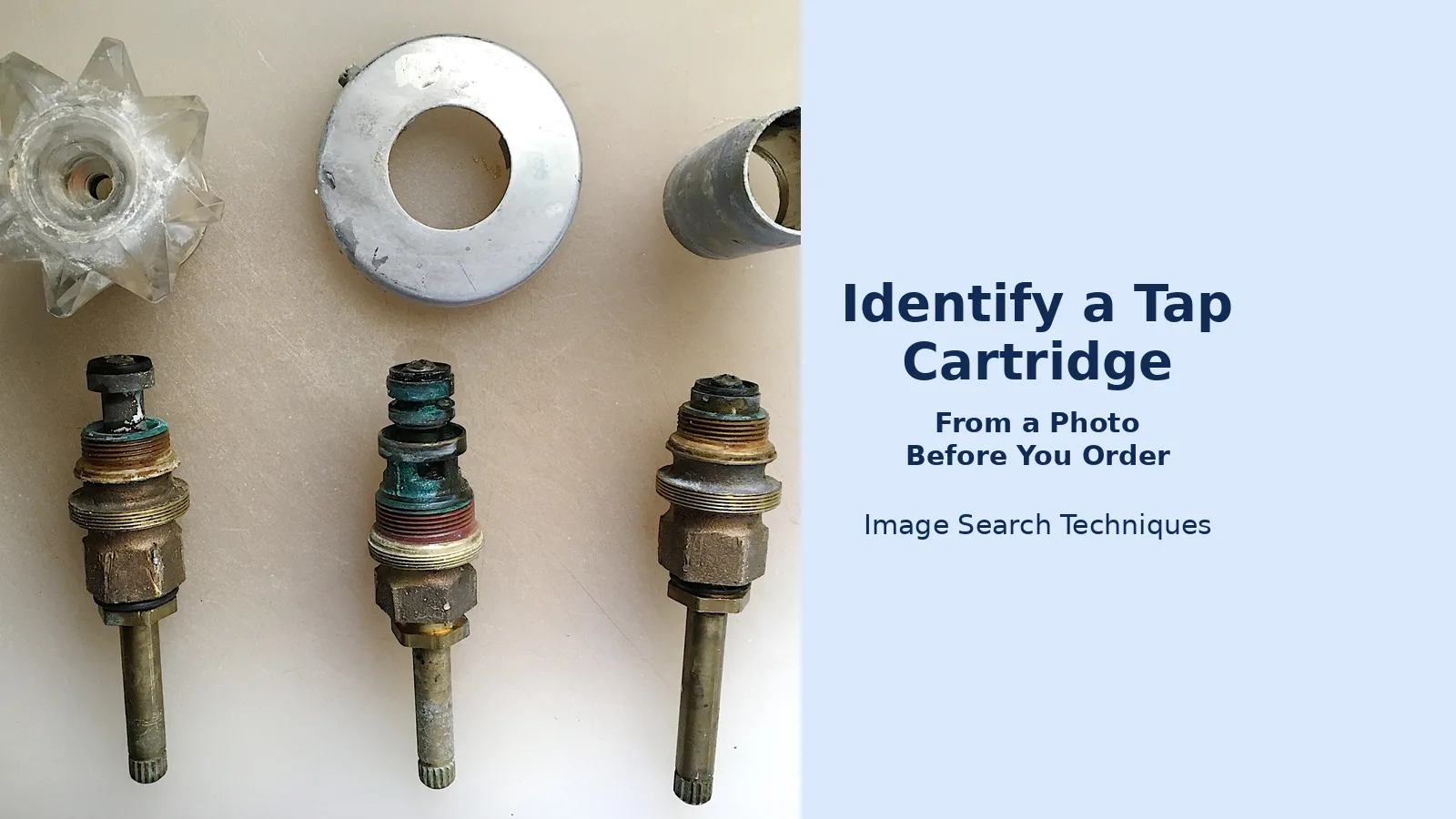
The photo is a real one. Alan Levine, a photographer in California, took it on 13 August 2016 and published it under a CC BY 2.0 licence on Wikimedia Commons. It shows the three valve stems from his 30-year-old shower, laid out on a bench with the star-shaped handle, the chrome escutcheon and the sleeve that came off with them. His own caption says he took the three cartridges to Home Depot and they could not match one of them. That is the whole problem in one picture: three parts from the same shower, three different bodies, and one with no match on the shelf.
Reading the photo the way this guide teaches, the stems are old-style compression stems, not ceramic disc cartridges. Each one ends in a splined broach where the handle sat. A side-on photo shows only the front half of the teeth, so I counted about nine teeth across the front face of the left-hand stem, which points to a 20-spline broach if the teeth run evenly all the way round. The photo cannot settle that number. You would need a top-down shot, or a marker pen and a count round the stem in your hand, before ordering on spline count alone. The middle stem carries a stack of red fibre washers and green corrosion, the right-hand one has a hex body and a longer threaded section, and the left-hand one shows a stamped mark on its stem that the photo is too soft to read. Three different bodies, three different lengths, one shower. No single photo match was ever going to name all three.
I reverse-searched the photo on 15 November 2026. TinEye searched more than 86.7 billion images and returned 0 matches. That does not clear the photo or identify the stems. TinEye itself says a zero can simply mean it has not crawled the pages where the image appears. Google Lens failed four times in the same session, answering “No image at the URL” each time, even though the same address loads fine in a browser and TinEye had just fetched it. No Lens count is reported here, because a failed search is not a zero. The lesson is the one this article keeps repeating: a reverse search can find a match, but it cannot prove a part, and when it fails you fall back on the measurements, not on a guess.
The photo is also the banner for this article, and it teaches a second lesson about old parts. All three stems came out of the same shower, yet no two are alike. The left-hand stem has a black cap and a stamped mark on its shaft that the photo is too soft to read. The middle one carries green corrosion and a stack of red fibre washers. The right-hand one has a hex body and a longer threaded section. If you had ordered by the look of any one of them, you would have bought the wrong part for the other two. Old showers were often assembled from whatever the plumber had, and mix-and-match valve gear is common in houses of that age.
What would have fixed it? The five photos from this guide, taken before the trip, plus the four measurements for each stem, sent to a specialist or taken to the merchant in a bag. A reverse search was never going to name a 30-year-old unbranded stem. The measurements would have, because a merchant can match a stem by spline count and length even when no brand survives. That is the point of the photo-first workflow: the photo gets you to the right conversation, and the measurements close the order.
What if no photo or tool names your cartridge?
Answer capsule: take the old cartridge to a plumbers’ merchant for a side-by-side match, or send your photos and measurements to a specialist, and if the tap itself is corroded or unbranded, replacing the tap may be cheaper than chasing the part.
Start again from the tap. Look once more for a make and model, on the body, under the spout, behind the handle and on any paperwork that came with the house. A model number typed into the maker’s spares list is the fastest route there is, and it is easy to miss on a first look. If the tap is a Grohe, a Bristan or another UK maker, the maker’s spares pages work by model number and will list the cartridge for that tap.
If there is still no name, take the part to a merchant. Put the old cartridge in a bag, take the five photos on your phone as a backup, and ask at a plumbers’ merchant counter. Holding the old part next to a new one is the safest comparison, because length, thread and spline count can all be checked in seconds against the real thing. Our spare part identification guide covers the same pattern for other parts, and the same rule applies here: the parent guide owns the general method, so this article stays on cartridges and does not repeat it.
By post or email, the specialist services named above will do the same job. Send the five photos and the four measurements together, and say which side the cartridge came from, hot or cold, because quarter-turn cartridges often turn in opposite directions and the two sides are not interchangeable. A good specialist will tell you when they cannot name it, which is more useful than a guess.
Sometimes the right answer is a new tap. Which? advises that replacing the whole tap can be the easier option for an older or budget model when the make is gone or the tap is corroded and tired. If the valve seat in the tap body is scored, no cartridge will seal, and if the body is corroded solid, no new part will save it. A new tap costs more than a cartridge, but it costs less than a second failed order and a plumber’s return visit. If you cannot isolate the water, the tap body moves, or the parts will not shift, stop and book a plumber rather than forcing anything.
Which mistakes waste an order?
Answer capsule: ordering by looks alone, ignoring hot and cold rotation, forgetting the base type, and throwing the old part away before the new one is tested.
- Ordering by the chrome. Two taps can look identical from the outside and hide different cartridges. The handle style tells you nothing about the spline count or the length. Measure the part, not the tap.
- Mixing up hot and cold. Quarter-turn cartridges for the hot and cold sides often turn in opposite directions. A hot cartridge fitted on the cold side will open when you expect it to close. Note which side yours came from before you order, and check the rotation when it arrives.
- Forgetting the base type. Some cartridges have a standard closed base and some have an open outlet base, and the two do not swap. Photograph the underside so the base type is on record, and check it against the listing before you pay.
- Skipping the O-rings. A new cartridge usually comes with new O-rings, but not always. Check the listing, and if the old O-rings are flattened or perished, order them with the cartridge rather than reusing them.
- Throwing the old cartridge away. Keep it until the new one is fitted and tested, with no drip after a day of use. It is your reference and your fallback, and it costs nothing to keep.
- Overtightening the retaining nut. Firm by hand plus a gentle spanner turn is enough. Cranking it can crack the body or make the handle stiff, which looks exactly like a faulty cartridge and sends you back to the shop for a part you did not need.
- Trusting a single photo match. A reverse search match is a lead, not a verdict. Check the part number against the maker’s diagram, and check the four measurements against the listing, before you order. Our screw and bolt identification guide follows the same pattern for another fiddly part, and it makes the same point: the photo starts the identification, the measurements finish it.
Identify the cartridge properly once, and the job is a ten-minute swap. Rush the identification, and it becomes three trips to the merchant and a tap that still drips. Take the five photos, write down the four measurements, run the reverse search, try the maker tool, and only then order. If you want the wider picture, our what is this picture guide covers photo identification across the whole house, from parts to plants to products.
FAQs
Can you identify a tap cartridge from a photo alone?
Not reliably. A photo shows shape, splines and markings, but two cartridges can look identical and differ by a millimetre. Use the photo with four measurements: spline count, total length, thread diameter and base diameter. Together they are usually enough for a maker tool or a specialist to name the part.
How many splines does a standard tap cartridge have?
There is no single standard. Counts vary by maker and age, and supplier guides list counts from 18 to 32 teeth. Count your own stem: mark the first tooth with a pen and count all the way round. Write the number down and photograph the splines from above so the count can be checked.
What size is a standard UK tap cartridge?
Most UK quarter-turn taps take a half-inch ceramic disc cartridge, and most single-lever mixers take a 35 mm or 40 mm cartridge. Measure your own part rather than trusting the word standard. Total length, thread diameter and base diameter matter as much as the headline size.
Can Google Lens identify a tap cartridge?
Sometimes. Lens can match a cartridge photo to a listing or a parts page, which gives you a part number to check. It can also fail outright: in our worked example it could not read a valid image address at all. Treat a Lens match as a lead to verify against the maker’s parts diagram, never as proof.
What is the difference between a 35 mm and a 40 mm cartridge?
The number is the diameter of the cartridge body in a single-lever mixer tap. A 35 mm cartridge will not seal in a valve body made for 40 mm, and the larger one will not fit the smaller body. Measure across the widest part of the body with callipers and order the size you measured.
Should I keep the old cartridge after fitting the new one?
Yes, until the new one is fitted and tested. Keep it beside the tap while you check for drips over the next day. If the new part leaks or the handle sits wrong, the old one is your reference for a second attempt and the fastest thing to show a merchant.