🔎 Reverse Image Search
Image search techniques made simple: upload a photo or paste a URL and search 6 engines at once. 100% free, nothing stored.
🔒 Your image is never stored on our servers longer than 24 hours and is never shared.
This guide answers a question readers keep asking on Quora about AI image copyright: if an AI tool generated an image for you, can that image be copyrighted, and can you safely use AI pictures inside a paid online course? The short answer is that it depends on where you live and on how much of the picture is genuinely your own work. This article gives the position in the United States and the United Kingdom, based on what the official sources actually say, and it is general information, not legal advice. For a decision about a specific work, ask a lawyer in your country.
The direct answer: In the United States, no. A picture made by an AI tool from a text prompt alone cannot be copyrighted, because US law requires a human author. A photo a person takes with a camera is different, and our guide to who owns drone photos explains how the pilot who took the shot usually owns the copyright. The UK is different: a computer-generated work can carry copyright for 50 years under section 9(3) of the 1988 Act, though the government has proposed removing that rule.
AI image copyright is the question of whether a picture made by a generative AI tool can be owned as copyright, and if so, by whom. Copyright is a legal right, not a setting in the tool. A tool’s terms of use are a contract between you and the company, and they decide what you may do with the output. Copyright law is separate, and it decides whether anyone holds exclusive rights in the picture at all. That split is the key to the whole topic: a tool can give you permission to sell an AI picture while copyright law gives you nothing to stop someone else copying it. If you want to sell that picture on a calendar, a book cover or a mug, our guide to selling AI art on products compares the generator licences side by side. The other side of that coin, using an AI picture someone else made, is covered in our guide to use someone else’s AI art for free.
Can you copyright an AI picture in the United States?
No, not if the AI made it from a prompt alone. US copyright protects original works of authorship, and the courts and the US Copyright Office read authorship to mean human authorship. A picture that a machine produced without meaningful human creative input has no author in the eyes of the law, so it has no copyright protection.
The US Copyright Office set this out in Part 2 of its report on Copyright and Artificial Intelligence, published on 29 January 2025. The report covers the copyrightability of outputs made with generative AI. Its conclusions are plain: copyright does not extend to purely AI-generated material, or to material where there is insufficient human control over the expressive elements. The report also says that prompts alone do not give a user enough control over the output to make the user its author, even when many prompts are used. The Office looked at how the tools actually work and found that a prompt conveys ideas, while the system decides how those ideas become an image.
The courts agree on the core point. Stephen Thaler applied to register an image called A Recent Entrance to Paradise, which he said his AI system, the Creativity Machine, had made on its own. The Copyright Office refused the registration. On 18 March 2025 the US Court of Appeals for the D.C. Circuit upheld that refusal, holding that the Copyright Act of 1976 requires all eligible work to be authored in the first instance by a human being. The court added that this rule does not stop people copyrighting work made by or with the help of artificial intelligence. The Supreme Court declined to hear the case on 2 March 2026, so the ruling stands. You can read the Office’s own account of its work on its Copyright and Artificial Intelligence page.
There is one more real case worth knowing. In February 2023 the Office reviewed Zarya of the Dawn, a graphic novel illustrated with Midjourney images. It found that the author’s own text, and her selection, coordination and arrangement of the written and visual elements, were protected. The Midjourney images themselves were not the product of human authorship, so the Office replaced the registration with one covering only the material she created. That case is the template for how the Office treats mixed works: your parts are yours, the machine’s parts are not.
What does the UK say about AI pictures?
The UK has a rule the US does not have, and it points the other way. Section 9(3) of the Copyright, Designs and Patents Act 1988 says that for a computer-generated literary, dramatic, musical or artistic work, the author shall be taken to be the person by whom the arrangements necessary for the creation of the work are undertaken. A computer-generated work is one generated by a computer in circumstances where there is no human author of the work. The text of the provision is on legislation.gov.uk, section 9 of the 1988 Act.
That sounds like a clear yes for UK copyright in AI pictures, but the position is shakier than it looks. First, the protection lasts 50 years from the end of the calendar year in which the work was made, which is much shorter than the usual life plus 70 years for a human author’s work, and the deemed author gets no moral rights. Second, the rule has barely been tested in court. The one notable case, Nova Productions v Mazooma Games, was about images generated during video gameplay, and the court treated the programmer as the author because he wrote the code and set the rules for how the images were made. Nobody has yet had a court rule squarely on a picture made by a modern image generator from a text prompt.
Third, the government has proposed removing the rule. Its Report on Copyright and Artificial Intelligence, published on 18 March 2026, proposes that the specific protection for computer-generated works should be removed, while copyright should continue to protect works created with AI assistance. No legislation has been introduced to repeal section 9(3) and no timetable has been set, so the provision remains in force as of November 2026. The direction of travel is clear, though: the UK is moving towards the US position, not away from it. If you are relying on section 9(3) for a picture you made today, know that the ground under it may shift.
The practical upshot is that the UK gives you a possible claim and the US gives you none. A picture that is unprotected in the US may still carry a thin, untested claim in the UK. That gap matters if you sell a course or a product in both countries, because the weaker US rule is the one a copier will rely on.
AI image copyright: the US vs UK comparison
The table below is the ranking asset for this guide. It sets out the two positions side by side, using only the official sources named in this article.
| Question | United States | United Kingdom |
|---|---|---|
| Can a picture made from a prompt alone be copyrighted? | No. The Copyright Office says copyright does not extend to purely AI-generated material. | Possibly, under section 9(3) of the 1988 Act, but the rule is untested for modern generators. |
| Who counts as the author? | A human being only. The D.C. Circuit confirmed this in Thaler v. Perlmutter in March 2025. | The person who made the arrangements necessary for the creation of the work. |
| Do detailed prompts make you the author? | No. The Office says prompts alone do not give enough control over the expressive elements. | Untested. A prompt is arguably part of the arrangements, but no court has said so. |
| What can you protect? | Your own input that is perceptible in the output, your creative edits, and your selection and arrangement of material. | The same human contributions, plus possibly the computer-generated work itself under section 9(3). |
| How long does protection last? | Life of the human author plus 70 years, for the human-authored parts only. | 50 years from the end of the year the work was made, for a computer-generated work. |
| Is the law changing? | No. The Office concluded in January 2025 that existing law handles the question and no new right is needed. | Yes, maybe. The March 2026 government report proposes removing section 9(3) protection. |
| What about other countries? | Canada and Australia follow the human authorship line in practice. | EU member states take the same view: only a natural person can be an author, per the Council’s December 2024 summary. |
One contrast is worth a line of its own. In 2023 the Beijing Internet Court ruled that a man who set up the model, wrote the prompts and chose the final Stable Diffusion image was the author of that picture and owned its copyright. That was one court deciding one image, and it cuts against the US and European position. It shows the law is not settled worldwide, even though the US and UK direction is now clear.
What parts of an AI picture can you actually protect?
The parts a person made. Copyright in an AI-assisted work is not all or nothing. The Copyright Office protects what a human actually authored, and it leaves the machine-made parts unprotected. Four kinds of human contribution count, and they are worth learning because they are the only route to protection in the US.
- Your own input that stays visible. If you feed in your own drawing or photograph and it is still perceptible in the result, you are the author of that portion. The AI output inherits the protection of your input, not the other way round.
- Creative edits you make after generation. Painting over parts of the image, redrawing sections by hand, or reworking it in Photoshop can be protected, as long as the changes are creative choices and not just a filter applied to the whole picture.
- Selection and arrangement. Choosing and ordering AI pieces creatively, as in a comic, a collage, a slide deck or a video, can be protected as a whole. The individual AI pieces inside the arrangement stay unprotected.
- Your words and structure around the image. The text you wrote, the captions, the layout of a page and the order of a lesson are your own authorship. They are protected even when the pictures between them are not.
What does not count is the prompt itself. The Office is explicit that a prompt is an instruction that conveys ideas, and that the system decides how those ideas become an image. Writing a longer prompt, or revising it four hundred times, does not change that. The number of attempts is not creative control over the expressive elements.
Worked example: the lighthouse picture in a paid course
Here is the test applied to a real picture, made for this guide on 15 November 2026. The prompt was: “A watercolour illustration of a lighthouse on a rocky coast at dusk, calm sea, soft pastel sky, simple flat illustration style for an online course slide.” The tool returned a watercolour lighthouse on a rocky shore at dusk. That image is the worked example below, and the same test applies to any picture you generate for a course.
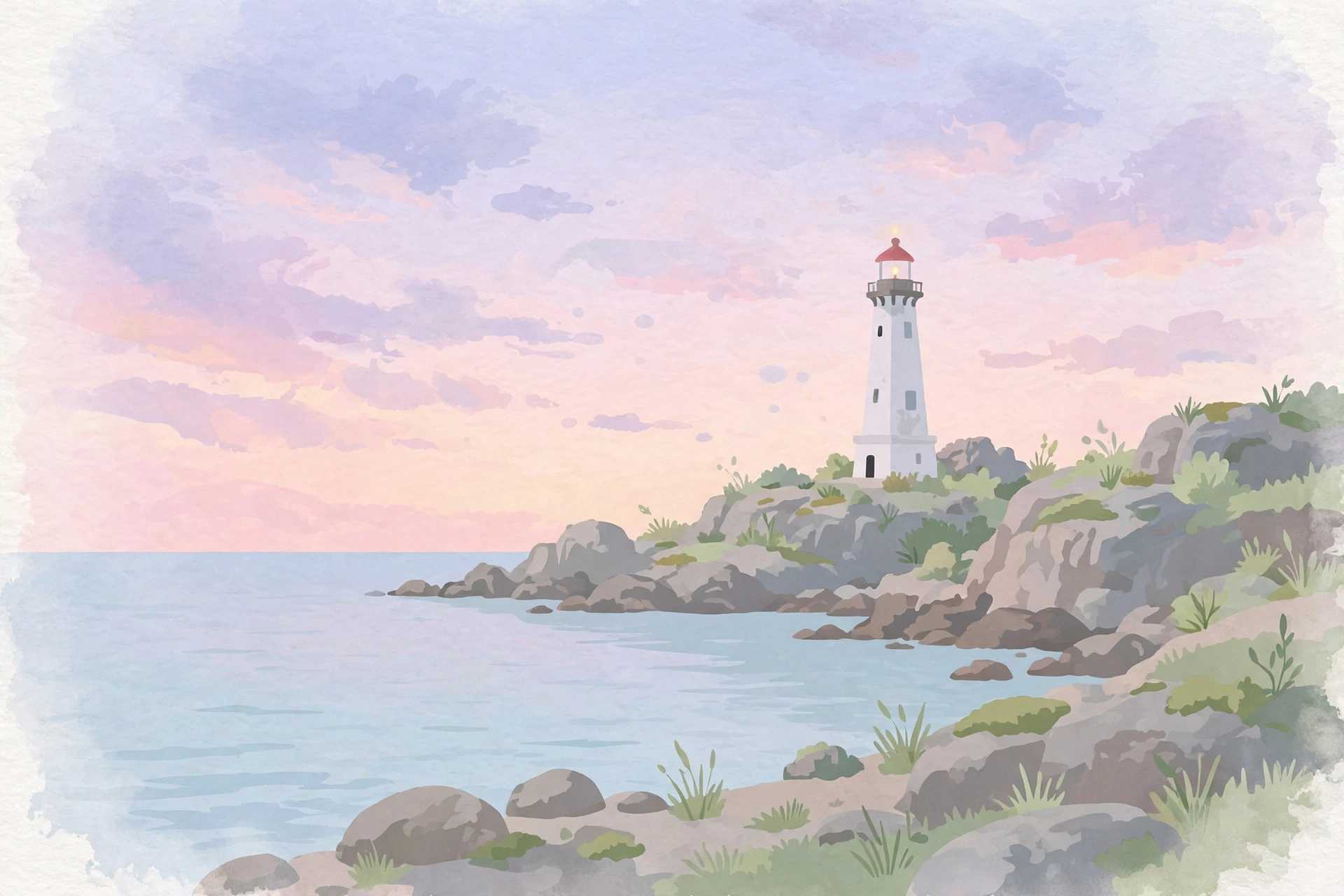
Now imagine a course creator, Maya, who builds a paid photography course and uses this lighthouse picture on one slide. Here is what she owns and what she does not, step by step.
- The raw lighthouse picture. In the US, Maya has no copyright in it. She typed a prompt and the tool decided the composition, the colours and the brushwork. Anyone who finds the same file can copy it, and she has no copyright claim to stop them.
- Her own edits. Maya opens the picture in Photoshop, repaints the sky by hand, and adds her own hand-drawn arrows pointing to the light and the rocks. Those painted additions are her authorship and can be protected. The unedited parts of the picture stay unprotected.
- The slide as a whole. Maya writes her own lesson text, picks the order of her twelve slides, and places the lighthouse picture beside a diagram she drew herself. Her text, her diagram and her arrangement are protected. The AI picture inside the slide is not.
- The course itself. The course as a whole is Maya’s work, because the structure, the teaching and the words are hers. A student who copies the whole course infringes her copyright in those parts. A student who takes only the lighthouse picture does not, because that picture has no copyright to infringe.
- The UK side. In the UK, Maya may have a thin claim in the lighthouse picture itself under section 9(3), as the person who made the arrangements for its creation. That claim is untested for a text-prompt image, lasts 50 years rather than life plus 70, and the government has proposed removing it. She should not build her business on it.
The lesson is simple: the value of a course built on AI pictures sits in the teaching, not in the pictures. If your course would fall apart the moment someone reused your images, the images were doing work your own material should have been doing.
Can you use AI pictures in a paid online course?
Yes, you can use them, but you cannot stop others using the same pictures. That is the position the Quora asker was really asking about. They wanted to make an online course and use AI graphs and photos for demonstrations, and they worried about facing copyright issues. There are two separate risks to check, and they point in different directions.
The first risk is whether you are allowed to use the picture at all. That is a question for the tool’s terms, not for copyright law. Most image generators let paying users use outputs commercially, and some free plans do not. Read the terms of the tool you actually used, on the day you use it, because the terms change and they differ between plans. If the terms say you may use the output in a commercial course, you may. If they say you may not, then using it breaks your contract with the tool, even though no copyright exists in the picture.
The second risk is whether the picture itself infringes someone else’s rights. An AI tool is trained on vast amounts of existing material, and its output can sometimes closely resemble an existing copyrighted work. The risk is highest when the picture shows a recognisable character, a famous photograph, a logo, or a distinctive artwork. If your course picture looks like a copy of a real work, the fact that an AI made it does not protect you. Check each picture against that test before it goes into a paid product, and replace anything that looks like a copy. If you need to check whether a picture you have seen before is AI-made, our guide on how to tell if an image is AI-generated walks through the signs.
There is also a practical risk that has nothing to do with the law. Because the pictures in your course have no copyright, a rival can take them and use them in their own course. Your protection is your own material: your words, your examples, your structure and your edits. Spend your effort there, and treat AI pictures as decoration, not as assets.
What happens if someone copies your AI image?
In the US, very little, because there is nothing to enforce. A raw AI-generated picture has no copyright protection, so it is effectively in the public domain from the moment it is made. Old photographs work differently, because dates and makers decide the answer, so our guide to public domain photos walks through the checks step by step. Anyone can use it, copy it or sell it without your permission, including for commercial purposes. That is the point the AI Overview on this question makes, and it follows directly from the Copyright Office’s position.
That does not mean you are powerless in every case. Three routes are worth knowing, and each one depends on something other than copyright in the picture itself.
- Your human additions. If you edited the picture, or combined it with your own work, the human-authored parts are protected. A copier who takes the whole edited version infringes your rights in those parts, even though the underlying AI picture is free to use.
- The platform’s terms. If someone took your picture from your own site or account, the platform’s terms of use may still help. Many platforms ban scraping and reuse of content posted on them, and a takedown request under the platform’s own rules can work where a copyright claim cannot. Keep a dated record of where and when you published the picture.
- Trade marks and passing off. If the picture carries your brand, your logo or your product name, copying it may still be actionable under trade mark law, because that law protects your brand rather than the picture. This is general information, not legal advice, and it is a question for a lawyer if real money is involved.
Two habits reduce the problem before it starts. First, watermark your photos and your course images, so a copied picture still carries your name and points back to you. A watermark does not create copyright, but it makes casual copying less attractive and it proves the picture came from you. Second, label AI pictures as AI-made when you publish them. Our guide to AI labels on social media explains what the platforms expect and what the labels look like. If you ever need to enforce your rights in the human-authored parts of a work, the small claims route for photo theft in the UK is explained in our guide to suing for photo theft in the IPEC small claims track.
One more warning matters here. If the picture you generated resembles a real person’s face, a real photograph or a real artwork, the risk runs the other way: you may be the one infringing. The advertising side of that risk is covered in our guide to AI faces in adverts, which works through copyright, likeness rights and the disclosure rules. Before you publish an AI picture that looks like a real person or a known work, opt your own photos out of AI training where the tools allow it, and check whether the picture you made is too close to something that already exists. A reverse image search of the finished picture takes a minute and can save a dispute.
How do you register a work that contains AI material in the US?
Claim only the parts a person made, and say so on the form. The Copyright Office’s registration guidance of 16 March 2023 sets out the procedure, and it is still the current rule. Applicants have a duty to disclose the inclusion of AI-generated content in a work submitted for registration, and they must briefly explain what the human author contributed.
- List only human authorship in the Author Created field. Describe what a person made: the text, the edits, the selection and the arrangement. Do not list the AI tool or the company behind it as an author or co-author.
- Exclude AI-generated content that is more than minimal. Use the Limitation of the Claim section to carve out the machine-made material. If the AI content is only a trivial part of the work, the Office treats it as de minimis and you do not need to exclude it.
- Describe the human contribution briefly. A short statement is enough, such as “text written by the author, AI-generated illustrations selected and arranged by the author, hand-painted edits to three illustrations”. The Office will contact you if it needs more detail when it reviews the claim.
- Keep your records. Save the prompt, the date, the tool and its version, and a copy of the raw output alongside your edited version. If the registration is ever questioned, that file shows exactly where the human work starts and the machine work ends.
Registration is not required to own copyright in the US, but it is required before you can sue for infringement, and it affects what damages you can claim. For a course, a book or a set of illustrations that you plan to sell, registering the human-authored parts is the one practical step that turns the rules in this guide into something enforceable.
The law of AI image copyright is still moving. The UK government may remove section 9(3), the US courts may refine where the line falls between prompting and authorship, and the generators’ terms change every few months. What will not change is the core test: copyright protects what a person created. Build your course, your product and your portfolio on the parts you made yourself, and treat AI pictures as useful raw material, not as property you own.
Can you copyright an AI-generated image in the United States?
No, not if the AI made it from a prompt alone. US copyright requires a human author, and the Copyright Office says purely AI-generated material is not protected. You can protect the parts you made yourself: your own input that stays visible in the picture, your creative edits, and the way you select and arrange AI material.
Does writing a detailed prompt make you the author of the picture?
No. The US Copyright Office says prompts alone do not give you enough control over the expressive elements of the picture, because the system decides how your ideas become an image. Writing a longer prompt, or revising it many times, does not change that. The prompt is an instruction, not authorship.
Can I use AI images in my paid online course?
Yes, you can use them, subject to the tool’s terms of use. Most paid plans allow commercial use, while some free plans do not, so read the terms of the tool you used. Remember that the pictures themselves have no copyright in the US, so a rival can reuse the same images. Your course text and structure are yours.
What does UK law say about AI pictures?
UK law is different. Section 9(3) of the Copyright, Designs and Patents Act 1988 treats the person who made the arrangements for a computer-generated work as its author, with protection for 50 years. The rule is untested for modern image generators, and the government’s March 2026 report proposes removing it.
Can someone else legally copy my AI image?
In the United States, yes. A raw AI-generated picture has no copyright protection, so anyone can copy it, use it or sell it without your permission. Your protection covers only the human-authored parts, such as your edits and your arrangement. Watermarking and the platform’s own rules can still help in practice.
How do I register a work that includes AI images in the US?
Claim only the parts a person made. The Copyright Office’s March 2023 guidance says you must disclose the AI-generated content, briefly explain what the human author contributed, and exclude AI material that is more than minimal in the Limitation of the Claim section. Never list the AI tool as an author.