🔎 Reverse Image Search
Image search techniques made simple: upload a photo or paste a URL and search 6 engines at once. 100% free, nothing stored.
🔒 Your image is never stored on our servers longer than 24 hours and is never shared.
This guide answers a question readers keep asking on Quora about landlord cameras in rental homes: what are the legal implications for landlords who install smart home devices like cameras or thermostats in rental properties without tenant consent? The question came with ten related landlord camera questions on the same page, and most of the answers were short, US-only, or just wrong about the UK. This is the tenant-side answer, with the UK and US rules kept separate.
Short answer: a landlord can put cameras in shared areas such as entrances, hallways and car parks, but not inside your rented home. In the UK, filming inside your flat without your clear written consent breaches UK GDPR and your right to quiet enjoyment. In the US, a hidden camera in a bedroom or bathroom can be a crime.
This is general information, not legal advice. Camera rules change by country and by state, and a few of them changed as recently as September 2025. If your situation is live, a local tenant organisation or a lawyer can tell you what applies where you live.
What counts as a landlord camera?
A landlord camera is any recording device a landlord or letting agent puts in or around a rented home. That covers the obvious ones, a CCTV camera on the wall and a video doorbell, and the ones people forget, a camera built into a smart lock, a camera in a communal hallway, and the sensors in a smart thermostat that log when you are home.
The question that started this guide mentions cameras and thermostats together, and that matters, because the law treats them differently. A camera records pictures of you. A thermostat records data about you, when the heating runs, when the house is warm, when nobody is home. Both can be a privacy problem. Only one of them can land a landlord in a criminal court.
One more definition first, because the rest of the guide turns on it. In the UK, the landlord is the data controller for any camera they run, which means they are the one responsible for following UK GDPR. In the US, there is no single federal landlord camera law, so the answer comes from three different bodies of law: state criminal privacy statutes for cameras inside a home, wiretap law for anything that records sound, and landlord-tenant law for when a landlord may enter, which says nothing about recording.
Can a landlord put cameras inside your rented home?
No. That is the short version, and it holds on both sides of the Atlantic, though for different reasons.
In the UK, once a property is let, the inside of it is the tenant’s home. A tenant has a right to quiet enjoyment, which means the right to live there without interference from the landlord. Tenant rights guidance treats installing cameras inside a rented flat or house without the tenant’s explicit written consent as a breach of that right, and a serious data protection breach under UK GDPR and the Data Protection Act 2018. The household exemption that lets a homeowner run CCTV over their own property does not apply to a landlord monitoring tenants. Covert surveillance inside a tenant’s home can also cross into criminal territory under the Regulation of Investigatory Powers Act 2000. One warning: the ICO’s own home CCTV guidance is written for a householder filming their own property, not for landlords filming tenants, so the inside-the-home rule comes from tenancy and data protection law, not from the ICO page itself.
In the US, every state and the District of Columbia has a criminal law against secretly recording people who are undressed where they expect privacy. Many states go further. In 22 jurisdictions, secretly recording a clothed person in a bedroom, a bathroom or their own home is a crime without any nudity or sexual purpose element at all. Illinois makes it a Class 4 felony to make a video record of another person in their residence without consent, and its statute says a residence includes a rented home. New York makes surreptitious recording in a bedroom or bathroom a Class E felony. Texas, since 1 September 2025, treats recording a person in a place where they could undress in privacy, including a bedroom, as a state jail felony carrying 180 days to two years and a fine of up to $10,000.
Notice the pattern. The law does not ask who owns the building. It asks where the camera is and whether the person filmed had a reasonable expectation of privacy there. Inside your home, you do. A lease clause does not fix it either. The statutes turn on the consent of each person recorded, and no statute or court decision treats a clause buried in a lease as consent to a hidden camera. California’s concealed camera offence even says it is no defence that the person behind the camera was the victim’s landlord. The most upvoted answer on the Quora page gets this exactly backwards. It says the tenant’s permission is not needed because they are not the owner, so the owner may install smart devices without permission. Ownership is not a right to film inside someone else’s home, and a reader who followed that answer would get the core question wrong.
Landlord cameras in rental homes: the rules table
This is the table to check first. It covers the places a landlord camera usually turns up, what the rules allow, and what you can do about each one. The UK and US columns differ in places, so read the one for where you live.
| Where the camera is | UK: allowed? | US: allowed? | What you can do |
|---|---|---|---|
| Inside your flat or house, any room | No, without your explicit written consent | No, secretly recording inside a home can be a crime in most states | Photograph it in place, do not touch it, call the police |
| Bedroom or bathroom | Never allowed | Never allowed, criminal in every state if it catches someone undressed | Police first, then a tenant organisation |
| Shared hallway, lobby or stairwell | Yes, with signage, a lawful basis and a retention policy | Generally yes for video, audio is a separate question | Ask in writing what it records and who can view it |
| Building entrance or car park | Yes, with signage and UK GDPR compliance | Generally yes for video | Check the angle does not see into your windows |
| Aimed into your windows or garden | No, the angle must be limited | No, a camera aimed into a home crosses the line | Ask for the angle to be changed, in writing |
| Audio recording in a shared area | Needs a lawful basis, and tenants must be told | Wiretap law applies, 13 states need every party to consent | Ask whether the microphone is on, and get the answer in writing |
| Hidden camera, anywhere inside | No, covert surveillance can be unlawful interception | No, hidden in-unit cameras risk criminal charges | Do not destroy it, preserve the evidence, call the police |
| Smart thermostat in your home | Allowed as a device, but the data it collects is personal data | Allowed as a device, no federal law covers the data specifically | Ask who holds the account and what data they can see |
| Smart lock on your front door | Allowed as a lock, the entry log is personal data | Allowed, but Washington requires a non-biometric key option from 1 January 2027 | Ask for the entry log policy and who can unlock the door remotely |
| Video doorbell at your front door | Yes, if it films only your doorway, with signage | Generally yes, the same audio and angle rules apply | Check it does not record your neighbours’ doors or windows |
Two rows in that table catch people out. The first is the hallway camera angled through an open flat door. A camera in a shared hallway is usually fine, but the moment its angle sees inside your home, it starts recording a private space, and the criminal statutes apply. The second is audio. Video and audio are governed by different laws in both countries, and audio is stricter in both. Many landlords turn the microphone off in shared spaces for exactly that reason. The same problem applies outside your front door too: if a camera films your home from the street, our guide to blurring your house on Google Street View covers the matching route for Street View itself.
What the UK rules say
The UK side is the one most online guides get wrong, because they copy American answers. In the UK, the rules come from data protection law and tenancy law, and they give tenants more protection than most people expect.
First, the data protection side. Any camera a landlord runs that films tenants is covered by UK GDPR and the Data Protection Act 2018. The landlord is the data controller, which means they must have a lawful basis for filming, usually legitimate interests, and they must tell tenants what is being recorded, why, and for how long. The Information Commissioner’s Office, the ICO, publishes guidance on home CCTV systems, and its position is clear: cameras must be clearly signed before you walk into the filmed area, the signs must say who runs the system and how to ask about it, footage should be deleted regularly and kept secure, and the ICO’s guidance says a person filmed can ask for a copy of their footage and must get an answer within one calendar month. The ICO’s page also says it is currently under review because of the Data (Use and Access) Act 2025. The GOV.UK companion guidance on domestic CCTV was updated on 21 May 2026, and it says the same in plainer terms: if CCTV captures images outside your property boundary, UK GDPR and the Data Protection Act 2018 apply, and you could face regulatory action by the ICO and legal action by the people affected.
Second, the tenancy side. A tenant has a right to quiet enjoyment of their home. A camera inside the home, or a camera outside it angled to watch the tenant’s windows, door or garden, interferes with that right. In shared houses, the position is tighter still. In a house in multiple occupation, cameras in kitchens, living rooms or corridors that film tenants continuously are rarely proportionate, and a landlord running them should have done a data protection impact assessment, put up clear signage, and be able to show a real justification. A camera pointed at a bedroom door in a way that logs comings and goings is high risk, and tenants can challenge it through the ICO.
Third, the complaint route, which is where most guides stop short. If a landlord will not answer or will not remove a camera that should not be there, the steps are: ask the landlord in writing what the camera records, whether audio is on, who can view the footage and how long it is kept; if that fails, complain to the ICO, which can investigate and take enforcement action, though its own home CCTV page is honest about the limits, saying it cannot remove or reposition a camera, retrieve footage for you, or take court action on your behalf; and for a breach of quiet enjoyment or privacy, apply to the First-tier Tribunal (Property Chamber). A local council’s environmental health team can also advise on illegal surveillance. Two gaps are worth knowing. Neither Shelter England nor Citizens Advice has a dedicated page on landlord cameras in a rental, as of November 2026, though Shelter’s landlord harassment guidance covers a landlord coming into your home without permission, and Citizens Advice points CCTV concerns to the ICO. Housing association guidance on the Data (Use and Access) Act 2025 also notes that a person recorded by a camera has a formal right to complain directly to the person running it first, and the controller must listen, review the set-up and respond before the matter is escalated.
One thing the UK rules do not do is give a landlord a free pass for communal areas. A landlord can put cameras in a shared hallway or car park without each tenant’s consent, but only with signage, a lawful basis and a retention policy. No sign, no stated purpose and footage kept forever is not compliance. It is the same breach in a quieter form.
What the US rules say
The US side is messier, because there is no single federal landlord camera law. The answer is built from three different bodies of law, and the state you live in decides which one bites.
The first body is state criminal privacy law. Every state has a law against secretly recording someone who is undressed where they expect privacy. In 22 jurisdictions, the law goes further and makes it a crime to secretly record a clothed person in a bedroom, a bathroom or their own home, with no nudity or sexual purpose needed. The named statutes matter, because they are the ones a police report would cite. Illinois, 720 ILCS 5/26-4(a-5), makes it a Class 4 felony to make a video record of a person in their residence without consent, and a residence includes a rented home. New York Penal Law 250.45(3) makes surreptitious recording in a bedroom, bathroom or changing room a Class E felony. Texas Penal Code 21.15(b)(2) makes recording a person in a place where they could undress in privacy, including a bedroom since 1 September 2025, a state jail felony. California Penal Code 647(j) covers viewing the interior of a bedroom or bathroom by camera with intent to invade privacy, and concealed camera recording of a person who may be undressed. Michigan, MCL 750.539d, makes it a felony to install a device in any private place without the consent of the person entitled to privacy there. New Hampshire, RSA 644:9, covers installing a device in a private place, and a private place includes the interior of a dwelling. Maryland, Criminal Law 3-903, covers placing a camera to conduct deliberate surreptitious observation of a person inside a private residence. Florida, Statute 810.145, covers secretly recording a person dressing or undressing where they expect privacy, and names the interior of a residential dwelling. Virginia is the only state whose peeping statute names a landlord’s own leased property directly: spying into a dwelling on property owned by the landlord and rented to another is a Class 1 misdemeanour.
The second body is wiretap law, and it governs audio. The federal Wiretap Act makes it illegal to record someone’s conversations without consent, and it is a one-party consent law at federal level, which means a person may record a conversation they are part of. A landlord’s camera recording two tenants talking in a laundry room, with the landlord in neither conversation and neither tenant consenting, falls outside that exception. On top of that, 13 states are all-party consent states, where even a conversation the landlord takes part in generally needs everyone’s consent before it is recorded. Connecticut and Nevada apply that rule only to phone calls, Oregon only to in-person conversations, and Michigan’s statute reads as all-party but its courts let a participant record. Illinois adds landlord-specific exposure: its eavesdropping civil remedy section allows a suit against a landlord who knowingly permits eavesdropping on the premises. That is why many landlords turn camera microphones off in shared spaces.
The third body is landlord-tenant law, and it is the one people overestimate. State landlord-tenant acts control when a landlord may enter a unit, usually with advance notice and for listed reasons such as repairs or inspections. California’s version says a landlord may enter only in the listed cases, starting with emergencies and necessary repairs. None of these entry statutes says anything about cameras. A right to enter is a right of entry, not a right to record. A device left behind after a repair visit records a private space without the tenant’s consent, which is exactly what the in-unit criminal statutes address.
Two more US facts are worth knowing. No state law requires a landlord to notify tenants about security cameras in common areas, according to a review of all 50 states and the District of Columbia published in November 2026. The only statute prescribing a camera sign for rentals is Louisiana’s short-term rental law, which bars a host from using a concealed camera except in common areas with a conspicuously posted sign. And Oregon, since 2025, lets a guest sue a transient lodging provider who, without consent, captures a visual image or recording of them in a private space, with compensatory damages and attorney fees. Airbnb’s own rules, in force since 30 April 2024, bar hosts from having cameras that monitor indoor spaces, even if the devices are turned off, and hidden cameras are prohibited outright.
Smart thermostats and smart locks: what your landlord can actually see
Cameras get the attention, but the Quora question that started this guide also asks about smart home devices, and thermostats and locks are the ones most tenants live with every day. The key principle is simple: whoever controls the account a smart device is linked to controls the device. A smart thermostat is registered to an online account when it is installed, and whoever can log into that account can see what the device sees, change its settings and read its logs.
A smart thermostat knows a lot about your routine, and the data lets whoever holds the account work out when the home is occupied. Google’s own help pages say a Nest thermostat collects temperature and humidity sensor data, device stats and usage data, and motion and ambient light sensor data, and that members of a Nest home receive broad rights over the thermostat, its settings and its history. That is an inference, not a Google claim: Google does not say in those words that a landlord can see when a tenant is home. But motion sensor data plus usage history plus account access adds up to the same thing in practice. A Honeywell T6 Pro, built for property management, has a lock mode that limits the temperature range a tenant can set on the device itself, while the landlord keeps full control through the app. Landlords install these devices for property reasons too: a thermostat can send an alert when the indoor temperature drops below a set threshold, typically 45 to 50 degrees Fahrenheit, so pipes do not freeze, and it can flag a furnace that starts short-cycling before the tenant complains. None of that makes the data less personal. It is a log of your daily routine.
Smart locks are the sharper end. A smart lock does not just lock and unlock the door. It records the exact time you leave for work, when you return, and how often you have guests. Google’s own help pages confirm the point for the Nest x Yale lock: the lock keeps a 10-day history plus a chronological list of every locking and unlocking event, and the owner of the Nest home, and anyone with full access, can see that history. So a landlord who is the Nest home owner can see a timestamped log of when the door was used. A landlord with administrative access can also unlock the door remotely, and can use entry logs to make claims about your behaviour, for example that you have an unauthorised occupant. In the UK, that entry log is personal data under UK GDPR, and the landlord must have a lawful basis for keeping it and tell you about it. In the US, no federal statute specifically addresses smart device data in rental housing, and most state landlord-tenant laws were written long before networked thermostats existed. The covenant of quiet enjoyment, which exists in virtually every state, is the protection tenants usually rely on. Cameras at work raise the same question, and our workplace cameras guide covers the UK and Ohio rules for recording employees.
Washington state has moved first on this. Its law ESSB 5937, chapter 55 of the Laws of 2026, regulates smart access systems in rental buildings, such as entry systems that use face geometry or a phone app, and it takes effect on 1 January 2027. If a tenant asks, the landlord must offer an alternative key that does not use biometric information or a phone app, and landlords must provide privacy and data policies and collect only the minimum data needed. It is not a camera law, and its definition of authentication data excludes video from entrance monitoring systems, but it is the first US law that treats a landlord’s smart entry system as a data problem rather than a lock problem.
What should you actually ask? Put it in writing, before you sign if you can, and keep a copy. Who holds the account for each smart device in the flat? What data can they see, and who else can see it? Can the landlord change the temperature or unlock the door remotely? How long are entry logs and thermostat data kept? If you install your own smart thermostat with permission, keep it registered to your own account and connected to your own network, and do a factory reset before you move out. The same applies in reverse: if you move into a home with smart devices left installed and still linked to a previous tenant’s or the landlord’s account, ask for them to be reset and re-registered before you settle in.
Worked example: the camera in the photo
Here is a real test, done for this article on 15 November 2026. The photo below is a real one: a pole-mounted security camera overlooking houses in Finaghy Road North, Belfast, photographed by Eric Jones on 4 June 2016 and shared on Geograph under a CC BY-SA 2.0 licence. It is the kind of camera a tenant might spot on a street view photo or a listing photo before ever visiting a property. The question is whether a reverse image search can trace a photo like this, and what that tells a tenant.
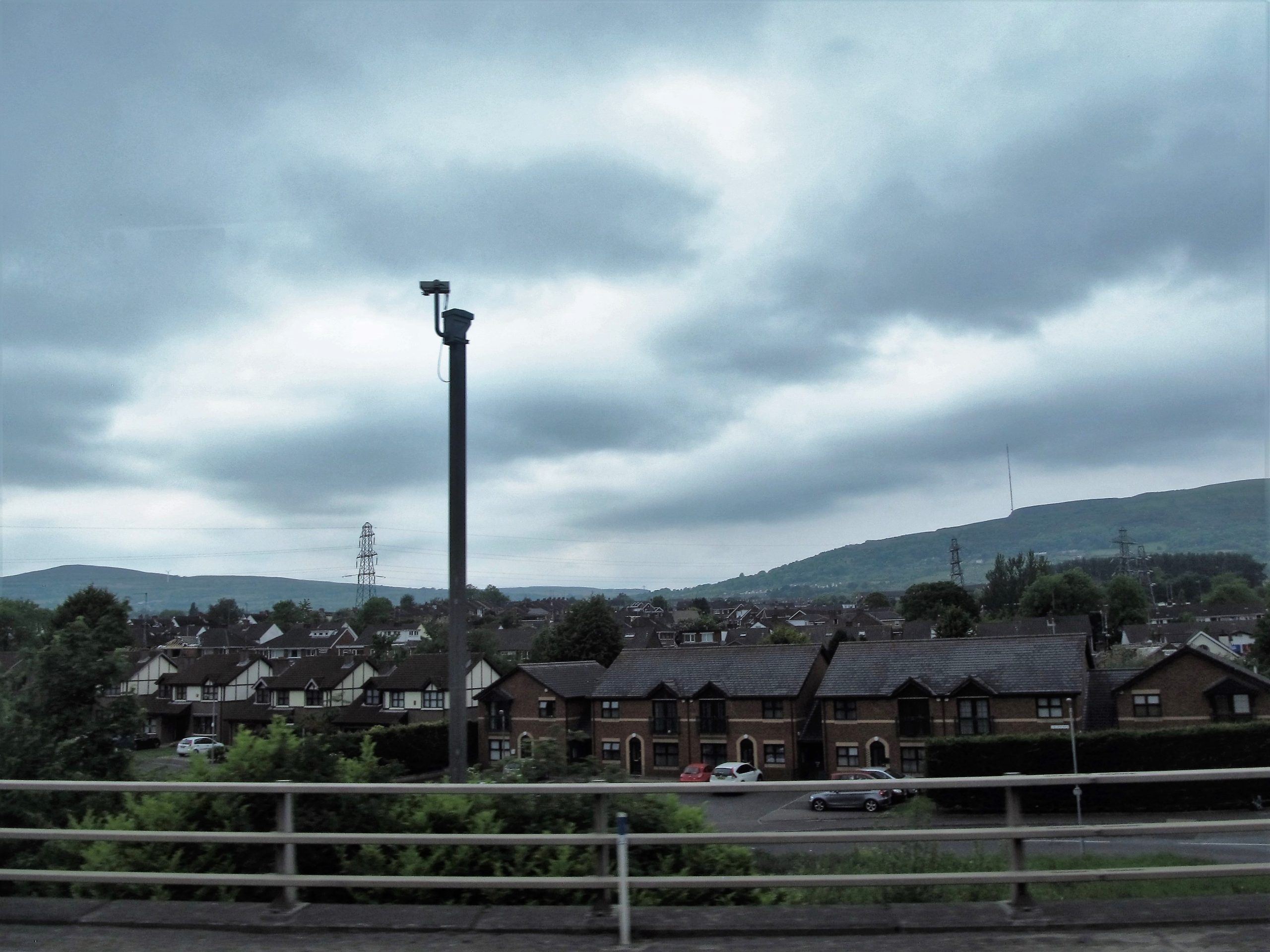
The test was simple. Take the photo’s direct Wikimedia Commons address and run it through TinEye and Google Lens, the two tools our how to reverse image search guide recommends, and record what each one finds. TinEye searched its index of over 86.7 billion images and found 0 matches for the photo, which means it has not yet crawled any page where this image appears. Google Lens failed outright: four attempts returned ‘No image at the URL’ on the exact-match and visual-match tabs, and the one view that did load recognised the photo as a security camera and showed only generic stock photos, with no exact copy and no count. Neither tool found the photo in use anywhere else, but a zero, and especially a failed Lens check, does not clear a photo. It only means no copies were found by these searches on 15 November 2026.
What does that prove? Less than people assume, and more than nothing. A match count tells you whether the photo has been crawled and where else it appears. It does not tell you who owns the camera, whether it records, or who watches the footage. For that, the steps in the next section matter more than any search tool. But the test does show one useful thing: cameras in and around a rental are often visible in photos before you sign anything. Check the listing photos closely, zoom into the corners, look above doors and at the eaves. The same no-kit sweep we explain in our guide to finding hidden cameras in hotels and rentals works in a flat too, and if a photo of you turns up online, our face search and photo privacy guide explains what happens to photos of you once they are posted. A camera you can see in a photo is a question you can ask before you pay a deposit, and that is worth more than discovering it on moving day.
The scenario this article is built around is a constructed one, labelled as such. Maya rents a two-bedroom flat in Manchester. On moving day she finds a small white dome camera above the front door, inside the hallway, pointing at the living room. It was not in the listing photos, it was not mentioned at the viewing, and there is no sign. Her landlord says it is for security. Under the UK rules above, that camera should not be there without her explicit written consent, and the landlord is the data controller, so he must be able to show a lawful basis, signage and a retention policy. Her first step is not to pull it off the wall. It is to photograph it in place, note the date and what it faces, and write to the landlord asking what it records, whether audio is on, who can view the footage and how long it is kept. If the answer is silence, or the camera stays, the ICO complaint route is next. The same facts in the US would point to the police non-emergency line first, because a hidden or undisclosed camera inside a home can be a crime in most states. If the camera turns out to be part of a wider pattern, our photo scams complete guide explains how photo-based scams work and what else to check.
What to do if you find a camera in your rental
Finding a camera is unsettling, and the worst thing you can do is act on the first impulse. Do it in this order instead.
- Photograph it in place. Take clear photos and a short video showing the camera, where it is mounted and what it faces. Note the date and time. Do not touch it, unplug it or destroy it. If it is inside your home and the matter becomes a police case, the camera itself is evidence, and destroying it can hurt your own position.
- Check your tenancy agreement. Look for any clause about cameras, smart devices or monitoring. A clause does not make an in-unit camera lawful on its own, as the statutes turn on the consent of each person recorded, but it tells you what the landlord thinks they agreed, and it matters for the conversation that follows.
- Write to the landlord. Email is best, because it leaves a record. Ask four questions: where exactly are the cameras, what do they record and is audio on, who can view the footage, and how long is it kept? Keep a copy of the request and the answer, along with your lease.
- If the camera is inside your home, contact the police. In the UK, use 101 for a non-emergency report, or 999 if you feel threatened. In the US, use your local police non-emergency line. Say plainly that you found a camera inside your rented home and that you did not consent to it. Let the police decide whether to investigate.
- In the UK, complain to the ICO if the landlord will not act. The ICO can issue enforcement notices, order footage deleted and fine a controller. A local council’s environmental health team can also advise, and Shelter England or Citizens Advice can advise on the tenancy side. For a breach of quiet enjoyment, the First-tier Tribunal (Property Chamber) is the route.
- In the US, contact a tenant organisation or legal aid office. Your state bar’s lawyer referral service can connect you with a landlord-tenant or privacy lawyer. Keep the log you started in step one, and keep every email.
- Do not remove the camera yourself unless you have been told to. In a shared building, a hallway camera may be lawful, and removing it can breach your tenancy. In your own flat, a camera that should not be there is still evidence until the police or a lawyer says otherwise.
One more thing, and it matters. Never advise yourself, or anyone else, to confront a landlord aggressively or to retaliate by filming them back in their own home. Keep the record, use the routes above, and let the process do the work.
In California, the complaint route has a few extra teeth worth knowing. If your landlord evicts you, raises your rent or cuts a service within 180 days of a complaint you made about conditions in the home, including a camera complaint, California law presumes the move was retaliation, and the landlord has to prove a genuine reason instead. That presumption under Civil Code section 1942.5 only applies if you are up to date on rent. A written demand helps here too. Cite your right to quiet enjoyment under Civil Code section 1927 and the entry rules under section 1954, ask for the camera to be removed and any footage of you deleted, and send it in a way you can prove was delivered. If the landlord refuses, small claims court in California takes claims from individuals up to $12,500. And on audio, California is a two-party consent state, so recording a private conversation needs everyone’s consent under Penal Code section 632.
Can you put up your own camera as a tenant?
Tenants ask this almost as often as they ask about landlord cameras, and the answer is shorter. Your lease controls it. Most leases treat a camera fixed to the wall as an alteration, and alterations usually need the landlord’s written permission first. A plug-in camera on a shelf is a different matter, but the same privacy rules apply to you as to anyone else: do not aim it at a neighbour’s windows, and do not record other people’s conversations.
There is one clear exception in the US. Colorado law says a landlord must not prevent a tenant who has notified the landlord, with documentation, of being a victim-survivor of unlawful sexual behaviour, stalking, domestic violence or domestic abuse from taking reasonable safety precautions, including installing window bars, cameras or other nonpermanent modifications. Everywhere else, ask in writing first, get the answer in writing, and keep the camera pointed at your own doorway.
Doorbell cameras sit in the middle. A tenant can usually fit one, but if it records beyond the tenant’s own doorway, the tenant becomes a data controller under UK GDPR, and the same signage and retention duties apply. That is a fuller topic, and it belongs to the neighbour CCTV rules, which this site covers separately.
FAQs
Can my landlord put a camera in my flat without telling me?
No, not inside your home. In the UK, a landlord needs your explicit written consent to film inside a rented flat. In the US, a hidden camera inside a home can be a crime in most states. Cameras in shared hallways and entrances are usually allowed, but only with signage and a lawful basis.
Can a landlord record audio in a rental property?
Audio is stricter than video in both countries. In the US, the federal Wiretap Act covers recording conversations, and 13 states need every party to consent before a conversation is recorded. In the UK, a landlord who records sound must have a lawful basis and must tell tenants. Many landlords turn camera microphones off in shared spaces for this reason.
Can my landlord see when I am home through a smart thermostat?
Whoever holds the account can see the data. A Nest thermostat collects motion, temperature and usage data, and home members get broad rights over its settings and history. That data lets the account holder work out when the home is occupied. Ask who holds the account, and keep any thermostat you install yourself on your own account.
What should I do if I find a hidden camera in my bedroom?
Photograph it where it is, note the date and what it faces, and do not touch it or destroy it, because it may be evidence. Then contact the police, in the UK on 101 or 999 if you feel threatened, and a tenant organisation. In the UK you can also complain to the ICO if the landlord will not act.
Can my landlord change the temperature on my smart thermostat remotely?
Yes, if the thermostat is registered to the landlord’s account. Some models let the account holder change settings from a phone, and some property thermostats have a lock mode that limits what a tenant can set. Ask who holds the account and how long the data is kept, and get the answer in writing before you sign.
Can I install my own security camera in a rented flat?
Your lease controls it. A camera fixed to the wall usually counts as an alteration and needs the landlord’s written permission first. A plug-in camera is simpler, but the same privacy rules apply to you: do not aim it at a neighbour’s windows or record their conversations. In Colorado, documented victims of abuse cannot be stopped from installing cameras.