🔎 Reverse Image Search
Image search techniques made simple: upload a photo or paste a URL and search 6 engines at once. 100% free, nothing stored.
🔒 Your image is never stored on our servers longer than 24 hours and is never shared.
This guide answers a question readers keep asking on Quora: “Is it necessary to notify neighbors before installing CCTV cameras outside your property?” It has three direct answers, and they disagree with each other, which is why searches for neighbour CCTV rules turn up such mixed advice. One says yes, notify them. One says do not tell them if they are the reason you are installing the cameras. The third, from a fire and security marketing manager, says there is no legal duty to give notice in the UK, but telling neighbours is good practice. All three are partly right, and none of them is the whole answer, because the real question is not whether your neighbour told you. It is what their camera records, and what the law says about that.
The short answer is this. In the UK, your neighbour can install CCTV and point it at your house, but limits apply. If the camera records only their own property, data protection law does not apply. Once it films your home, garden or a path, your neighbour becomes a data controller under UK GDPR and the Data Protection Act 2018.
That is the answer in 60 words. The rest of this guide works through both sides of the fence: what the installer must do, and what you can do if you are the one being filmed. It is general information about the rules as they stand in November 2026, not legal advice. If your case turns on a fine point, a solicitor who handles neighbour disputes is the right next step. Cameras at work follow the same privacy test, and our workplace cameras guide covers what your boss can and cannot record.
Is it legal for a neighbour to point CCTV at your house?
Yes, in most cases, and that surprises people. There is no UK law that bans a householder from installing a camera. Your neighbour can film their own driveway, their front door, and their garden. The law does not start with a ban. It starts with a boundary line.
The line is the edge of their property. A camera that stays inside that line is a private matter. A camera that looks past it is not. The Information Commissioner’s Office, the ICO, puts it plainly in its home CCTV guidance: position cameras to capture only your own property where possible, and if they capture someone else’s property, a public area, or a communal space, data protection law applies. Images and voices of other people count as their personal information.
So the question to ask about any neighbour’s camera is not “can they have one?” It is “where does it point, and what does it record?” A camera aimed at a front door that also catches a slice of the pavement is a different thing from a camera aimed straight at your bedroom window. The first is usually lawful if the owner follows the rules below. The second is hard to justify, and the ICO’s guidance says owners should point cameras away from other people’s property where possible.
Google’s AI Overview on “neighbour CCTV rules” gives the same shape of answer, citing GOV.UK guidance, the House of Commons Library, and ADT among ten sources. It says a neighbour can install CCTV, but strict rules apply once a camera captures outside the boundary. This article covers every point in that overview, and adds the parts it leaves out: doorbell cameras, audio, the subject access request by name with its one month deadline, the ICO complaint route in full, and the step by step route for the filmed neighbour.
When does data protection law start to apply?
The turning point is a legal idea called the domestic purposes exemption. Section 36 of the Data Protection Act 2018 exempts personal data processed by an individual only for personal, family, or household affairs. In plain words, what you film inside your own home for your own household is your business.
But the exemption has a hard edge, and a European court drew it. In December 2014 the Court of Justice of the European Union ruled in Case C-212/13, known as Rynes, that the domestic purposes exemption only applies if a camera’s field of view is restricted to the householder’s own property. The moment the camera covers a neighbour’s garden or the street outside, the exemption falls away. The House of Commons Library briefing on home CCTV, updated 21 October 2024, records the same point: if the camera covers areas beyond the boundaries of the property, the operator may be unable to rely on the exemption.
That is why the boundary matters so much. A camera over your own front door is exempt. The same camera, tilted a few degrees so it takes in next door’s front garden and the people walking in and out of it, is not. Nothing about the camera changed. Only the view did.
Once the exemption is gone, the camera owner becomes what the law calls a data controller. A data controller is the person who decides why personal data is collected and how it is used. For a home camera, that is usually the householder who installed it. If a security company runs the system for them, the company may be the controller instead. Either way, somebody is responsible, and the rules in the next section apply to them.
Neighbour CCTV rules: what your neighbour must do if their camera films beyond their boundary
Once a home camera records outside the property, the owner has six duties under the ICO’s home CCTV guidance. These are not suggestions. They are what data protection law requires of a domestic data controller.
First, have a clear reason. Protecting your home from crime counts. Watching the neighbours out of curiosity does not. Second, capture no more than you need. That means aiming the camera so it takes in as little of other people’s property as possible, and using privacy masking or blackout zones where the camera lets you block out a window or a garden. Third, put up a sign. People who may be recorded should be able to see that recording is taking place.
Fourth, store the footage securely, and let only the people who need it see it. Fifth, delete it regularly, or set the system to delete it automatically. There is no fixed legal retention period for home CCTV, and anyone who quotes one as a rule is guessing. The ICO says delete footage when it is no longer needed, and many home systems are set to overwrite after about 30 days. Sixth, respond properly when someone in the footage asks for a copy, or asks to be left out of it. The ICO says an owner should stop recording a person who objects if there is no legitimate reason to keep recording them.
GOV.UK’s own guidance on domestic CCTV, updated in May 2026, adds the practical side of the same duties. Check the date and time on the system are accurate. Check there is enough recording space. Do not share recordings on social media. And keep the recordings for their purpose only, which is protecting the property, not settling scores with the street.
| If you installed the camera | If you are the neighbour being filmed |
|---|---|
| Have a clear reason, such as protecting your home from crime | Ask what the reason is, and whether the camera could be aimed differently |
| Aim it at your own property, and mask out windows, doors, and gardens next door | Note exactly what the camera can see from your side, including windows and garden |
| Put up a clear sign that recording is taking place | Check for a sign, and ask for one if there is none |
| Store footage securely, and share it only with people who need it | Ask who can see the footage, and how it is stored |
| Delete footage regularly, or set automatic deletion | Ask how long footage is kept, and ask for deletion of footage of you |
| Answer requests for footage, usually within one calendar month | Put your request in writing, keep a copy, and note the date |
| Stop recording a person who objects, unless you have a strong reason to continue | Object in writing if the filming goes on after you have raised it |
| Never post recordings of neighbours on social media | Keep screenshots and dates if footage of you appears online |
Read the table from either side and the shape of a fair setup is clear. The installer films their own property, keeps the view tight, tells people, and deletes. The neighbour knows what is recorded, can ask for a copy, and can object. When one side of that table is missing, that is where disputes start.
Do they have to tell you before they install it?
This is the question the Quora thread actually asks, and the honest answer is no, not in advance, but yes, in practice. There is no UK law that forces a householder to knock on your door and ask permission before putting up a camera. The security professional who answered on Quora, Jayden Rees of Foxmoor Fire and Security, says exactly that: it is not legally required in the UK to give notice about domestic CCTV, but telling neighbours is good practice for transparency and trust.
That is only half the story, though. Once the camera is up and it records beyond the boundary, the owner has to be transparent in other ways. GOV.UK’s guidance tells installers to inform their neighbours about the system and to put up a notice that recording is taking place. The ICO’s guidance says the same, and adds that an owner must be able to respond to requests from the people in the footage. So there is no permission slip to sign before installation, but there is a duty to be open about it afterwards. A camera that appears overnight with no sign and no word, pointed at your front door, fails that duty even if the installation itself was lawful.
The other two Quora answers show why people get this wrong. Jim Wam argues you should notify neighbours because footage used as evidence could be challenged if people did not know they were recorded. That is not quite how it works: a lack of notice does not automatically make footage useless as evidence, and the police can still use it. But the instinct behind it is right, because secret recording looks like spying, and spying is the one reason that never counts as a legitimate purpose. Colin Ross asks the opposite question: if the neighbours are the reason you are installing the cameras, why would you tell them? That is understandable, and it is also the wrong move. If you believe a neighbour is a threat, that is a reason to talk to the police, not a reason to film them in secret. A camera installed to watch a specific neighbour, with no sign and no stated crime prevention purpose, is the setup most likely to draw an ICO complaint.
What about video doorbells?
Video doorbells follow the same rules as fixed cameras, and they cause more disputes than fixed cameras do. The reason is the field of view. A doorbell camera sits at the front door and looks out across the path, the pavement, and often the houses opposite. That wide view means it almost always records beyond the boundary, which means the domestic exemption almost never applies to it, and the owner is a data controller from the day it is switched on.
That is the gap in the best known competitor article on this topic. ADT’s guide, “Can my neighbour point CCTV at my house?”, updated 7 January 2026, never mentions doorbells at all. It covers the GDPR position and the neighbour’s rights in general terms, but it says nothing about the device that causes most real complaints. If your neighbour has a Ring or a similar doorbell, the same six duties apply: a clear reason, a tight view, a sign, secure storage, regular deletion, and answers to requests. Many doorbell apps let the owner set privacy zones or motion zones so the camera ignores the pavement or the house opposite. If your neighbour has not set those up, that is a reasonable first thing to ask about.
One more doorbell point matters. A doorbell that records audio as well as video is recording voices, and voices are personal data. The ICO’s guidance covers fixed cameras and smart doorbells together for exactly this reason. If a doorbell is picking up conversations on the pavement or in your garden, that is a bigger intrusion than video alone, and it is worth raising on its own.
What about audio?
Audio is where a home camera setup most often goes wrong. Video of a person walking past a house is one thing. A recording of what they said to their partner on their own doorstep is another. The ICO treats images and voices alike as personal information, and its guidance says owners should think before they record audio at all. GOV.UK’s guidance asks the same question directly: does the system need to record audio?
Most home cameras do not need audio to do their job, which is to show who came to the door or whether someone tried a car. If the audio is on, it is usually on by default, and the owner may not have thought about it. Turning it off, or setting it to record only when the doorbell is pressed, is often the easiest fix in a dispute, and it costs the owner nothing in security terms. If you are the one being filmed, ask whether audio is recording, and ask for it to be switched off. If the owner refuses and the audio is picking up private conversations inside your home or garden, that is a strong point to put in a written complaint, because continuous audio recording of other people’s conversations is much harder to justify than video of a driveway.
There is also a separate legal risk for the owner here, and it is worth knowing about even if it rarely applies to a doorbell. Recording a private conversation can engage the laws on intercepting communications. That is a different regime from data protection, and it is one more reason a sensible installer keeps audio off unless there is a specific need for it.
What can you do if you are being filmed?
Start with the step most people skip, and the one that works most often: talk to them. Many neighbour camera disputes are not malice. They are a camera fitted at the wrong angle, or a doorbell with its motion zone set too wide. A calm conversation, or a short note through the door if talking face to face feels difficult, can fix it in a day. Say what the camera can see from your side, ask why it is there, and ask whether it can be re-aimed or masked. The ICO’s own guidance for people being filmed starts in exactly this place, and so does GOV.UK’s guidance on neighbour disputes.
If talking does not work, put it in writing. A short letter or email does three things a conversation cannot. It creates a record with a date. It sets out what you want, which is usually a re-aimed camera, a privacy mask, or the audio switched off. And it starts the clock on the formal rights that follow. The ICO publishes a template letter for this, and it asks the owner to explain why they use CCTV, whether it records your property or a public area, whether privacy filters are used, whether it can be repositioned, and to send you a copy of any footage of you. Use that template, or write your own version with the same points. Keep a copy, and note the date you sent it.
The next step is a subject access request, usually called a SAR. This is your right to a copy of the personal data someone holds about you, and CCTV footage of you is personal data. Put the request in writing, describe yourself and the dates you want footage for, and send it to the camera owner. The owner usually has to respond within one calendar month. That deadline is the part the ADT guide never names, and it matters, because a missed deadline is something you can point to later. You can also ask for footage of you to be deleted, and you can object to being recorded at all. The owner does not have to agree to either request automatically, but they do have to consider it, and they need a strong reason, such as crime prevention, to keep recording you after you have objected.
While you wait, gather evidence. Note the camera’s position and what it points at. Take a photo of the camera from your garden or the street, showing the angle. Keep a short diary: dates, times, what was recorded, and what you asked for. If footage of you or your children appears on social media, save screenshots with the date. Do not touch the camera, cover it, or try to disable it. That turns a dispute about their camera into a dispute about your behaviour, and it hands the other side a complaint of their own.
If the owner will not move, there are four routes, in this order. First, mediation, which is a neutral third party helping both sides agree. Many councils and housing associations offer it, and it is cheaper and faster than a court. Second, the landlord, if your neighbour rents. A landlord can enforce tenancy terms about nuisance, and our guide to landlord cameras in your rental covers the tenant side of that in detail. Third, the ICO, covered in the next section. Fourth, the police or the courts, but only if the filming is part of harassment, or a private nuisance. The ICO is clear on this point: CCTV alone is unlikely to count as harassment without other misconduct. A camera that films your front door is a data protection issue. A camera that films your front door while its owner follows you, shouts at you, or posts the footage online to shame you is a different matter, and that is when the Protection from Harassment Act 1997 comes into play.
If talking and the formal routes do not fix it, there are two things you can still do on your own side. A tall fence, a hedge, or privacy film on the window blocks the camera’s view into your home, and none of them needs your neighbour’s agreement. It is also worth checking your tenancy agreement or lease, because some agreements limit exterior cameras, and the rules are not the same in Scotland and Northern Ireland.
Worked example: what a reverse image search shows about a camera photo
Knowing the rules is one thing. Knowing what a photo of a camera can reveal is another, and it matters if you are the neighbour being filmed. If someone posts a photo of your house or your street online, a reverse image search can show where else that photo appears. So we tested it on a real photo, the same way a filmed neighbour would.
The photo is a white wall mounted CCTV camera, photographed in Poland on 9 July 2021 by MichalPL and published on Wikimedia Commons under a CC BY-SA 4.0 licence. On 15 November 2026 we ran it through TinEye by its direct image URL. TinEye searched over 86.7 billion images and found 0 matches. It explained that it had probably not yet crawled any page where the image appears, and suggested trying again soon. The original Commons file page did not appear among the matches, because there were no matches at all.
We then tried Google Lens twice with the same URL, once encoded and once passed directly. Both attempts failed with the same error: “No image at the URL. Try again with a different URL or image.” The URL itself is valid, and opening it directly in the browser loads the photo, a 2152 by 1614 image of the camera, so the failure was on Lens’s side, not a bad link. No count was shown, and none is guessed here.
What does that prove? Less than it looks like. A zero on TinEye means the photo has not been crawled, not that it has never been used. A Lens error means the tool could not fetch the image, not that the image is clean. If you are checking whether a photo of your home is circulating online, run the same test yourself with our how to reverse image search guide, and treat a zero the same way we do here: as no result, not as a clean bill of health. If the photo does appear somewhere it should not, our guide to stopping your photos appearing in reverse image search covers the removal routes. The worked example photo itself is shown below, with its credit, so you can see exactly what was tested.
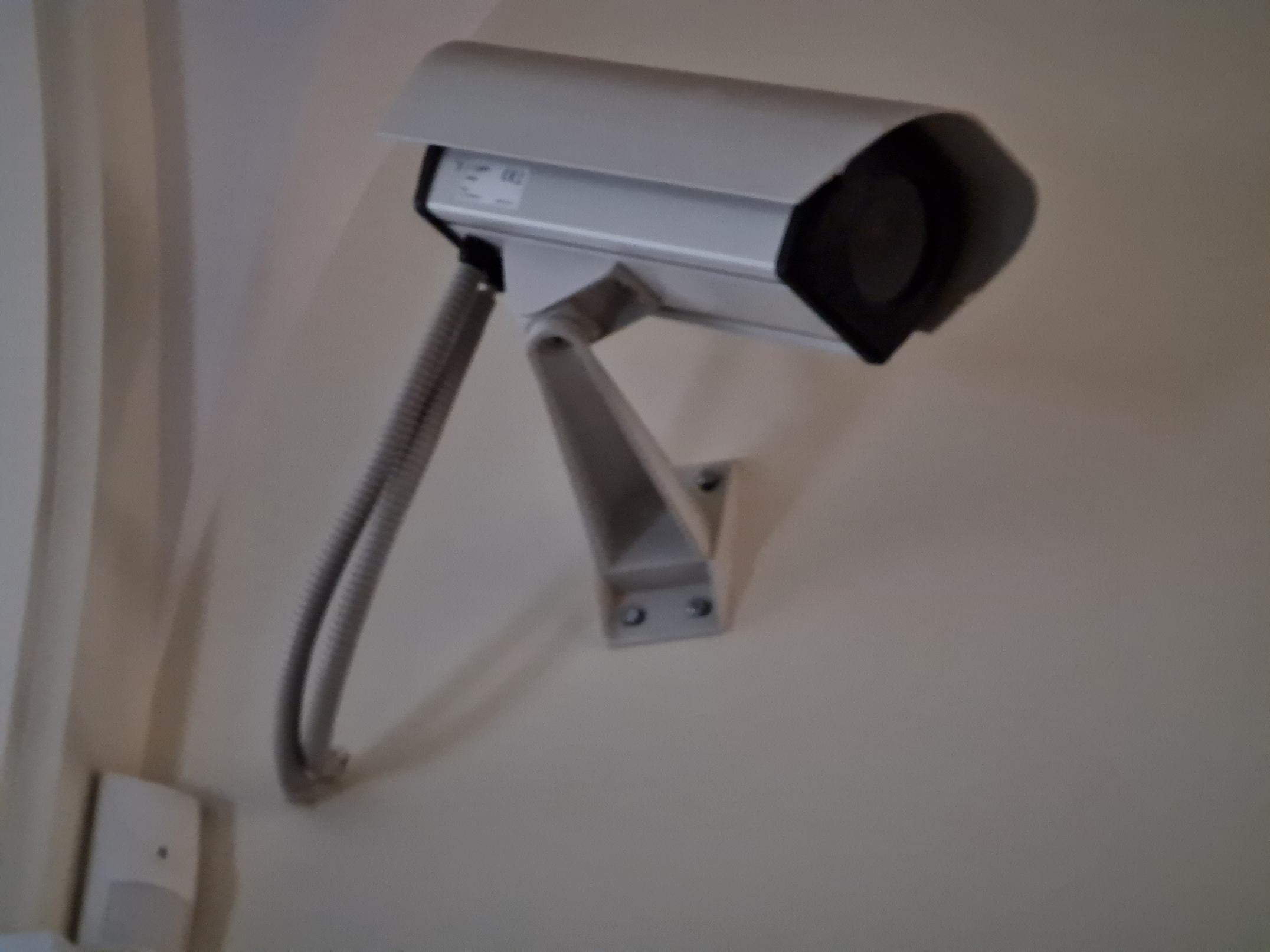
A white wall mounted CCTV camera in Poland, photographed 9 July 2021 by MichalPL, CC BY-SA 4.0, via Wikimedia Commons. Reverse searched live on 15 November 2026: TinEye 0 matches over 86.7 billion images, Google Lens failed to load the image URL.
What the ICO can and cannot do
If the owner will not act, you can complain to the ICO. The complaint is made under section 165 of the Data Protection Act 2018, and the ICO’s home CCTV page links directly to the complaint form. The ICO will consider the complaint and respond, investigating as appropriate, and it prioritises cases by the harm involved, from a light touch review to detailed enquiries. Its helpline is 0303 123 1113.
But go in with honest expectations, because the ICO’s own guidance sets out what it cannot do, and it is a long list. It cannot remove a camera. It cannot force an owner to reposition or remove one. It cannot retrieve footage for you. It cannot force deletion. And it cannot take court action on your behalf. The ICO has also said it is unlikely to force a camera to be moved. What it can do is tell the owner to comply with the rules, and in serious cases take regulatory action. That is still worth doing, because an ICO letter changes the tone of a dispute, and because a complaint on record supports any later step you take. Just do not file it expecting the camera to come down the next day.
One more honest limit: the ICO’s home CCTV guidance is currently under review following the Data (Use and Access) Act 2025, so the page carries a banner saying so. The duties in this guide, the six in the table above, are the ones the ICO still publishes, and they are the ones to rely on.
Does the same law apply in Scotland and Northern Ireland?
Yes, for the data protection part. UK GDPR and the Data Protection Act 2018 apply across the whole of the UK, and the ICO covers Scotland and Northern Ireland as well as England and Wales. A neighbour camera in Glasgow or Belfast is judged by the same boundary test and the same six duties as one in Kent.
What differs is the route you take when the problem goes beyond data protection. Harassment and nuisance law is not identical across the UK, and the courts and mediation services are organised separately in each nation. If you are in Scotland, the local route runs through the Scottish courts and Scottish mediation services. In Northern Ireland, it runs through the Northern Ireland courts. The practical advice is the same in all three: talk first, write second, use the SAR, and complain to the ICO. Only the last step, court action, changes its address.
The neighbour test, in one paragraph
Before you install a camera, or before you complain about one, run this test. Stand where the camera sits and look at what it sees. If the view stops at your own gate, you are inside the domestic exemption and the law leaves you alone. If it takes in the house next door, the garden, or the street, you are a data controller, and the six duties apply. And if you are the neighbour in the frame, the order of operations is talk, write, request, complain. Most disputes end at the first step, because most cameras are just pointed a little too wide.
This guide sits in our face search and photo privacy guide, and it pairs with our camera guides for other settings: the hidden camera check for hotels and rentals covers the no kit room sweep for guest rooms, and the landlord cameras guide covers cameras inside a rented home. The rules change with the setting, but the test is always the same: where does the camera point, and who is in the frame?
Two official sources sit behind everything in this article. The ICO’s home CCTV systems guidance is the authority on the data controller duties and the complaint route, and the GOV.UK guidance on the use of domestic CCTV is the authority on operating a system responsibly. Read both before you install a camera, or before you write a complaint about one.
Can my neighbour point a CCTV camera at my house?
Yes, they can install a camera, but the rules change once it records beyond their boundary. If it films your house, garden, or a shared path, they become a data controller under UK GDPR and the Data Protection Act 2018. They need a clear reason, must record no more than needed, put up a sign, and delete footage regularly.
Do neighbours have to tell you before installing CCTV?
No, there is no UK law that forces a householder to notify neighbours before putting up a camera. Once it records beyond the boundary, though, the owner must be open about it, with a sign and answers to requests for footage. Telling neighbours first is good practice, and GOV.UK guidance says installers should inform them.
Can I ask my neighbour to delete CCTV footage of me?
Yes. You can ask for footage of you to be deleted, and you can object to being recorded at all. The owner must consider the request and needs a strong reason, such as crime prevention, to keep recording you after you object. Put the request in writing and keep a copy with the date.
How long can a neighbour keep CCTV footage?
There is no fixed legal retention period for home CCTV. The ICO says footage should be deleted regularly, or automatically, once it is no longer needed. Many home systems are set to overwrite after about 30 days, but that is a common setting, not a rule. Ask the owner how long they keep it.
Can I complain to the ICO about a neighbour’s CCTV?
Yes, you can complain under section 165 of the Data Protection Act 2018, and the ICO’s home CCTV page links to the complaint form. The ICO will consider it and may investigate, prioritising by harm. It cannot remove the camera or force deletion, so treat it as one step, not the whole answer.
Is it legal for a neighbour’s doorbell camera to record the street?
A doorbell camera follows the same rules as a fixed camera. Because it usually looks across the path and pavement, it almost always records beyond the boundary, so the owner is a data controller. They must have a clear reason, keep the view tight with privacy zones, put up a sign, and delete footage regularly.