🔎 Reverse Image Search
Image search techniques made simple: upload a photo or paste a URL and search 6 engines at once. 100% free, nothing stored.
🔒 Your image is never stored on our servers longer than 24 hours and is never shared.
A reader on Quora asked a question about workplace cameras that will sound familiar to anyone who has spotted a new camera at work: “In the state of Ohio, can my employer put up a camera and record some hidden some out in open all outside without telling employees?” The short answer is that it depends where the camera is, whether it records sound, and which side of the Atlantic you work on. This guide answers the question for both places, because the rules in the UK and in Ohio point in opposite directions on the one point the reader cared about most, being told.
Your boss can record video in open work areas such as entrances, shop floors and car parks, for a reason like safety or stopping theft. Cameras are never allowed in toilets, changing rooms or showers. In the UK your employer must normally tell you first, while Ohio has no law forcing them to. Audio is far more restricted than video.
That split is the heart of this guide. Google’s AI Overview for “workplace cameras” is written from a US point of view and cites no UK source at all, while the strongest UK guides say nothing about Ohio. So this article keeps the two halves separate, and says which rule belongs to which place at every step. Everything here is general information, not legal advice. If a camera at your work is already causing a dispute, speak to an employment lawyer or, in the UK, to ACAS before you act.
What counts as workplace camera monitoring? It means video or audio recording by an employer in a place of work. In the UK, footage that can identify a person is personal data under UK GDPR and the Data Protection Act 2018. In the US there is no single federal video surveillance law, so the answer comes from a mix of federal wiretap law and the law of the state where you work. Ohio is the state the Quora question is about, so Ohio is the US example used here, and it is never presented as the rule for the whole of the US.
Can your boss put cameras up at work?
Yes, in most workplaces, for a genuine business reason. The reasons the law accepts are the practical ones: safety, stopping theft, protecting stock and equipment, and recording what happened if there is an incident. A camera pointed at a till, a stockroom door, a warehouse aisle or a car park is the normal case, and it is lawful in both the UK and Ohio when it is set up properly.
What changes between the two places is what “set up properly” means. In the UK an employer needs a lawful basis for the recording, and that is usually legitimate interests rather than your consent, because consent from an employee is rarely free when the employer holds the power in the relationship. Cameras at work are a different question from an employer using your photo without permission, which is about a photo of you being reused, not about being filmed at your desk. The employer must also tell staff what is recorded, why, who can see it and how long it is kept, and must carry out a data protection impact assessment before introducing monitoring that is likely to be high risk. In Ohio there is no single statewide video surveillance law at all, and video in open work areas is broadly lawful when there is a legitimate business reason and nobody filmed has a reasonable expectation of privacy in that spot.
Footage should not be kept for ever. Around 30 days is a common standard employers use, and only the people who need the footage for a stated reason should be able to view it, with a record kept of who looked at it.
The Quora answers show how the question looks from the shop floor. The top answer comes from George Craig, a manager who ran a shipping and receiving department covering more than two million square feet of warehouse and production space across three buildings. After theft incidents, his site put cameras over almost every square inch except offices, bathrooms, locker rooms, meeting rooms and visitor rooms. Footage was kept for three weeks or more, supervisors could view it from their desks, access was logged, and police and insurers asked for footage after accidents and collisions on the road outside. That is the Ohio answer in practice: cameras everywhere people work, and nowhere people expect privacy.
Another answer on the same page gets the audio part wrong, and it is worth naming because it is a common mistake. One answerer writes that an employer has “every right to record audio and video”. On video in open areas that is broadly right in Ohio. On audio it is not, and the audio section below explains why. Do not take a confident Quora answer as the law.
Where can workplace cameras go, and where can they never go?
The test in both places is the same idea in different words: is this a place where a worker can reasonably expect privacy? A shop floor is not. A toilet is. The same privacy test applies at home too, and our neighbour CCTV rules guide covers cameras filming next door. The table below is the ranking asset for this article, and it separates the two jurisdictions so neither rule is mistaken for the other.
| Place | UK position | Ohio position |
|---|---|---|
| Entrances, exits and reception | May record, with signs and a privacy notice | May record, no statewide signage law |
| Open work floors, warehouse floors and shop floors | May record, for a stated business reason, after a DPIA | May record, with a legitimate business reason |
| Car parks and loading bays | May record, with signs and a privacy notice | May record, including cameras facing over the property line |
| Tills, stockrooms and storage areas | May record, a common theft prevention use | May record, a common theft prevention use |
| Corridors and stairwells | May record, if the view is limited to what the reason needs | May record |
| Offices and meeting rooms | Only with justification, a DPIA and notice to staff | Video generally allowed, audio needs one party’s consent |
| Break rooms and staff rest areas | Avoid, only with a very strong justification | Not banned outright, but a camera aimed at people resting invites a privacy claim |
| Toilets, showers, changing rooms and locker rooms | Never, in any circumstances | Never, banned by Ohio’s voyeurism law |
| Anywhere workers discuss union matters | Never target it, workers have a right to organise | Never target it, illegal under US labour law |
Two rows in that table deserve a closer look, because they are the ones people get wrong. Break rooms are not a flat never in either place, and an article that says so would be wrong. The UK Information Commissioner’s Office treats a camera in a break room as extremely likely to infringe workers’ privacy unless the employer has a very strong justification for it, which is a high bar, not a ban. Ohio law does not ban break room cameras outright either. So the honest row is “avoid, only with a very strong justification”, not “never”. Toilets and changing rooms are the hard never in both places, and that line does not move.
The other row people miss is the union row. Google’s AI Overview makes this point, and it is correct: secretly recording workers, or aiming cameras at workers, because they are discussing union organising is illegal under the US National Labor Relations Act. A camera that is fine on a warehouse floor becomes unlawful the moment its purpose is to watch who is talking about a union. The same principle applies in the UK, where workers have a right to organise and to be consulted about monitoring. If a camera appears right after union talk starts, that timing is the thing to note down.
Does your boss have to tell you about the cameras?
This is where the UK and Ohio give opposite answers, and it is the point the Quora question is really asking about. In the UK, yes, almost always. Apart from very exceptional covert monitoring, an employer must inform workers about any monitoring, keep that privacy information up to date, tell workers when it changes, and seek the views of workers or their representatives, ideally while the system is still being planned. Signs, a written CCTV policy and a privacy notice are the normal way this is done. The ICO’s monitoring workers guidance says all of this, and it is currently under review after the Data (Use and Access) Act 2025, so an employer should check the current version of the guidance rather than relying on an old printout. The same tension between notice and no notice shows up in rented homes too, and our landlord cameras in your rental guide covers cameras in a property you rent.
In Ohio, no. There is no general statewide law that forces a private employer to put up signs or tell staff about video-only surveillance. That was confirmed against the Ohio Revised Code, which contains no signage or notice provision for private sector video, and against a 2026 guide to Ohio video surveillance law, which states the point directly. The same guide notes that sector specific rules can still apply, for example in assisted living settings, and that visible signage is still sensible because it weakens any claim that a worker expected privacy in that spot. So “no law forces them to” is not the same as “signs are a bad idea”, and a good employer in Ohio will still post them.
Other US states sit between the two. Connecticut requires employers to give workers written notice of electronic surveillance. New York requires notice before electronic monitoring, including video and audio monitoring in private workspaces. Google’s AI Overview names both states, and it is right to do so, because the answer really does change at the state line. That is why this article never presents an Ohio rule as a US rule.
Notice is not a formality in the UK. Before a new system goes in, the employer should carry out a data protection impact assessment, a DPIA, which is a written check on the risks to workers and how they will be reduced. The ICO says a DPIA is a must before monitoring that is likely to be high risk, and good practice even when no specific high risk is obvious. The employer’s data protection officer must be consulted, workers must be given the privacy information before monitoring starts, and if a high risk cannot be reduced, the employer must consult the ICO before going ahead. A camera system installed without any of this is not automatically unlawful, but the employer will struggle to show it was done properly if a worker complains.
Can your boss record sound as well as video?
Audio is far more restricted than video, in both places, and it is the part of workplace surveillance most likely to get an employer into trouble. The reason is simple: a video camera shows where you were, while a microphone hears what you said, and the law treats a conversation as more private than a location.
In the UK the ICO’s position is that audio recording should be switched off by default and used only in exceptional circumstances, for example by a trigger switch in a specific high risk area. Continuous audio and video recording together is likely to be disproportionate. Any audio use needs a DPIA, workers must be told the extent of it and why it is happening, and visitors and customers caught by it must be made aware too. Sprintlaw’s UK guide, updated in November 2026, makes the same point: disable audio by default unless there is a clear, documented, proportionate reason, and hidden audio is rarely lawful.
In Ohio the rule is different but still a limit. Ohio is a one-party consent state for audio, under section 2933.52 of the Ohio Revised Code. That means a conversation can be recorded if at least one party to it knows and consents. An employer who is part of a conversation can record it, but an employer cannot secretly record a conversation between two other people who have a reasonable expectation of privacy. The Ohio State Bar Association states this plainly in its public guidance on tape recording. So the Quora answer claiming an employer has “every right to record audio and video” is wrong on audio: the right stops at conversations the employer is not part of.
California, which Google’s AI Overview uses as its example, is stricter still. California is an all-party consent state, so audio recording generally needs the consent of everyone in the conversation, and the state’s Penal Code section 647(j) bars cameras in restrooms, locker rooms and similar private places. At federal level, the Wiretap Act allows one-party consent for audio, which is why the answer changes from state to state. If your workplace has an always-on microphone, the question to ask is not whether the camera is legal, but whether the audio is, and in which state you are standing.
Can your boss hide a camera?
A hidden camera is lawful only in narrow circumstances, and the UK and Ohio draw the line in different places. In the UK covert monitoring is allowed only in exceptional cases, and all the conditions must be met together. Senior management must authorise it, a DPIA must be carried out, there must be grounds to suspect criminal activity or an equivalent such as gross misconduct, it must be strictly targeted at getting evidence within a set timeframe, and it must stop when the investigation ends. Covert audio or video must never be used in areas where workers would reasonably expect to be private, or to capture communications workers would reasonably expect to be private. Information gathered must be used only for the intended purpose, and anything else picked up must be disregarded or destroyed unless it reveals something no employer could reasonably ignore.
That is a high bar, and it is deliberately so. A hidden camera to check whether staff are working hard enough will not meet it. A hidden camera to investigate a specific suspected theft, for a defined period, with senior sign-off and a written record, might. The employer must also be able to justify every decision afterwards, which is why the ICO says to limit the people involved and set clear rules on who can see the footage.
In Ohio the line is drawn by the voyeurism law, section 2907.08 of the Ohio Revised Code, and it is narrower than many people assume. The law does not ban secret workplace video in general. It bans secretly recording someone in a place where they have a reasonable expectation of privacy, for the purpose of viewing their private areas, and it bans secret recording done to spy on someone for sexual gratification. A hidden camera in a toilet or changing room is a crime under this law. A hidden camera over a warehouse floor, installed after thefts, is not covered by it, because nobody has a reasonable expectation of privacy on a warehouse floor and the purpose is not to view private areas. That is exactly the situation the Quora warehouse manager describes, and his answer is consistent with the law: cameras almost everywhere, and none where privacy is expected.
The practical difference is that in the UK a hidden camera needs a documented investigation reason even in a work area, while in Ohio a hidden camera in a work area needs no special reason at all. Neither place allows a hidden camera where privacy is expected, and neither place allows a hidden microphone to listen in on private conversations.
What should you do if a camera at work worries you?
Start with the facts, not a confrontation. Note where the camera is, what it points at, whether it has a microphone, whether there are signs, and when it appeared. A camera that appeared the day after a union meeting is a different matter from a camera that has been over the entrance for five years, and the dates are what turn a feeling into a complaint.
Then check the paperwork you already have. In the UK, look for the CCTV policy, the staff handbook and the privacy notice, and ask your manager or HR for them if you cannot find them. The policy should say why the cameras are there, who can view the footage, how long it is kept and how to ask for a copy. In Ohio, check the employee handbook and any notice given when you were hired, and ask the same questions even though no law forced the employer to write the answers down.
In the UK you can ask for CCTV footage of yourself. This is a subject access request, and the employer must respond without undue delay and within one month, blurring out other people in the footage. If the employer refuses, or the camera is in a place it should not be, you can complain to the ICO. The ICO cannot remove a camera or force footage to be deleted, but it can investigate and tell the employer to change what it is doing. You can also raise the matter through your trade union, or through ACAS if it becomes a dispute about your employment.
In Ohio, the routes are different. If a camera is in a toilet, changing room or locker room, that is a matter for the police, because secret recording in such a place can be a criminal offence under section 2907.08. If audio is being recorded without any party’s consent, that can also be a criminal matter under the wiretap law. For anything else, such as a camera in a break room or a camera that seems aimed at union activity, the practical route is to document it and speak to an employment lawyer, and, for union related surveillance, to the National Labor Relations Board. Do not tamper with a camera, cover it, or unplug it: that can be treated as misconduct or damage to company property, and it weakens your position even if the camera should not have been there.
One more check is worth doing before you decide anything. A photo of a camera, or of the room it watches, can be reverse searched to see where else it has appeared, and that sometimes shows whether a camera is a standard model or something unusual. The worked example below does exactly that with a real workplace camera photo. For the wider question of photos of you being found and used, our face search and photo privacy guide covers the checks that apply outside work too.
Worked example: what a reverse search finds on a real workplace camera photo
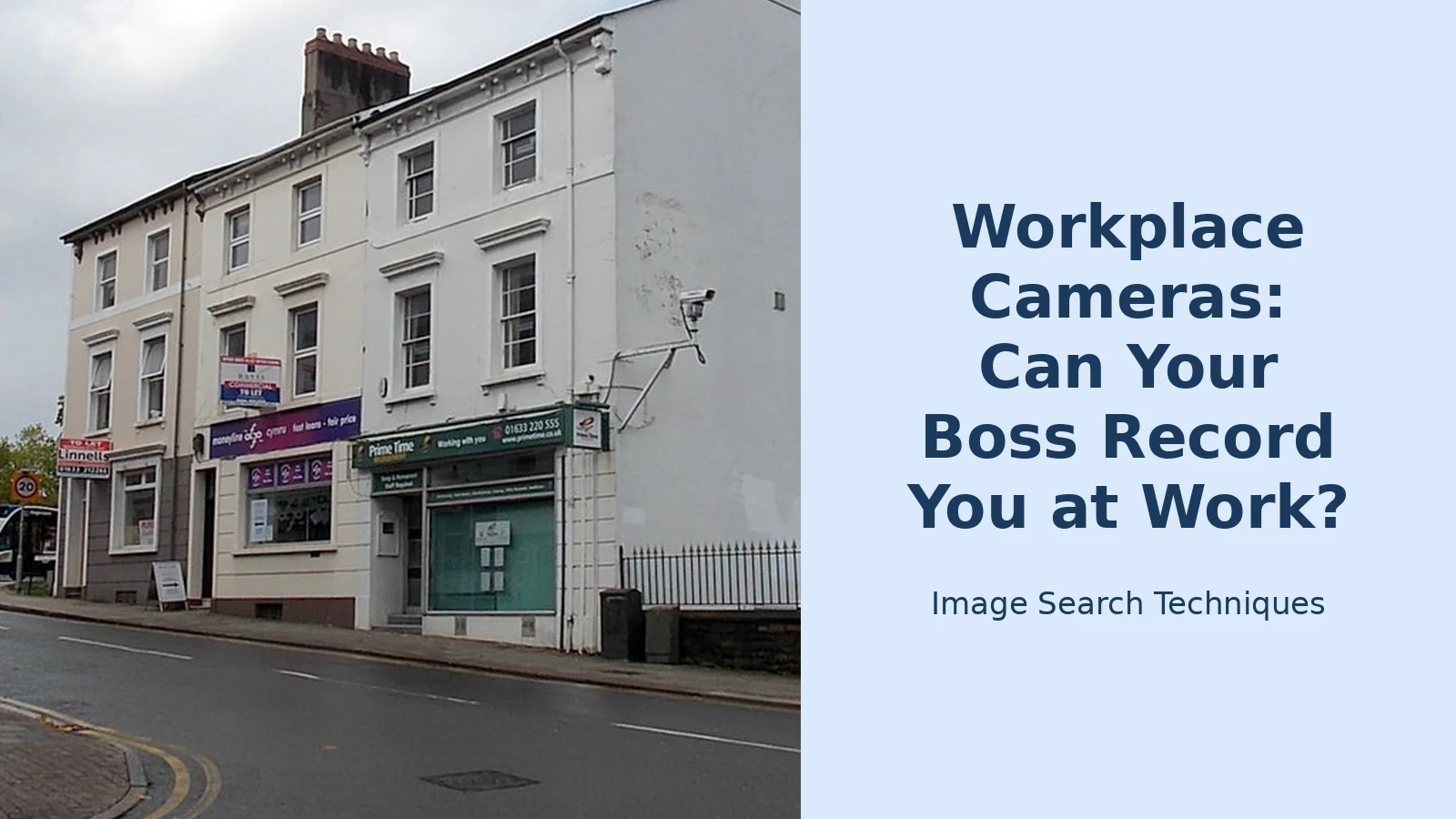
The photo below is a real one. It shows three offices and a CCTV camera on Bridge Street in Newport, Wales, photographed by Jaggery on 28 October 2013 and published on Wikimedia Commons under a CC BY-SA 2.0 licence. The camera is mounted high on the building front, in the open, looking out over the street and the office entrances. It is the kind of visible, entrance-facing camera that the UK rules expect: signed, open, and aimed at a place where nobody has a reasonable expectation of privacy.

On 15 November 2026 this photo was reverse searched live, by its public URL, to test what the search engines know about it. TinEye reported 0 matches across its index of more than 86.7 billion images, and the original Commons page did not appear among them, because there were no matches at all. TinEye’s own message was that it has yet to crawl any page where this image appears. Google Lens gave no result at all: Google blocked the search with its unusual-traffic check, and the challenge could not be cleared, so no Lens count is reported here. A zero from TinEye never clears a photo, and a blocked Lens search proves nothing either. Neither outcome says anything about whether the camera in the photo was lawful, and that is the point of the test.
That limit matters for the reader who started this article. If you photograph a camera at your work and reverse search the photo, a match tells you the camera model or the photo’s history, not the legality of the recording. The legality questions are the ones in the sections above: where the camera points, whether it records sound, whether you were told, and whether the employer can show a reason for it. A photo check is a starting point, not a verdict. If you want to run the same test on a photo of your own workplace, our how to reverse image search guide walks through the steps.
FAQs
Can my employer put a camera in my office without telling me?
In the UK, almost never. Your employer must normally tell you about monitoring through signs, a policy and a privacy notice, and carry out a data protection impact assessment first. In Ohio there is no law forcing an employer to tell staff about video-only cameras in work areas, so it can happen without notice, though good employers still post signs.
Can my boss record audio at work?
Audio is far more restricted than video. In the UK it should be switched off by default and used only in exceptional cases. In Ohio, audio needs the consent of at least one party to the conversation, so an employer cannot secretly record a conversation between two other people. In California, all parties must consent.
Are cameras allowed in staff break rooms?
They are not banned outright, but they are hard to justify. In the UK a break room camera is extremely likely to infringe workers’ privacy unless the employer has a very strong reason for it. In Ohio there is no outright ban, but a camera aimed at people resting still invites a privacy complaint.
Can my employer watch me on camera all day?
A camera can record a work area all day if it is there for a genuine reason such as safety or theft prevention, but it cannot be used to monitor your productivity minute by minute. In the UK, footage collected to detect crime must not be repurposed to watch how hard people work.
Can I ask my employer for CCTV footage of myself?
In the UK, yes. You can make a subject access request for footage that shows you, and your employer must respond without undue delay and within one month, blurring out other people. In the US there is no equivalent general right, so ask under your employer’s own policy or through a lawyer.
What should I do if I find a hidden camera at work?
Do not touch it, cover it or unplug it. Note where it is, what it points at, whether it has a microphone and when you found it. In the UK, ask HR for the CCTV policy and consider a complaint to the ICO. In Ohio, a camera in a toilet or changing room is a matter for the police.