🔎 Reverse Image Search
Image search techniques made simple: upload a photo or paste a URL and search 6 engines at once. 100% free, nothing stored.
🔒 Your image is never stored on our servers longer than 24 hours and is never shared.
Short answer: here is how to tell if designer sunglasses are fake from photos: combine three checks, a reverse image search on the seller’s pictures, a close look at the lens etching and hinges, and a read of the code inside the temple arm. No single photo check proves a pair is genuine, but they catch most fakes before you pay.
A “designer sunglasses legit check” sounds like something only an expert can do. In practice, most of it is photo work: the seller’s listing pictures either stand up to a few simple checks or they fall apart. Fakes usually fail on the small details, the depth of an engraving, the layout of a temple code, the quality of a hinge, and those details are exactly what shows up when you compare real vs fake sunglasses pictures side by side. This guide walks through the process photo by photo, so you can judge a pair before money changes hands.
One thing to settle first: a photo check gives you a verdict in the form of checks passed or failed, never a guarantee of authenticity. Even the brands say so in their own way, Luxottica, which owns Ray-Ban, states it cannot verify the authenticity of any product not bought directly from ray-ban.com or an authorised dealer. That is the honest frame for everything below. Your aim is not certainty; it is to spot enough failed checks to walk away from a bad buy, or enough passed checks to buy with confidence.
What can a photo actually prove, and what can it never prove?
A photo can prove that the pair in the pictures has the right markings in the right places, that the engraving looks crisp rather than printed, and that the seller’s photos are genuinely of the pair they are selling rather than stolen from somewhere else. A photo can never prove that the pair in your hands, or in the post, is the same pair that was photographed. That gap is why the first check in this guide is not about the sunglasses at all. It is about the photos themselves.
There is also a limit worth knowing before you start: Ray-Ban does not operate a public database where you can type in a serial number and get an instant authenticity answer, as the repair specialists at AlphaOmega and the authentication guide LuxeDetect both point out. The code inside the temple arm identifies the model, the colour and the size, every pair of that model shares it, so a correct code proves nothing on its own. What the code can do is expose a fake: a code that does not exist, that belongs to a different model, or that is printed in a layout Ray-Ban never uses is a strong reason to stop. Keep that distinction in mind throughout: passing checks raise confidence, failing checks lower it, and no photo check closes the case.
The other limit is the quality of the photos themselves. A seller who only posts one soft, front-on shot in bad light has given you nothing to check. That is itself a signal. A genuine seller with a genuine pair has no reason to refuse a close-up of the lens corner or the inside of the temple arm. Asking for those photos is the single most useful thing you can do, and the shot list later in this guide tells you exactly which ones to request.
How to tell if designer sunglasses are fake: start with a reverse image search
Before you examine a single marking, run the seller’s photos through a reverse image search. This takes about a minute and answers the most important question first: are these photos actually of the seller’s sunglasses, or have they been lifted from somewhere else? A seller using stolen catalogue photos is selling you a picture, not a pair of sunglasses.
The steps are the same for any listing:
- Save the seller’s best front-on photo of the sunglasses to your phone or computer.
- Open Google Lens and upload the photo. You do not need to sign in.
- Open the “Exact matches” tab first. If the same photo appears on other pages, look at what those pages are: a retailer’s own listing, a stock-photo site, or a blog that embedded the image.
- Then check “Visual matches” for lookalikes. These are similar frames, not the same pair, and they are useful for a price comparison, if the seller’s price is far below every similar genuine pair, that is a warning in itself.
- Repeat with a second photo from the listing, ideally a different angle. One photo can be a coincidence; two matching elsewhere is a pattern.
If you want a guided start, our homepage’s free reverse image search tool walks you through the same upload step. For a fuller walkthrough of the tool itself, our guide to how to reverse image search covers the same steps on phone and desktop. The same trick works for other designer goods too, we use it in our guide to identify sneakers from a photo, and the principle is identical: the photo is the evidence, and the search tells you where that evidence has already been used.
Worked example: what Lens actually returned for an aviator photo
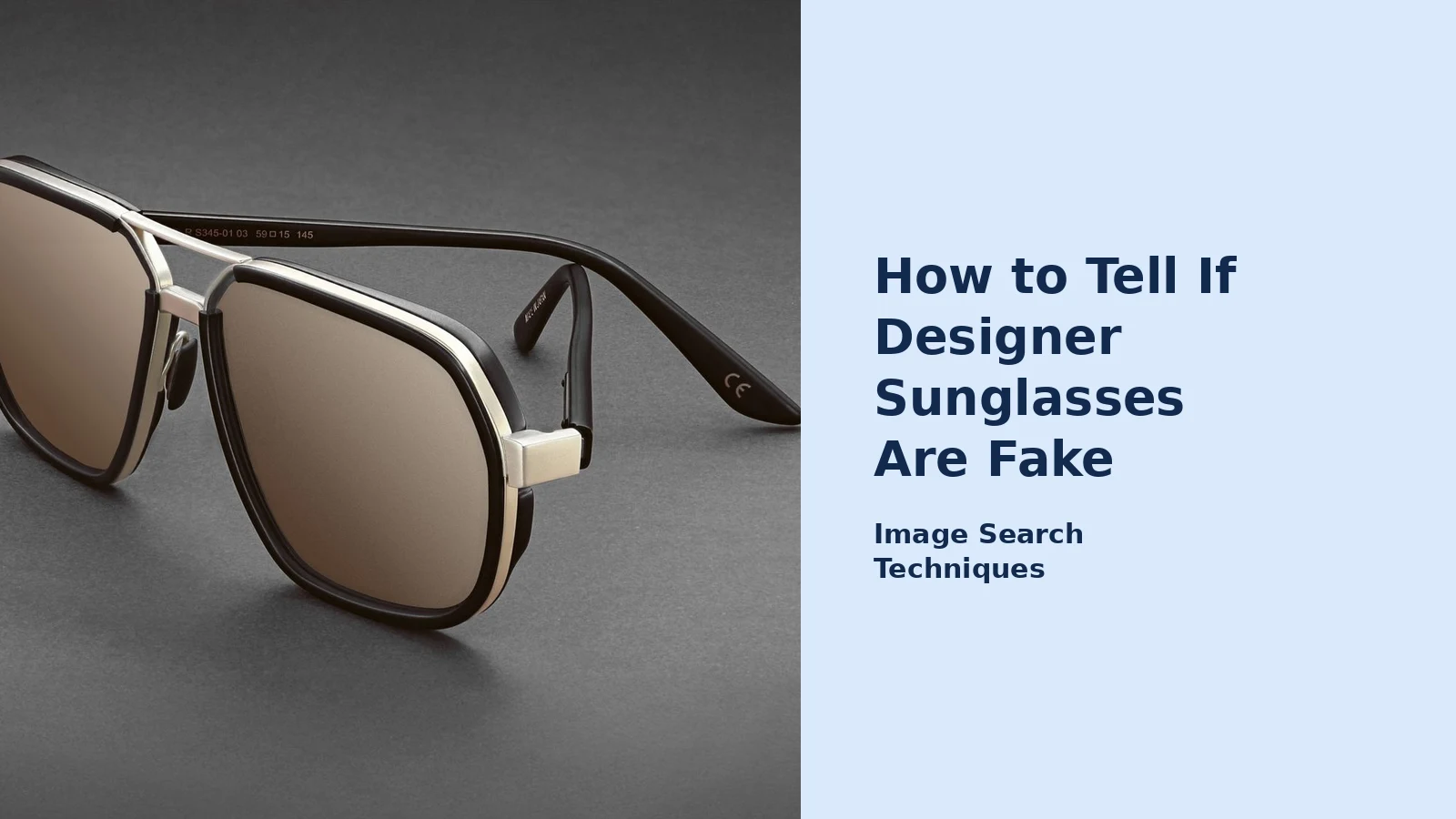
To show what this looks like in practice, we ran a real product-style photo through Google Lens on 10 November 2026: a stock photo of black-and-silver double-bridge aviator sunglasses on a grey background, with the temple-arm markings “59 □ 15 145” and a “CE” mark visible on the arm. We used the photo exactly as a seller might use a listing picture, and we signed in nowhere. Here is what came back, exactly as observed.
Lens returned 21 exact matches, and every one of them was the same photograph reused on another page. The source was the Pexels page for the photo, dated November 2024, and the rest were articles and blogs that had embedded it, including an Outlook Luxe piece on luxury sunglasses and an India Today article. Not one exact match was a retailer selling the sunglasses in the picture, and no price appeared on any of them. That is the tell: if a seller’s listing photo produces a long list of exact matches on stock-photo sites and blogs, the photo is not theirs. It is a widely reused stock image, and it says nothing at all about the pair they will actually send you.
The visual matches told a different story. Lens showed 60 similar frames, almost all of them other brands’ double-bridge aviators and navigators rather than the photographed pair: MYKITA, RIMOWA × MYKITA, DITA Lancier, Jacques Marie Mage, ic! berlin, Cutler and Gross and Chopard among the premium names, with cheaper lookalikes from Sungait at $20, Addison at $30 and Zenni at $40. The most expensive lookalikes shown were a T HENRI C2 at $1,350 and a Jacques Marie Mage Earl at $1,270. No result identified the brand or model of the sunglasses in the photo itself. Lens described them only generically, as “luxury double-bridge aviator-style sunglasses”, and its AI Overview read the arm markings as “59 [15] 145”, 59 mm lens width, 15 mm bridge, 145 mm temple length, without matching those dimensions to any brand or product. The “CE” mark on the arm was not mentioned anywhere in the results.
That outcome is typical, and it teaches the right lesson about this check. A reverse image search is excellent at one thing: proving that a photo has been used before, and where. It is poor at another: it cannot identify an unbranded or generic frame from a photo alone, and it cannot authenticate anything. Use it as the first filter, not the final verdict. If the seller’s photos are original, no exact matches anywhere, move on to the marking checks below. If the photos are stock images, stop there. No amount of temple-code reading can rescue a listing whose photos are not of the seller’s own pair.
What photos should I ask the seller for?
If the listing photos are too soft, too few or too carefully cropped to check, ask the seller for more. A genuine seller can take these in two minutes with a phone. A seller who refuses, delays or sends the same blurry shot again has answered your question. This is the shot list to send them, it is the ranking asset for this guide, and every shot has a job to do.
| Shot to request | What it must show | What it catches |
|---|---|---|
| Front-on, both lenses | Whole frame, straight on, in daylight | Wrong shape, wrong proportions, sloppy logo |
| Lens-corner etching macro | Top corner of the right lens, tilted to the light; left lens “RB” etching for Ray-Ban | Printed or missing etching, blurry logo |
| Inner left temple code | Model code, colour code and size, sharp and legible | Non-existent code, wrong layout, smudged print |
| Inner right temple | Brand logo, “Made in” line and CE mark | Missing origin mark, merged or crooked text |
| Hinge close-up | Hinge from the side, arms half open | Flimsy or painted hinges, gaps, glue |
| Nose pads and bridge | Pads, bridge and any logo on the nose area | Stuck-on logos, rough or uneven pads |
| Case, box and card | Case logo, box label with model code, authenticity card | Codes that do not match the frame, cheap packaging |
Two practical notes. First, ask for the photos one message at a time if the seller seems slow, a single long list can feel like an interrogation, and you want the photos, not an argument. Second, check that the photos you receive actually show the same pair: the same scratches, the same colour, the same code in every shot. A listing that mixes photos of two different pairs, one genuine-looking front shot and a temple code from another pair entirely, is a classic stitch, and it is exactly what a reverse image search on each photo will expose.
Ray-Ban, Oakley and Gucci: what should I look for in each photo?
The three most faked names have different tells, and knowing which detail belongs to which brand stops you checking for the wrong thing. The table below is the second half of this guide’s ranking asset. Read the brand you are buying, and check only its row, a “missing” feature that the brand never had is not a red flag.
| Check | Ray-Ban | Oakley | Gucci |
|---|---|---|---|
| Lens marking | “Ray-Ban” script printed on the top corner of the right lens; discreet “RB” laser-etched on the left lens near the hinge. On polarised pairs, a small “P” sits next to the logo. | No “O” logo on a standard non-prescription lens, if you see one painted or etched there, that is a fake. Etched tech labels such as “PRIZM” or “POLARIZED” on the bottom edge are normal. | Logo on the lens should be crisp and precisely rendered; blurry, oversized or off-centre logos are a warning. |
| Temple code | Left arm: “RB” plus four digits (RB2140 Wayfarer, RB3025 Aviator), then colour code, then size such as 55 □ 18, then lens type such as 2N or 3P. | Left temple: SKU starting with “OO”, “OX”, “OY” or “OJ”, for example OO9417-2259. Letters, not zeros: “OO” is not “00”. | Left arm: model number such as GG0459S or GG1234, plus colour code and measurements. Gucci uses a model-number system, not a unique per-pair serial. |
| Other arm | Right arm: Ray-Ban logo, “Made in Italy” or “Hand Made in China”, both are legitimate, and a stylised CE mark. | Check the model code against Oakley’s official site for the same model and colour. Oakley Customer Care can also verify a pair from photos and purchase details. | Right arm: Gucci logo, “Made in Italy” and the CE mark. All Gucci eyewear is made in Italy under Kering Eyewear. |
| Frame and hinges | Real acetate is cut from a single sheet and hand-polished, no seams, no rough edges. Wayfarers have a seven-barrel metal hinge. | Frames are moulded under pressure, so seams are completely smooth; fakes often have sharp, raised plastic lines. Hinges are sturdy, never flimsy. | Engraving is laser-etched, crisp and perfectly aligned, never printed, stuck on or smudged. The double-G logo is the most copied detail, so check its size and balance. |
| Packaging | Branded box with a label showing model, lens and frame details; black case with a gold Ray-Ban emblem; grey cleaning cloth with a red logo. | Look for the correct box, microfibre bag and documentation for the model; low-quality pouches are a common counterfeit sign. | Sturdy textured box in deep brown, green or velvet with an embossed Gucci logo; case, cleaning cloth and an authenticity card whose details match the frame. |
A few details in that table deserve emphasis, starting with the fake Ray-Ban check by photo: the “RB” etching on the left lens is subtle and hard to see unless you tilt the lens toward the light. Run a fingernail gently across it, a real etching feels smooth and sits in the glass, while a fake is often printed on the surface and can feel flat or scratch off. The same test works for the temple engraving: genuine engraving is neat, evenly spaced and sits flush with the material, while counterfeiters often get the font, spacing or alignment slightly wrong even when the code itself is correct.
Second, the Oakley lens rule is the opposite of Ray-Ban’s and catches people out, and it is the first thing to check in fake Oakley photos. On a standard non-prescription Oakley lens there should be no “O” icon at all, the Oakley Forum’s long-running fake-spotting guide is blunt about it: if the icon is printed on the lens, “they’re big, fat fakes”, and any marking on the lens will be etched, never painted. The exception is prescription pairs bought directly from Oakley or an authorised retailer, which may have the “O” etched in the lower corner. Knowing that exception matters, because a prescription pair is not automatically fake for having it.
Third, the Gucci “serial number” is a source of confusion. Some guides tell you to check a unique serial number on the frame, but Frames Direct’s authentication guide is clear that Gucci glasses do not use a traditional serial number at all, they use a model number engraved on the frame, with colour and size codes, which functions as the reference to check. If a seller quotes you a “unique serial” that they claim proves authenticity, that claim itself is worth questioning. What you should check is that the model number exists on Gucci’s own site or a trusted retailer’s listing, in the same colour, and that the code on the frame matches the code on the box label and the authenticity card.
How do I read a temple-arm code?
The sunglasses temple arm code check starts with a line that looks like a jumble of letters and numbers, but it follows a strict format, and once you can read it you can check it in under a minute. Take a Ray-Ban line such as “RB4165 622/55 54 □ 16 145 3P”, as decoded by LuxeDetect’s authentication guide: RB4165 is the model (Justin), 622 is the frame colour with lens 55, 54 is the lens width in millimetres, 16 is the bridge width, 145 is the temple length, and 3P means lens category 3, polarised. Every element has a job, and a fake often gets one of them wrong, a size that does not match the frame when you measure it, a colour code that belongs to a different frame, or a lens category that contradicts the listing.
The layout itself is a check. LuxeDetect notes that a temple line starting with the model number and no “RB”, reading “BR”, or printing the size as “53 □ 24-145” with no colour code is a layout they have only seen on fake sunglasses. The same applies to Oakley: the code should start with “OO”, “OX”, “OY” or “OJ” followed by four or five digits with no spaces, usually separated from the colour code by a dash, as in OO9417-2259. And as EZContacts points out, a matching model code is a useful check but is not proof by itself, because counterfeiters can copy authentic codes. A correct code clears the first hurdle only; a wrong code ends the inspection.
To verify a code, search it on the brand’s own site or a trusted retailer’s listing and compare everything: model, colour, lens width, bridge and temple length. If the code does not exist anywhere, or it belongs to a different model or colour, walk away. For Ray-Ban, remember the two origin lines, “Made in Italy” and “Hand Made in China” are both legitimate, so “Made in China” alone is not evidence of a fake. What matters is whether the whole line is present, crisp and consistent with the model. Vintage pairs are the exception to the online check: models made before 2000 carry a “BL” etching for Bausch & Lomb, the company that owned Ray-Ban before Luxottica bought it in 1999, and very old models may no longer be listed online at all.
Why do fake sunglasses matter for your eyes, not just your wallet?
This is the part buyers underestimate. A fake pair is not just a cheaper version of the same thing, it is often a pair of dark lenses with no real ultraviolet protection, and that combination is worse for your eyes than wearing no sunglasses at all. Dark lenses make your pupils open wider, and if the lens does not filter ultraviolet light, more of it reaches the eye. Genuine Ray-Bans are sold with a sticker reading “100% UV Protection”, and their lenses are rated UV400, meaning they block wavelengths up to 400 nanometres, covering UVA and UVB. A counterfeit carries no such guarantee, and as the men’s style guide Hotdrops puts it, there is no guarantee of UV protection with fakes, so you could end up doing serious damage to your eyes if the UV light is not being filtered out.
You cannot verify UV protection from a photo, which is why this section sits after the photo checks rather than among them. What you can do is treat the UV claim as part of the verdict: a seller who cannot show you the UV400 marking, the original sticker or the box label that states it has given you one more failed check. And once the pair arrives, there are two quick tests worth doing. Hold the glasses in front of a phone or laptop screen showing a plain white background and rotate them about 90 degrees, genuine polarised lenses darken or show a clear change as you turn them, as AlphaOmega’s guide describes. Then, if you can, have an optician check the UV transmission; many high-street opticians will do this in a minute, and it is the only test that actually measures what the photo checks cannot.
The money matters too, but keep it in proportion. A fake pair bought for the price of a fake pair is a small loss. A fake pair bought at near-retail price, worn all summer because it looks right, is a health risk you paid full price for. That is why the checks in this guide are worth the ten minutes they take.
What should I do if the checks fail?
Work through the failures in order of strength. One soft photo is a reason to ask for better ones. A stock photo found on a dozen other sites, a temple code that does not exist, or an “O” painted on an Oakley lens are each enough on their own to walk away. Do not let a seller talk you past a failed check with a story about a “factory overrun” or a “direct from the supplier” deal, those are the standard lines, and the listing’s photos are the evidence, not the seller’s explanation.
If you have already bought the pair and the checks fail afterwards, keep everything: the listing screenshots, the messages, the photos the seller sent, the box and the receipt. Report the listing on the marketplace where you bought it, and if you paid by card or through a payment provider, ask about a chargeback or buyer protection, the evidence pack you saved is what makes that claim work. You can also report counterfeit Ray-Ban listings through Luxottica’s own reporting route, and Oakley Customer Care can verify a pair from photos and purchase details if you are still unsure. For more on finding where a seller’s photos really came from, our search by image for shopping guide covers the same reverse-search workflow for any product, and our reverse image search for clothes guide shows how the same stolen-photo test applies to fashion listings generally.
Finally, remember the frame this guide started with: these are checks, not guarantees. A pair that passes every photo check is a good buy, not a certified one. The only way to be certain is to buy from the brand or an authorised dealer, and if the price you are being offered is far below what those sellers charge, that gap is itself the most reliable tell of all.
FAQs
Can you tell if designer sunglasses are fake from a photo alone?
No. A photo can show failed checks, a printed etching, a non-existent temple code, stolen listing photos, and any one of those is enough to walk away. Passing every photo check only raises confidence; it never proves the pair in the post is the pair in the pictures. For certainty, buy from the brand or an authorised dealer.
What does the code inside the temple arm mean?
It identifies the model, colour and size. A Ray-Ban line such as RB4165 622/55 54 □ 16 145 3P reads as model RB4165, colour 622, 54 mm lens width, 16 mm bridge, 145 mm temple length and 3P polarised. Search it on the brand’s site; if it does not exist or belongs to another model, the pair is fake.
Do real Ray-Bans always say Made in Italy?
No. Genuine Ray-Bans are made in both Italy and China, so “Hand Made in China” on the right temple arm is legitimate, as is “Made in Italy”. What matters is that the line is present, crisp and correctly spelled, with the Ray-Ban logo and CE mark. A missing or sloppy origin line warns far more than the country named.
Is it safe to wear fake sunglasses?
Often it is not. Dark lenses without real UV400 protection make your pupils open wider while letting ultraviolet light through, which is worse than wearing no sunglasses at all. Fakes carry no guarantee of UV filtering. If you already own a suspect pair, ask an optician to test the UV transmission before wearing them in strong sun.