

🔎 Reverse Image Search
Image search techniques made simple: upload a photo or paste a URL and search 6 engines at once. 100% free, nothing stored.
🔒 Your image is never stored on our servers longer than 24 hours and is never shared.
Album covers look like free decoration. They are everywhere: on streaming apps, in search results, in blog posts about music. A cover is also a piece of artwork, and somebody owns it. That owner is usually the record label, not the streaming service and not the search engine that showed you the image.
Short answer: can I use album cover art on my blog? Usually yes, when you are writing a review of that album and you use a small image with a credit, because US fair use and UK fair dealing both allow criticism and review. Decoration, headers and commercial use are different: they need permission from the label or the artwork owner.
The rest of this article works through the three uses that matter: review, decoration and commercial use. It gives you the US rule and the UK rule separately, because they are not the same thing, and it finishes with a real test: I took one of the most famous album covers ever made, Pink Floyd’s The Dark Side of the Moon, and reverse searched it to find out who owns it and where it is licensed. If you want the wider picture first, our complete guide to protecting your photos online covers the same questions for photographs.
Who owns an album cover?
Album cover art is the artwork printed on, or shown with, a recorded release: the front image, the back, the booklet and any inserts. It is a separate copyright work from the music. The music belongs to one set of owners, the words to another, and the cover art to the label or the designer who made it.
Buying the record does not buy the copyright. It buys you one physical copy. Streaming the album does not buy anything at all: it gives you a licence to listen. The right to copy the cover, put it on a blog, or print it on a shirt stays with the owner. For The Dark Side of the Moon, released on 1 March 1973 in the US by Capitol and on 16 March 1973 in the UK by Harvest, the sleeve was designed by the London art group Hipgnosis with George Hardie. Hardie drew the prism. The band were offered seven designs and all four members agreed on the prism. Roger Waters later said there were no arguments. The artwork is credited to Hardie, and the album itself is a Harvest and Capitol release, so the label is the first place to look when you ask who controls the cover.
That split matters for bloggers. A cover is not a photograph you took, and it is not a free image just because it appears in a search result. It is a commercial artwork made for a commercial product, and that fact shapes every rule that follows.
Answer capsule: an album cover is a copyrighted artwork owned by the label or the designer, and buying or streaming the album gives you no right to copy it.
Can I use album cover art in a review of the album?
Yes, in most cases, and this is the strongest case a blogger has. Both the US and the UK allow a work to be reproduced for criticism or review, but they do it through different doctrines, and the conditions are not identical.
In the US, the rule is fair use, set out in Section 107 of the Copyright Act. The US Copyright Office lists four factors a court weighs: the purpose and character of the use, the nature of the work, the amount used, and the effect on the market for the original. Criticism and comment are named in the statute as examples of uses that may qualify. A review is the classic favoured purpose. A small cover image that identifies the album you are reviewing is a transformative use: it does not replace the album or the cover art, it talks about it. There is no fixed percentage that is safe. The Copyright Office is explicit that no formula guarantees a result, and every case turns on its facts.
In the UK, the rule is fair dealing for criticism or review, under section 30 of the Copyright, Designs and Patents Act 1988. GOV.UK confirms that fair dealing for criticism, review or quotation is allowed for any type of copyright work, and that a sufficient acknowledgement is required. The work must have been issued to the public, which a released album plainly has been. Fair dealing has no statutory definition in the UK. GOV.UK puts the test this way: how would a fair-minded and honest person have dealt with the work? The courts look at whether the use affects the market for the original and whether the amount taken was reasonable and appropriate.
Four habits keep a review use on the safe side of both rules. First, the post must genuinely review that album: a few sentences about the record, the songs, or the sound, with the cover there to identify what you are writing about. Second, use a small image. A low-resolution thumbnail that identifies the album is a small taking; a full-size, print-quality copy is the whole work. Third, credit the artist and the label by name, next to the image. In the UK, acknowledgement is a condition of the exception, not a courtesy. Fourth, do not use a bigger or better copy than the review needs, and do not reuse the same cover across many posts where it is not the subject.
Answer capsule: a small cover image inside a genuine review of that album is the strongest case a blogger has, in both the US and the UK.
Can I use album cover art on my blog as decoration?
Decoration is the weakest case. A cover used as a header image, a sidebar picture, a “music I like” collage, or playlist art is not criticising or reviewing anything. It borrows the art for its looks. Neither US fair use nor UK fair dealing protects looks alone.
In the US, the first fair use factor, purpose and character, weighs against you. A decorative use adds nothing new to the work and does not comment on it. It uses the cover for the same purpose the cover was made for: to look good and to attract attention. In the UK there is no general exception for decorative use at all. The exceptions are specific: research, private study, criticism, review, quotation, teaching, reporting current events. Decoration is none of those. A blog that uses a row of covers as a visual header is simply reproducing artworks without a permitted purpose.
The top competitor page on this question, a short client Q and A from HCR Law, shows how easily this goes wrong. Their client wanted to use his own flat-lay photograph of album covers he had bought, and the firm answered that “in theory” it was fine, because the artists had already been paid through the purchase and the use would not lose them revenue. That reasoning is shaky in two ways. First, buying a CD pays for the physical copy and the music on it. It does not exhaust the right to reproduce the cover art in a new digital copy on a blog: exhaustion covers the copy you bought, not a fresh reproduction. Second, the page calls the defence “fair use” in an answer about UK law. The UK doctrine is fair dealing, and it is narrower than US fair use. A UK blogger who relies on the American test is applying the wrong law. The firm hedged its own answer heavily, saying it would “depend hugely on the individual circumstances” and advising the client to check first. That hedge is the honest part of the page.
Photographing covers you own does not change the analysis much. Your photograph is your own work, but the cover inside it is still the label’s artwork, reproduced in your image. A photo of your own copy, used small, inside a genuine review, with a credit, is the strongest version of this idea. The same photo used as decoration, with no review attached, is still a reproduction of somebody else’s artwork for its looks.
Answer capsule: decoration is the weakest case, because it borrows the art for its looks, and neither US fair use nor UK fair dealing protects looks alone.
Can I use album cover art commercially on my blog?
Commercial use needs permission. That covers the obvious cases, selling shirts or posters printed with a cover, and the less obvious ones: a blog that runs adverts, carries affiliate links, or takes sponsored posts. If the cover helps the blog earn money, the use is commercial, even if the post itself is a review.
In the US, the first fair use factor asks directly whether the use is of a commercial nature. Commercial purpose weighs against fair use. It is not fatal on its own: courts have found commercial uses fair, and non-commercial uses unfair. But it counts, and it counts against you, especially when the cover is used to draw readers in. The fourth factor, market effect, is usually the one that decides these cases. A court asks whether your use harms the existing or future market for the original work, and whether it would cause substantial harm if it became widespread. A cover used as the visual hook for a money-making post is close to a substitute for the licensed uses of that artwork, such as licensed merchandise and official imagery.
In the UK, the position is stricter. Most fair dealing exceptions are framed around non-commercial purposes. GOV.UK describes the research and private study exception as non-commercial, and the teaching exception as non-commercial instruction. The criticism and review exception does not carry an explicit non-commercial limit in the statute, but a court weighing fairness will look hard at market impact, and a commercial blog using a cover to pull in traffic looks like a use that takes value from the owner. The safe reading is that a commercial blog should not rely on fair dealing for cover art at all without advice.
The practical line is simple. If your blog earns money, treat cover art like any other licensed image: get permission, or use an image you have rights to. The label’s press or media page is the usual route for review copies and approved artwork. For a commercial post, ask the label or the artist’s management in writing and keep the reply.
Answer capsule: the more money the cover helps your blog make, the weaker your defence, so commercial use needs a licence.
Does using a small thumbnail make it safe?
Size helps, but it is only one factor. In the US, amount and substantiality is the third fair use factor. A court looks at both the quantity taken and the quality: a small part can still be unfair if it is the heart of the work. A low-resolution thumbnail that identifies the album is a small taking, and it is the taking most likely to be fair. A full-size, high-resolution copy is the whole work, and it is much harder to defend, because it gives readers a copy they could reuse instead of buying the album or licensing the art.
Wikipedia’s own practice is a useful example of how the thumbnail idea works in real life. Album covers on Wikipedia are low-resolution files, used to identify the album in the article about that album, under a written fair-use rationale. That practice is tied to identification in an article about the specific album. It is not a general permission to reuse the file anywhere. Downloading the same low-resolution file and using it as a header on your own blog is a different use, with a different purpose, and the Wikipedia rationale does not travel with the file.
Cropping does not rescue a bad use either. Taking only the prism from The Dark Side of the Moon, or only the faces from a band photograph cover, still takes the part people recognise. If the part you took is the heart of the work, the amount factor can weigh against you even when the pixels are few.
Answer capsule: size helps, but it is one factor of four in the US and one consideration in the UK, so a small image used for the wrong purpose is still the wrong use.
The album cover use table: review, decoration and commercial use
This table is the whole article in one place. Read your planned use across the row, then check the US and UK columns before you publish.
| Use | US fair use | UK fair dealing | Verdict |
|---|---|---|---|
| Small cover image inside a genuine review of that album, with a credit | Strongest case: criticism and comment are named in Section 107, and a review thumbnail is transformative | Strongest case: criticism or review under section 30, with sufficient acknowledgement | Usually fine. Keep it small, credit the artist and label, and review the album in the text. |
| Cover as decoration: header, sidebar, collage, playlist art | Weak: no criticism or comment, and the use serves the same purpose the cover was made for | Weak: no exception covers decorative use | Do not do it without permission. |
| Cover on a blog that earns money from adverts, affiliates or sponsored posts | Weakened: commercial purpose weighs against fair use under factor one | Weak: most fair dealing exceptions are non-commercial, and market impact is weighed heavily | Get a licence, or do not use the cover. |
| Full-size, high-resolution copy of the cover | Weak: the whole work is taken, and it can substitute for licensed copies | Weak: the amount taken is rarely reasonable for identification | Never. Use a low-resolution thumbnail instead. |
| Low-resolution thumbnail that identifies the album in a review | Strong: a small taking for identification, with little market harm | Strong: a reasonable amount for criticism or review, with acknowledgement | The safest way to show a cover. This is the practice Wikipedia itself uses. |
| Your own photograph of a cover you bought, used in a review | Arguable: your photo is your work, but the artwork inside it is still reproduced | Arguable: the review context and the small size do the work, not the fact that you own the record | Usable in a genuine review, small, with a credit. Not a free pass. |
Streaming-service artwork is not free stock. The cover you see on Spotify, Apple Music or YouTube Music is licensed to the service for listening. Spotify’s own terms, last updated 4 September 2026, say the content is “licensed, not sold or transferred to you”, that Spotify and its licensors “retain ownership of all copies”, and that you agree not to “redistribute, sell or transfer” the content. Your subscription buys personal, non-commercial access. It does not buy the cover art. Downloading a cover from a streaming app gives you a file, not a licence, and the same applies to artwork found in a Google image search: being able to download it is not permission to use it.
Answer capsule: check your use against the table before you publish, and remember that a file you can download is not a file you are licensed to use.
How I checked a real album cover
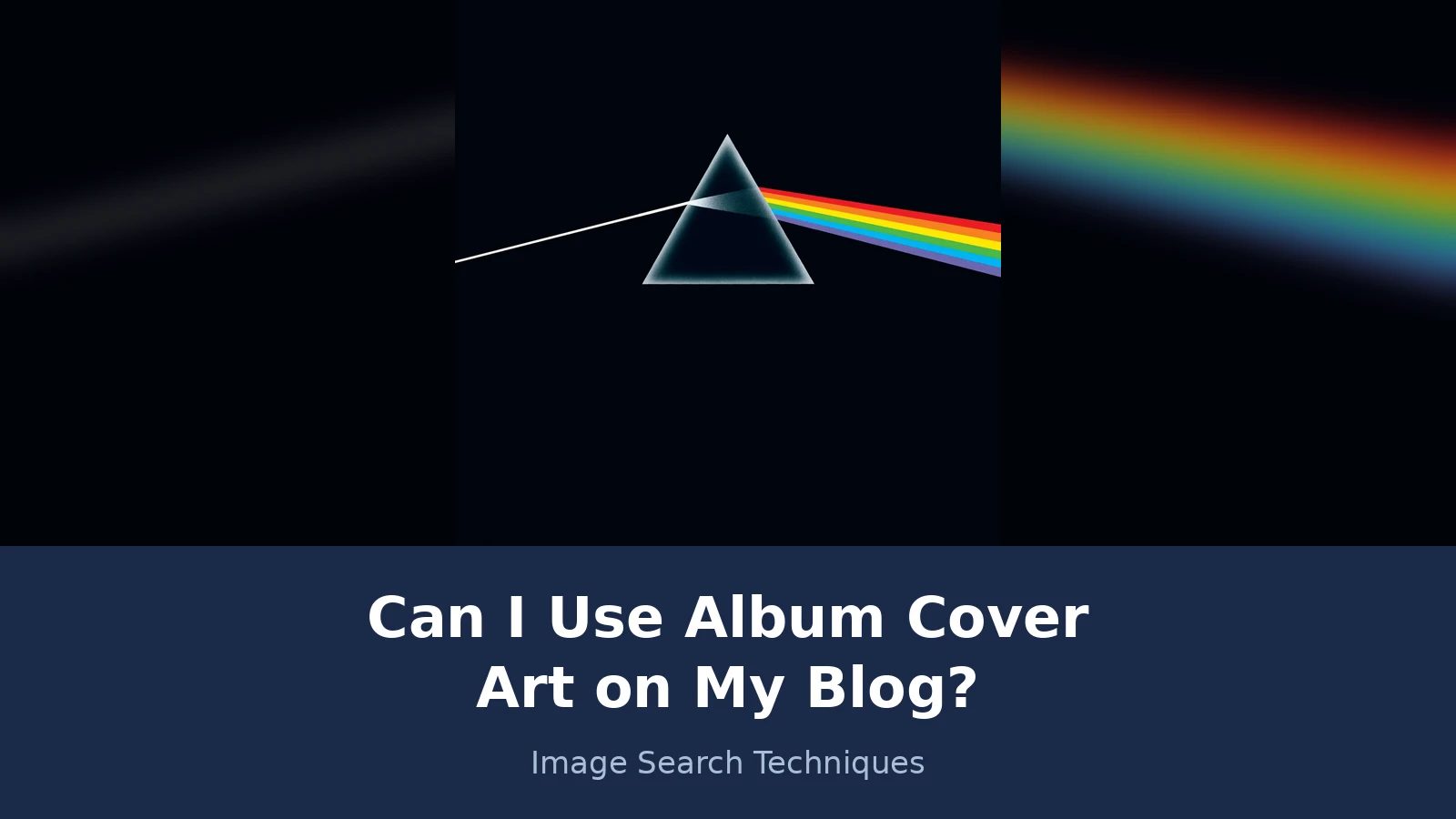
Advice is cheap, so I tested the method on a real cover. The cover is Pink Floyd’s The Dark Side of the Moon. The sleeve was designed by Hipgnosis with George Hardie, who drew the prism, and the band chose it from seven designs. The album was released on 1 March 1973 in the US by Capitol and on 16 March 1973 in the UK by Harvest. I took the cover image from the album’s Wikipedia page and reverse searched it live on 21 November 2026.
TinEye searched 86.8 billion images and returned 3,448 results. The earliest match it had indexed was 6 February 2008, a forum post that reused the cover as a banner image. The source Wikipedia page appears among the matches. The results also show how the cover travels: stock sites sell lookalike prism images, Alamy lists a photograph of the vinyl sleeve, and forums and fan pages have reused the cover for years. None of those results is a licence. A stock lookalike is a different image, and a forum reuse is just somebody else using the cover without showing any permission.
Yandex named the image correctly at once: “The Dark Side of the Moon”, labelled Album, with a description drawn from the Russian Wikipedia page. It showed 75 similar images on first load and 50 sites containing the image. The first sites were a Russian retailer selling the vinyl, a technology site whose caption credits the cover to “Harvest Records/Pink Floyd”, a Forbes article about the cover’s designer, a marketplace listing, and a bookshop page for a book about the album. That caption is how ownership shows up in the wild: the label’s name travels with the image, even on pages that have nothing to do with music.
Google Lens did not run. Google blocked the search with its unusual-traffic wall and the service was cooling down until 08:45 PKT, so Lens produced no count at all. That is a blocked test, not a zero, and I am reporting it as blocked rather than pretending the engine found nothing. The two engines that did run agree with each other: this is a famous, widely copied cover, and its owner is easy to find.
The reverse search also turned up a twist worth knowing. Wikipedia’s file page for this cover says the prism design is ineligible for copyright in the US, because it consists of simple geometric shapes with no original authorship, and the page lists the image as public domain on that basis. The same page warns “Do not copy this file to Wikimedia Commons. Not free in home country, UK.” So the same image is treated as free in the US and still protected in the UK. That is the exception, not the rule. Most album covers carry photography or illustration and are fully copyrighted everywhere, and the gatefold, posters and band photographs from this same album are not covered by the prism’s US tag at all. Do not take this one file’s tag as permission to use any cover. If you want to know whether a cover is safe, check the file page and the licence on it, and check the law where you publish. Our guide to finding a song or album from its cover art shows the same reverse-search routine step by step.
Before you use any cover, run the same check. First, reverse search the image, as I did above, to find the owner and the official source: the label site, the artist’s page, or the Wikipedia file page. Second, read the licence on the page where you found it. Third, ask whether your use is a genuine review, decoration, or commercial use, and match it against the table above. If you cannot find the owner, that does not make the image free: an orphan work is still owned by somebody, and using it without permission is still a risk. Our guide on how to check a photo’s licence before you use it walks through the licence check in full, and our guide to reverse image search covers the search engines themselves.
Answer capsule: reverse image search tells you who owns the art and where it is licensed, and it never gives you permission.
What should I do instead?
If the table says your use needs permission, there are better options than taking a chance on the cover. Work through them in order.
- Write the review first. If the post genuinely reviews the album, a small thumbnail with a credit is the safest use available. Let the words do the work and keep the image small.
- Use the label’s own images. Check the label’s press or media page, or the artist’s official site, for approved artwork. Review copies and press images are supplied for exactly this purpose, and the terms on the page will tell you what you may do with them.
- Ask in writing. For commercial use, or any use beyond a small review thumbnail, ask the label or the artist’s management for permission and keep the reply. A short email is enough, and a written yes protects you later.
- Photograph your own copy, in a review. A photo you took of your own record, used small inside a genuine review with a credit, is the strongest of the risky options. It is still a reproduction of the artwork, so the review context and the small size are doing the work, not the fact that you own the record.
- Use an image you do have rights to. A photograph you took at a concert, a public-domain image, or a stock photo can illustrate a music post without touching the cover at all. Do not use a stock lookalike of the cover and pretend it is the cover: that misleads readers and still borrows the design.
- Link instead of showing. If you cannot get permission, link to the album on the artist’s page or a streaming service and describe the cover in words. A link is not a reproduction, and it sends readers to the owner.
If you are unsure, the cautious route is the right one. Removing a cover from a post costs you a picture. A takedown notice, or a complaint from a label, costs you the post and the trust of your readers. The law here is general information, not legal advice: the rules are different in the US and the UK, every case turns on its facts, and a solicitor is the right person for a use you are unsure about. For the fair use side of that decision, our guide to fair use images on your blog works through the four US factors with examples.
Answer capsule: when in doubt, review it small, ask for permission, or link instead of showing the cover.
FAQs
Can I use an album cover on my blog if I credit the artist?
No. A credit names the owner, but it does not give you permission. Credit is a condition of the UK fair dealing exception for criticism and review, not a substitute for a licence. If your use needs permission, you still need to ask the label or the artwork owner for it.
Is it fair use to use an album cover in a review?
In the US, yes, when the post genuinely reviews that album and the image is a small thumbnail with a credit. Criticism and comment are named in Section 107, and a review thumbnail is a transformative use. In the UK, fair dealing for criticism or review under section 30 allows the same use, with a sufficient acknowledgement.
Can I use a photo I took of my own vinyl record?
Your photograph is your own work, but the cover inside it is still the label artwork, so the photo does not give you a free pass. A photo of your own copy, used small inside a genuine review with a credit, is the strongest version of this idea. As decoration, it is still a reproduction of the artwork.
Is album cover art on Spotify free to use?
No. Streaming services license the artwork for listening, and the licence does not extend to your blog. Spotify terms say the content is licensed, not sold, and that Spotify and its licensors retain ownership of all copies. Downloading a cover from a streaming app gives you a file, not a licence, so you still need permission to publish it.
What happens if I use an album cover without permission?
The owner can ask you to remove the image, send a takedown notice to your host, or, in serious cases, take legal action. Most disputes end with the image being removed, but a label can also claim damages where the use was commercial. If you receive a notice, remove the image promptly and do not re-upload it.
Can I use an album cover on a blog that earns money from ads?
Commercial use weakens your defence on both sides of the Atlantic. In the US, a commercial purpose weighs against fair use. In the UK, most fair dealing exceptions are non-commercial, and courts weigh market impact heavily. If your blog earns money from adverts or affiliates, get a licence for the cover or use an image you have rights to.