🔎 Reverse Image Search
Image search techniques made simple: upload a photo or paste a URL and search 6 engines at once. 100% free, nothing stored.
🔒 Your image is never stored on our servers longer than 24 hours and is never shared.
A fake shop using my product photos can steal sales and trust fast. Find every copy with a reverse image search, save screenshots before you report anything, then file on Meta’s copyright form for your photos or TikTok’s copyright form, because Instagram’s impersonation form is built for a person holding ID and stalls for a business.
What this means in plain words: a fake shop is any account or storefront that copies your product photographs, your brand name or your logo to sell something, while pretending to be you or trading on your name. It is not a fan page, and it is not a reseller of your genuine stock. The photos are the proof, and the photos are also how you find it. It is not the same as a tradesperson’s real job photos being taken. If a competitor is using your before-and-after shots of a real job, our guide to a competitor stealing your before-and-after job photos covers the trades proof pack and the host takedown route.
If you sell anything with photographs, this has probably happened to you already, or it will. A customer messages you about an order you never took. A friend spots your best-selling product on an account you have never seen. Your hero shot, the one you paid a photographer for or staged on your kitchen table, is now the face of a shop with a different name, a different price and no intention of sending anything. This guide is written for the brand owner on the receiving end of that, and it stays on your side of the problem. If you are a shopper trying to work out whether a shop is real, our guide to checking whether an online shop is real from its product photos is the one for you.
How can you tell a shop is using your photos?
The first sign is usually a customer, not a tool. Someone asks where their order is, and you have no order. Someone tags you in a post selling your product at half your price. Someone leaves a review on your page about a parcel that never arrived from a shop that is not yours. Take every one of those messages seriously, even the ones that sound confused. The customer is describing the fake shop’s behaviour, and the details they give you, the handle, the price, the link in the bio, are the start of your evidence.
The second sign is your own photos turning up where they should not be. Your product shots have a look: the same background, the same light, the same angle, the same props. When a stranger’s account has five of them in a row, that is not coincidence. A single shared photo can be a repost with credit. A full set, lifted in order, is a shop built from your catalogue. Check the bio as well. A fake shop often copies your bio word for word, then changes the link and the contact details. Compare the follower count with the account age. An account created last month with 200 followers and a shop tab full of your products is not a new competitor. It is a copy.
Watch the price. A fake shop almost always undercuts you hard, because it has no stock, no costs and no intention of shipping. If your product sells at 60 pounds and the copy sells it at 19, the price is the tell. Watch the payment route too. Real shops take cards through a normal checkout. A fake shop pushes you to a bank transfer, a payment link in a direct message, or a gift card. That is the same pattern our complete guide to protecting your photos online warns about, and it applies to your customers as much as to you.
How do I find a fake shop using my product photos?
You find it by searching with the photo itself, not with words. A reverse image search takes your product shot and looks for every place it appears on the web, including social profiles, shop listings and adverts. Start with your hero shots, the images that appear on your best-selling listings, because a fake shop copies the photos that sell. Then work through the rest of your catalogue in order of sales, not in alphabetical order. A monthly sweep of your top ten images catches most copies before they have taken many orders.
Here is the sweep method, step by step.
- Pick your hero shots. Choose the five to ten product photos that bring in the most sales. These are the ones a copier wants.
- Search each one. Run every photo through a reverse image search, using our guide to how to reverse image search if you have never done it. Save the original file, not a screenshot of it, because a screenshot is a new image and matches less well.
- Open every match that is not you. Your own website, your own social accounts and your genuine stockists will appear. Ignore those. Open the rest and check whether the page is selling something.
- Run the flipped and cropped variants. Some copiers flip your photo or crop it to dodge a search. Flip the image horizontally, crop 10 to 20 percent off one edge, and search again. A match in flipped form is strong evidence, and our flipped-photo technique explains the method in full.
- Check the adverts too. A fake shop that never posts can still run paid ads with your photos. Search Meta’s Ad Library by your brand name to see who is buying attention against it today.
- Save everything before you report. Screenshot each copy with the date visible, save the page link, and keep your original file beside it. Accounts get archived or deleted once they know they have been noticed, and a dead link is not a claim.
That last step matters more than the search itself. The reporting forms ask for links to specific posts, not for a profile address, and they cap the number of links you can attach. If the posts disappear before you file, you have lost the material the form needs. Search first, save second, report third. Never warn the account first.
The worked example: one product photo, five engines
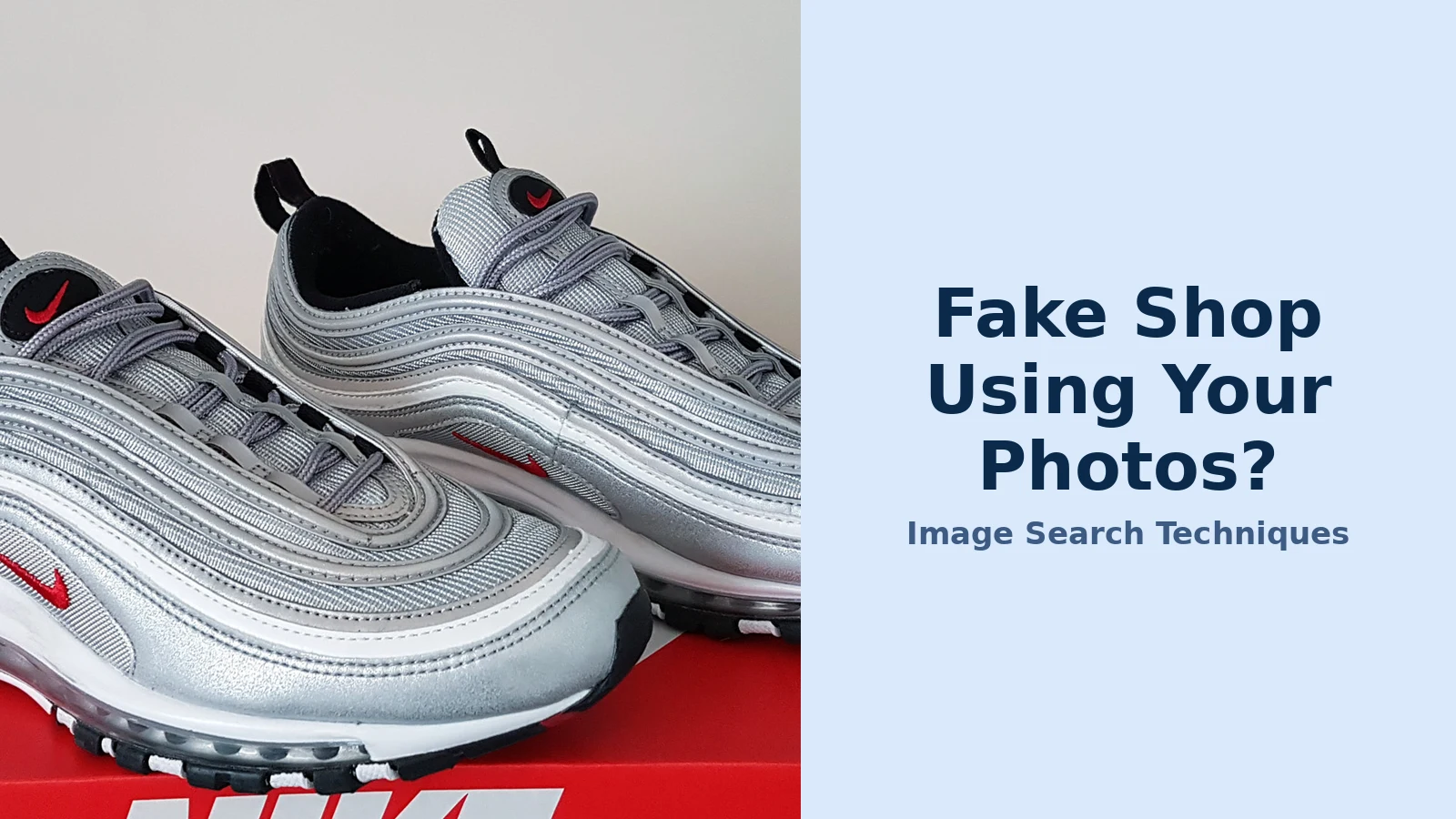
To show what the sweep actually returns, I ran a real product photo through the search on 13 November 2026. The photo is a Nike Air Max 97 trainer shot from Wikimedia Commons, the kind of clean catalogue image a fake trainer shop would lift whole. Here is what each engine found.
| Engine | Exact matches found | Top source named |
|---|---|---|
| Google Lens | 147 result links on the Exact matches page (Google shows no total count) | TheGrio article about the Air Max 97 “Silver Bullet” (11 Nov 2022); the Commons source file itself appears 4th. Top visual match: an Amazon listing for the same shoe. |
| TinEye | 3 results, from 86.7 billion images searched | sorayacartegui.com, the full-size file, first indexed 24 Oct 2021. TinEye did not list the Wikimedia Commons source page itself. |
| Bing | 2 pages with this image | Wikiwand “Nike Air Max” first, Wikipedia second. Bing named the shoe as the Air Max 97 OG “Silver Bullet” and its top web result was StockX. |
| Yandex | 15 sites listed, plus 9 copies in other sizes including the original | cozumdisleksi.com first; the Wikimedia file page appears 15th, with Wikipedia’s Nike Air Max article also listed. |
| 0 | Nothing. The tool’s Pinterest button opens a keyword search for the image’s host domain, not a visual search, and the 17 pins it returned were unrelated Wikimedia images. |
Every engine recognised the photo as the Nike Air Max 97 “Silver Bullet”, but the exact-match counts are wildly different, because each engine counts an exact match differently and each one indexes different sources. TinEye missed the Commons source page that Lens put fourth, and Yandex found copies in nine sizes that Bing never showed. That is the practical lesson of the sweep: never trust one engine. Run at least two, open every match that is not you, and treat a blank result on any single engine as nothing on its own. No CAPTCHA appeared on any engine this time, and the tool’s Google and Lens buttons open the same Lens page, so Lens is counted once.
Which Instagram report form should a business use?
This is the decision the whole article turns on, because the form most guides point a business to is the one that stalls. Instagram’s impersonation form is built for a person, not for a company. It says it can only act on reports from the person being impersonated or their authorised representative, and it asks for a photo of that person holding their ID. A brand has nobody to put in that photograph. If one of your people is being impersonated by name, that form is theirs and they should file it with their own documents. If the fake is wearing your company’s name, it is not your form.
The routes that work for a brand are Meta’s intellectual property forms, and the choice between them depends on what the fake account actually took. That is the route map.
| What the fake account did | Which form to use | What it asks for | What you give up |
|---|---|---|---|
| Reposted your product photographs | Copyright report form | Where you assert rights, the rights owner’s name, an example of your work, up to 30 links, a good-faith statement and your electronic signature. No registration needed. | Your name and email address are passed to the person you reported. |
| Used your brand name or logo | Trademark report form | One trademark per report, where it is registered, the registration number, and links to the specific posts. | Your name and email address are passed to the person you reported. |
| Sells fakes of your product | Counterfeit report form | Registration details including a link to the registry record, up to 30 links, and a path for when you have no links. It warns that other claim types will not be dealt with here. | Your name and email address are passed to the person you reported, and the form warns that abuse of it may end your own account. |
| Pretends to be a named person at your company | Impersonation report form | A photo of that person holding their ID, one account per report. | Nothing. The report stays anonymous, but a company has no photograph to attach. |
One row does most of the work. If the fake account is using your photographs, take the copyright route, because it is the only one of the four that asks for nothing you have to have registered in advance. Your photographs are protected from the moment you take them, and the form was built for exactly that. File it here: Instagram’s copyright report form. A stolen-photo case sent to the counterfeit form runs into its own warning that other types of claims will not be addressed through it, and you will have to file again somewhere else. Creators face the same pattern on video: our guide to a stolen YouTube thumbnail covers the find-and-claim routine there. A brand report on the impersonation route stalls on a request for identity documents nobody at your company can produce. Neither of those is a decision about your case. Re-file on the route that matches what was taken.
Two things about every intellectual property route are worth deciding before you file rather than after. First, Meta will hand your name and email address to the person you reported. The forms state it plainly, so use a business address you are happy to have read back to you and keep the description factual. Second, Meta publishes no turnaround commitment on any of these pages. Silence is not the same as a decision, and any specific number of hours you have read about these forms did not come from Meta. What Meta does publish about accounts is one sentence: it removes accounts that engage in repeated violations of its policy. No strike count is published with it, so the record you build matters more than any single report.
If you own a registered trademark, the forms also point you toward Brand Rights Protection, a tool for finding and reporting trademark violations, counterfeit products and copyright infringements across Meta’s platforms in one place. The one gate stated on the forms is owning a registered trademark. Beyond that, the application criteria are not published, and no review time is published either. It is worth applying for if you qualify, but it is not a reason to delay filing the copyright report on the copies you have already found.
What is the TikTok equivalent?
TikTok runs the same split as Instagram: copyright and trademark travel separately, and the form you need depends on what was taken. TikTok’s Intellectual Property Policy, in force since 26 April 2025, covers both, and it publishes no review deadline for either. Do not expect a date. Expect a process.
| What the fake account did | Which TikTok route | What it asks for |
|---|---|---|
| Reposted your product photographs or video in a post | Copyright infringement report form | Proof you own the work, the links to the infringing content, and a compliant notice. No registration needed. |
| Used your brand name or logo to pass as you | Trademark infringement report form | A registered mark, the registration number and certificate, the infringing links, and an explanation of how the use confuses people about who stands behind the account or product. |
| Sells counterfeit goods in a TikTok Shop listing | TikTok Shop Intellectual Property Protection Centre | Register as a rights owner first, with your IP documents, then file the complaint against the listing from one portal. |
| Runs your photos in a paid TikTok advert | IP infringement in advertising report | The advert link and the same ownership proof as the copyright route. |
File the copyright cases here: TikTok’s copyright infringement report form. Inside the app, the quick route to a single account is to open it, tap the share icon or the three dots, choose Report, then pick Pretending to be someone, Fraud and scams, or an intellectual property violation depending on the situation. Treat that as a flag, not as your filing. The web form is where the evidence goes.
TikTok’s counterfeit route has one more step than Instagram’s. The TikTok Shop Intellectual Property Protection Centre asks you to register as a rights owner before you can complain, and that means identity verification and uploading your IP documents first. A trademark needs the official certificate from the relevant national authority. A copyright claim needs a registration certificate or a claim statement plus an image of the copyrighted material. Only then can you search for infringing listings and file against them. It is slower to set up and stronger once it is running, which is why it is worth doing before you need it rather than after the copies appear.
Two honest limits apply on TikTok. First, trademark rights are territorial. A mark registered only in the UK cannot support a complaint about a listing operating in another country, so file where your rights actually exist. Second, TikTok’s own policy says it may give the reported user information about your report, such as the name of the copyright owner, so the same disclosure trade as Instagram applies. TikTok does have a repeat infringer policy under which it bans the account of a user who repeatedly commits trademark infringement, in appropriate circumstances. Keep every report reference, because the second and third reports against the same operator are built on the first.
What if the fake shop is running ads with your photos?
A fake account with 200 followers is an annoyance. A fake account with an ad budget is a sales channel, and it is the version that reaches your customers without ever appearing in your mentions. The FTC’s data spotlight from April 2026 puts a number on how that reaches people: nearly 30 percent of people who reported losing money to a scam said it started on social media, with reported losses reaching 2.1 billion dollars, and more than 40 percent of people who lost money to a scam on social media said it started when they ordered something they had seen in an ad. Those are reports made to one agency, not a measure of the whole problem, but they describe the shape of it. The same agency reported in June 2026 that people lost 3.5 billion dollars to imposter scams in 2025, with nearly 1 billion dollars going to business impersonators. Your photos in a paid ad are the sharp end of that.
There is a discovery surface for the ads themselves. Meta’s Ad Library is public, and you can search it by your brand name to see whether somebody is buying attention against your name today, rather than waiting for a customer to tell you. Search your brand name, your product names and common misspellings. When you find an advert using your photographs, screenshot it with the advertiser name and the date in frame, then report it through the copyright form, because the advert is the infringing content and the form takes links to specific content. On TikTok, the equivalent is the IP infringement in advertising report, listed in the table above.
Clone ad accounts are cheap to run and quick to replace, so expect the account to come back. One pattern, described by people who have done this, is the clone returning as the same handle with an underscore added, then another underscore, then a dot, working through the variations of a name that is already taken. Keep the link list, the captures and the report references from every filing, so the next report is an edit rather than a rebuild. Then work the parts that cost the operator money: the domain behind the bio link, the host, the payment page. An account is free. A domain has a registrar with an abuse desk, and a registrar acts on hosting and naming rather than on posts. That is where a copy that keeps returning finally gets expensive to run.
What evidence should you save before you report anything?
Report forms are narrow and there is no credit for volume. What every route needs is a link, a capture and a reason. Build the pack before you file, because posts can be archived or deleted before a review happens, and a dead link is not a claim.
- A direct link to every post you plan to name. Not the profile. The forms cap at 30 links, so the list is the report.
- A screenshot of each one with the date in frame. Capture the handle, the photo, the caption and the bio link in the same shot where you can.
- Your original beside theirs. For a photograph, the camera file with its embedded date, or your own product page showing when it went live. The original file proves the photo is yours in a way a screenshot never can.
- Whatever the bio points at. The storefront is where the money is, and it is a separate report to a separate company. Save the shop address and the domain name.
- The advert, if there is one. Screenshot the advert from the Ad Library with the advertiser name visible, and keep the library link.
- Your report references. Keep the confirmation number or email from every filing, with the date, so the next report against the same operator names the pattern.
Store the pack in one folder per fake shop, named with the handle and the date you found it. If the same operator returns under a new handle, you will know it is the same person from the photos, the prices and the bio, and your second report will take minutes instead of an afternoon. Our guide to removing your photos from Google covers the search-result side of the same problem, for copies that have already been indexed.
What do you do when the report goes nowhere?
First, check you filed on the right form. A stolen-photo case on the counterfeit form, or a brand case on the impersonation form, was never going to work. Re-file on the route that matches what was taken, with links to specific posts rather than a profile address. A profile URL is not a claim the copyright form can act on. The trademark form takes an account-level report only when the profile itself uses your mark, in the picture, the name, the username or the bio.
Second, keep filing. Meta removes accounts that engage in repeated violations, so a second and third report against the same operator, each naming the new handle and referencing the earlier reports, is how an account removal happens. One post report usually removes the content you linked to, not the account. That is a feature of the system, not a failure of your report, and it means the record matters.
Third, go after the storefront rather than the posts. The fake shop’s website has a host and a registrar, and both have abuse desks. A copyright notice to the host, with your originals and the copied links, is a different lever from a social media form, and hosts act on it because they carry the liability. The domain registrar can act on the naming side. This is also where the bio link pays off: follow it, and the shop gives you a domain, a checkout and sometimes a payment provider, each of which is a separate place to complain.
Fourth, warn your customers in public, once, from your real account. A short post saying you have one official account and one official shop, naming the fake handles you have found, stops some orders before they are placed. Do not name the operator as a criminal and do not post their personal details. State the facts: these accounts are not us, we have reported them, here is our only real shop link. Customers who have already paid should be pointed to their bank or card provider and to Action Fraud, not told to chase the fake shop themselves. This is general information, not legal advice, and for a case involving real money or a persistent operator, a solicitor’s letter is the next step, not another form.
What mistakes make a fake-shop report fail?
The most common mistake is reporting the account instead of the content. The copyright and trademark forms are scoped to specific links, so a profile address on its own is not a claim. The second is filing on the impersonation form and then waiting. A business cannot supply the photo of a person holding ID that the form asks for, so the report stalls on a request you cannot answer, and the silence that follows is not a decision. The third is warning the account before you save the evidence. A fake shop that knows it has been noticed archives its posts, and the links stop resolving before the form is filed.
Two more mistakes are worth naming. One is treating a single report as the end of the job. The account will come back under a new handle, and the work is the sweep, the pack and the re-file, repeated until the operator finds it cheaper to stop. The other is drifting into marketplace listings in this same report. Listings on eBay, Amazon or Facebook Marketplace are a different surface with different forms, and our guide to copycat listings that stole your product photos covers them properly. Keep this report to social shops and clone ad accounts, and file the marketplace copies separately.
Finally, do not try to buy the product to test it, and do not message the seller to argue. A test purchase hands money to the operator and teaches you nothing the photos have not already shown. A message tells the operator you are watching and gives them your details. Save the evidence, file the report, and let the platform and the host do the work.
The same photo theft hits estate agents too. When a listing is cloned, the agent’s photos end up under another name with a different price, and our estate agent guide to cloned listings walks through the audit, the evidence pack and the portal report routes.
Can I report a fake Instagram shop if I do not own a trademark?
Yes. The copyright route is the one for you, because your photographs are protected automatically and the form asks for no registration. You file as the rights owner, name the posts by their links, and sign a good-faith statement. A trademark only matters when the complaint is about your brand name or logo, not your photos.
How long does Instagram take to remove a fake shop?
Meta publishes no turnaround time, so there is no honest number to quote. Silence is not a decision. What usually happens first is that the posts you linked are removed, while the account stays up, because the forms are scoped to specific content. Account removal follows repeated violations, so keep every report reference and re-file when the shop returns.
What if the fake shop is on TikTok instead of Instagram?
TikTok runs the same split. Use its copyright form for your photos, its trademark form for your brand name or logo, and the TikTok Shop Intellectual Property Protection Centre for counterfeit goods in a Shop listing. TikTok publishes no review deadline in its policy, so expect a process rather than a date, and keep your report references for next time.
Should I message the fake shop or buy the product to test it?
No to both. Messaging tells the operator you are watching and hands them your details, and the posts get archived before you can file. A test purchase hands them money and teaches you nothing the photos have not already shown. Save the evidence first, file the report with the links, and let the platform and the host do the work.
Can I stop anyone copying my product photos in the first place?
Not completely. Any photo you publish can be saved, screenshotted or reposted, and a watermark only slows a copier down. What you can do is make copying less useful: keep your original files private, watermark the images that sell best, and run a reverse image search on your hero shots so you find copies while they are still new.
What if the same fake shop keeps coming back under new names?
Assume it will, because an account costs nothing and takes a minute to make. Keep the link list, screenshots and report references from every filing, so the next report is an edit rather than a rebuild. Then work the parts that cost the operator money: the domain, the host, and the payment page.
See also: find an item by image