
🔎 Reverse Image Search
Image search techniques made simple: upload a photo or paste a URL and search 6 engines at once. 100% free, nothing stored.
🔒 Your image is never stored on our servers longer than 24 hours and is never shared.
If you are threatened with leaked private photos, the first hour matters more than the first day. Someone has just told you they will post your private photos online unless you pay, send more, or do what they say. Your hands are shaking, and the worst part is the waiting. You do not know if they really have the photos or if they are bluffing, and every minute feels like the deadline. This guide answers the question readers keep asking on Quora: “How do I deal with someone who is threatening to post my private pictures online?” It covers the threat stage only, the hours before anything is posted, step by step.
The short answer: Do not pay, do not reply, and do not send more photos. Save screenshots of the threats, block the account and report it. If you are an adult, pre-register the photo with StopNCII so platforms can block it, and report the threat to the police. If you are under 18, tell a trusted adult and use Take It Down instead.
What sextortion means: Sextortion is blackmail with an intimate image. Someone threatens to share a photo or video of you, real or fake, unless you pay money, send more images, or do something else they want. The threat itself is a crime in many places, even if nothing is ever posted. This guide is general information, not legal advice. If you are in immediate danger, contact the police first. This guide is one part of our face search and photo privacy guide, which covers how to keep your photos under your control.
What is happening when you are threatened with leaked private photos?
You are being blackmailed, and the person threatening you is the one breaking the law, not you. That sounds obvious, but it is the sentence most people in this situation need to hear first. The shame is the weapon. The threatener counts on you feeling too embarrassed to tell anyone, and that silence is what makes the threat work.
There are three usual shapes to this threat, and the right first move is the same for all of them. The first is an ex-partner, or someone you dated, who has photos from the relationship and now uses them as leverage. If the photos are ordinary, non-intimate pictures your ex is posting, the route is different, and our guide to an ex posting photos of you online covers that case. Intimate photos are a different matter, and this guide is for those.
The second shape is a stranger you met online. It often starts fast: a friendly chat, a move to a private app, a video call that was recorded without you knowing, or a request for one photo that turned into a demand for more. The FBI calls this financially motivated sextortion, and its warnings say the person on the other end is often overseas, working through many victims at once, and following a script. The third shape is someone who took a photo of you without you knowing, in a public place or a private one. A photo taken without consent is not a smaller problem, and our guide on a stranger taking photos of your family explains the in-the-moment side of that situation.
Some threats are bluffs. The person may not have any photo at all, and may be sending the same message to hundreds of people hoping one of them panics. You cannot tell a bluff from a real threat by reading the message, so do not try. Act as if it is real for the first hour, do the steps below, and let the evidence, not the fear, decide what happens next. The deadline they gave you is part of the pressure. It is almost never a real deadline. Nothing they do gets better for them if you rush, and everything gets worse for you if you do.
What should you do in the first 10 minutes?
Do nothing that gives them more leverage: no payment, no reply, and no more photos. That is the whole of the first ten minutes, and it is harder than it sounds, because every instinct tells you to fix it now.
Do not pay. The FBI, the Revenge Porn Helpline and every police force that publishes advice on this say the same thing, and they say it because the evidence is consistent: paying rarely ends the threats. The Revenge Porn Helpline puts it plainly. The amount is set to be just enough to make you pay, it will not be enough, and they will come back for more. Once someone knows you will pay, the demands usually continue and grow. The same applies to sending more photos or videos in the hope of calming them down. It hands them more material to threaten you with.
Do not reply, negotiate, or explain. You do not have to answer at all. Every reply teaches them what scares you, and a long back and forth gives them more of your words to use. If you have already replied, stop now. Stopping is not rude, and it is not an admission. It is the single most useful thing you can do in the first minutes.
Do not delete the chat. Your first instinct may be to wipe everything and pretend it never happened. Do not. The messages are your evidence, and you need them before you block anyone. Tell one person you trust what is happening, even if it feels embarrassing. You do not have to handle this alone, and a second pair of eyes helps you think clearly when yours will not.
How do you save the evidence before you block them?
Screenshot everything first, because blocking can delete the messages you need. Work through these steps in order, and do them before you press block or report.
- Screenshot the threat messages. Capture the full screen, showing the username or phone number, the message itself, and the date and time. Take more than one screenshot if the conversation runs long.
- Screenshot the profile. Capture the account name, photo, bio, follower count, and the profile link. If the account is deleted later, this may be the only record that it existed.
- Note any payment details they sent. Write down the wallet address, account number, or payment link exactly as given. Do not pay it. The details are evidence for the police, not an invoice.
- Record the chat if messages can disappear. On some apps messages delete themselves. A screen recording of you scrolling through the conversation keeps a copy that a screenshot of a single message does not.
- Write down the timeline in your own words. When you first met them, where, what you sent, what they asked for, and when the threats started. Memory fades fast under stress, and the police will ask for this.
- Do not forward or re-upload the intimate photo itself, even as proof. Describe it instead. Sending it on, even to the police or a helpline, spreads the very image you are trying to contain, unless they specifically ask for it through their own secure route.
- Store the evidence somewhere safe. Put the screenshots in a folder only you can open, or email them to an address only you control. If the photo is already posted somewhere, note the web address before you report it, because reporting can take the page down before you have the link.
If the images were taken when you were under 18, the rule is different: do not save, send, or download extra copies of the image at all. Tell a trusted adult and let the National Center for Missing and Exploited Children guide you. The under-18 section below explains why.
How do you check whether the photo is already online?
A reverse image search tells you whether a copy is already circulating, and it takes two minutes. But there is one rule that comes before the method: never upload the private photo itself to a search engine. That would spread the image you are trying to contain. The check below uses a public stand-in photo to show you how the method works, and the same steps apply to any photo you are happy to be public, such as the threatener’s own profile picture.
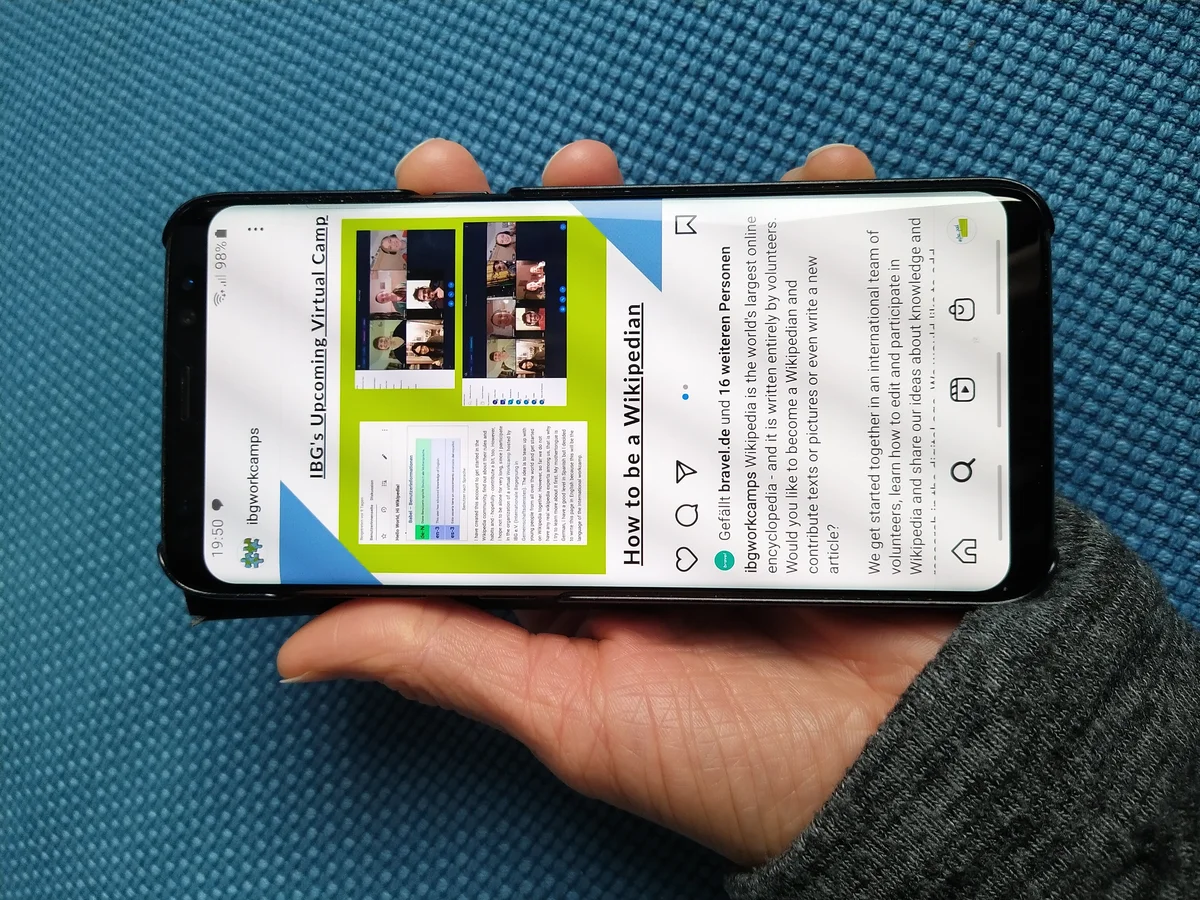
We ran the test on 15 November 2026 with a real public photo: a hand holding a smartphone, by Wikimedia Commons user Mictlancihuatl, licensed CC BY-SA 4.0, 3000 by 4000 pixels. We searched it by its public web address on TinEye and on Google Lens, the two tools our how to reverse image search guide recommends for this job. TinEye searched over 86.7 billion images and found 0 matches, which it explained by saying it has yet to crawl any pages where this image appears. Google Lens failed outright, showing “No image at the URL” on both its exact match and visual match tabs, even after a retry in a fresh tab. That is a failure, not a clean result, and we are reporting it as one.
Here is what the two outcomes mean for you. A zero on TinEye means the photo has not been found on any page TinEye has crawled so far. It does not prove the photo is nowhere, because a photo can sit on a page TinEye has not visited yet, or on a private account, or in an encrypted chat. A failed Lens search means nothing at all: the tool could not fetch the image, so it checked nothing. If a search does return matches, look at where they are, not just how many there are. A match on a public page tells you the photo is already out there, and you should save that page address as evidence before you report it. A match on a site you do not recognise is worth a closer look, because it may be the threatener’s own upload.
The honest limit is this. A reverse search can only find copies that are public and indexed. It cannot see inside private messages, closed groups, or encrypted chats, which is where a leaked private photo usually spreads first. That is why the next step matters more than the search: pre-registering the photo so platforms block it before it can spread.
How does StopNCII stop the photo spreading before it is posted?
StopNCII turns your photo into a digital fingerprint on your own device, and platforms block matching uploads. This is the single most useful step in the threat stage, because it works before anything is posted, and it is free.
StopNCII.org is run by the UK Revenge Porn Helpline, which is part of SWGfL, a UK not-for-profit charity, and it was developed with Meta. It works by generating a hash from your intimate image or video. A hash is a short code, like a barcode, made from the file. Identical copies of the image produce the same hash, so a platform can recognise the image without ever seeing it. The fingerprinting runs on your own device. The picture or video is never uploaded, and only the hash leaves your device. StopNCII then shares that hash with participating companies, which compare new uploads against it and remove matches under their own rules. The algorithms are PDQ or PhotoDNA for photos and MD5 for videos. Participating companies include Facebook, Instagram, Threads, TikTok, Reddit, Snap, X, Bluesky, Patreon, Depop and Microsoft, plus adult platforms such as OnlyFans and Pornhub. Our full StopNCII and Take It Down guide walks through the whole service, and the official tool is at StopNCII.org.
Before you can create a case, StopNCII asks you to confirm a short eligibility checklist, and you should answer each point honestly, because ineligible media will not be removed. You must be the person who appears in the image or video. You must have been 18 or older when it was taken, and 18 or older now. It must show you nude, semi-nude, or in a sexual act, and you must not have agreed to it being published online. Commercial or professional images, such as content made to sell, are excluded from the case form. If the image was taken when you were under 18, even if you are an adult now, StopNCII is not the right service. Use NCMEC’s Take It Down instead.
To pre-register, follow these steps:
- Go to StopNCII.org and start a case. You do not need an email address. You will receive a case number and a PIN.
- Choose the intimate image or video from your device. The hash is created on your phone or computer, and the file itself stays where it is.
- Save the case number and PIN somewhere safe before you press submit. StopNCII warns that if they are lost, they are not recoverable, and you need them to check your case status or withdraw it.
- Wait. StopNCII says you may need to wait 3 to 5 days to see updates on your case dashboard, while the hash is sent out to the participating companies.
- Hash every version. If the image is cropped, filtered, or a video is trimmed, the original hash may not recognise the new version, so each edited version needs its own hash.
Know the limits before you rely on it. Hash matching finds exact or near-exact copies on participating platforms only. It cannot reach services that have not joined, or encrypted chats. It is a blocking layer, not a magic eraser, and StopNCII says so itself. But as a threat-stage move it is the best one available: once the hash is in the bank, the platforms are watching for the photo, and the threatener’s main leverage, that they can post it anywhere, is much weaker. If the photo has already been posted, report it to the platform first, then add it to StopNCII for future protection.
Who should you report the threat to?
Report in three places: the platform, the police, and the specialist helpline for your country. One report is rarely enough, because each one does a different job. The platform can remove the account, the police can investigate the person, and the helpline can help with both.
Start with the platform. Report the account inside the app, using the harassment, blackmail, or non-consensual intimate image category. Report before you block where it is safe to do so, because blocking first can make the report harder to file, and keep the reference number the platform gives you. Instagram, WhatsApp, Snapchat and Facebook all have an in-app reporting route for this, and the Instagram Help Center has a dedicated page on dealing with blackmail. If the platform refuses or does nothing, report again with the evidence screenshots attached, and note the date of each report.
In the UK, report to the police on 101, or 999 if you are in immediate danger. The threat itself is an offence here. Section 66B(4) of the Sexual Offences Act 2003, inserted by section 188 of the Online Safety Act 2023 and in force from 31 January 2024, makes it an offence to threaten to share a photograph or film which shows, or appears to show, another person in an intimate state, intending that the person will fear the threat will be carried out, or being reckless about it. It carries up to two years in prison on indictment. The full text is on legislation.gov.uk. You can also contact the Revenge Porn Helpline on 0345 6000 459, Monday to Friday from 10am to 4pm, or by email at help@revengepornhelpline.org.uk. The helpline is for adults aged 18 and over in the UK, it is free and confidential, and it can help with reporting and removal. If you paid money, report that to Action Fraud as well, because the payment is a separate crime with its own evidence trail.
In the US, report to the FBI through IC3.gov, or call 1-800-CALL-FBI. Threatening to injure someone’s reputation to extort money or something else of value is a federal crime under 18 U.S.C. 875(d). The TAKE IT DOWN Act, signed into law on 19 May 2025, makes it a federal crime to knowingly publish intimate images of an identifiable adult without consent, including AI-generated ones, and separately punishes threats to publish them. Since 19 May 2026, covered platforms must remove a reported intimate image within 48 hours of a valid request and make reasonable efforts to identify and remove known identical copies, and the Federal Trade Commission enforces that duty. If a platform misses the deadline or has no working process, report it at takeitdown.ftc.gov. The FBI also warns that victims should never have to pay to receive assistance or to have their images removed, and that law enforcement and non-profit organisations help victims at no charge.
In Australia, the eSafety Commissioner is the reporting route. Its page “Someone is threatening to share my nudes” was updated in October 2026, and it takes reports from Australians who are being threatened. Wherever you are, report to your own national police or cybercrime line if none of the routes above fits, and keep a note of every reference number you are given.
What if the photo is fake?
A fake photo is treated the same way: report it, hash it, and do not try to prove it is fake first. Some threats use edited, face-swapped, or AI-generated images. The person may have taken a real photo of you from social media and edited it, or generated a fake from scratch. Either way, the threat is real, and the routes are the same.
StopNCII accepts manipulated images, including deepfakes, when they depict you, are nude or semi-nude, and you hold the file. The UK offence covers a photograph or film which shows, or appears to show, a person in an intimate state, so a fake is covered. The US TAKE IT DOWN Act covers AI-generated images too. You do not need to prove the image is fake before reporting it, and you should not feel you have to explain or justify yourself to the person threatening you. Do not send the fake to friends or family to ask whether it looks like you. That spreads it, and it gives the threatener exactly what they want: more people seeing it.
If you are not sure whether the photo they claim to have is real, the reverse search in the earlier section can help with public photos, and the StopNCII pre-registration works for real and fake images alike. The one thing a fake changes is the evidence. Save the threat messages that describe the image, because they prove what the person claimed, even if the image itself never appears.
What if you are under 18?
Tell a trusted adult today. You are not in trouble for asking for help, and you have not done anything wrong. An adult who pressures a young person for images is the one committing a crime. This is the one situation where handling it alone is the wrong approach, and telling someone early almost always makes it easier to stop.
If the image was taken when you were under 18, even if you are an adult now, use NCMEC’s Take It Down service at takeitdown.ncmec.org. It works the same way as StopNCII: it creates a digital fingerprint, a hash, of the image on your own device, without uploading the image itself, and participating platforms use that fingerprint to detect and limit the spread of matching content. It is free, and you can stay anonymous. Report it to the NCMEC CyberTipline at report.cybertip.org, or call 1-800-843-5678. In the UK, Childline runs Report Remove with the Internet Watch Foundation, and you can call Childline on 0800 1111 if you are under 19.
Do not save, send, or download extra copies of the image. Take It Down asks people not to do this, and NCMEC can guide you on what they need. Do not pay, do not send more images, and save the evidence, the threat messages, before blocking. If you are in immediate danger, call your local emergency number at once.
What if you already paid?
Stop paying now. One payment almost never ends it, and the next demand is usually bigger. This is not your fault for paying. The threat was designed to make you pay, and the pressure was real. But the only way to break the cycle is to stop the money, and then do the same steps as everyone else: save the evidence, report, and pre-register the photo.
Contact your bank or card provider at once and tell them you were blackmailed. Their fraud team can try to stop or reverse the payment, and they deal with this every day. Keep the payment record, the amount, the date, the account or wallet address, as evidence. Report the payment to Action Fraud in the UK, or to IC3 in the US. If the demand was in cryptocurrency, note the wallet address exactly, because the police can sometimes trace it even when the person cannot be found.
Watch out for the second scam. After the first threat, some victims are contacted by firms offering to remove the images for a fee. The FBI warns that victims should never have to pay to receive assistance or to have their images removed. Law enforcement and non-profit organisations help victims at no charge, and the free routes in this guide, StopNCII, Take It Down, the police, and the Revenge Porn Helpline, are the ones to use. Do not pay a company to do what these services do for free.
How do you look after yourself and lower the risk next time?
Tell someone, then tighten the accounts the threatener can reach. The stress of this does not end when the messages stop, and it is normal to feel shaken for days afterwards. Tell a person you trust, even if it feels embarrassing. If you feel overwhelmed, speak to a trained counsellor. In the US and Canada you can call or text 988, the Suicide and Crisis Lifeline. In the UK you can call Samaritans on 116 123, free and 24 hours a day, or the police on 999 if you are in immediate danger.
Then lower the risk. Turn on two-step verification on every account you use, and change any password the threatener might know. Make your social media accounts private for now, so the threatener cannot message your friends or family, and check which apps have access to your photos. Do not share intimate photos with, or go on intimate video calls with, people you have only met online. Be wary of someone who moves quickly to flirting and wants to switch apps. That pattern, fast intimacy plus a move to a private app, is the shape most sextortion cases start with, and spotting it early is the best protection there is.
The first 24 hours: your checklist
Work down this list in order. Each step is small, and each one makes the next one easier.
| When | Do this | Why it matters |
|---|---|---|
| First 10 minutes | Stop replying. Do not pay, and do not send more photos. | Every payment and every reply gives them more leverage. |
| First hour | Screenshot the threats, the profile, and any payment details, with dates and times. | Blocking deletes the evidence you need for the police. |
| First hour | Tell one person you trust what is happening. | You think more clearly with someone beside you, and shame loses its grip. |
| First few hours | Report the account in the app, then block it everywhere they can reach you. | Reporting first keeps the evidence trail, and blocking stops the next message. |
| First few hours | Pre-register the photo with StopNCII, or Take It Down if you were under 18 when it was taken. | The hash lets platforms block the photo before it spreads. |
| Same day | Report to the police: 101 in the UK, IC3 or 1-800-CALL-FBI in the US. | The threat itself is a crime, even if nothing is posted. |
| Same day | Call the Revenge Porn Helpline on 0345 6000 459 if you are an adult in the UK. | Free, confidential help with reporting and removal. |
| Within 24 hours | Turn on two-step verification, change passwords, and make your accounts private for now. | It closes the doors the threatener used to reach you. |
Most threats end when the money stops coming. The threatener moves on to the next person, because uploading the photo risks their accounts and exposes them to prosecution, while a victim who will not pay is no use to them. That is not a promise, and it is not a reason to skip the steps above. It is the reason the steps work: each one makes you a harder target, and together they take away the leverage the threat depends on.
FAQs
Should I pay if someone threatens to leak my photos?
No. Paying rarely ends the threats, and the demands usually continue and grow once someone knows you will pay. The Revenge Porn Helpline says the amount is set to be just enough to make you pay, and it will not be enough. Stop replying, save the evidence, report the account, and pre-register the photo with StopNCII instead.
What if I am not sure they really have the photo?
Act as if they do for the first hour, because you cannot tell a bluff from a real threat by reading the message. Save the evidence and pre-register with StopNCII either way, since the hash protects you whether or not they hold the photo. Most threats end when the money stops coming, and the steps cost you nothing.
Can I stop the photo being posted before it happens?
Yes, and that is the best move in the threat stage. StopNCII creates a digital fingerprint of your photo on your own device, without uploading it, and shares only the fingerprint with participating platforms such as Facebook, Instagram and TikTok. If someone tries to upload a matching copy, the platform blocks it. Hash every version, including cropped or filtered ones.
Is threatening to share a photo a crime if nothing is posted?
Yes. In England and Wales, section 66B(4) of the Sexual Offences Act 2003 makes threatening to share an intimate photograph an offence, in force from 31 January 2024, with up to two years in prison. In the US, the TAKE IT DOWN Act separately punishes threats to publish. Report the threat even if nothing has been posted.
What if the photo is fake or AI generated?
Treat it exactly the same way, and report it through the same routes. StopNCII accepts manipulated images that depict you nude or semi-nude, the UK offence covers images that appear to show you in an intimate state, and the US TAKE IT DOWN Act covers AI-generated images. You do not need to prove it is fake before reporting it.
What if I am under 18?
Tell a trusted adult, a parent or teacher. You are not in trouble, and an adult who pressures a young person for images is the one committing a crime. Use NCMEC’s Take It Down service, which hashes the image on your device without uploading it, and report to the CyberTipline. In the UK, call Childline on 0800 1111.