🔎 Reverse Image Search
Image search techniques made simple: upload a photo or paste a URL and search 6 engines at once. 100% free, nothing stored.
🔒 Your image is never stored on our servers longer than 24 hours and is never shared.
This guide answers a question readers keep asking on Quora: “Can you use images or diagrams from a book in a YouTube video given you give the credit?” It is a fair question, and the short answer catches most people out. Credit feels like the honest thing to do, and it is, but honesty and permission are two different things in copyright law. Before you use book images in YouTube video uploads, run the checks in this guide. They take ten minutes, and they are the difference between a video that stays up and one that loses its income or disappears. This is general information, not legal advice, and the rules differ between the US and the UK, so both are covered below. It is part of our Protect Your Photos Online hub, which gathers our guides on photo rights in one place.
Direct answer: No. Giving credit to the author or publisher does not give you permission to use book images in a YouTube video. Credit stops a plagiarism complaint, not a copyright claim. You need permission, a licence, a public-domain image, or a fair use or fair dealing case, and a credit line in the description covers none of those on its own.
Credit means naming the author, illustrator or publisher, usually on screen or in the video description. Permission means the copyright owner said yes, in words you can show someone later. Plagiarism is passing work off as your own. Copyright infringement is using work without the owner’s permission, even when you credit them. Credit fixes plagiarism. It does not fix infringement. Keep those four words apart and most of this guide falls into place.
Why does credit feel like permission?
Most of us learned the credit rule at school or university. Cite your sources and you are safe. That rule is real, but it is a rule about plagiarism, not about copyright. A bibliography stops a teacher from accusing you of passing work off as your own. It never gave you the right to copy the work in the first place. The two ideas sit so close together that people mix them up for years, and YouTube is where the mix-up finally costs money.
Social media makes the confusion worse. Reposting with credit is normal on Instagram, X and TikTok, and it usually passes without a complaint. That is a platform habit, not a law. The owner may simply not have seen it, or may not care enough to act. Silence from an owner is not permission, and a habit that works on one platform can still end a video on YouTube, where the owner has a one-click takedown route. The same habit trips up brand accounts on Instagram too: the copyright rules for movie screenshots on Instagram show why a credit line does not licence a film still.
The Quora answers to this exact question say the same thing in plain words. Alan Wexelblat, the top answer, puts it bluntly: “Generally speaking you cannot use material (such as images) that is copyright by others, regardless of credit.” Jim Bagrazzi, a patent and IP lawyer, adds the one-liner that sums up the whole guide: “because credit is not legal license, what you propose is not enough to provide cover from legal liability for copyright infringement.” Neither answer talks about monetised use, diagrams on their own, or YouTube’s claim system, which is where this guide picks up.
There is one more reason the credit idea sticks. It feels fair. You are not hiding anything, you are not claiming the work is yours, and you are even sending viewers toward the book. All of that is true, and none of it matters to the legal question. Copyright asks who gave permission, not who was polite. A polite copy is still a copy.
Answer capsule: Credit is a courtesy and a plagiarism fix. It is not a licence, and it never turns an unlicensed copy into a licensed one.
Can you use book images in YouTube video content under fair use?
Sometimes, but fair use is narrower than most creators think, and it is decided after the fact, not in advance. In the US, fair use sits in section 107 of the Copyright Act, and a court weighs four factors together: the purpose and character of the use, including whether it is commercial; the nature of the copyrighted work; the amount and substantiality of the portion used; and the effect of the use on the potential market for the original. No single factor decides the case, and no one factor saves a use on its own.
The strongest case for a creator is a genuine review, criticism or commentary. You show a book cover for a few seconds while you talk about the book, you point at one diagram while you argue with it, you quote a short passage to show why you disagree. That adds new expression and meaning, which is what courts call transformative. The weakest case is the opposite: you show pages so the viewer does not need the book. That is the “CliffsNotes” pattern Google’s AI Overview warns about, and it fails the fourth factor, market effect, because it replaces a sale.
Three myths need clearing up, because YouTube’s own help page answers all three directly. First, giving credit does not help. YouTube’s fair use page says: “Giving credit to the owner of a copyrighted work won’t by itself turn a non-transformative copy of their material into fair use.” Second, a disclaimer does not help. “No infringement intended” and “all rights go to the author” are not magic words, and YouTube says so in the same page. Third, not monetising does not settle it. Non-profit uses are favoured in the test, but YouTube is clear that non-profit status is not an automatic defence by itself. A monetised review can be fair use and an unmonetised read-aloud can fail. The money is one factor, not the verdict.
There is also no safe number of seconds, pages or words. The US Copyright Office states that there is no formula to ensure that a predetermined percentage or amount of a work can be used without permission. A few seconds of the heart of a work can fail the test, while a longer use of a minor part can pass. Anyone selling a “30 second rule” or a “10 percent rule” is selling a myth.
The UK position is different, and tighter. The UK has no general fair use. It has fair dealing, which only covers specific purposes. The ones that matter for video creators are criticism, review or quotation, which need a sufficient acknowledgement, and non-commercial research and private study, which is limited to extracts and must be genuinely for study. Teaching has its own narrow exception for illustrating a point, and it does not cover commercial videos. GOV.UK’s exceptions guide puts the fair dealing test as a plain question: how would a fair-minded and honest person have dealt with the work? A monetised video that shows whole pages from a book to save the viewer buying it would struggle with that question.
The EU sits closer to the UK than to the US. YouTube’s help page notes that in the EU a use must fit specific categories such as quotation, criticism, review, caricature, parody and pastiche. So the same video can be lawful in one country and infringing in another, and YouTube says it considers local rules when it reviews removal requests. If your audience is global, plan for the strictest rule that applies, not the kindest one.
Answer capsule: Fair use and fair dealing are defences a court applies after the fact. They are not permissions you hold in advance, and no fixed number of seconds makes a use safe.
What happens on YouTube when you use a book image?
Start with the surprise. YouTube’s automated Content ID system matches video and audio reference files, not still photographs. A book image held on screen for a few seconds will usually not trigger an automatic claim, because there is no reference file for a still image in the same way there is for a song or a film clip. That is why plenty of videos with book pages sit online for months with no claim. It is not proof that the use is lawful. It is proof that the automation did not catch it.
The owner still has a manual route, and it is a short one. A copyright removal request goes to YouTube, the video comes down, and a strike lands on your channel. A Content ID claim and a copyright strike are different things, and mixing them up is a common mistake. A claim is automated: the video stays up, but the owner can take the revenue, block it in some regions, or track it. A strike is a legal takedown: the video is removed and your channel takes a penalty. Three copyright strikes within 90 days can end a channel, and a strike expires 90 days after it is issued if you complete YouTube’s Copyright School.
If a claim arrives and you believe it is wrong, YouTube Studio has a dispute route. Open the video, go to the Restrictions column, open See details, and choose Dispute. You pick a reason, such as you own the content, you hold a licence, the material is public domain, or it is fair use, and you write a short, truthful explanation. The claimant has 30 days to respond. If they reject the dispute, you can appeal once, and after that the road leads to a counter-notification, which carries real legal consequences if a court later disagrees with you. Dispute only when you have genuine grounds. A rejected dispute can be escalated by the owner into a formal takedown, which turns a harmless claim into a strike.
The safest response to a claim you cannot defend is the boring one. Trim the claimed part out of the video, replace the image with one you have rights to, or accept the revenue split and move on. None of those options feels good, but all of them are cheaper than a strike. And if the image in your video is your own photo, the position flips entirely. The removal routes for that side are covered in our guide on your photo in someone else’s YouTube or TikTok video, which walks through the copyright door and the privacy door step by step.
Answer capsule: No automatic claim does not mean no risk. A still image can sit quietly for months, then a manual takedown removes the video and adds a strike.
Credit vs permission: which uses are safe and which are not?
This is the table to check before you publish. It is the ranking asset for this guide, and it covers the uses creators actually ask about. Read the middle column first. In every risky row, the problem is the same: the credit line is doing a job it cannot do.
| What you want to do | Is credit enough? | What actually makes it safe |
|---|---|---|
| Show a book cover for a few seconds while you review the book | Credit helps, but the safety comes from the review | Real commentary, a brief shot, cover only, your own words doing the work |
| Show one diagram in an explainer and talk over it | No | The publisher’s permission, or draw the diagram yourself |
| Hold a full page on screen while you read it aloud | No | Permission, or a book that is out of copyright |
| Read a picture book aloud with every illustration shown | No | Permission only. The artwork has its own copyright, separate from the text |
| Use a public-domain diagram, such as a Gray’s Anatomy plate | Credit is good practice | The public-domain status is the permission, not the credit line |
| Use a Creative Commons image from Wikimedia Commons | Credit is required by the licence | The licence terms, followed exactly, including the licence name |
| Show your own redraw of a diagram, in your own style | Credit is a courtesy | Your own work. Ideas are not protected, the original lines are |
| Pull an image from Google Images for a monetised video | No | Nothing, until you hold a licence for that exact image |
| Show pages in a summary that replaces buying the book | No | Permission. A summary that diverts sales is the riskiest use of all |
Two rows deserve a second look. The picture-book row is the one Google’s AI Overview singles out, and it is right to do so. A picture book’s illustrations are separate copyright works from its text, so reading the words aloud with permission still leaves the pictures unlicensed. And the Google Images row is the one that catches the most creators. An image found through a search engine has an owner, and the search engine never had the right to give it to you. “I found it on Google” is not a defence, and it is not a licence.
Answer capsule: If the table says no, no form of words in the description will change the answer. Change the image, not the credit line.
Worked example: one brain diagram, two very different answers
Here is the test, run live on 15 November 2026, so you can see what the checks actually look like. The image is a brain diagram from Gray’s Anatomy, plate 728, “Principal fissures and lobes of the cerebrum viewed laterally”, drawn by Henry Vandyke Carter for Henry Gray’s Anatomy of the Human Body, 20th edition, 1918. It is a 500 by 348 pixel PNG, and it has been on Wikimedia Commons since 29 January 2006.
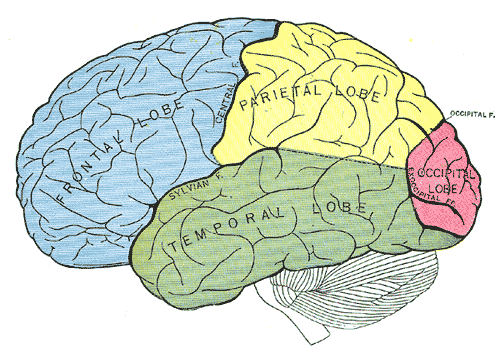
Step one was the licence check, on the Commons file page. The page marks the file public domain three ways: it is a scan of a public domain original, the work is out of copyright in its country of origin and in countries where the term is the author’s life plus 100 years or fewer, and it is public domain in the United States because it was published before 1 January 1931. It also carries the Creative Commons Public Domain Mark 1.0, which means it has been identified as free of known restrictions under copyright law.
Step two was a live reverse search, using the method in our how to reverse image search guide. TinEye searched its index of 86.7 billion images and returned 1,099 matches, having first indexed this image on 6 February 2008. The top two results were sponsored stock listings, a modern lookalike vector on Shutterstock and a different Gray plate on Alamy, which are not matches at all. The first genuine match was the English Wikipedia article on memory errors, and most of the real matches were of a Dutch SVG derivative of the plate rather than the original file. Google Lens gave no match count, because Lens never shows one, but it described the image correctly as a side view of the cerebrum with four colour-coded lobes, cited Wikimedia Commons as a source, and returned the Commons file pages plus a StatPearls page from the US National Institutes of Health carrying the exact caption and the Carter credit.
So the verdict for this image is yes, you can use it. But notice what made it yes. The permission comes from the public-domain status, checked on the file page, not from any credit line. The reverse search was the tool that proved the image was traceable to its source and its licence in seconds. That is the point of the exercise: the same search that clears a public-domain image will also find the owner of a modern one.
Now the contrast, and this is the part that matters for most creators. Take Maya, a constructed example, labelled as such. She runs a small monetised anatomy channel and wants a brain diagram from a 2023 textbook for an explainer video. She screenshots the diagram, puts “Credit: Oxford University Press, 2023” in the description, and uploads. The credit changes nothing. A reverse search on her screenshot would trace it to the publisher’s site in seconds, the diagram is in copyright, her video is monetised, and the diagram is the heart of the lesson she is selling. Her safe options are the ones in the table: ask the publisher, buy a licence, use a public-domain plate like the Gray one above, or draw her own version of the diagram from the idea, not by tracing the original lines. Copyright does not protect the idea that the brain has four lobes. It protects the particular drawing of them.
Answer capsule: The same search that clears a public-domain image will also find the owner of a modern one. Check first, credit second.
How do you ask a publisher for permission?
Asking sounds slow, and it can be, but it is the only route that ends with a yes you can show someone. Most big publishers have a permissions page, and smaller ones answer an email. Follow the steps in order, and keep everything in writing.
- Find who owns the rights. Check the title page and the copyright page of the book. For a diagram, the rights may sit with the publisher, the author, or the illustrator, and the text and the images can have different owners. The publisher’s website usually has a permissions or rights page. If the book is academic, the Copyright Clearance Center handles many requests.
- Write a short, specific request. Name the book, the edition, the page or figure number, and the image itself. Say how it will appear: on screen for how long, in a YouTube video, worldwide, monetised or not, and roughly how many viewers you expect. Vague requests get slow answers.
- Ask for the licence in writing. Ask for an email or a licence document that names the exact uses: YouTube, the video title, the time period, and whether it covers thumbnails and clips. A verbal yes on a call is worth very little if the owner later disagrees.
- Decide whether the fee is worth it. Some permissions are free for small creators, some are not. Compare the fee with what the video is likely to earn, and with the cost of the alternatives in the next section. A fee you decline is still a useful answer: it tells you to use something else.
- Keep the reply with the video files. File the permission next to the video project, with the date and the name of the person who granted it. If a claim arrives in two years, that file is your defence.
- No reply means no permission. Silence is not a yes, and neither is a reply that says “we will get back to you”. If the owner does not answer, use an alternative. Do not upload and hope.
- If they say no, move on. A refusal is the end of that image, not the end of your video. The next section has five replacements that need no permission at all.
One warning from the AI-art corner of this site: if you use an AI-generated image instead of a book image, check who owns that output before you rely on it. Our guide on whether you can copyright AI pictures covers the US and UK positions, and the short version is that a purely AI-generated image has no copyright of its own to protect in the US, while the tool’s terms decide what you may do with it.
Answer capsule: Ask in writing, name the exact use, file the reply. Silence is not permission, and a refusal is a direction to use something else.
What can you use instead, with no permission needed?
The alternatives are better than most creators expect, and they start with books that are already out of copyright. In the US, works published before 1931 are in the public domain, and in the UK copyright generally lasts for the author’s life plus 70 years. Our guide on how to tell if a photo is public domain walks through the date checks, the government-works route and the orphan-works gap, and the same checks apply to book illustrations. A diagram from a 19th century anatomy book, a map from a Victorian travelogue, or an engraving from a pre-1931 novel is free to use, and the Gray plate above is the worked proof.
Creative Commons images are the second route. Wikimedia Commons holds millions of freely licensed images, including book illustrations, diagrams and plates, each with its licence on the file page. The licence is the permission, and you must follow it exactly: credit the author, name the licence, and keep any share-alike condition. A CC BY image with no credit is an unlicensed use, which is the mirror image of this guide’s main point. Credit matters when the licence asks for it. It just cannot stand in for a licence that was never granted.
The third route is to make the image yourself. Copyright protects expression, not ideas. Learning a subject from a book and explaining it in your own words is fine, and the same holds for a diagram. Draw the brain, the chart or the map yourself, in your own style, from what you understood. Do not trace the original lines and change the colours. Tracing is copying with extra steps, and a court will see it that way.
Two more routes are worth knowing. Project Gutenberg and the Internet Archive host public-domain books you can quote and illustrate from freely. And a photo you take of a book you own is your photo, but it is not a free pass on the cover art inside it. A brief cover shot in a genuine review is the fair use case, not a licence to use the cover as your thumbnail or your channel art.
Answer capsule: The safest image in your video is one you made yourself, or one whose public-domain status you checked on the source page.
You already used a book image. What do you do now?
First, do not panic, and do not ignore it. Open YouTube Studio, go to Content, and read the notice properly. A claim and a strike need different responses, and the first step is knowing which one you have.
If it is a Content ID claim, check which part of the video was claimed. If you hold a licence for the image, or the image is public domain, dispute it with your evidence attached. The Copyright Office’s fair use page is worth reading before you dispute on fair use grounds, because a dispute is a legal position, not a complaint form. If you have no licence and no fair use case, trim the image out, replace it with a public-domain or licensed alternative, or accept the revenue split and move on. Editing the video is always cheaper than fighting a claim you will lose.
If it is a strike, the video is already down. Complete YouTube’s Copyright School, which starts the 90 day clock for the strike to expire, and check your other videos for the same image before a second strike arrives. Three strikes within 90 days can end a channel, so treat the first strike as the warning it is.
A counter-notification is the last step, not the first. It tells YouTube and the owner that you believe the takedown was wrong, and it can lead to a lawsuit if the owner disagrees. Use it only when you are confident, ideally after advice, and never as a way to buy time. And going forward, replace the image rather than the credit line. The credit line was never the problem. The missing permission was.
Answer capsule: Read the notice, dispute only with real grounds, and replace the image. The fix is a licence or a different image, not a better credit line.
FAQs
Can I use a book cover in a YouTube video if I credit the author?
Yes, when the cover appears briefly inside a review or commentary, because the review is what makes the use fair, not the credit. Show it for a few seconds while you talk about the book, and do not use it as your thumbnail or channel art, which is a different use that needs permission.
Is it fair use if my video is educational and not monetised?
It helps, but it does not settle the question. Non-profit educational use is favoured in the fair use factor, yet YouTube’s help page says it is not an automatic defence. A monetised review can be fair use and an unmonetised read-aloud can fail, because courts weigh four factors, including how much you took and whether the video replaces the book.
Can I show pages from a book if I only show them for a few seconds?
Short does not mean safe. There is no fixed number of seconds that makes a use fair, and the US Copyright Office says no percentage rule exists. What matters is why you showed the page, how much of the book it gives away, and whether viewers still need to buy it.
What if the book is out of print?
Out of print is not out of copyright. A book can sit unsold for decades while the copyright still runs, and the owner can still enforce it. Check the publication date and the author’s death date instead. In the US, works published before 1931 are public domain, and in the UK copyright lasts for the author’s life plus 70 years.
Can I read a picture book aloud on YouTube if I credit the illustrator?
No, not without permission. The illustrations have their own copyright, separate from the text, so crediting the illustrator does not license them. Showing every picture while you read the story aloud is one of the riskiest uses, because the video replaces buying the book. Ask the publisher first, or use a book that is out of copyright.
How do I find out if a book image is public domain?
Start with the book: the publication date on the copyright page and the author’s death date. In the US, works published before 1931 are public domain, and in the UK the term is generally the author’s life plus 70 years. Then reverse search the image to find its source page and read the licence stated there.