🔎 Reverse Image Search
Image search techniques made simple: upload a photo or paste a URL and search 6 engines at once. 100% free, nothing stored.
🔒 Your image is never stored on our servers longer than 24 hours and is never shared.
You took a photo of a moth in bright sunshine, on a flower or a garden wall, and now you want its name. Most moths fly at night, so a moth you saw in daylight belongs to a small group of day-flying species, and that narrows the search a lot. This guide shows you how to identify a day moth from a photo, step by step, with a real test on a real photo.
Short answer: To identify a day moth from a photo, reverse search the image first, then read the wing pattern, then check where and when you saw it. A six-spot burnet, for example, has six red spots on metallic green-black wings and flies in flowery grassland from June to August.
We tested the method on a real photo of a six-spot burnet moth, taken in July 2025, and ran it through Google Lens, TinEye, Yandex and Bing. Only one of the four named the species outright. The rest of this guide shows you what each engine did, how to read the wings yourself, and how to confirm the name in a moth database, so you are not stuck when an engine hedges or finds nothing.
What Is a Day Moth?
A day moth is simply a moth that flies in daylight. Most moths in Britain fly at night, which is why people are surprised to meet one in sunshine. A small set of species break that rule. Burnet moths fly slowly from flower to flower on sunny days. Some tiger moths fly in the day as well as at night. The hummingbird hawk-moth hovers in front of flowers in sunshine, sipping nectar with a long proboscis. The cinnabar moth is mainly a night flyer, but it is often disturbed from long grass during the day, so it turns up in daylight photos too.
The fact that you saw it in daylight already cuts the list of candidates down to a handful of families, and that is what makes a day moth easier to name than a moth caught at a light trap. Before you start, check that it is a moth at all. Moths usually have threadlike or feathery antennae, while butterflies have thin antennae with clubbed tips. Moths often rest with their wings flat or folded like a tent over the back, while butterflies often hold theirs upright or spread out. Moths also tend to have a thick, furry body, while butterflies are usually slimmer. If the antennae have clubbed tips and the wings sit upright, you may have a butterfly instead, and our guide to identifying a butterfly from a photo covers that case.
In short: a day moth is a moth that flies in sunshine, and the fact that you saw it in daylight already cuts the list of candidates down to a handful of families.
How Do You Identify a Day Moth from a Photo?
Work in this order, and do not skip a step. Each step rules something out, and the answer usually comes from two steps agreeing, not from one engine guessing.
- Save the best version of the photo and crop it tight around the moth. Use the original file, not a screenshot of it, and crop out the empty background so the moth fills the frame.
- Reverse search it. Run the same photo through Google Lens, Yandex, TinEye and Bing, following our step-by-step guide to reverse image search, or run the search free on our homepage image search tool. Note what each engine names, and what it does not.
- Read the wing pattern. Count the spots, note the colours and the bands, look for eyespots or lines, and check the underwings too, because in tiger moths the underwing can be the clue that settles it.
- Check where and when. Note the place, the habitat, the month, the time of day, and whether the moth was flying, feeding on flowers, or resting. A moth found indoors or near a light at night is a different case from one feeding on a flower at noon.
- Confirm the name in a moth database. Compare your photo with the species photos, the flight chart and the range map before you settle on a name.
This is the same reverse-search workflow we use to identify an object from a photo, applied to a living insect, so the habitat and season checks carry more weight than they do for a statue or a vase. A moth that flies only in July cannot be the answer to a photo taken in May, however good the visual match looks.
In short: reverse search first, read the wings second, and let the place and the month confirm or rule out what the engines suggest.
What Did the Reverse Search Find on a Real Photo?
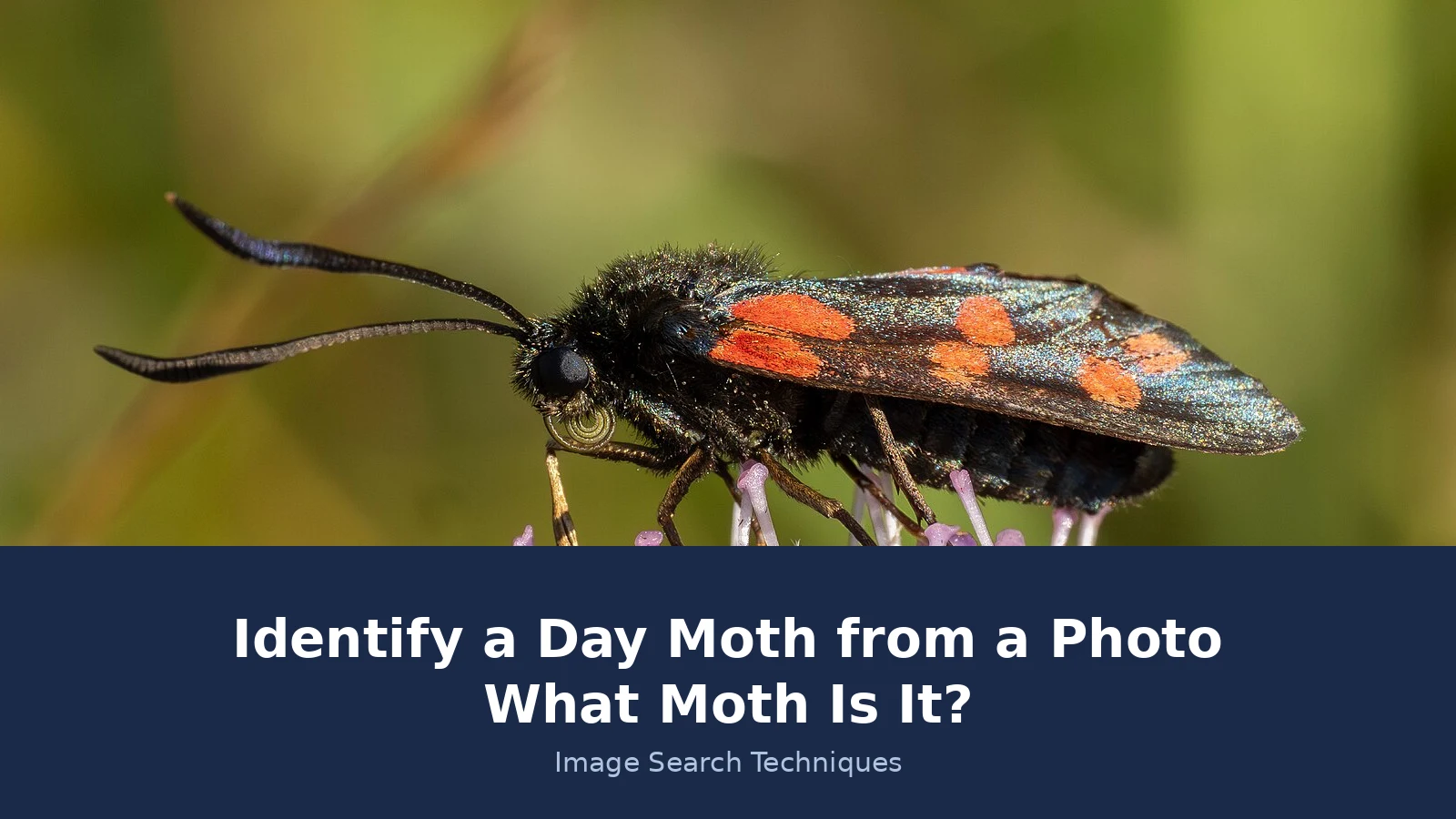
Our test photo is a six-spot burnet moth, Zygaena filipendulae, on a scabious flower, photographed on 19 July 2025 by Reinhold Moller and published on Wikimedia Commons under a CC BY-SA 4.0 licence. It is a sharp, well lit photo of the moth from the side, with all six red spots visible. We uploaded the same file to four engines on 18 November 2026 and recorded exactly what each one did.
| Engine | What it named | Match count shown | Exact match to this photo? |
|---|---|---|---|
| Google Lens | Hedged: a burnet moth in the genus Zygaena, a six-spot or a five-spot burnet | None shown | No |
| TinEye | No result: its human-verification check failed four times, so the search never ran | None | No |
| Yandex | Named it outright: zygaena filipendulae | None shown | No |
| Bing | Turned the photo into a search for “Zygaena Filipendulae Identification”, but the results page showed unrelated pages | No reliable count | No |
Google Lens (how Google reverse image search works) gave an AI Overview that said the moth appears to be a burnet moth in the genus Zygaena, such as a six-spot burnet or a five-spot burnet. That is a hedge, not an answer, and it is an honest one. Six-spot and five-spot burnets look alike, and Lens would not commit. Its Exact matches tab said no exact matches were found, and it did not link the Wikimedia Commons file page for this photo, even though the photo has been public since July 2025.
Yandex was the only engine that named the species without hedging. Its first tag read zygaena filipendulae, its similar-images grid showed a wall of burnet moth photos, and its Sites tab listed 18 site links. It gave no total match count, and it did not link this photo’s Commons file page either. It linked Commons pages for other burnet photos, which tells you the engine recognises the species but has not indexed this exact file.
Bing named the moth correctly in the search query it built from the upload, then showed a broken results page full of unrelated pages. A correct query with wrong results is not a result you can use, so we record Bing as a partial success only. TinEye gave us nothing at all. Its verification check failed four times across two browsers, and each failure threw the search away, so there is no TinEye number to report. A failed engine is a finding, not a gap to fill with a guess.
The lesson is simple. One engine is never enough. Lens hedged, Yandex named it, Bing broke, and TinEye never ran. If we had trusted Lens alone we would still be choosing between two species. If we had trusted Bing alone we would have nothing. Run all four, write down what each one says, and let the wing pattern and the habitat settle what the engines leave open.
In short: on a real photo, only Yandex named the species outright, Lens hedged between two burnets, Bing broke, and TinEye never ran, so a single engine is never enough.
How Do You Read the Wing Pattern?
Start with the spots. The six-spot burnet is the only British burnet moth with six red spots on each forewing, according to Butterfly Conservation’s six-spot burnet page, but count with care. The outermost spots can fuse into one, so a six-spot burnet can look like it has five. Rarely the red colour is replaced by yellow. The wings are metallic green-black, the wingspan is 30 to 38 mm, and the moth has a thick, furry body with threadlike antennae. It flies with a slow buzzing flight in sunshine and is drawn to thistles, knapweeds and scabious, which is why our test photo shows it on a scabious flower.
The five-spot burnet is the moth most often confused with it. It is smaller, with a wingspan of 28 to 33 mm, and it lives locally in south-west England and Wales, in damp meadows, marshes and sea cliffs. It flies in the day in July and August, and its caterpillars feed on bird’s-foot trefoils. If your photo was taken on a dry chalk downland in Kent, a five-spot burnet is unlikely. If it was taken on a damp meadow in Devon, count the spots twice.
Two other day flyers are worth knowing. The cinnabar moth has black wings with red markings, a wingspan of 32 to 42 mm, and flies from May to July. It is mainly nocturnal, but it is often disturbed from long grass during the day, so it appears in daylight photos. Its caterpillars are unmistakable, with yellow and black hoops, and they feed in groups on ragwort. The Jersey tiger is much larger, with a wingspan of 42 to 52 mm and a bold pattern, and it flies in the day as well as at night from July to September. It was once restricted to the Channel Islands and parts of the south coast, but it has spread north and east, and there are now good numbers in London and neighbouring counties.
The hummingbird hawk-moth is the one people most often mistake for a bee or a hummingbird. It flies in sunshine, hovers in front of flowers and sips nectar with a long proboscis, and its wingspan is 40 to 50 mm. If your photo shows a moth hovering rather than sitting, this is the first species to check.
Do not forget the underwings. In tiger moths the forewings can look plain while the hindwings carry the colour, so a photo that shows only the top of the wings can mislead you. Note the body too. A thick, furry body points to a burnet or a tiger moth, while a slim body with narrow, swept-back wings points to a hawk-moth. And note the antennae: threadlike or feathery means a moth, thin with clubbed tips means a butterfly.
In short: count the spots, check the wing colour and size, and use the body, the antennae and the underwings to separate burnets from tiger moths, hawk-moths and butterflies.
What Do Habitat and Season Tell You?
The wing pattern gives you a shortlist. The habitat and the season cut it down. A six-spot burnet lives in meadows, woodland clearings, sea cliffs and flowery grassland, and it flies from June to August. Butterfly Conservation calls it the commonest and most widely distributed burnet moth in the UK, found in England, Wales, Scotland and Ireland. UK Moths records 39,955 sightings in its database, mainly from June to August, which matches the flight period. If your photo was taken in October, it is not a six-spot burnet, however good the match looks.
Use the table below as the check. Find the row that matches the wings in your photo, then ask whether the place and the month fit. If they do not fit, the name is wrong, even if an engine suggested it.
| Species | Wing pattern | Where it lives | When it flies |
|---|---|---|---|
| Six-spot burnet | Six red spots on metallic green-black wings, 30 to 38 mm | Meadows, woodland clearings, sea cliffs, flowery grassland | June to August |
| Five-spot burnet | Five red spots, 28 to 33 mm | Damp meadows, marshes, sea cliffs in south-west England and Wales | July and August |
| Cinnabar | Black wings with red markings, 32 to 42 mm | Long grass and low herbage across much of Britain | May to July |
| Jersey tiger | Large and boldly patterned, 42 to 52 mm | Southern counties, spreading north, now in London | July to September |
| Hummingbird hawk-moth | Hovers at flowers, long proboscis, 40 to 50 mm | Gardens and flowery places, an immigrant species | June to October |
Where you found it matters as much as when. A moth on a flower in a meadow at noon is feeding, and burnets and hawk-moths feed in the open. A moth found indoors, or near a light, may be a night flyer that came in after dark and stayed, so do not use a night-time indoor sighting to claim a day-flying species. Note the plant as well. Our test moth was on scabious, and six-spot burnets are drawn to scabious, knapweed and thistles. The caterpillars feed mainly on common bird’s-foot trefoil, so a meadow full of that plant in July is exactly where you expect to find them. The UK Moths species page for the six-spot burnet gives the wingspan, the habitat, the flight period and a month-by-month chart of records, so you can check your sighting against real data instead of guessing.
In short: match the wings to the table, then check the place and the month, and drop any name that does not fit both.
How Do You Confirm the Name in a Moth Database?
Once you have a shortlist of one or two names, confirm it in a database built from real sightings. UK Moths has a species page for every British moth, with photos, the wingspan, the habitat, the flight period and a chart of records by month. Butterfly Conservation has species pages for the common day flyers, with identification notes and distribution maps. Compare your photo with the species photos side by side, and check the spot count, the wing colour and the flight month, not just the general look.
UK Moths also runs an experimental photo tool. You upload one clear photo of an adult moth at rest, add the month, the region and the size if you know them, and it suggests the most likely UK species, with similar species to compare. Treat its suggestions as a shortlist, not a confirmed identification, and check the suggestions against the species pages yourself. iNaturalist works the same way from the other direction: look at what other people have recorded near you, in the same place and the same month, and see whether your moth matches the local records.
Two sources agreeing is the standard to aim for. If the reverse search and the database both point to a six-spot burnet, and the place and the month fit, that is the answer. If they disagree, trust the database and the habitat over a single engine, because engines guess and repeat each other’s mistakes. A photo of a worn moth with faded spots can mislead a database too, so if the spots are rubbed away, say so, and treat the name as likely rather than certain.
In short: confirm the name in UK Moths or Butterfly Conservation, compare the photos and the flight chart, and accept the name only when two sources and the habitat agree.
What If the Search Finds Nothing?
A blank result proves nothing. It does not mean the moth does not exist, and it does not mean your photo is useless. It usually means the photo is too new to be indexed, too dark, too tightly cropped, or too far away. Our own test photo, public since July 2025, returned no exact match on any engine, and Lens said so plainly. A zero is a zero, and it should be reported as one, not filled in with a guess.
If the search finds nothing, take a better photo next time and keep the notes that make identification possible. Photograph the moth from above with the wings flat, get close enough to show the spots, and keep the whole moth in the frame. Include the flower or leaf it is sitting on, because that gives scale and a habitat clue. Take a second photo from the side, so the body and the antennae are visible. Note the place, the date and the time of day, and note whether the moth was flying, feeding on flowers, or resting. Those five notes are what a database or an expert needs, and they are the same details the search engines ask for when they cannot name a photo.
Do not handle the moth roughly to get a better shot. Burnets sit still in sunshine and are easy to photograph without touching, and a moth with rubbed wings is harder to identify than one left alone. If you are still stuck after a second search on another engine, post the photo with the place and the date to a moth recording group or to iNaturalist, where recorders check identifications against local sightings. A named moth with a place and a date is a useful record. A guess with no notes is not.
In short: a blank search proves nothing, so improve the photo, keep the place and date notes, and run a second engine before you give up.
FAQs
Can Google Lens identify a moth from a photo?
Yes, it can, but it does not always give a firm answer. On our test photo of a six-spot burnet, Lens said it was a burnet moth in the genus Zygaena, either a six-spot or a five-spot burnet, and showed no exact match. Use Lens first because it is fast and free, then run the photo through Yandex and Bing.
How do I tell a six-spot burnet from a five-spot burnet?
Count the red spots on each forewing, and check where you saw it. A six-spot burnet has six red spots on metallic green-black wings, with a wingspan of 30 to 38 mm, and it lives across Britain. A five-spot burnet has five spots, is smaller at 28 to 33 mm, and lives locally in south-west England and Wales.
What is the most common day-flying moth in Britain?
The six-spot burnet is the commonest of Britain’s day-flying burnet moths, according to UK Moths, and Butterfly Conservation calls it the commonest and most widely distributed burnet in the UK. It flies in flowery grassland from June to August, and it is the moth you are most likely to photograph on a summer meadow.
Can I identify a moth from a blurry photo?
It is hard, and often impossible, because the spots and the wing edges are the clues that matter. Crop it tight around the moth, try a reverse search, and if nothing comes back, take a sharper photo from above, wings flat. A clear photo with the place and date noted is worth more than any guess from a blurry one.
What should I photograph to identify a moth?
Photograph the moth from above with the wings flat, close enough to show the spots and the wing colour, and take a photo from the side so the body and antennae are visible. Include the flower or leaf it sits on for scale. Note the place, the date, the time of day, and whether it was flying, feeding or resting.
Where can I check a moth identification for free?
UK Moths has a free species page for every British moth, with photos, wingspan, habitat and a flight chart, and Butterfly Conservation has free species pages for the common day flyers. iNaturalist lets you compare your photo with sightings near you. All three are free, and none of them needs a paid app.