🔎 Reverse Image Search
Image search techniques made simple: upload a photo or paste a URL and search 6 engines at once. 100% free, nothing stored.
🔒 Your image is never stored on our servers longer than 24 hours and is never shared.
A letter lands on your doormat saying you were caught speeding. It names an offence code, a fine of £100 and three penalty points, and it tells you to pay online. It looks official. It may not be. Fake speeding fine letters are now a regular scam in the UK, and the paper letter is the version most guides skip. They cover the text message. This guide reads the letter itself, line by line, and shows you how to tell it from the real thing.
A real speeding fine starts as a Notice of Intended Prosecution posted to the registered keeper within 14 days of the offence, and it never asks for payment. A letter that demands £100, calls a speeding matter a Penalty Charge Notice, or asks you to pay by link is fake. Check any fine through GOV.UK, not through the letter.
Three terms do most of the work in this guide, so fix them now. A Notice of Intended Prosecution, or NIP, is the police telling the registered keeper that they intend to prosecute for a motoring offence. A Fixed Penalty Notice, or FPN, is the offer to settle that offence with a set fine and points instead of going to court. A Penalty Charge Notice, or PCN, is a different document for a different world: parking, bus lanes, congestion charging and the Dartford Crossing, issued by a council or Transport for London. A speeding matter is never a PCN. If the letter in your hand mixes those names up, that is your first fail, and it is usually enough on its own.
The same name confusion powers the parking version of this scam: our fake parking fine PCN photo check reads a real DVSA parking text line by line and shows why a council never texts about a PCN.
What does a real speeding fine letter look like?
Answer capsule: a real speeding fine arrives by post, names the offence, the date, the place and the vehicle, and asks who was driving. It does not ask for money.
The real process has a fixed order, and the order is the test. Within 14 days of your car being caught speeding, the police send the registered keeper two things: a Notice of Intended Prosecution and a section 172 notice. The section 172 notice is the form that asks who was driving the car at the time. You must return it within 28 days, naming the driver. Only after you send it back do you get either a Fixed Penalty Notice or a letter telling you to go to court. Payment comes at the FPN stage, after the driver has been named, never with the NIP itself.
The 14 days are counted from the offence, not from the day you open the envelope. The law behind it is section 1 of the Road Traffic Offenders Act 1988: for a speeding offence, a notice of intended prosecution must be served on the driver or on the registered keeper within 14 days of the offence. A notice sent by first class post counts as served on the second day after posting. That detail matters, because a letter that arrives on day 16 is not automatically invalid. If the keeper details held by the DVLA were out of date, the police may have posted it in time to an old address. A late letter is a reason to ask questions, not a verdict on its own.
The minimum penalty for speeding, published on GOV.UK, is a £100 fine and 3 penalty points added to your licence. Paying the FPN means pleading guilty. A speed awareness course may be offered instead, where you qualify. If you plead not guilty, you go to court, where the fine can be a percentage of your weekly income up to £1,000, or £2,500 on a motorway, plus points or disqualification. The offence code for the common speeding offence is SP30, exceeding the statutory speed limit on a public road, which carries 3 to 6 points and stays on your driving record for four years. The standard £100 FPN sits at the bottom of that range, at 3 points.
Notice what is missing from a real NIP. There is no payment button, no QR code, no bank details, no card form and no deadline for paying. The police need to know who was driving before anyone can be fined, so a letter that asks for money before it asks for the driver has the process backwards. Lancashire Police put it plainly in their own warning about fake letters: if they send a Notice of Intended Prosecution, they will never provide payment information at that stage, because they need to determine who was driving first. For fixed penalties, all payments are made to HMCTS North Fixed Penalties, and the police do not specify an account or sort code in the letter.
That is the shape to hold in your head before you read anything else: post, not email or text. NIP first, payment later. Driver first, fine second. Anything that breaks that order is suspect, whatever letterhead it wears.
NIP vs PCN vs FPN: which document is real for which offence?
Answer capsule: a NIP starts a speeding prosecution, an FPN settles it, and a PCN has nothing to do with speeding at all.
Scammers rely on these three names sounding alike. They do not mean the same thing, and the table below is the fastest way to see it. Read the heading on your letter first, then find its row. If the heading and the offence do not belong together, the letter fails.
| Document | Who sends it | For what | How it arrives | When you pay |
|---|---|---|---|---|
| Notice of Intended Prosecution (NIP) | The police | A motoring offence such as speeding | By post to the registered keeper, within 14 days of the offence | Never at this stage. It asks who was driving, on a section 172 form returned within 28 days |
| Fixed Penalty Notice (FPN) | The police, a council or the DVSA | A motoring or parking offence, offered as a fixed fine instead of court | By post, or handed over at the roadside, after the driver is known | Within 28 days. Unpaid, it rises by 50 percent and risks prosecution |
| Penalty Charge Notice (PCN) | A council, Transport for London or Dart Charge | Parking, bus lane, congestion charge or Dartford Crossing offences | On the windscreen or by post to the registered keeper | Within 28 days, often at a discount if paid within 14 days. Unpaid, a charge certificate adds 50 percent |
The confusion is the scam. A PCN is a civil penalty for parking and moving-traffic contraventions. Speeding is a criminal motoring offence, dealt with by the police through a NIP and then an FPN or a court summons. So a document headed “Penalty Charge Notice, Speeding Offence” is a contradiction in its own heading. It is the single most common tell in the fake letters, and it is the one the worked example below fails on. If you do hold a real PCN, for parking rather than speeding, the check is different: our PCN photo evidence check shows what the council’s photos must prove before you pay.
The deadlines get confused the same way. The 14-day rule belongs to the NIP: the notice must reach the registered keeper within 14 days of the offence. The 28-day rule belongs to the FPN and the section 172 form: 28 days to name the driver, and 28 days to pay the FPN once it is issued. A letter that says “pay within 14 days or go to court” has stitched the NIP deadline onto a payment demand. No real document says that.
How do you read a fake speeding fine letter photo?
Answer capsule: read it top to bottom, one line at a time, and check each line against what a real NIP looks like. Five fails are enough. You do not need a sixth.
This table is the Ranking Asset of this article: the fine-letter read, built from the real NIP rules above and the fake notice in the worked example below. Photograph or screenshot the letter, then work down the rows with the image open. Write pass or fail next to each one. A genuine NIP passes all of them. A fake usually fails four or five before you reach the bottom.
| What to read | What a real letter shows | What the fake shows |
|---|---|---|
| How it arrived | By post, to the registered keeper | By email or text, or as a photo in a message. The police do not send a NIP by email or text |
| The document name | Notice of Intended Prosecution for speeding, then a Fixed Penalty Notice later | “Penalty Charge Notice, Speeding Offence”, mixing a parking document with a speeding offence, and calling it an FPN in the same text |
| Payment demand | None at the NIP stage. Payment comes only with the FPN, after the driver is named | A “Pay the Penalty Online” button and a payment deadline in the first notice |
| The amount and points | £100 and 3 points, as the minimum penalty for speeding, on the FPN only | £100 and 3 points quoted in the first notice, before any driver is named, as if the fine were already decided |
| The payment route | The official portal reached from GOV.UK, the Home Office Penalty Notice Portal, for an FPN. Court fines go through HMCTS | A button or QR code inside the letter, leading to a look-alike payment page. The route is the letter itself |
| The sender | A police force, on police letterhead, to the registered keeper by name | A free webmail-style address, not a police.uk or gov.uk address, or a force name that does not match the area |
| The reference | A NIP reference that the force can confirm, with a section 172 form and a PIN for the force photo viewer where one is offered | An incorrect reference number, or a reference the force cannot trace. HMCTS says the fake notices carry incorrect reference numbers |
| The deadline wording | 28 days to return the section 172 form naming the driver | “Pay within 14 days or go to court”, stitching the NIP deadline onto a payment threat |
Two rows deserve a second look, because they are the tells most people miss. The first is the payment route. A real fine can always be paid without the letter, because a real fine exists in a real system, and that system has its own front door. The scammer’s letter is the only door it offers, and it is a copy. The second is the sender. A police letter comes from a police force, and a court fine comes from HMCTS, and neither asks you to pay by email. If the letter arrived by email, the channel is the verdict: HMCTS says plainly that it will never ask you to pay a fine or penalty by email or text message.
One caution before the worked example. A photo of a letter is not the letter. A screenshot of an email is not a posted letter either. Judge what is in front of you for what it is, and say so. The worked example below is a screenshot of a fake email, not a photo of a paper letter, and this guide says that out loud, because the tells are the same either way, and the channel is one of them.
Worked example: the fake notice HMCTS warned about
Answer capsule: HMCTS stamped it SCAM for five reasons, and each one is visible in the image.
On 15 June 2026, HM Courts and Tribunals Service posted a warning on Facebook about fake Fixed Penalty Notice emails. Scam emails were being sent to members of the public, the post said, with incorrect reference numbers, directing people to a fake payment website. They appeared to be from HMCTS, but they were not. HMCTS added that it will never ask anyone to pay a fine or penalty by email or text message, and told anyone who received one to delete it and report it as phishing. The post was shared 299 times.
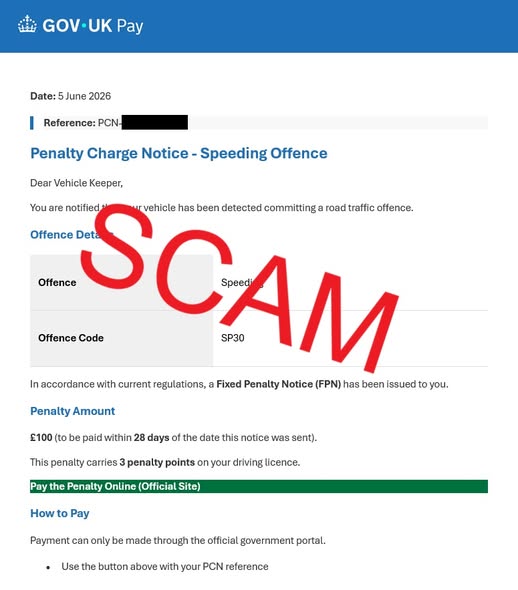
The image HMCTS published is the fake notice itself, a screenshot of a fake email rendered to look like a GOV.UK Pay page, with a red diagonal SCAM stamp added by HMCTS. Read it line by line against the table above.
The heading is the first fail. It reads “Penalty Charge Notice, Speeding Offence”. As the table shows, a speeding matter is never a PCN. The same text then says a Fixed Penalty Notice has been issued, so the notice calls itself two different documents in the space of a few lines. A real NIP calls itself one thing, and it is not either of these at this stage.
The offence details are the second fail. The table lists the offence as speeding, with the code SP30, which is the real code for exceeding the statutory speed limit on a public road. The code is right and the document is wrong, which is how these fakes work: one true detail, borrowed to carry the rest. A correct code does not make a fake letter real, any more than a correct logo does.
The money is the third fail. The notice states a penalty amount of £100, to be paid within 28 days of the date the notice was sent, and says it carries 3 penalty points. £100 and 3 points are the real minimum penalty for speeding, published on GOV.UK. But the amount appears in the first notice, before any driver has been named, and before any FPN has been issued. A real NIP never states a fine, because no fine exists yet. The scammer has taken the real FPN figures and pasted them into a document that comes two steps too early.
The button is the fourth fail. A green button reads “Pay the Penalty Online (Official Site)”, and the text below it says payment can only be made through the official government portal, using the button with the PCN reference. A real NIP has no button, because there is nothing to pay. The words “Official Site” in brackets are the tell: a real government page does not need to announce that it is official. The button is the whole point of the email, and the rest of the notice exists to get you to press it.
The channel is the fifth fail, and it is the one that settles it without reading another line. The notice arrived by email. HMCTS says it will never ask for payment by email or text. The police say the same about a NIP. A speeding fine that only exists as an email does not exist.
GOV.UK carries its own HMCTS scam guidance, last updated 17 September 2026, which names the sender addresses used in this scam and says plainly that mail from them is likely to be a scam. HMCTS will never call asking for payment from its inbound-only number, will not contact you by automated message, and will never telephone to ask for bank details or a bank transfer. The guidance is the page to check if a message claiming to be from HMCTS lands in your inbox.
That is five fails from one screenshot. The template is older than the June 2026 warning, which the reverse search below confirms: the same notice has been circulating since at least 2019. The scammers change the date and the reference, and the document stays the same.
Worked example: the West Mercia email warning
Answer capsule: the same scam, ten years earlier, with the same tells and a different force name on it.
On 14 December 2016, West Mercia Police posted a warning on Facebook after residents reported an email scam. The email purported to be from Greater Manchester Police and told the recipient they had been caught speeding. The force said the email was fraudulent, and that it might ask for personal or financial information, or try to infect the computer with malware, which could then be used to defraud the recipient. The police, the post said, would never send out correspondence by email requesting payment of fines or personal or financial information. Any correspondence on speeding offences would be sent via post.
Three details in that warning are worth keeping. First, the email claimed to be from Greater Manchester Police, not West Mercia, the force warning about it. Scammers borrow a force name at random, and the name on the letter is often not the force for the area where the recipient lives. A letter from a force you have no connection to deserves a second look. Second, the email asked for personal or financial information, and it could also carry malware. The 2016 version wanted your details or your computer. The 2026 version wants your card through a payment button. The ask changes, the channel does not. Third, the force’s own advice page for speeding tickets repeats the same rule, though its site would not load for us on the day of writing, and we do not quote it as a source we read. The Facebook warning, read in full, is the evidence, and it is enough.
Put the two examples together and the pattern is clear. In 2016 the scam was an email pretending to be the police, asking for details. In 2026 it is an email pretending to be HMCTS, asking for a payment. In both cases the channel is the giveaway: a speeding matter that arrives by email is fake, because the real thing arrives by post. In both cases the fix is the same: delete it, do not click anything in it, and report it.
Can a reverse image search check the letter?
Answer capsule: yes, and on this image it works well, because the fake has been published as a warning by the very bodies it impersonates.
Most guides on fake fines never mention reverse image search. That is a gap, because a search can show you that the exact image in your hand has already been published by an official body as a scam example. That turns a suspicion into a certainty, and it takes less than a minute. We ran the HMCTS screenshot through three engines on 21 November 2026, by image URL, without signing in anywhere. Here is what each one did.
| Engine | Result on 21 November 2026 | What it found |
|---|---|---|
| Google Lens | 11 exact matches | The HMCTS Facebook post itself, dated 15 June 2026, first. Then a LinkedIn warning from the same day, a Staffordshire Police Facebook post from 23 June 2026, Neighbourhood Alert scam warnings, and reuses of the same template from 2019 and 2020. The template predates the HMCTS alert by years |
| TinEye | 0 matches, after searching over 86.8 billion images | Nothing. TinEye had not crawled any page carrying this image, so it found no copy at all. A genuine zero, not a block |
| Yandex Images | No exact-match total given, at least 2 identical copies visible | Recognised the image as a fake email and a penalty charge notice scam. Its Similar images tab showed at least 2 visually identical copies of the same SCAM-stamped notice, and its Sites tab listed 20 loosely related pages |
Read the three results together, not one at a time. Lens is the winner here: 11 exact matches, and the top result is the official warning itself. If your own search ends the same way, with an HMCTS or police warning as the top result, you have your answer and you can stop there. TinEye’s zero does not contradict Lens. TinEye only finds images it has crawled, and it had not crawled this one. A zero on TinEye means the image is not in its index, not that the letter is genuine. Yandex sits in the middle: no exact count, but it recognised the scam and showed identical copies.
The method matters as much as the result. Search the image, not the words. Screenshot the letter or photograph it, then upload the image to Lens, TinEye and Yandex and compare what each one returns. A photo you took yourself will almost never be in any index, because it has never been published, so a blank on your own photo proves nothing on its own. That is why the reading table comes first and the search comes second. The table judges the words. The search checks whether anyone official has already judged them.
How do you check if you really have a fine?
Answer capsule: use a route the letter did not give you. Type the address yourself, or ring the number on the agency’s own site.
A fake speeding fine letter wants you to use its button, its QR code or its link, and everything else in it is built to stop you thinking of another route. So think of another route. A real fine can always be checked without the letter, because a real fine exists in a real system, and that system has its own front door.
First, work out which body would actually hold the fine. For speeding, that is the police force for the area where the offence happened, and the process runs through GOV.UK. The letter names a body, but the letter is the thing under suspicion, so do not trust its choice. If it names a force for an area you have never driven in, that alone settles it.
Second, go to GOV.UK and read the speeding penalties page. It states the £100 minimum fine and 3 points, the 14-day NIP rule, the 28-day section 172 return, and the FPN or court letter that follows. A Fixed Penalty Notice is paid through the Home Office Penalty Notice Portal, which GOV.UK links to, and which asks for the FPN number and payment card details. HMCTS handles court fines and fixed penalties that have been registered in a magistrates’ court, not a first FPN. GOV.UK Pay is the government’s payment platform, so its branding alone does not prove a message is genuine. A fake can copy a logo. It cannot copy a place in the official system.
Third, check the fine on the official portal using the reference from a paper notice you trust, or ring the force on the number published on its own website. Do not ring any number printed in the letter, and do not use its link or QR code, even to see where it goes. If you have a paper NIP, the force can confirm the reference, and some forces run a photo viewer where you can see the camera evidence with a PIN from the letter. Lancashire Police advise checking the photo viewer even when the letter itself contains photos, because the force does not include those images in its own documents.
Fourth, remember how a real fine reaches you. A speeding matter starts by post, to the registered keeper, within 14 days of the offence. It does not start by email, by text, or by a message with a payment button. If the only notice you have is an email, and no paper NIP exists, there is almost certainly no fine. One more note on the current search results: Google’s AI Overview for this keyword is written for the United States, naming the FTC and state DMVs, with no UK procedure in it at all. The UK rules in this guide are the ones that apply to a letter that arrived in the UK.
What should you do with the letter?
Answer capsule: report it, then delete it. Reporting takes two minutes, it helps the next person, and it costs the scammers an address and a domain.
Start by not touching the link, the QR code or the button, and not replying. Take a screenshot or a photograph first, because the image is your evidence, and it is also the artefact this whole guide is built to read. Then report it to Report Fraud at reportfraud.police.uk, which is the UK reporting route for this scam. If it arrived by text, forward the text to 7726, which spells SPAM on a phone keypad, and that sends it to your mobile carrier. If it arrived by email, report it as phishing through your email provider, and delete it.
If you already paid through a link like this, contact your bank straight away, not tomorrow, and ask them to freeze or replace the card. Watch your accounts for charges you do not recognise. If you entered a password on the fake payment page, change it from a clean device, and change it anywhere else you used the same one. If you gave a driving licence number or other identity details, the bank and Report Fraud can advise on the next steps.
Block the sender, then delete the message. Blocking stops that address, though the scammers will use another one, so keep the habit, not just the block. And keep the screenshot until you have reported it, because the report asks for the sender and the linked website, and the screenshot is where those details live. Then delete it, and do not forward the letter to friends as a warning with the link still live in it. Describe the scam in your own words instead, and point people at the official guidance. Posted letters are the scammers’ oldest channel, and the same line-by-line read works on the others: our fake debt collection letter photo check takes apart another posted letter that demands money it is not owed.
A final note on what not to do. Do not pay a fine to make it go away, and do not ignore a real NIP either. The two mistakes look opposite and cost the same: paying a fake loses your money, and ignoring a real NIP can end in court. The check in this guide takes a minute, and it tells you which one you are holding. Use it every time a fine arrives, real or not.
How is this different from a DMV ticket text?
Answer capsule: it is the same gang with a different story. The letter pretends to be the police or the courts. The text pretends to be the DMV.
The two scams are twins, and they are often run by the same operators, because the method is identical: a threat, a deadline, a link, a copycat payment page. The ticket text claims you owe a fine and your licence is at risk, and it names a DMV. The letter claims you were caught speeding, and it names a police force or HMCTS. The ticket text is American, and it has no place in the UK at all, because the UK has no DMV. The letter is written for a UK reader, with UK codes, UK amounts and UK branding, which is what makes it more dangerous.
The reason to keep them separate is that the tells are different in detail. The text has the fake law code and the “Reply Y” instruction, which the letter does not use. The letter has the NIP versus PCN confusion and the 14-day rule, which the text does not have. Learn both sets of tells, because the next fine in your hand could be either one. Our DMV ticket text screenshot check takes that screenshot apart the same way, with its own reading table and its own reverse search test. Between the two guides, you have the whole family covered: text, email and paper.
For the wider picture, our complete photo scams guide uses the same reading method on other scam messages, and our fake bank letter photo check reads a posted bank letter the same way, line by line. A letter that asks for money before it asks who was driving is not a fine. It is a trap with a letterhead, and now you know how to read it.
This guide is general information, not legal advice. If your case is complicated, speak to a solicitor or your local Citizens Advice. Banner photo: a Gatso speed camera on Earls Colne Airfield Road, Geograph, CC BY-SA 2.0.
FAQs
The DVLA name turns up in texts too, not just letters. If a message says your licence needs renewing, read our fake DVLA driving licence renewal text check before you click anything in it.
Is a speeding fine letter real if it arrives by email?
No. A real speeding matter starts as a Notice of Intended Prosecution sent by post to the registered keeper, and the police never send one by email or text. HMCTS also says it never asks for payment by email or text. A speeding fine that only exists as an email is fake, so delete it and report it.
How long does the police have to send a Notice of Intended Prosecution?
Fourteen days from the offence, under section 1 of the Road Traffic Offenders Act 1988. The notice must reach the driver or the registered keeper in that time, and a first class posting counts as served on the second day after posting. A late letter is not automatically invalid, so ask the force to confirm the reference.
What is the difference between a NIP, a PCN and an FPN?
A NIP is the police notice that starts a speeding prosecution, sent by post within 14 days, and it asks who was driving. An FPN is the fine offered later to settle the offence, £100 and 3 points for speeding. A PCN is a council penalty for parking or bus lane offences, and it has nothing to do with speeding.
Can I reverse image search a speeding fine letter?
Yes. Photograph or screenshot the letter, then search the image on Google Lens, TinEye and Yandex. On the HMCTS example in this guide, Lens found 11 exact matches, with the official HMCTS warning first, while TinEye found none. A blank proves nothing alone, so use the search with the reading table in this guide, not instead of it.
Where do I pay a real Fixed Penalty Notice?
Through the Home Office Penalty Notice Portal, reached from GOV.UK, using the FPN number and a payment card. HMCTS handles court fines and fixed penalties registered in a magistrates court, not a first FPN. Never pay through a link, button or QR code inside a letter or email, and never ring a number printed in the message itself.
What should I do if I already paid a fake speeding fine?
Contact your bank straight away and ask them to freeze or replace the card, then watch your accounts for charges you do not recognise. Report the letter to Report Fraud at reportfraud.police.uk, and keep the screenshot until you have reported it. If you entered a password on the fake payment page, change it from a clean device.