


🔎 Reverse Image Search
Image search techniques made simple: upload a photo or paste a URL and search 6 engines at once. 100% free, nothing stored.
🔒 Your image is never stored on our servers longer than 24 hours and is never shared.
To tell if a debt collection letter is real, check it field by field against the CFPB Model Validation Notice. A real notice names the collector and creditor, itemises the amount since a date, prints the end date of your 30-day dispute window, and carries a tear-off dispute form. A one-paragraph demand with a payment link fails on sight.
This guide shows you how to tell if a debt collection letter is real, using the official model form as your comparator. You do not need to trust the letterhead, the logo, or the tone. You need to match what is on the page against what federal law requires to be there. That is the whole method, and it works on a letter you received in the post, a photo of one, or a scan someone sent you.
A debt collection letter is a stressful thing to open. The amount may be one you do not recognise. The name of the creditor may be a company you have never dealt with. The letter may threaten court action, or arrest, or wage garnishment, and it may give you only a few days to pay. That pressure is the point. A real collector has to follow a set process, and a fake one relies on you not knowing what that process looks like. Once you know the fields a real notice must carry, most fakes fall apart in under a minute.
Student loan letters use the same tricks, a seal, a case number and a deadline, with a fee where a real notice has none. Our fake student loan forgiveness letter check works through a real scam email line by line and shows the one test that settles it: federal student loan help is free, so any fee means fake.
The best guide on this topic so far comes from MeetFelix, published on 20 August 2026. It is strong and well sourced, but it is built around calls and texts. It never audits a letter line by line, it shows no image of the model form or any letter, and it gives you no field-by-field comparator and no endpoint for a letter that passes the check. This article fills those gaps. The letter in your hand is the artefact, and the CFPB Model Validation Notice is the standard it gets measured against.
What is a validation notice, and when must you get one?
A validation notice is the written statement a debt collector must send you about the debt it says you owe, and it must arrive with the first communication or within five days of it. That is the short answer. The rule comes from the Fair Debt Collection Practices Act, the FDCPA, and from Regulation F, which sets out how the Act works in practice.
Validation notice: a written notice from a debt collector that identifies the collector and the creditor, states the amount owed with an itemisation, and tells you how to dispute the debt or ask for the name and address of the original creditor, all inside a 30-day validation period.
The FDCPA was enacted in 1977 and took effect on 20 March 1978. Regulation F, which added the detailed validation rules and the model form, took effect on 30 November 2021. The timing rule sits in 12 CFR 1006.34(a)(1) and in 15 U.S.C. 1692g. A collector that contacts you by phone first still owes you the written notice within five days of that first contact. If the first contact is the letter itself, the notice is the letter, or it must be enclosed with it.
The validation period ends 30 days after you receive the validation information, or are assumed to have received it. That window matters more than anything else in this article. Inside it, you have the right to dispute the debt in writing, or to ask in writing for verification of the debt or for the name and address of the original creditor. If you do that, the collector must pause collecting the disputed amount until it has responded properly, for example by sending you written verification such as a copy of the original bill.
If you do not dispute within the 30 days, the collector is allowed to assume the debt is legitimate. That does not mean you have admitted the debt, and it does not stop you disputing it later. It means you have lost the automatic pause, and the collector can carry on. So the first thing a letter tells you, before anything about the amount, is how much time you have left. A letter with no end date printed on it is hiding the most important fact in the whole process.
One more rule belongs here, because it shapes the whole check. For consumer financial debts, the notice must state that more information is available at www.consumerfinance.gov/debt-collection. A Spanish-language model notice also exists, so a letter in Spanish is not automatically suspicious. What matters is whether the fields are present, not which language they are printed in.
How to tell if a debt collection letter is real: the seven-step check
You can tell if a debt collection letter is real by working through seven checks in order, and stopping at the first one that fails. The order matters. Start with the fields the law requires, then check the payment method, then check the sender independently. Never start by ringing the number on the letter. The same rule applies to a loan offer: our fake loan approval letter photo check shows how to read a mailer line by line and verify the lender before you pay anything.
Step 1. Photograph the whole letter. Lay it flat in good light and photograph every page, front and back, including the envelope if you still have it. Keep the original somewhere safe. You will need the photos for the field check, and you may need them later if you dispute the debt or report the letter.
Step 2. Find the collector and the creditor. A real notice names the debt collector and gives its mailing address, and it names the creditor you supposedly owe. It also gives your own name and mailing information, and the account number, if there is one. If the letter names no creditor, or names one you cannot trace, that is a fail. A vague line like “your account with our client” is not a creditor name.
Step 3. Read the itemisation. The notice must itemise the current amount of the debt, showing interest, fees, payments and credits since a particular date. That date is called the itemisation date, and it must be one of five reference dates: the last statement date, the charge-off date, the last payment date, the transaction date, or the judgment date. A single balance with no breakdown and no itemisation date is not a validation notice. It is a demand.
Step 4. Find the end date of the validation period. The notice must print the end date of the 30-day period during which you can dispute the debt or ask for verification or original-creditor information. Work out whether that date has already passed. If there is no end date at all, the letter fails, whatever else it gets right.
Step 5. Look for the tear-off dispute form. The consumer-response information must be set apart at the bottom of the notice, under the heading “How do you want to respond?” followed by “Check all that apply:”, with dispute prompts and a request for original-creditor information. This is the tear-off form. A letter with nowhere to dispute the debt in writing is not following the model, and that absence is itself evidence.
Step 6. Read the payment instructions. A real collector will not ask you to pay by gift card, wire transfer, or cryptocurrency. It will not demand payment only through a link in the letter, and it will not threaten arrest. The FDCPA forbids a collector from lying about the amount, pretending to be an attorney or from the government, or saying you will be arrested or sued if that is not true. A letter that does any of those things has failed, even if the rest of it looks tidy.
Step 7. Check the sender independently. Look the collector up yourself, on a search engine or through the CFPB, and use a phone number or address you found independently, never the one printed on the letter. Ask the collector to confirm the account number, the creditor, and the itemisation date. Then, if you know who the original creditor is, contact them separately and ask whether the debt was sold or assigned, and to whom. A real debt leaves a trail at both ends. A fake one usually leaves a trail at neither.
One rule runs through all seven steps. No validation notice, no payment, until the collector proves the debt in writing. That is not a slogan. It is how the validation system is designed to work. The collector has to show its workings before you owe it a reply, let alone money.
What does the real CFPB model form contain?
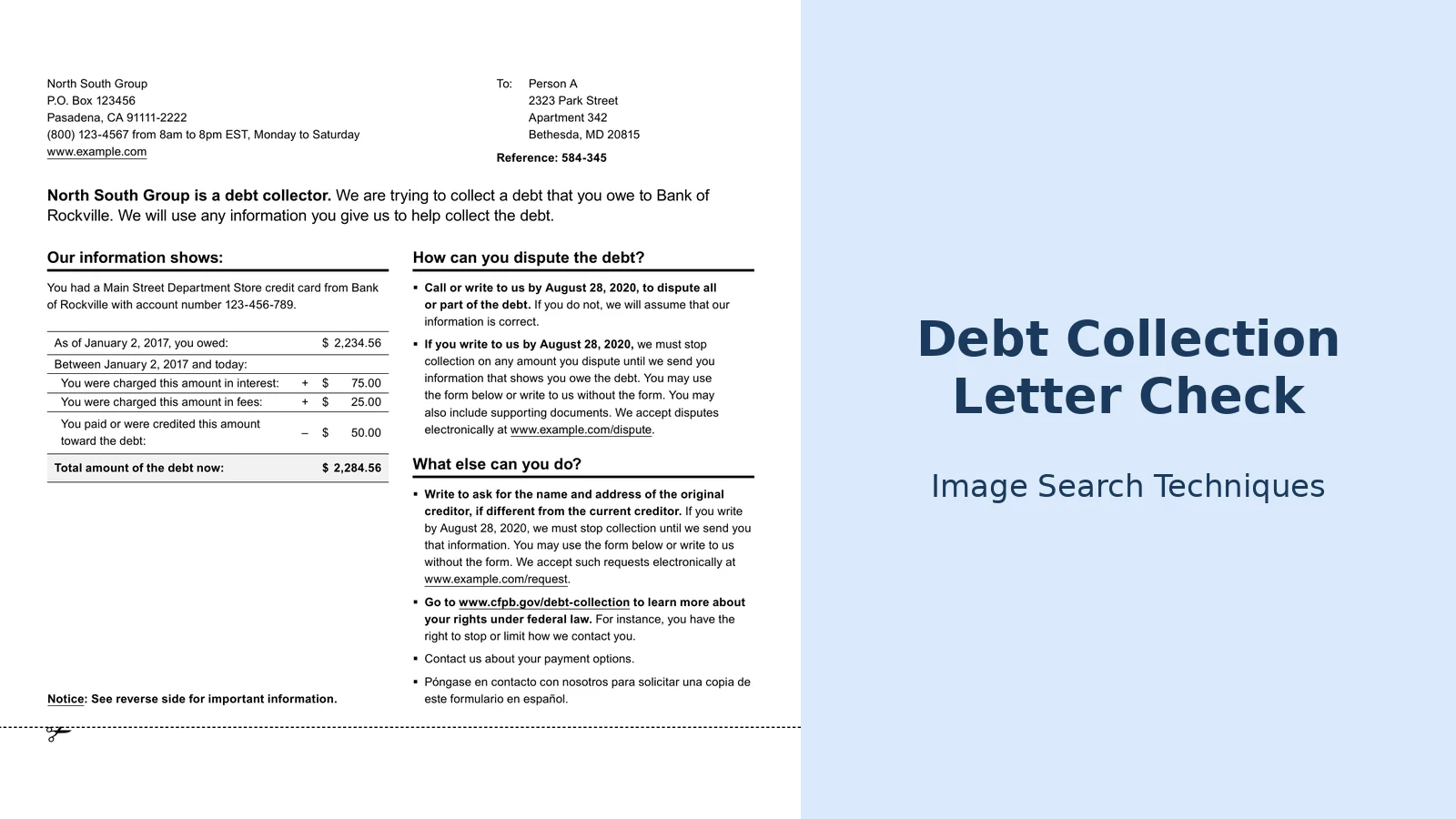
The real CFPB Model Validation Notice, known as Model Form B-1, contains every field listed in the table below, in a layout the CFPB published as Appendix B to Part 1006. The form was published in the Federal Register at 86 FR 5856 on 19 January 2021, and a collector that uses it, or a form substantially similar to it, gets a safe harbor for the content and form requirements. Using the model form is not required, so a real letter may look different. What it cannot do is leave the required information out.
That distinction matters. A scammer can copy the layout of a real notice, and some do. Layout is not the test. The fields are the test. A letter that copies the look of the model form but drops the itemisation, the end date, or the tear-off form has still failed, however professional it looks. Keep the CFPB’s own model forms page open while you work: the CFPB model forms and samples page carries the form itself, free, with no sign-in.
| Model form field | What to look for on your letter | Pass or fail |
|---|---|---|
| Collector name and mailing address | Full legal name of the collector and a real mailing address, not a PO box alone with no name | Pass if both are printed clearly |
| Creditor name | The name of the creditor you supposedly owe, stated plainly | Fail if the creditor is unnamed or only “our client” |
| Your name and mailing information | Your name and address as the collector holds them | Fail if the letter is addressed to no one in particular |
| Account number, if any | The account number for the debt, where one exists | Pass if it matches your own records, or is honestly marked as not applicable |
| Itemisation date | One of five dates: last statement, charge-off, last payment, transaction, or judgment date | Fail if no date is given at all |
| Itemised interest, fees, payments and credits | Each figure shown separately, running from the itemisation date to today | Fail if only a single total appears |
| Current amount of the debt | The total you are said to owe right now, matching the itemisation | Fail if the total does not add up from the items above it |
| Reply information | How to dispute the debt and how to ask for the original creditor’s name and address | Fail if no dispute route is given |
| End date of the validation period | The printed date by which your 30 days run out | Fail if no end date is printed |
| Tear-off dispute form | A separate section at the bottom headed “How do you want to respond?” with “Check all that apply:” and dispute prompts | Fail if there is nowhere to respond in writing |
| Mini-Miranda disclosure | On the first communication, a statement that the collector is attempting to collect a debt and any information obtained will be used for that purpose; later communications must state they are from a debt collector | Fail if the letter never says it is from a debt collector |
| More information statement | For consumer financial debts, a statement that more information is available at www.consumerfinance.gov/debt-collection | Fail if it is missing on a consumer financial debt |
Work down the table with your letter beside you and tick each row. A letter that passes all twelve rows is worth taking seriously, and the next section explains what to do with it. A letter that fails even two or three rows is almost certainly not a genuine validation notice. A letter that fails on the itemisation, the end date, and the tear-off form together has failed on the three fields a scammer finds hardest to fake well, because each one forces them to invent specific, checkable facts.
The mini-Miranda deserves a word of its own, because readers often miss it. The first communication from a collector must disclose that it is attempting to collect a debt and that any information obtained will be used for that purpose. Later communications must state that they are from a debt collector. This is the sentence that tells you, in plain language, who is writing to you and why. A letter that reads like a court order, a government notice, or a friendly reminder from a bank, and never once says it comes from a debt collector, is hiding its identity. That is a fail, not a quirk.
What does a fake debt collection letter look like?
A fake debt collection letter usually looks urgent and short. It gives you a balance, a deadline, and a way to pay, and very little else. Hospital bills are a common example. A collector chasing a medical debt sends the same kind of short, urgent letter, and the bill behind it needs its own check first: matching it line by line against your insurer’s Explanation of Benefits before you pay anything. The worked example below is a constructed composite, not a real letter anyone received. It is built from the pattern in a real enforcement case, the FTC’s case against Blackrock Services, so that every flaw in it is a flaw real scammers have actually used.
The case is FTC v. Blackrock Services, Inc., filed in the Central District of California as No. 8:25-cv-00363, with the complaint dated 24 February 2025. The operators were Ryan and Mitchell Evans, trading as Blackrock Services, Blackstone Legal Group, Capital Legal Services, Quest Legal Group, Viking Legal Services, and other names. Their letters and calls chased debts that never existed. The FTC said their letters “often contain a wealth of sensitive personal information about the consumer, including the last four digits of their Social Security number”. The threats included arrest, wage garnishment, and home seizure. A final stipulated order in June 2025 banned them permanently from debt collection and debt brokering, and imposed a monetary judgment of $8,254,368, partly suspended on their financial condition.
Here is the composite letter, built on that pattern. Read it as a reader would, then check it against the model form.
FINAL NOTICE. You owe $4,812.37 on account ending 4417. Your Social Security number ends in 8821. Pay within 72 hours at the link below or your wages will be garnished and a warrant will be issued for your arrest. Do not ignore this letter. Pay now: [payment link]. Legal Recovery Group.
It is one paragraph. It names no creditor. It gives no itemisation and no itemisation date. It gives no end date for any validation period, no tear-off form, and no way to dispute the debt. It never says it is from a debt collector. It threatens arrest and wage garnishment in the same breath, and it gives a payment link with a 72-hour deadline. Run it through the model form table and the result is clear.
| Model form field | What the composite letter shows | Result |
|---|---|---|
| Collector name and mailing address | “Legal Recovery Group” with no address at all | Fail |
| Creditor name | None named | Fail |
| Account number | Only “account ending 4417”, no full reference | Fail |
| Itemisation date | None | Fail |
| Itemised interest, fees, payments and credits | None, only a single total of $4,812.37 | Fail |
| Current amount | Stated, but with nothing behind it | Fail |
| Reply information | None, no dispute route and no original-creditor request | Fail |
| End date of the validation period | None, only a 72-hour payment deadline | Fail |
| Tear-off dispute form | None | Fail |
| Mini-Miranda disclosure | None, the letter never says it is from a debt collector | Fail |
| Payment method | Payment link only, with a threat of arrest | Fail |
Eleven fails out of eleven. That is what a fake looks like when you stop reading it as a threat and start reading it as a form. Two details in it deserve extra care, because they are the ones that fool people. The first is the last four digits of the Social Security number. Personal details in a letter feel like proof, but they are not. The FTC found that the Blackrock letters routinely carried exactly that detail, on debts that never existed. Breached and leaked data is cheap, and scammers buy it. A letter that knows four digits of your Social Security number has proved it bought a data list, not that you owe a debt.
The second is the threat of arrest. A debt collector cannot have you arrested for not paying a civil debt, and it cannot garnish your wages or seize your home without first suing you and getting a court order. A letter that threatens arrest is telling you, in its own words, that it is not following the law. The FTC’s own advice on this point is plain, and it is worth reading in full on the FTC’s page about fake and abusive debt collectors. If your letter threatens arrest, wage garnishment, or home seizure without mentioning a court, treat that as the clearest red flag in the whole letter.
Compare this with the other letter in the family. A fake bailiff letter works the same way, with court language instead of a balance, and our fake bailiff letter check covers that comparator separately. The two articles are siblings, not duplicates: this one checks a debt against the CFPB model form, that one checks a notice against the court and enforcement system. Do not merge the two checks. A letter that claims to be from a court needs the court test, and a letter that claims to be from a collector needs the validation test.
Can a reverse image search prove a letter is real?
No, a reverse image search cannot prove a letter is real, and a blank result proves nothing either way. That is the honest answer, and it is the most important sentence in this section. A real validation notice can be faked in layout, so the field check plus the independent creditor check carry the weight, not the search result.
The search is still worth doing, for a narrower reason. It can tell you whether the letter, or a letter very like it, has already been reported as a scam. Scammers reuse templates, letterheads, and logos, and victims and regulators publish them. If your letter matches a published scam warning, you have your answer. If it matches nothing, you have learned only that the image is not widely shared online. A fake letter printed at home for the first time will return zero matches on every engine, and so will a real letter that has never been published. We saw the same zero on a fake jury summons: our fake jury duty summons letter photo check ran the sample through Lens, TinEye and Yandex and all three returned nothing. Our how to reverse image search guide walks through the engines if you have not used them before.
The worked example below tests the other direction. It runs the CFPB’s own Model Form B-1 through the four main reverse image engines, to see whether the engines find the CFPB original. If the engines struggle to find the official form itself, that tells you how little a blank result means on a letter nobody has published.
Test: page 1 of the CFPB Model Validation Notice (Model Form B-1, from the CFPB’s own PDF) was run through the site’s own reverse image search tool on 13 November 2026, 21:35 to 21:41 UTC, through Google Lens, TinEye, Bing Visual Search, Yandex Images and Pinterest, to check whether each engine finds the CFPB original. The tool’s Google and Lens buttons run the same Lens search, so they count as one engine here. Two of the four visual engines found it. The lesson does not depend on the numbers: a real validation notice can be faked in layout, and a blank reverse search proves nothing about a letter, so the field check and the independent creditor check carry the weight.
| Engine | Result | Notes |
|---|---|---|
| Google Lens | Found the CFPB original | Top visual match was the CFPB’s own “Appendix B to Part 1006, Model Forms” page, at the exact size of the uploaded file, 1,275 by 1,650. The exact-matches list showed 11 tiles, and the AI Overview identified the document as a Debt Collection Validation Notice (Model Form B-1) under CFPB Regulation F. Copies on eCFR and Regulations.gov were also listed. |
| TinEye | Did not find the CFPB original | 3 results from 86.7 billion images, first indexed 23 August 2019. The oldest was the Federal Register’s copy of the form, and the newest was an exact-size copy on a law firm’s blog, dated 19 October 2026. The CFPB’s own GitHub copy was not found by any engine. |
| Bing Visual Search | Found the CFPB original | 5 pages with this image, with the CFPB page listed 5th at the exact size. Bing also surfaced the CFPB PDF itself in its web results. The other four pages were a Regulation F guide, a debt validation notice format page, a PNG download site and the Federal Register. |
| Yandex Images | Did not find the CFPB original | No exact match, only one other size listed and two sites, neither of them the CFPB. Yandex’s text recognition did read the printed web address www.cfpb.gov/debt-collection from the image itself, but that is text inside the picture, not a search result. |
| Not a visual search | The tool’s Pinterest button opens a keyword search for pins mentioning the tool’s own domain. It returned 22 unrelated pins about domain names, nothing to do with the form. |
When you run your own letter through the same engines, photograph it cleanly first. A skewed, shadowed, or cropped photo returns worse results than a flat, well-lit one, and a partial crop can miss the letterhead entirely. Search for the letterhead and the logo as well as the whole page: scammers often lift a real company’s logo onto a fake letter, and the logo search can surface the real company’s warning page. Save screenshots of anything you find, with the date, because a scam warning page can change or disappear.
One warning about what not to upload. Do not post a photo of your letter on social media or a public forum to ask whether it is real. The letter carries your name, address, account details, and possibly part of your Social Security number. Once that image is public, you cannot take it back, and scammers watch those forums for fresh personal details. Check it privately, with the model form beside you, and report it through the official routes in the next section if it fails.
What should I do if the letter passes every check?
If the letter passes every check, do not pay it yet, and do not ignore it either. That is the endpoint this article is built for. A letter that matches the model form field by field is probably a real validation notice, and the right move is to use the rights the notice itself gives you, inside the 30-day window.
First, dispute it in writing or ask for verification, if you have any doubt about the debt at all. Send your letter by certified mail with return receipt requested, and keep a copy of everything you send. Your letter should say, in plain words, that you dispute the debt, or that you are asking for verification of the debt, or that you want the name and address of the original creditor. You do not need legal language. You need a paper trail with a date on it.
Once the collector receives a written dispute or verification request inside the 30 days, it must pause collecting the disputed amount until it has responded properly. A proper response means written verification, such as a copy of the original bill, not another demand letter repeating the same total. If the collector keeps demanding payment of the disputed amount while your request is outstanding, that is a problem for the collector, and you should keep a record of every contact after that date.
Second, check the debt with the original creditor directly, using contact details you found yourself. Ask whether the account exists, whether it was sold or assigned, and to whom. If the creditor says the account does not exist, or that it was never passed to this collector, tell the collector that in writing and keep the creditor’s reply. If the creditor confirms the debt and the collector, you still have the right to ask for the itemisation to be explained, line by line, before you agree any payment.
Third, check your credit reports. Before a collector reports a debt to a credit bureau, it must talk to you or mail or send you the validation notice and then wait a reasonable time, usually 14 days. If a debt appears on your credit report that you never received a notice for, that is worth a dispute with the bureau as well as with the collector. You can also place a fraud alert if you believe your identity has been misused, and the identity theft route is IdentityTheft.gov.
Never advise yourself, or let anyone advise you, to ignore a letter that passes the match. The FTC warned in a consumer alert on 11 February 2026 that debt that might be yours should not be ignored, because it might be reported, sued over, or garnished. Ignoring a real validation notice does not make the debt go away. It spends the 30 days in which you had the strongest rights, and it leaves the collector free to assume the debt is legitimate. The safe endpoint for a letter that passes is the dispute and verification route, used promptly, in writing, with copies kept.
If the letter fails the check instead, report it. The complaint routes are the FTC at ReportFraud.ftc.gov, the CFPB at consumerfinance.gov/complaint or on (855) 411-2372, and your state attorney general. Give them the photos of the letter, the envelope, and anything you found in your checks. A single report may not get your money back, but reports are how cases like Blackrock get built, and a letter that threatened you is evidence, not rubbish to throw away.
The same document-check method works on the other letters in this family. Our fake IRS letter check matches a notice against the IRS notice code and your IRS Online Account, and our fake Companies House letter check works through the known fake gallery on GOV.UK. Each letter has its own official comparator. Our fake car warranty letter photo check reads a warranty mailer against a real BBB report and the FTC rule, field by field. The skill is the same every time: find the official document, and check the letter in your hand against it, field by field.
What are my rights if the collector breaks the rules?
If the collector breaks the rules, you have rights under the FDCPA, and the limits are specific enough to be useful. The short version is that a collector may not harass you, lie to you, or treat you unfairly, and if it does, you can sue it. This article is general information, not legal advice, and the details below are the rules as the FTC states them.
On contact, a collector may not call before 8 a.m. or after 9 p.m. unless you have agreed to it, and it may not contact you at work if you have told it that calls are not allowed there. It may not call more than seven times within seven days about a particular debt, and it may not call within seven days after a phone conversation with you about that debt. It must identify itself as a debt collector. It may not publicly reveal your debts, for example by discussing them with other people or posting about them.
On conduct, a collector may not threaten you with harm, use obscene language, or repeatedly call to annoy you. It may not lie about the amount you owe, pretend to be an attorney or from the government, or say you will be arrested or sued when that is not true. It may not collect interest or fees that your contract or state law does not allow, and it may not deposit a post-dated check early. It may not sue you, or threaten to sue you, on a time-barred debt, meaning a debt so old that the collector can no longer sue over it.
On enforcement, a collector must sue you and get a court order before it can garnish your pay or your bank account. A letter that threatens garnishment without mentioning a court is threatening something it cannot do on its own. Keep that distinction in mind when you read threats: the question is not whether the words are frightening, but whether the collector has taken the legal step the words imply.
If a collector violates the FDCPA, you have one year from the violation to sue it. A judge can award you up to $1,000 in statutory damages even if you cannot prove you lost money, plus attorney’s fees and costs. That $1,000 figure is the statutory ceiling for an individual claim, not a typical payout, and it comes from the Act itself. One point the FTC stresses, and it matters: even if the collector violated the FDCPA, you may still owe the debt. A violation by the collector does not cancel what you owe to the creditor. The two questions are separate, and you should keep them separate in your own thinking too.
Time limits cut both ways, so note the dates on everything. The validation period is 30 days. The credit-reporting wait is usually 14 days after the notice. The window to sue a collector is one year from the violation. Write the dates on the envelope the day the letter arrives, and keep a dated note of every call, with the caller’s name, the number they called from, and what they said. If you ever need to complain or sue, that note is worth more than your memory.
Common mistakes when checking a debt collection letter
The most common mistake is paying from the letter before checking it. A payment link, a QR code, or a phone number printed on the letter all lead back to the sender, not to an independent check. A posted bank letter works the same way, and our fake bank letter photo check shows the same slow read applied to a real QR code letter, including the envelope and postmark check. Never pay from a letter before checking it, and never send money by gift card, wire transfer, or cryptocurrency. A real collector accepts traceable payment methods and gives you time to verify the debt. A demand for gift cards is a scam on its own, whatever the letterhead says.
The second mistake is ringing the number on the letter to ask if it is real. A scammer answers their own phone. The check has to be independent: look the collector up yourself, and ring a number you found on the collector’s own site, the CFPB, or a regulator, not the number in the letter. The same rule applies to email addresses and web links in the letter. Treat every contact route printed on it as unproven until you have verified it somewhere else.
The third mistake is trusting personal details as proof. A letter that carries your full name, your address, the last four digits of your Social Security number, and a plausible account number can still be fake, as the Blackrock case shows. Those details are bought and sold in bulk. What proves a debt is the itemisation, the creditor name, and the paper trail back to the original creditor, not the fact that the letter knows who you are.
The fourth mistake is treating a blank reverse image search as proof the letter is genuine. As the worked example shows, a real document can return no matches, and a fake one printed for the first time will too. The search is a bonus check for reused scam templates, not a verdict. The field check and the creditor check are the verdict.
The fifth mistake is ignoring a letter that passes the check. A real validation notice starts a 30-day clock, and the clock runs whether you read the letter or not. If the letter passes, use the dispute and verification rights inside the window, in writing, by certified mail, with copies kept. If you miss the window, you can still dispute, but you lose the automatic pause, and the collector can assume the debt is legitimate.
Finally, do not assume a letter is fake just because the debt is old or the creditor is unfamiliar. Debts are bought and sold, and a collector you have never heard of may hold a genuine debt from a creditor whose name you have forgotten. That is exactly why the model form exists: it forces the collector to show the creditor, the itemisation date, and the breakdown, so you can check the debt instead of guessing about it. For the full set of photo-based scam checks, see our complete guide to photo scams. Renewal letters are not the only posted demand to check line by line: see how to check a fake insurance renewal letter, which compares the policy number and renewal date with your real documents before any payment is made. If the letter claims to come from a solicitor rather than a collector, the check changes: see how to check a fake solicitor letter, which covers the SRA register, the letterhead comparison and the release fee trap.
FAQs
What should I do first when a debt collection letter arrives?
Photograph every page and keep the original. Do not ring the number on the letter or pay from any link in it. Check the letter field by field against the CFPB Model Validation Notice, looking for the creditor name, the itemisation, the end date of the validation period, and the tear-off dispute form. Then verify the collector independently.
Can a real debt collector demand payment by gift card, wire or crypto?
No. A real collector will not ask for gift cards, wire transfers, or cryptocurrency, and will not demand payment only through a link in the letter. Those payment methods are hard to trace and almost impossible to reverse, which is why scammers prefer them. If a letter demands gift cards, wire, or crypto, treat it as fake and report it.
What does the 30-day validation window mean?
The 30-day validation period is the window in which you can dispute the debt in writing or ask for verification or the original creditor’s details. It ends 30 days after you receive the validation information. If you dispute inside the window, the collector must pause collecting the disputed amount until it responds properly in writing.
What happens if I miss the 30 days?
If you miss the 30 days, the collector may assume the debt is legitimate, and you lose the automatic pause on collection. You can still dispute the debt afterwards, and you can still complain to the CFPB or the FTC if the collector breaks the rules. But the dispute is weaker, so act inside the window whenever you can.
Is a letter with my Social Security details automatically real?
No. Letters in the FTC’s Blackrock case carried the last four digits of victims’ Social Security numbers on debts that never existed. Personal details are bought and sold in bulk, so they prove the sender bought a data list, not that you owe a debt. Trust the itemisation, the creditor name, and the paper trail, not the personal details.
What should I do if the letter passes every check?
Do not pay it yet, and do not ignore it either. Dispute it in writing or ask for verification inside the 30-day window, by certified mail, and keep copies. Check the debt with the original creditor using contact details you found yourself. If the collector verifies the debt, you can then discuss payment from knowledge.






