🔎 Reverse Image Search
Image search techniques made simple: upload a photo or paste a URL and search 6 engines at once. 100% free, nothing stored.
🔒 Your image is never stored on our servers longer than 24 hours and is never shared.
A drone shoot ends with a memory card full of aerial shots and a simple question that causes most of the arguments: who owns drone photos? The pilot flew the drone, the client paid for the shoot, and the landowner owns the house in the frame. Only one of them usually owns the copyright, and it is not always the person who paid.
Short answer: The person who takes a drone photo usually owns its copyright, even when someone else paid for the shoot. Payment normally buys a licence to use the photos, not the copyright. An employer owns photos taken by staff at work, and a landowner owns no copyright in a photo of their property. Only a signed written agreement transfers copyright.
This guide works through the rules in plain language, for the UK and the US side by side. It is general information, not legal advice. If a shoot is worth real money, or a dispute has already started, take the contract to a solicitor before you act on it. The short version is worth remembering though. Copyright follows the person who made the photo, not the person who paid for it, and not the person who owns the thing in it.
Who owns drone photos by default?
Answer capsule: The pilot who takes the photo is normally the first owner of its copyright, because a drone photo is treated like any other photograph.
A drone photo is a photo. Nothing in UK or US copyright law gives aerial images a special category, and the same rules that cover a photo taken on the ground cover one taken from 120 metres up. The pilot frames the shot, chooses the height and the angle, and presses the shutter or starts the capture. That makes the pilot the author of the photo, and the author is the first owner of the copyright.
In the UK, the Copyright, Designs and Patents Act 1988 says the author of a work is the person who creates it, and the author is the first owner of any copyright in it. In the US, copyright vests initially in the author of the work. The US Copyright Office explains that copyright protects original works of authorship, and a photograph counts as one. The UK Intellectual Property Office says the same for photographs in its copyright notice on digital images and photographs.
Two words cause most of the confusion here, so it helps to pin them down. Copyright is the right to control how a photo is copied, shared, published and adapted. A licence is permission to use a photo in agreed ways, for an agreed time, while the copyright stays with its owner. Owning the files is a third thing again. A memory card, a download link and a printed copy are objects. Copyright is not an object, and handing over the files does not hand over the copyright.
That gives us the ownership table. Keep it beside you when you read the rest of this guide, because every later section is one row of this table with the detail filled in.
| Person | Owns the copyright? | Owns the files? | What a contract changes |
|---|---|---|---|
| Independent pilot, hired for a shoot | Yes, by default | Only if the pilot hands them over | Can transfer copyright or limit the licence |
| Client who paid for the shoot | No, by default | Yes, once the pilot delivers them | Can buy the copyright with a signed written assignment |
| Employee pilot, flying for their employer | No, the employer owns it | The employer holds them | An agreement can give ownership back to the pilot |
| Landowner or householder in the photo | No, never from ownership of the land | No | Nothing, unless they also took the photo |
| Platform the photo is posted on | No | No, it hosts a copy | Its terms take a licence to display the photo |
One wrinkle is worth naming. Some drones fly a planned route and take photos on their own, and some shots are triggered by a second person while the pilot flies. The law does not have a drone-specific answer for who the author is in those cases. The practical reading, and the one most pilots work to, is that the person who set up the shot, chose the route and the framing, and decided when to capture is the author. If two people split that work, put the answer in the contract before the flight, not after it. A photo made by a fully automatic process with no human creative choice sits in a grey area, and the same question comes up with AI-made images, which our guide to who owns AI pictures works through in detail.
What changes when you pay for drone photos?
Answer capsule: Paying for a shoot normally buys a licence to use the photos, and the copyright stays with the pilot unless a signed written agreement says otherwise.
Paying for the files does not transfer copyright. This is the sentence that settles most drone photo arguments, and it is worth reading twice. When you pay a pilot, you are usually paying for their time, their skill, their drone and the finished files. None of that moves the copyright. What you get is a licence, which is permission to use the photos in the ways you agreed, and the pilot keeps the copyright.
That is why the wording of the agreement matters so much. A pilot who says “you can use these on your listing and your website” has granted a narrow licence. A client who then puts the same photos on a billboard, in a paid advert or in a brochure for a different development is outside that licence and needs fresh permission. The Atlanta Drone Photography guide, the top result for this question, makes the same point from the US side, and it lists listing, website, social media, brochures and paid advertising as separate uses for a reason. Each one needs to be covered by the licence, or it needs new permission.
An assignment is different from a licence, and the law treats it differently. An assignment moves the copyright itself to a new owner. In the UK, an assignment of copyright is not effective unless it is in writing and signed by or on behalf of the person assigning it, under section 90 of the Copyright, Designs and Patents Act 1988. In the US, a transfer of copyright ownership is not valid unless an instrument of conveyance, or a note or memorandum of the transfer, is in writing and signed by the owner of the rights conveyed, under section 204(a) of the Copyright Act. An email saying “sure, use them however you like” is a licence, not an assignment. A spoken promise is not an assignment either. If you want to own the copyright, get a signed written assignment that says so in plain words.
None of this means a client is left with nothing. A good licence covers the real uses, and most shoots never need an assignment at all. An estate agent who needs the photos on a listing, a portal and social media can get all three in the licence. A developer who wants to use the photos in adverts for two years can get that too. The mistake is assuming the payment covered it. Ask for the licence in writing, read what it covers, and check the three things that cause trouble later: how long it lasts, where the photos can appear, and whether the pilot can still use them in a portfolio.
What if the pilot is your employee?
Answer capsule: When an employee takes drone photos as part of their job, the employer normally owns the copyright, in both the UK and the US.
Employment changes the default completely. In the UK, where a literary, dramatic, musical or artistic work is made by an employee in the course of their employment, the employer is the first owner of the copyright, unless there is an agreement to the contrary. That is section 11(2) of the Copyright, Designs and Patents Act 1988. In the US, a work made by an employee within the scope of their employment is a work made for hire, and the employer is considered the author and the copyright owner. The US Copyright Office sets this out in Circular 30, which also explains that the question turns on the facts at the time the work was created.
The hard part is deciding who counts as an employee. A member of staff on a salary, flying the company drone on company time, for a company job, is an employee for this purpose. A freelancer you hire for one shoot, who brings their own drone, sets their own hours and works for other clients, is usually not. The US courts look at agency law factors such as who provides the tools, who controls when and how long the person works, how they are paid, and whether they get employee benefits. The UK asks whether the work was done in the course of employment, which is a facts-and-circumstances question too.
This is where drone work trips people up. A marketing assistant who flies the office drone on a Friday afternoon for a company video is likely creating work the employer owns. The same person flying their own drone at the weekend, for their own portfolio, is not. And a contractor who flies for you every week for a year starts to look like an employee, which is why the contract should say plainly whether they are engaged as an employee or as an independent contractor, and who owns the photos. If the contract is silent, the facts decide, and facts are harder to argue about than a sentence in an agreement.
One more US detail matters for clients who hire contractors. A commissioned work can only be a work made for hire in the US if it falls into one of nine listed categories and the parties expressly agree in a signed written instrument that it is a work made for hire. A drone photograph for a property listing does not fit those categories neatly, so a client who wants ownership from a contractor should ask for a written assignment of copyright instead of relying on work-made-for-hire language. The assignment route works in both countries, and it is the safer sentence to have.
What does the landowner own?
Answer capsule: A landowner owns no copyright in a drone photo of their property, because owning the subject of a photo is not the same as owning the photo.
This is the row of the table that surprises people most. If a drone photographs your house, your farm or your land, you own the house, the farm and the land. You do not own the photo. Copyright belongs to the person who took it, and owning the subject of a photograph has never, on its own, given anyone the copyright in it. The AI Overview for this question says the same thing in plain terms: owning the land, house or event shown in a photo does not automatically give you copyright over the image itself.
That does not mean a landowner has no rights at all. It means the rights they have are different rights, and they need a different argument. Privacy, trespass and nuisance are separate from copyright. A drone flown low over a garden, hovering outside a bedroom window, is a privacy problem and possibly a trespass problem, even though the landowner owns no copyright in the photos it takes. A drone flown high over a roof for a survey, without hovering over private space, is a different matter. Our guide to drone photos of your house and your privacy rights works through that side in detail, including what to do when a drone photo of your home appears online.
Commercial use adds one more layer. A pilot who sells a drone photo of a recognisable private home for advertising may need a property release, which is the owner’s written permission for commercial use of the image of their property. That is a permission question, not a copyright question, and it sits beside the copyright rules rather than replacing them. The release protects the photographer and the buyer from a claim by the owner, and it is worth getting before the photo is sold rather than after. If you want the wider picture on keeping your own photos safe, start with our complete guide to protecting your photos online, which covers ownership, licences and removal in one place.
Fair use in the US and fair dealing in the UK are different doctrines, and they are often confused in this argument. In the US, fair use is an open-ended test that weighs four factors, including the purpose of the use and its effect on the market for the original. In the UK, fair dealing is narrower, and it only covers specific purposes such as research and private study, criticism and review, and reporting current events. Neither one gives a landowner a right over a photo, and neither one gives a stranger a free right to use a drone photo commercially. Both are defences a user can raise in court, not permission slips, and both are judged on the facts of the use. If you plan to use someone else’s drone photo on a blog, read our guide to fair use for images on a blog before you publish, and remember that crediting the photographer is not a substitute for a licence.
Worked example: one drone photo, three claims on it
Answer capsule: A real drone photo shows how the table works in practice, because the same image can be owned by one person, licensed to another, and objected to by a third, all at once.
The photo is “Embo Village and Beach” by Elliot Smith, a drone shot taken on 10 June 2025 above Embo beach in Sutherland, Scotland, with the village of Embo and the holiday park Grannie’s Heilan’ Hame behind it. It is published on Geograph under a Creative Commons Attribution-Share Alike 2.0 licence, which means anyone may reuse it if they credit the photographer and share any adapted version under the same licence. The description on the page says plainly, “Taken by drone.”
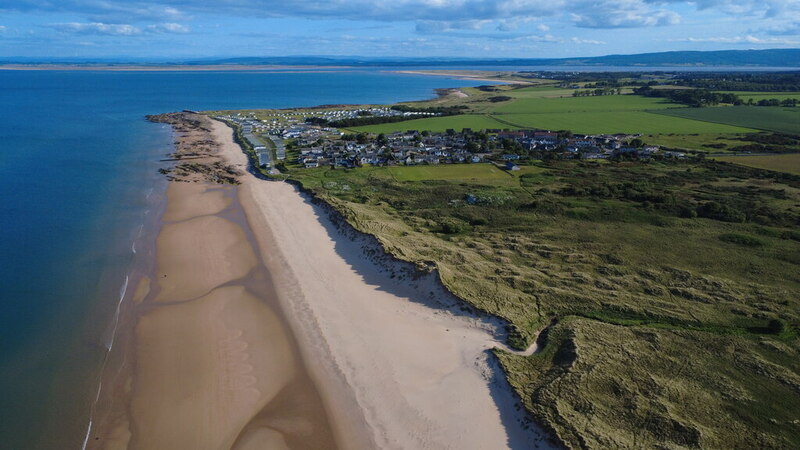
I reverse-searched the photo live on 21 November 2026, uploading the file itself to each engine rather than searching by URL. Google Lens named the image “Embo” and found 11 exact matches. Ten of the 11 were BBC pages reusing the same photo, mostly about Embo and the Coul Links golf course plans, and one was a LinkedIn profile. Lens also listed 60 visual matches, mostly other aerial beach and caravan-park images around Dornoch. TinEye searched over 86.8 billion images and found 0 matches, which tells you its index had not yet crawled a page carrying this photo. Yandex found 0 exact matches, tagged the image as a beach, coast and landscape, and listed 78 similar aerial beach images on its first page, none of them this photo.
Those results are the worked example, because they show the copyright story in the wild. The BBC used the photo under its Creative Commons licence, crediting the source, which is exactly how a CC licence is supposed to work. The photographer still owns the copyright. The BBC owns no copyright in the photo because it used it, and neither does anyone whose house appears in it. Now run the three scenarios through the table.
First, the pilot sells the files. Suppose Elliot Smith sells the full-resolution files of this shot to a holiday park. The park now owns the files and can use them under the licence it agreed. The copyright stays with Elliot Smith unless the sale included a signed written assignment. If the park later uses the photo in a national advert that the licence did not cover, it needs fresh permission.
Second, the client posts them. Suppose the holiday park posts the photo on its own website and social media. That is fine if the licence covers website and social use. It is not fine if the licence covered the website only and the park also puts the photo on a billboard. And if the park’s post is copied by a third site, the park cannot complain as the copyright owner, because it is not the owner. Only the photographer can enforce the copyright.
Third, the landowner objects. Suppose the owner of a house visible in the photo objects to it being published. The owner has no copyright claim, so they cannot demand removal on copyright grounds. They could raise privacy or trespass if the drone was flown in a way that invaded their privacy, and they could ask for a property release before any commercial use, but the copyright answer stays the same. The photographer owns the photo, the client holds a licence, and the landowner owns neither.
How do I check who owns a drone photo I found online?
Answer capsule: Reverse-search the photo, read the licence on the page where you found it, and ask for the contract if the answer still is not clear.
Start with a reverse image search. Upload the photo to Google Lens, TinEye and Yandex, and see where else it appears. A photo that appears on the photographer’s own site, or on a stock library under their name, usually has its ownership stated on that page. A photo that appears on dozens of unrelated sites with no credit is a warning sign, not a free pass. The Embo example shows the pattern: Lens found the exact photo on BBC pages, which told us who had used it and under what licence, while TinEye and Yandex found nothing exact, which told us their indexes had not crawled those pages yet. A zero on one engine is not proof the photo is unowned. It is only proof that engine has not indexed a copy.
Next, read the licence where you found the photo. A Creative Commons licence, a stock licence or a “free to use” note tells you what you may do, and a photo with no licence statement tells you nothing. “Found on Google” is not a licence, and neither is a credit line. If you need a photo you can use safely, work through our guide on how to check a photo’s licence before you use it, which shows the checks in order.
Then follow these steps in order:
- Reverse-search the photo on Lens, TinEye and Yandex, and note the earliest and most authoritative page that carries it.
- Read the licence or terms on that page, and note who is named as the photographer or copyright holder.
- Check whether the page you found it on is the photographer’s own site, a stock library, or a third party reusing it.
- If the use you want is commercial, ask the photographer for a written licence that names the use, the time period and the places the photo can appear.
- If the photographer offers to sell you the copyright, ask for a signed written assignment, and keep it with the files.
- If nobody can name the owner, treat the photo as owned by someone you cannot find, and do not use it. An orphan photo is still owned.
Keep a record of the search. Save the page that names the photographer, save the licence text, and save the assignment if there is one. If a dispute comes up later, that record is what you will be asked for.
What should a drone photo contract say?
Answer capsule: A good drone photo contract names the owner, the licence, the uses, the time limit and the portfolio rights, in plain words, before the flight.
Most drone photo arguments come from a contract that said nothing. The pilot thought the fee covered a licence for the listing. The client thought the fee bought the copyright. The landowner thought nobody could photograph their house at all. Every one of those arguments is cheaper before the flight than after it, and a short written agreement settles all three.
Whether you are the pilot or the client, ask for these points in writing before the drone goes up. A one-page agreement that covers them is worth more than a long argument later.
| Contract point | What to write down |
|---|---|
| Copyright owner | Name the owner, usually the pilot, unless an assignment says otherwise |
| Licence scope | List every use: listing, website, social media, print, paid adverts |
| Licence length | State how long the licence lasts, and what happens when it ends |
| Exclusivity | Say whether the client is the only user, or the pilot can licence others |
| Portfolio use | Say whether the pilot can show the photos in a portfolio or on social media |
| Editing rights | Say what edits are allowed, and whether the property must not be misrepresented |
| Third parties | Say who else may use the photos, such as an agent, a portal or a printer |
| Files and delivery | State what files are delivered, in what size, and by when |
| Assignment, if any | If copyright is to move, say so plainly and sign it as an assignment |
For a pilot, the contract is also where you protect the work you have already done. Keep the copyright, licence the uses the client actually needs, and charge again for uses outside the licence. For a client, the contract is where you get what you actually need. List the uses you plan, including the ones you might want later, and pay for them now rather than arguing about them later. For both sides, the rule from the top of this guide still holds. The files are not the copyright, and the payment is not the copyright either. Only a signed written agreement moves it, and only a clear licence lets you use it.
If you are hiring a pilot, ask to see their drone registration and insurance as well, and check the local flying rules for the site. Those are separate from copyright, but a shoot that breaks flying rules creates problems no contract can fix. A clean flight, a clear licence and a signed agreement will cover almost every drone photo you ever commission or sell.
FAQs
Do I own drone photos if I paid for them?
No, not usually. Paying a pilot normally buys a licence to use the photos, not the copyright. The pilot keeps the copyright unless a signed written agreement transfers it to you. Check what your licence covers, including the uses, the time period and the places the photos can appear. If you want full ownership, ask for a written assignment.
Can a landowner stop me using a drone photo of their house?
A landowner cannot stop you on copyright grounds, because they own no copyright in a photo of their property. They may still have a privacy or trespass claim if the drone was flown in a way that invaded their privacy. Commercial use may also need a property release, so check both questions before you publish.
Who owns drone photos taken by an employee?
The employer usually owns them. In the UK, work made by an employee in the course of employment belongs to the employer under the Copyright, Designs and Patents Act 1988. In the US, the same work is a work made for hire, and the employer is the author and owner. An agreement can change this, so check the employment contract.
Does the pilot own the photos if the client supplied the drone?
Usually yes. Copyright follows the person who takes the photo, not the person who owns the equipment. Supplying the drone does not make the client the author, and it does not transfer copyright. What matters is who framed the shot and decided when to capture it, so put the ownership in the contract if the arrangement is unusual.
Can I post a drone photo I found online on my blog?
Only if you have permission or a licence that covers blog use. Finding a photo online does not make it free to use, and crediting the photographer is not a substitute for a licence. Check the licence on the page where you found it, or ask the photographer. If you cannot find the owner, do not use the photo.
What should I ask for in writing before a drone shoot?
Ask for the copyright owner to be named, the licence to list every use you need, the licence length, and whether the pilot can use the photos in a portfolio. If you want the copyright itself, ask for a signed written assignment. Get it all before the flight, not after, and keep the agreement with the files.