🔎 Reverse Image Search
Image search techniques made simple: upload a photo or paste a URL and search 6 engines at once. 100% free, nothing stored.
🔒 Your image is never stored on our servers longer than 24 hours and is never shared.
You open Facebook and there it is: an aerial photo of your house, taken from above your garden, posted by someone you do not know. Searches for drone photo of my house privacy help usually start exactly here, with a photo the homeowner never agreed to. Or an estate agent has used a drone shot of your home in a listing for a house that is not for sale. Or a neighbour’s drone video has ended up on YouTube with your back garden in clear view. The flying is only half the story. The photo is the part that stays online, gets shared, and keeps showing your home to strangers. This guide deals with the photo.
The short answer: a drone can legally photograph your house from the air in many cases, because UK law gives you no ownership of the sky above your roof. But once that photo is posted, different rules apply. If it shows you in a private space, or is used to harass you, you have removal routes through the platform, the ICO, and police.
What this guide means by a drone photo of your house. A drone photo of your house is any still image of your home, garden, or the people in it, taken from a drone and then published somewhere: social media, a listing site, a video site, a drone pilot’s portfolio, or a search result. The flight and the photo are two separate problems, and they have two separate sets of answers. On the photo side, our guide to who owns drone photos explains that the pilot usually owns the copyright, not the homeowner whose house is in the picture.
Can a drone legally take a photo of your house?
The honest answer is that it often can, and that surprises most homeowners. There is no UK law that bans flying a drone over private property outright. The air above your garden is regulated by the Civil Aviation Authority, not owned by you, and a drone flying at a legal height and distance is not automatically breaking the law by being there. What changes the picture is the camera, what it points at, and what happens to the photo afterwards.
A photo of the outside of your house, taken from a height where anyone in a passing plane could see the same roof, is hard to complain about on privacy grounds alone. Your roof, your driveway, and the front of your house are visible from the street, and a court would likely treat them as things you have already exposed to public view. A photo that looks into your back garden while you are sitting there, or through a bedroom window, or over a high fence into a space you clearly keep private, is a different matter. The test is not whether a drone took the photo. The test is whether you had a reasonable expectation of privacy in what was photographed.
That distinction is the whole of this subject. People who ask “can a drone fly over my house” usually mean “can a drone photograph me at home”, and the law answers those two questions differently. The flying rules limit where the drone can be. The privacy rules limit what the camera can do and what the pilot can do with the pictures. Keep the two apart and the rest of this guide makes sense.
One more point matters before you act. In the United States the position is similar in shape but different in detail: federal aviation rules control the flying, while privacy protection comes mostly from state law, and the states disagree with each other. This guide is written for UK readers and uses UK rules and UK reporting routes. If the photo was taken in the US, the platform removal steps below still work, but the legal routes do not, so use the reporting route for the state where the photo was taken.
What does the Drone Code cover, and what does it leave out?
The CAA Drone and Model Aircraft Code is the rulebook every drone pilot in the UK Open Category must follow. It sets the flying limits, and those limits are tighter than most people realise. The maximum height is 120 metres, about 400 feet. Most drones of 250 grams and over must stay at least 50 metres away from uninvolved people, and that includes people inside buildings, so your home counts. Heavier drones in the A3 category must stay at least 150 metres away from residential areas. Drones under 250 grams, and those carrying a UK0 or C0 class mark, are allowed to fly in residential areas and closer to people, though never over crowds.
Answer capsule: the Drone Code limits where a drone can fly, not what its camera can publish, so a legal flight can still produce a photo you can ask to have removed.
What the Drone Code does not do is just as important. It does not give you a right to have a photo deleted. It does not cover what a pilot does with the pictures after landing. And it does not decide whether a photo of your garden is an invasion of your privacy. For that, the Code points to data protection law. Its own privacy line is plain: using a camera where people can expect privacy, such as inside their home or garden, is likely to break data protection law. That single sentence is the bridge from flying rules to photo removal, and it is the sentence to quote when you report a photo.
There are also hard limits on what you may do back. Deliberately damaging or destroying a drone is criminal damage under the Criminal Damage Act 1971, because a drone is someone else’s property even when it is over your land. Signal jammers are illegal under the Wireless Telegraphy Act 2006, and jamming can send a drone into an uncontrolled flyaway, which is more dangerous than the flight you were trying to stop. Do not touch the drone, do not jam it, and do not threaten the pilot. Every route in this guide works without any of that.
Finally, the Code’s distance rules have a gap you should know about. A small drone under 250 grams can legally fly close to your house and over your garden. If the pilot is breaking the distance rules, that is a flying complaint for the police. If the pilot is flying legally but photographing you in a private space, that is a privacy complaint, and the flying rules will not help you. Knowing which complaint you actually have saves you from reporting to the wrong place and hearing nothing back.
How do you find where a drone photo of your house has been posted?
Before you can ask for a photo to be removed, you need to know where it lives. A photo posted once is often copied, and each copy needs its own removal request. The tool for this is reverse image search: upload the photo, or a screenshot of it, and the search engines show you the pages that carry the same image. Start with the copy you have, even if it is only a screenshot from a social media post. A screenshot works for the search, though the original file is better if you can get it, because it may carry extra detail in its file data.
Run the search on two engines, not one. TinEye and Google Lens index different parts of the web, and a photo that one misses, the other may catch. Note the exact counts each one gives you, and save the list of pages. A result of zero matches does not mean the photo is not online. It means the engines have not crawled the page where it sits yet, which is common for new posts, private groups, and pages that block crawlers. Treat zero as “not found yet”, never as “cleared”.
Worked example: a real drone photo of a real house, reverse searched on 15 November 2026
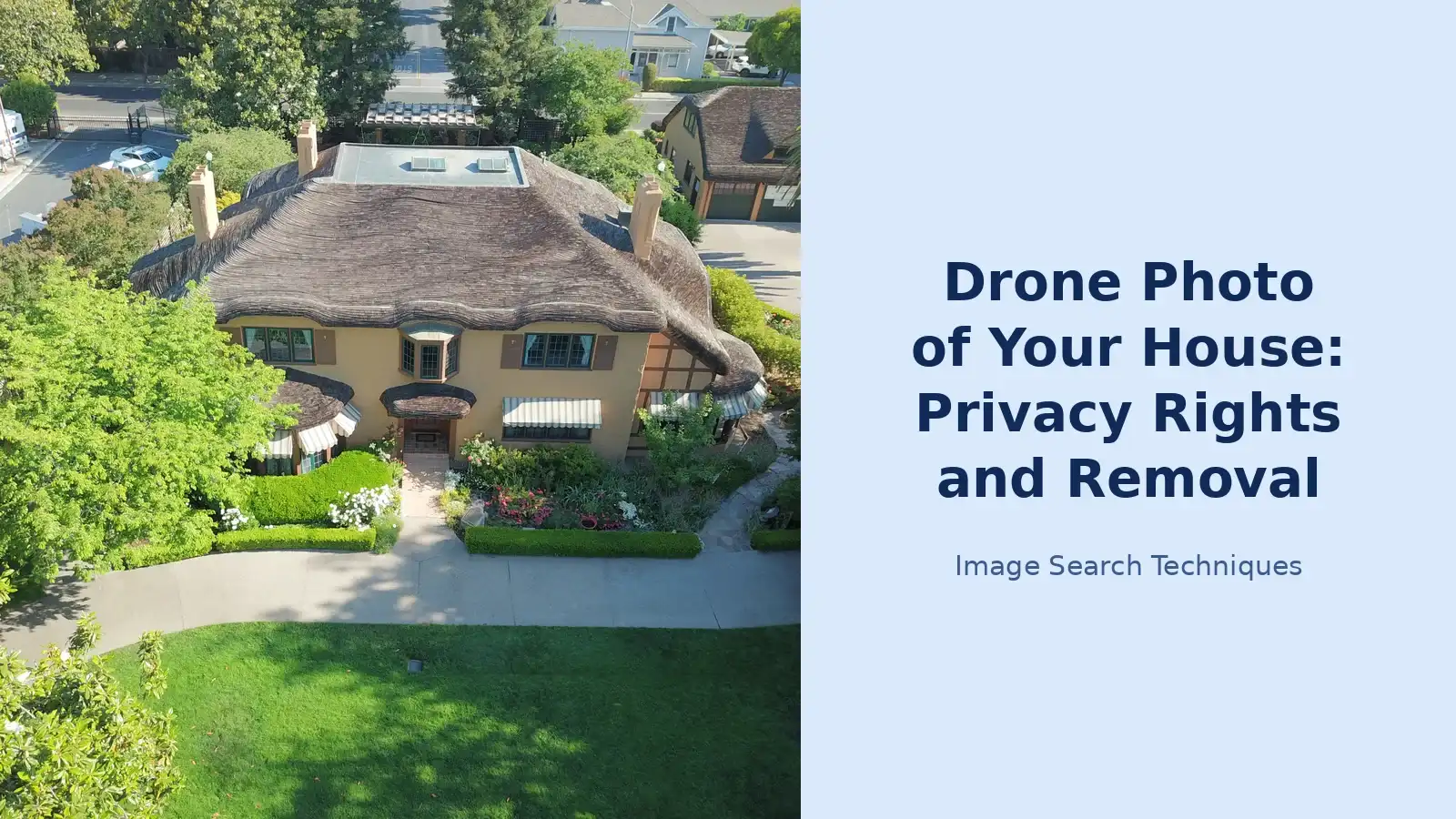
To show how this works in practice, I took a real drone photograph of a real house and ran it through both engines. The photo is an aerial view of Ainsley House in Campbell, California, taken from a DJI drone on 29 May 2018. It is a public photo from Wikimedia Commons, taken with a DJI FC220 camera, and the file still carries its original data: the camera model, the date, and a GPS position of latitude 37.288472. That file data alone would tell a stranger the camera, the day, and the place, which is worth remembering the next time you share a drone photo of your own home. Knowing the camera model is only half of it: our guide on how to identify a drone model from a photo shows how to name the aircraft itself from its arms, camera and printed text.
TinEye searched over 86.7 billion images and returned 0 matches for the exact photo. Google Lens also returned 0 exact matches, and said plainly that it could not find any pages containing the image. But Lens did something useful anyway: it identified the house, giving “Ainsley House in Campbell, CA” as its best guess, and its visual matches were different, ground level photos of the same house from Zillow, Wikipedia, the Campbell Chamber of Commerce, and Campbell Museums. So the engines knew the house even though they had never seen this exact aerial photo. That is the lesson: a zero match count tells you the file has not spread, not that the house is unfindable. Anyone who recognises the roof, the garden layout, or the street can find the place without any search engine at all.
There is a second lesson in this example, and it cuts the other way. Ainsley House is a historic house museum, open to the public, and this photo was taken openly and shared with a free licence. Nobody’s privacy is harmed by it. The same aerial view of a private family home, posted without permission to a stranger’s account, would be a different case entirely. The photo is the same kind of image. What changes the answer is what the photo shows, who is in it, and where it was posted. Keep that in mind as you work through the removal steps, because every platform and regulator will ask you those same three questions.
How do you get a drone photo of your house taken down?
Removal works platform by platform, and the fastest route is almost always the platform where the photo sits, not the law. Platforms remove photos of private homes far more readily than they remove anything else, but only if you use the right report reason and give them the exact link to the photo. A vague complaint about “a drone” gets a slow answer. A report that names the photo, the address shown, and the reason it should come down gets a fast one.
Answer capsule: start with the platform that hosts the photo, then the search engine that shows it, then the regulator, in that order, because each step is slower than the one before it.
Here is the removal workflow. Find your situation in the table, follow its route, and keep a copy of every request you send.
| Where the photo is posted | Report route | What to ask for | What to expect |
|---|---|---|---|
| Facebook or Instagram | Report the post, choose privacy or harassment | Removal of the photo, not just the account | Usually days; appeal if refused |
| YouTube or TikTok | Privacy complaint form on the video | Removal or blurring of the house and garden | Review takes days to weeks |
| Google Maps or Street View | Report a problem on the image | Blurring of your house | Blurring is usually granted for homes |
| Rightmove or Zoopla listing | Report the listing to the portal | Removal of the photos of your home | Portal contacts the agent first |
| Estate agent or pilot website | Written request to the agent or pilot | Removal within a named number of days | Often quick; escalate if ignored |
| Google search results | Google removal request | Removal of the image from results | Only after the source is dealt with, or for personal data |
Work through the steps in this order.
- Save the evidence first. Screenshot the photo where it is posted, including the page address, the account name, and the date. Download the image if you can. If the photo disappears later, your screenshots are the only proof it was ever there.
- Report it on the platform. Use the report button on the photo itself, not a general contact form. Choose the privacy reason, not the copyright reason, unless you took the photo yourself. Write one short sentence: this is a drone photo of my home, it shows my garden, I did not give permission, please remove it. Give the exact link.
- Write to the person who posted it. If you can identify the poster, send one polite written message asking for removal within seven days, and keep a copy. Many drone pilots and agents remove a photo at once when asked, because a complaint costs them more than the photo is worth. Keep the tone calm even if you are angry. A polite request that is refused is far more useful to a regulator than an angry one.
- Ask Google to remove it from search results. If the photo still appears in search after the source page is dealt with, or if it shows personal data, use Google’s removal request process. Our guide to remove your photos from Google walks through the exact request. Search removal does not delete the photo from the site that hosts it, so do this after the platform step, not instead of it.
- Escalate to the ICO if the poster is an organisation and refuses. The next section explains when the ICO can help and what it needs from you.
- Check again a week later. Search for the photo again with reverse image search. Copies turn up on other sites, and each copy needs its own report. One removal is rarely the end of the job.
Two places deserve a special mention. If the photo is on a property listing for a house that is not yours to sell, or a listing that uses your home to advertise another property, our guide to remove photos of your house from Rightmove and Zoopla covers the exact portal routes. And if the photo is on Google Street View rather than a drone shot, the blurring route is different again: our guide to blur your house on Google Street View explains how to ask Google to blur your home, which is a request Google grants readily for private houses.
When should you complain to the ICO, and when is it the police?
The Information Commissioner’s Office, the ICO, is the UK regulator for personal data. A drone photo counts as personal data when it identifies a person, which includes a photo of you in your garden, a photo through your window, or a photo that identifies your home together with you. A photo of an empty roof with no people in it is much harder to frame as personal data, which is why the ICO route works best when a person is visible or identifiable in the image.
Answer capsule: go to the ICO when an organisation holds or publishes a photo that identifies you and will not remove it; go to the police when the flying is dangerous, or the flights are repeated and frightening.
The ICO expects you to complain to the organisation first. That means writing to the company, the agent, or the pilot, and giving them a chance to answer. Keep a copy of your complaint and their reply, or the fact that they did not reply, because the ICO will ask for it. Then you can make a data protection complaint to the ICO. The ICO’s own guidance says it focuses on cases where there is clear and serious harm, and it will tell you that it cannot award compensation even when it finds that an organisation broke the law. Compensation is a separate claim you would make against the organisation itself. The ICO also says that complaints needing a closer look are currently being assigned to case officers around ten months after they are submitted, so treat the ICO as the slow, heavy route, not the first one. Its phone number for advice is 0303 123 1113, open Monday to Friday, 9am to 5pm, according to GOV.UK.
The police are the right call in three situations. First, if the flying itself is dangerous or illegal: a drone flown close to people, over a crowd, or in a way that risks an accident. Second, if the flights are repeated and targeted at you in a way that causes alarm or distress, which can amount to harassment under the Protection from Harassment Act 1997. That Act needs a course of conduct, meaning more than one incident, so keep a dated log of every flight with the time, the duration, and a photo of the drone if you can take one safely. Third, if you feel unsafe or threatened, right now. Call 101 for the first two, and 999 if there is an immediate danger. The CAA writes the drone rules, but the police enforce them, so reporting a flying complaint to the CAA on its own will not get a patrol car to your street.
One route people often miss is the simplest: the drone pilot’s own professional body or insurer. Commercial pilots who fly for estate agents usually carry insurance and belong to a training scheme. A written complaint to the pilot, copied to the agent who hired them, is often resolved in days, because nobody in that chain wants a data protection complaint on their record. Use the formal routes as the backup, not the opening move.
What if the photo shows you, your children, or the inside of your home?
The seriousness of a drone photo depends on what it shows, and three cases need faster and firmer action than the rest. If the photo shows a child in your garden, report it to the platform at once using the child safety reason, and do not wait for a polite exchange with the poster. If the photo shows through a window into a bedroom or bathroom, treat it as a privacy complaint with the highest priority, and report it to the police as well as the platform, because it may amount to voyeurism under the Sexual Offences Act 2003. If the photo is intimate, or it is being used to threaten or blackmail you, report it to the police immediately and use the fast removal routes for intimate images, including StopNCII, which hashes the image so it is blocked across platforms.
Answer capsule: the more private the space in the photo, the faster you should act, and the more routes you should use at the same time.
If the photo shows you but not in an intimate or private setting, the routes are the same as for any photo of you posted without permission. Our guide on what to do when someone posted a photo of you without permission covers the platform reports and the right to erasure in detail. The key point for drone photos is that the photographer does not need your permission to take a photo of your house from the air, but they do need a lawful basis to publish a photo that identifies you, and your objection carries real weight once you have made it in writing.
Do not post the photo yourself while complaining about it. People often share the offending image in a neighbourhood group to ask who took it, and that spreads the very photo they want removed. Describe it in words, share a cropped screenshot that hides your house number and your family if you must share anything at all, and keep the original evidence private. The same applies to naming the pilot publicly: a public accusation can turn into a defamation problem for you, even when you are right about the photo. Keep it private, keep it written, and keep it factual.
Mistakes that waste your time, and the one thing never to do
The most common mistake is reporting the flight when the problem is the photo. If you write to the CAA about a photo on Facebook, nothing will happen, because the CAA does not remove Facebook posts. If you write to Facebook about a drone flying too low, nothing will happen either, because Facebook does not enforce flying rules. Match the complaint to the body that can actually fix it, using the table above.
The second mistake is asking for the wrong thing. Asking a platform to “ban drones” or “delete the account” is a much bigger ask than removing one photo, and it is usually refused. Asking for one photo to be removed, for a stated privacy reason, is a small ask that fits the platform’s own rules, and it usually succeeds. Keep your request narrow and specific.
The third mistake is waiting. Photos spread. A drone photo of your house that sits on a public account for a month will be screenshotted, shared to local groups, and picked up by search engines. The removal steps in this guide work best in the first days, while the photo is still in one place. Do the evidence step today, even if you are not sure which route to use yet, because screenshots taken now are useful whatever you decide later.
And the one thing never to do: never pay anyone to remove a drone photo of your house. Removal requests to platforms, to the ICO, and to the police are free. If someone contacts you offering to delete the photo for a fee, or demanding a fee to stop posting more photos of your home, that is a scam or an extortion attempt, and it should be reported to the police. A genuine pilot or agent removes a photo when asked, and charges nothing for doing so.
To sum up, the flight and the photo are different problems. The Drone Code limits the flight. Data protection law, the platform rules, and harassment law deal with the photo. Save the evidence, report the photo where it sits, write once to the person who posted it, and escalate to the ICO or the police only if those steps fail. Most drone photos of houses come down with the first two steps, and the ones that do not are the ones where a written record and a calm, specific request matter most. For the wider picture of keeping your images under your control, our protect your photos online guide brings the removal routes for every kind of photo together in one place.
FAQs
Can I ask for a drone photo of my house to be removed?
Yes. Report the photo on the platform where it is posted, using the privacy reason, and ask the poster in writing to remove it. If the photo shows you in a private space, or the poster is an organisation that refuses, you can complain to the ICO. An empty roof with no people in it is harder to remove.
Is it illegal for a drone to photograph my house?
Not usually. There is no UK law that bans photographing a house from the air, and the outside of your home is visible from the street. It becomes a legal problem when the photo captures you in a place where you can expect privacy, such as your garden or through a window, or when it is published to harass you.
Who do I report a drone to, the CAA or the police?
Report dangerous or illegal flying to the police on 101, or 999 if there is an immediate danger. The CAA writes the drone rules but the police enforce them. Report a photo that breaches your privacy to the platform first, then to the ICO if the poster is an organisation that will not remove it.
Can the ICO force someone to delete a drone photo of my house?
The ICO can investigate and take action when personal data is misused, but it expects you to complain to the organisation first, and it cannot award compensation. Complaints needing a closer look are currently assigned to case officers around ten months after submission, so use the platform report first for a faster result.
What if the drone keeps coming back over my garden?
Keep a dated log of every flight with the time, duration, and a photo of the drone if you can take one safely. Repeated targeted flights that cause alarm or distress can amount to harassment under the Protection from Harassment Act 1997. Take the log to the police on 101 and report each new flight.
Can I knock down a drone flying over my house?
No. Deliberately damaging a drone is criminal damage under the Criminal Damage Act 1971, even when it is over your land. Signal jammers are also illegal under the Wireless Telegraphy Act 2006. Do not touch the drone. Save evidence, report the flight to the police, and report the photo to the platform.