🔎 Reverse Image Search
Image search techniques made simple: upload a photo or paste a URL and search 6 engines at once. 100% free, nothing stored.
🔒 Your image is never stored on our servers longer than 24 hours and is never shared.
The Short Answer
No, the photo is fake. It is an AI-generated image. A Melbourne gift shop called Homing Instincts posted it on Instagram on Wednesday 25 November 2026, claiming Harry Styles had dropped into its Hawthorn store. Fans spotted it within minutes: the man in the photo has no tattoos on his legs, while Styles is famous for his heavily tattooed legs. No real photo of a visit exists.
If you saw Harry Styles posing inside a Melbourne gift shop this week, you were not alone. The photo spread fast, because the real Harry Styles has been wandering around Melbourne. But the shop photo is fake. This article explains what the photo shows, why people believed it, and how to check the next celebrity photo before you share it.
What the Photo Shows
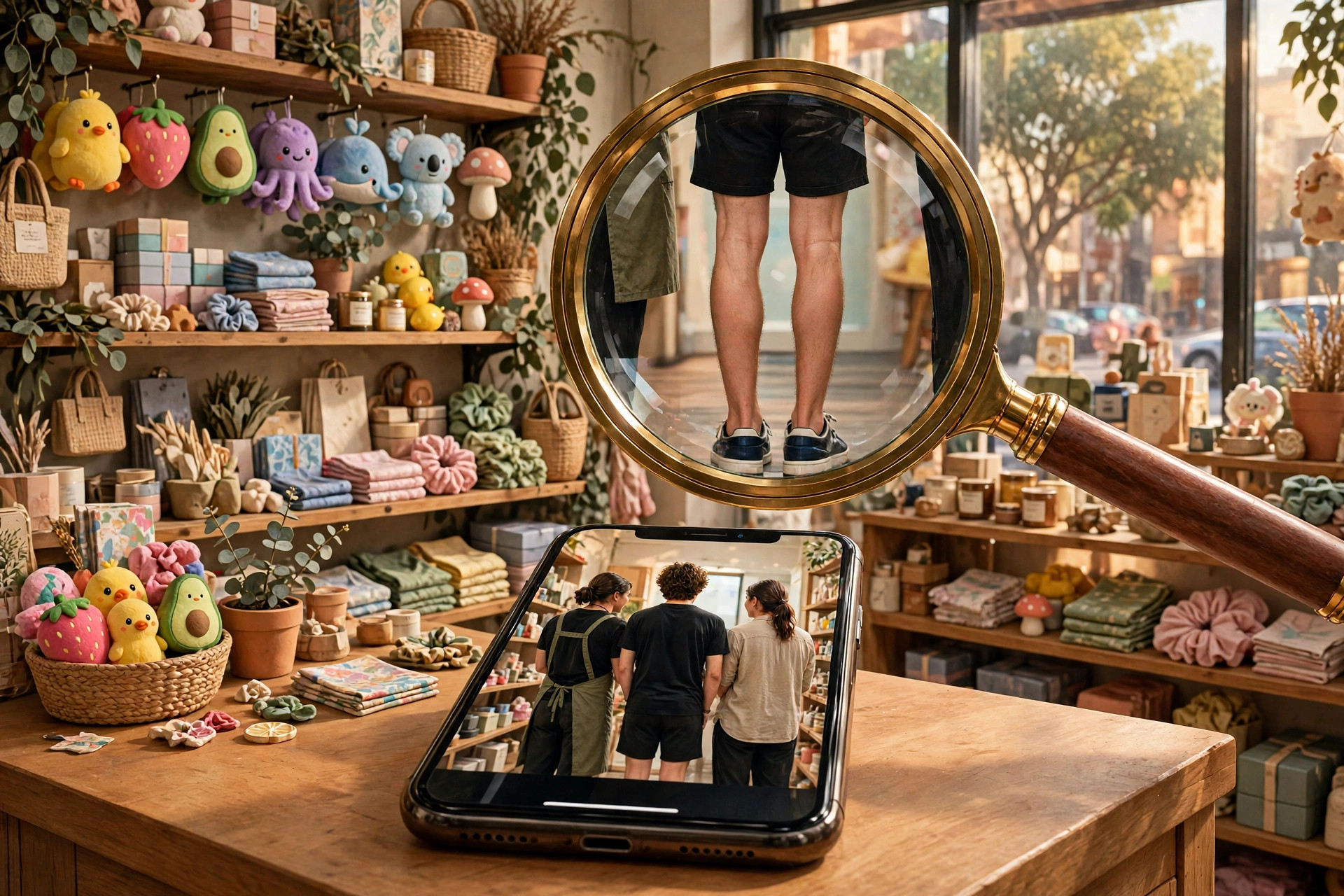
Homing Instincts is a gift shop with several outlets in Victoria, Australia. On Wednesday it shared a photo on Instagram that appeared to show Harry Styles dropping into its Hawthorn location and posing with staff. The figure who looks like Styles is holding a Needoh toy, and the caption reads: “Guess who popped into the Hawthorn store!! @harrystyles. Even Harry can’t resist a Needoh!”
But look closely and the photo falls apart. The man supposed to be Styles has bare legs with no tattoos. Styles has prominent tattoos on his legs, and fans know them well. One commenter wrote, “Left his tattoos at home though,” and another added, “Fake. Not his tattoos on his legs.” The generator built a convincing pop star and forgot the one detail his fans would check first. The Daily Mail reported on the image the same day.
“Is this real or AI?” one person asked. Several people raised a sharper question: “How is it legal to use a celebrity’s image to promote your product without their consent like this?”
Why People Believed It
The fake worked because the true story underneath it was real. Styles is in Australia for his Together, Together tour, and he really has been spotted visiting Melbourne businesses in the past few days, with no security or entourage. That is what made the shop photo plausible.
The real sightings are well documented. On Monday, a shop assistant called Dylan told the Fox radio show Fifi, Fev and Nick that he had served Styles at a Prahran convenience store. “I saw him, served him a sparkling water, and had to confirm that it was him,” Dylan said. “I asked, ‘Are you Harry Styles?’, and he said, ‘Yep.'” When Dylan asked for a photo, Styles politely declined, saying, “Do you mind if we don’t?”
Fans also reported seeing him at Elsternwick Cinema and Albert Park Lake over the weekend. His four Marvel Stadium shows start on Friday night, 27 November.
That is the pattern behind most viral celebrity fakes. They take a real person, a real place and a true story, then add a fake image on top. The Homing Instincts photo borrowed the real sightings and turned them into a shop visit that never happened. Our check of the fake Travis Tritt CMA video shows a clip built the same way, around a real awards night.
How Fans Spotted the Fake
The fans who caught this photo did not need special software. They knew the person in the picture, and they checked the story. Here are the five signs that gave the fake away.
1. The tattoos are missing. Styles has heavily tattooed legs, and the photo shows smooth, bare skin. Tattoos are hard for a generator to get right, and easy for a fan to check. Compare any distinctive tattoo, birthmark or scar with real photos before you believe a new one.
2. The photo exists only on the shop’s account. A real visit by one of the most photographed men in the world would leave more than one trace. There would be fan photos outside the shop, a story on a local news site, or a post from someone who was there. This image exists only where the shop put it.
3. The story does not match the real sightings. The genuine encounters in Melbourne all have the same shape: Styles keeps to himself, wears a cap and sunglasses, and declines photos. A man who turns down a photo with a shop assistant is unlikely to pose holding a toy.
4. The photo is selling a product. The caption names the toy and tags the singer. That is marketing, not a fan snap. A business has a reason to post a photo like this, and that reason is foot traffic and sales. That does not prove a photo is fake on its own, but it is a reason to check before you share.
5. The comments did the checking in public. Within hours, the comments under the post were full of people pointing out the missing tattoos and asking whether the image was AI. Read the replies before you share.
The Bigger Pattern: AI Celebrity Photos Are Everywhere Now
The Melbourne shop photo is not a one-off. Fake celebrity images are now a daily event, and the better ones are much harder to catch.
In October 2026, Futurism reported that engagement-chasing accounts on X were taking real paparazzi photos of male celebrities and using AI to alter them, then reposting the results as genuine new pictures. The targets included Harry Styles and other male celebrities. The writer Sarah Hagi flagged the tactic, and Futurism found that the altered images kept most of the original photo intact, including the tattoos, which made them hard to spot.
That detail matters. In Melbourne, the generator forgot the tattoos, and the fake was caught in minutes. In the X cases, the fakes kept the tattoos, because they were built on top of real photos. That means the tattoo test that caught this photo will not catch the next one. One check is never enough.
The same method is spreading beyond celebrities. AI influencers with fake model profiles are now used to sell products, and brands have been caught using AI-generated faces in adverts as if they were real people. Our guides to AI influencers and fake model profiles and AI-generated faces in adverts explain how it works. The Sonia Gandhi memoir bookseller video used a fake shopkeeper to attack a book launch. The Elon Musk deepfake crypto scam used a fake celebrity to sell a fraud. The Melbourne photo used a fake celebrity to sell a toy. The product changes, but the method stays the same: a familiar face, a believable setting, and a reason to share.
How to Check a Celebrity Photo Before You Share It
Use this seven-step check next time a celebrity photo makes a surprising claim. It takes about two minutes.
1. Compare the person’s marks with real photos. Tattoos, birthmarks, scars and moles are the fastest check there is. Open a known real photo and compare it side by side. If a tattoo is missing, moved or changed, the image is fake or altered.
2. Reverse image search the photo. Save the image and run it through Google Lens. If the same photo appears on a stock site, an AI art gallery or an older post in a different context, you have found its real origin. If it appears nowhere at all, that is also a signal. Our guide to reverse image search walks through the steps, and you can cross search an image across search engines to cover Google, Bing, Yandex and TinEye in one pass.
3. Check who posted it. Is it the celebrity’s verified account, a news outlet, a fan account, or a business selling something? Our complete guide to photo scams explains the same source check.
4. Look at the small details. AI images still struggle with hands, ears, teeth, jewellery and text. Look for fingers that bend the wrong way, earrings that do not match, and lettering that dissolves into nonsense. In this photo, the giveaway was the legs, but in the next one it might be a hand holding the product, or the text on a shop sign.
5. Run the image through a free AI detector. Tools such as Hive Moderation and Sightengine can score a still image for signs of AI generation. They sometimes flag real photos too, so treat a detector result as one clue, never a verdict. Our roundup of the best deepfake video detector tools covers the free options.
6. Search the news for the claim. Type the celebrity’s name and the place into Google News. A real visit by Harry Styles to a Melbourne shop would be covered by Australian entertainment outlets within hours. If the only results are the shop’s own post and social media reposts, the visit probably never happened.
7. Check the claim, not just the photo. Even if a photo looks real, ask whether the story makes sense. Would a singer who declined a photo pose for a staged picture with a toy? If the story fails, the photo fails with it. Our fake Trump stockpile screenshot check shows the same habit.
Can a Shop Legally Use a Celebrity Photo Like This?
Fans were quick to ask this question in the comments, and it is a fair one. Using a famous person’s face to promote products without their permission is risky in most countries. A fake endorsement can mislead customers into thinking the celebrity supports the shop, and regulators in many places treat misleading advertising seriously.
Whether Homing Instincts faces any formal complaint is not clear from the reports so far. What is clear is the reputational cost. The post that was meant to bring customers into a Hawthorn gift shop has instead brought the shop a wave of angry comments and a Daily Mail story about a fake photo. A real celebrity visit would have been free publicity. A fake one has become the opposite.
If a business ever uses your own photo, or an AI image of you, to promote its products, you do have options. Our guide to how to report an AI-generated image of you explains the steps. For a business owner, the lesson is simple: a real photo of a real customer beats a fake photo of a celebrity.
What to Do If You Already Shared It
If you shared the Melbourne photo before you knew it was fake, do not feel embarrassed. The photo was designed to be believable, and it borrowed a true story. Delete the post if you can, and add a short reply saying the photo is AI-generated and that Styles’ missing tattoos gave it away. Share the correction too, because corrections travel slower than fakes.
Check who posted the version you saw. Accounts that spread AI celebrity photos often post many of them, and some use them to build an audience they later use for scams. Our Elon Musk deepfake crypto scam check shows how such images can lead to fraud. If an account keeps posting AI pictures of famous people, unfollow it and report the posts.
Celebrity fakes will keep getting better. The defence stays the same: check the source, compare the details, and do not share until both hold up. For the full method, start with our image search techniques master guide.
Is the Harry Styles Melbourne gift shop photo real?
No. The photo is AI-generated. The Melbourne gift shop Homing Instincts posted it on Instagram on Wednesday 25 November 2026, claiming Harry Styles had visited its Hawthorn store. Fans spotted it as fake within minutes: the man in the photo has no tattoos on his legs. No real photo of a visit has been produced.
How did fans know the Harry Styles photo was AI?
The main giveaway was Styles’ missing leg tattoos. Fans also noticed that the photo exists only on the shop’s own account, with no fan photos or news coverage of a visit, and the story does not match his real behaviour in Melbourne.
Did Harry Styles really visit shops in Melbourne?
Yes, he really has been spotted around Melbourne. A shop assistant called Dylan served him at a Prahran convenience store and told the Fox radio show Fifi, Fev and Nick about it. Fans also reported seeing him at Elsternwick Cinema and Albert Park Lake. He is in Australia for his Together, Together tour, with four Marvel Stadium shows starting on Friday 27 November 2026.
How can I check if a celebrity photo is AI-generated?
Compare the person’s tattoos, birthmarks and scars with real photos, and reverse image search the picture to find its origin. Check who posted it and whether any news outlet covers the claim. Look for glitches in hands, ears and text, and run the image through a free AI detector such as Hive Moderation.
Can a business use a celebrity’s photo to promote its products?
Using a famous person’s face to sell products without their permission is risky. A fake endorsement can mislead customers, and regulators in many countries treat misleading advertising seriously. No formal complaint against the shop has been reported so far, but the post has brought the shop angry comments and press coverage instead of the publicity it wanted.