🔎 Reverse Image Search
Image search techniques made simple: upload a photo or paste a URL and search 6 engines at once. 100% free, nothing stored.
🔒 Your image is never stored on our servers longer than 24 hours and is never shared.
A fake bailiff letter is easy to spot once you know what a real one must carry: a proper Notice of Enforcement, sent at least seven clear days before any visit, with every field the law requires and fees that match the fixed scale. If any part is missing or wrong, stop and check the letter before you pay anything.
A Notice of Enforcement is the written warning an enforcement agent must send before taking control of your goods, and it must list the debt, the court behind it, the amount owed and the date by which you must pay. This guide works for letters in England and Wales, where the Taking Control of Goods Regulations 2013 apply. Scotland has a different process, so if your letter is Scottish, use the Scottish route instead.
What is a Notice of Enforcement?
The letter in your hand should be a Notice of Enforcement, not a threat on headed paper. Under regulation 6 of the Taking Control of Goods Regulations 2013, the notice must reach you at least seven clear days before the enforcement agent takes control of your goods. GOV.UK puts it in plainer words and says bailiffs must usually give you at least 14 days’ notice of their first visit. Either way, a letter that arrives today and says someone is coming tomorrow has failed the notice test.
The notice is the first stage of a fixed process. It is called the compliance stage, and it carries a fixed fee of 75 pounds, which we cover in the fee table below. The point of the notice is to give you time to pay, agree a plan or get advice before anyone comes to your door. A real enforcement agent wants the notice to work, because a visit costs them time and costs you more money. A scammer wants the opposite: pressure, speed and payment before you think. A notice left on your door by your landlord is a different paper from an enforcement notice, and it is checked differently: our fake eviction notice check covers the landlord’s notice, starting with the court case number. A letter from a debt collector is a different paper again, and it is checked against the CFPB model validation notice: our debt collection letter check works through it field by field.
One more thing to fix in your head before you start. “Bailiff” is the word everyone uses, but firms themselves use “enforcement agent”. A letter that keeps calling its own staff “bailiffs” in the body text is already suspect, and the trade body Civea lists that as a red flag. The only place “bailiff” normally appears in a real letter is inside a company name.
How do I check the letter in front of me, field by field?
Photograph the letter first, before you do anything else. Take the photo straight on, in daylight, with all four edges of each page in shot, and keep the original paper safe. Then work through the fields below, one at a time, and tick each one off against the letter. Regulation 7 of the Taking Control of Goods Regulations 2013 says a Notice of Enforcement must contain all of the following.
| Field the letter must carry | What to look for | Fail means |
|---|---|---|
| Your name and address | Your full name, spelled right, and your current address | Wrong name, old address or no address at all |
| Reference number | At least one reference number you can quote back | No reference, or a reference that looks made up |
| Date of the notice | A clear date, so you can count the seven clear days | No date, or a date that leaves no time to act |
| Court or enforcement power | The judgment, order or power that makes the debt enforceable | No court named, or a vague “court order” with no detail |
| Details of the debt | Enough detail for you to recognise the debt: what it is for and when it arose | A bare total with no explanation of what it covers |
| Amount owed | The debt plus any interest due on the date of the notice | A round total with no breakdown |
| Enforcement costs so far | The costs already incurred, listed separately | Costs hidden inside the total, or no costs shown |
| Possible further costs | What extra costs could follow if the sum stays unpaid | No warning about further costs |
| How and when to pay | Payment methods, days and hours | Bank transfer as the only option |
| Contact details | A phone number and address, with the days and hours the office can be reached | A mobile number only, or no address |
| Deadline to pay | The date and time by which the sum must be paid to stop goods being taken | No deadline, or a deadline hours away |
Work the table in order and write down what you find. A real letter passes every row. A fake usually fails several at once: no reference number, no court named, a round total with no breakdown, and a payment demand that gives you hours instead of days. The debt detail row matters most. If you cannot tell from the letter what the debt actually is, you cannot verify it, and that alone is a reason not to pay.
Next, check the debt itself against your own records. Is there a council tax bill, a parking fine, a court fine or a county court judgment behind it? Enforcement agents collect those kinds of debts, plus High Court and family court judgments. If you have no such debt and no memory of a court case, say so when you contact the sender, and do not pay first and ask later. Which? reports cases where people paid a caller posing as a bailiff and threatening to seize furniture, and the money was gone. A letter that asks you to pay before you have verified it is asking you to do the one thing the Ministry of Justice warns against: the Ministry told Which? that if you are in any doubt about whether a payment demand is genuine, you should not pay until you have verified the contact.
If the letter is a different kind of demand, the check changes. A fake tax letter is checked against the notice code in the corner, and a fake Companies House letter is checked against the sender domain. Our guides to the fake IRS letter and the fake Companies House letter cover those two artefacts. This guide stays with enforcement notices, because the comparator here is the court system, not a tax office or a company register.
What fees can a real bailiff charge?
Enforcement fees in England and Wales are fixed by law, not set by the firm. They come from the Taking Control of Goods (Fees) Regulations 2014, and a real letter itemises them. If the fees on your letter do not match this table, the letter fails the check.
| Stage | Fixed fee | Extra charge | When it applies |
|---|---|---|---|
| Compliance stage | 75 pounds | None | From the instructions being received until a visit happens. This is the stage your letter is in. |
| Enforcement stage | 235 pounds | 7.5 percent of the sum over 1,500 pounds | From the first attendance at your premises. |
| Sale or disposal stage | 110 pounds | 7.5 percent of the sum over 1,500 pounds | From the first attendance to move goods for sale until the sale is complete. |
Read the table with two examples. A debt of 800 pounds that is still at the compliance stage carries a 75 pound fee and nothing else, so the total to pay is 875 pounds plus any interest the letter states. A debt of 2,000 pounds that has reached the enforcement stage carries 235 pounds plus 7.5 percent of the 500 pounds over 1,500, which is 37.50, so the enforcement fee is 272.50. If your letter shows a different number for the same stage, ask the sender to explain it in writing before you pay.
High Court writs use a different table, so check which one your letter claims. For a High Court writ the compliance fee is still 75 pounds, the first enforcement stage is 190 pounds plus 7.5 percent of the sum over 1,500, the second enforcement stage is 495 pounds, and the sale stage is 525 pounds plus 7.5 percent of the sum over 1,500. A letter that quotes the county court fees for a High Court writ, or the other way round, has its sums wrong.
The fee test catches the most common fake. Scam letters invent round-number charges that appear nowhere in the regulations: a “release fee” of 250 pounds, an “admin charge” of 150 pounds, a “same-day settlement fee” of 500 pounds. Real fees are fixed, itemised and named by stage. If your letter has a charge you cannot find in the table above, treat the letter as failed and verify it through the routes below.
How do I check the enforcement agent is real?
Start with the name on the letter. There are four kinds of bailiff in England and Wales, and each one is checked a different way. GOV.UK lists them as certificated enforcement agents, High Court enforcement officers, county court and family court bailiffs, and civilian enforcement officers or Approved Enforcement Agents who enforce magistrates’ court fines.
If the letter says certificated enforcement agent, search the official register of certificated bailiffs at certificatedbailiffs.justice.gov.uk. Type the surname exactly as the letter spells it, because the search is sensitive to spelling, and try the company name too if the person search finds nothing. If the letter says High Court enforcement officer, check the list on the High Court Enforcement Officers Association website. If it says county court or family court bailiff, contact the court that sent them. If it says Approved Enforcement Agent, check the firm is one of only three companies GOV.UK names: CDER Group, Marston Holdings Limited or Jacobs Enforcement. Anyone who claims to be a bailiff when they are not is committing fraud, and GOV.UK says so in plain words.
Here is the honest limit on the register check, and it matters. The trade body Civea told Which? that the official register is severely out of date and cannot be relied on to verify contact, and Which? reported that HMCTS has reviewed its processes and recirculated guidance to court staff in response. So a name that is missing from the register is a flag, not a verdict. Do not treat a missing name as proof the letter is fake, and do not treat a name that is present as proof the letter is real. A scammer can copy a real agent’s name onto a fake letter. Use the register as one check among several, then confirm through a second route: call the firm on a number you found yourself, not the number on the letter, or call the court the letter names.
The letter should also tell you who the agent works for, with a company name, a landline number and a postal address. Cross-check the company on its own website and on Companies House, and check the phone number with a web search to see whether it belongs to the firm it claims to be. A letter from a firm with no website, no landline and no address has failed the identity check. You can find the full GOV.UK guidance on bailiff powers when they visit your home, including what to ask for at the door.
What are the red flags in a fake bailiff letter?
Civea, the enforcement trade body, gave Which? a list of warning signs it sees in fake debt letters. Run your letter against each one. Any single flag is a reason to stop and verify. Two or more together mean you should not pay anything until the letter has been confirmed through an independent route.
- A domain ending in .legal. Civea warns these could be a scam, and says to look for a UK domain. A real enforcement firm writes from its own company domain, not a lookalike.
- The word “bailiffs” in the body of the letter. Other than inside a company name, firms refer to enforcement agents, not bailiffs. A letter that keeps saying “our bailiffs will attend” is written by someone outside the trade.
- Threats of Home Office attendance. The Home Office does not attend enforcement visits. Any letter that says it will is fake.
- Appointments for a removal action. Enforcement agents do not make appointments after notice has been given. A letter offering you a timed removal slot is inventing a process that does not exist.
- Threats of police attendance. Police do not attend a removal unless there has been a breach of the peace. A letter that promises police at the door is bluffing.
- A High Court Enforcement Officer collecting a parking charge. Penalty charge notices are not collected by High Court Enforcement Officers, and parking charge notices are not collected under the Taking Control of Goods Regulations 2013 at all.
- Threats of locksmith attendance or forced entry for a parking charge or council tax debt. Agents cannot force entry for those debts. Forced entry is allowed only as a last resort to collect unpaid criminal fines, Income Tax or Stamp Duty.
- Bank transfer as the only payment option. If the letter gives you one way to pay, and it is a bank transfer to a personal-sounding account, that is likely a scam. Real firms take card payments and give you a receipt.
- Typos and grammatical errors. A genuine letter is unlikely to contain spelling mistakes. Sloppy text on an official-looking letter is a strong signal, not a small one.
Two more tells sit outside Civea’s list. The first is the tone. A real Notice of Enforcement is dry and procedural: it lists the debt, the amount, the deadline and the contact details, then stops. A fake leans on fear, with bold threats, a countdown and a demand to pay now. The second is the payment route. A genuine enforcement agent will never phone you to ask for your bank details, and will never ask you to make a bank transfer using a sort code and account number given over the phone. If the letter tells you to call a mobile number and pay by transfer, do not call it.
Finally, check the letter against the debt you actually owe. The photo scams complete guide explains the same habit for every kind of demand photo: verify the artefact before you act on it. And if the demand arrived as a text rather than a letter, the check is different again, because real agencies do not demand payment by text link. Our guide to the HMRC scam message check shows how that version of the trick works.
What did a reverse image search find on a real bailiff notice?
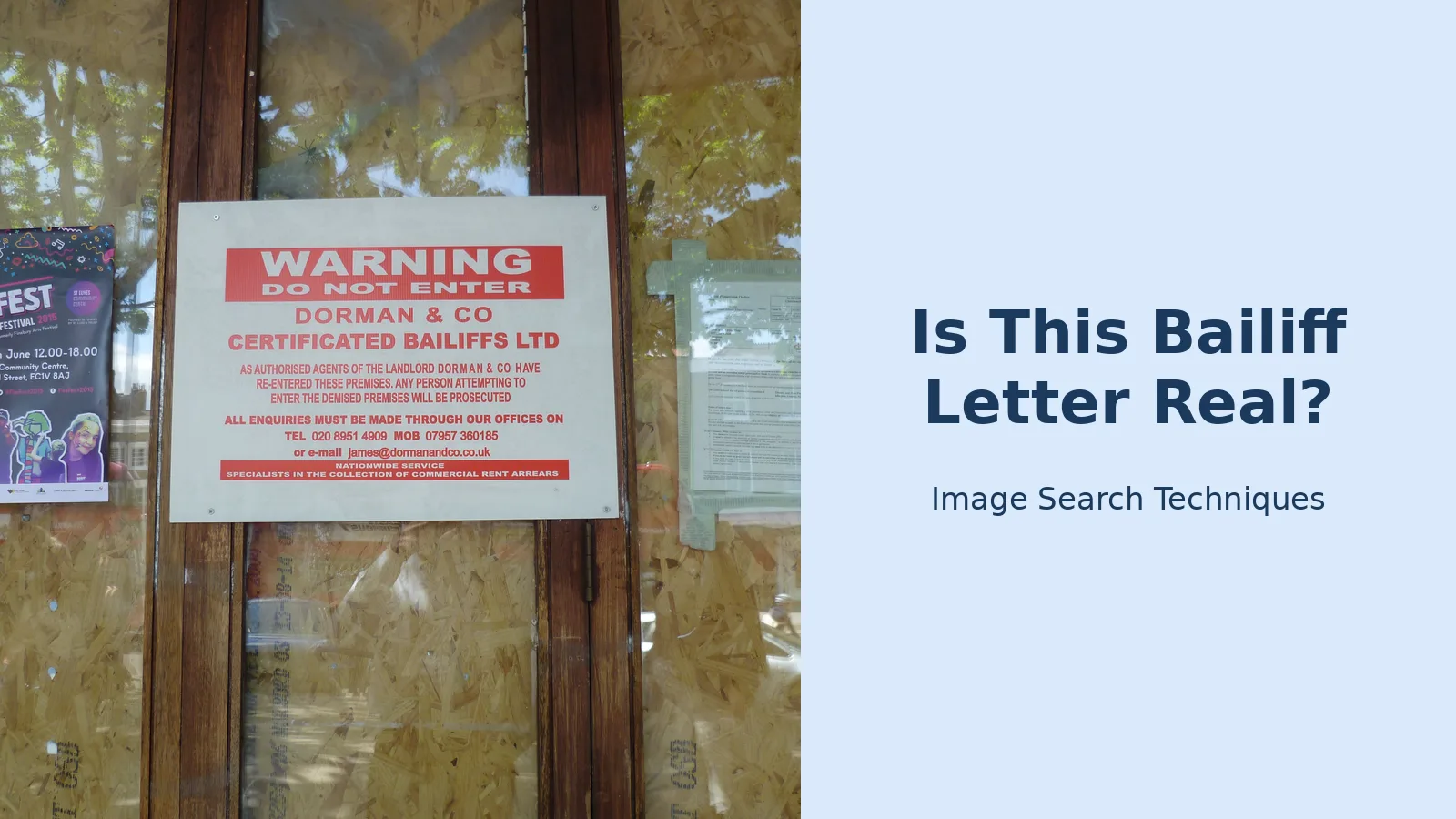
To test the reverse-search step honestly, I ran a real bailiff artefact through the site’s own reverse image search tool on 13 November 2026, between 18:29 and 18:35 UTC. The photo is a warning notice from Dorman and Co Certificated Bailiffs Ltd, fixed to the boarded-up front of a London shop, photographed on 16 May 2015 and published on Wikimedia Commons under a CC BY-SA 4.0 licence. One honest note before the results: this is a re-entry warning notice on commercial premises, for commercial rent arrears, not a Notice of Enforcement letter. No public photo of a real Notice of Enforcement exists on Commons, so this is the closest real artefact, and it still tests exactly what a reader would test: a photo of bailiff paperwork, run through the engines.
The tool loaded the image by its URL on the first attempt and showed the preview at 4000 by 3000 pixels. Here is what each engine returned.
| Engine | Result | Source page found? |
|---|---|---|
| Google Lens | Failed. Lens read the notice text, then showed “Expired visual search” and “No image at the URL” on both the exact and visual matches tabs. A fresh retry at lens.google.com/uploadbyurl gave the same error. Zero exact matches. | No |
| Bing Visual Search | Worked. Four pages with this image: a West Wales Chronicle council tax article, Alchetron’s Bailiff page, beefbank.org and the Bailiff article on en.wikipedia.org. Bing misread “Dorman” as “Format” in the notice text. | No, not the Commons file page |
| Yandex Images | Worked, and the best result. It identified the image, linked to Wikimedia Commons, listed 15 sizes of the same image from 4000 by 3000 down to 130 by 130, and listed 14 sites carrying it, including the Commons file page at full size, the Bailiff article on en.wikipedia.org, Wikiwand and Everipedia. | Yes |
| TinEye | Worked. Eleven results, first indexed 29 August 2015: copies on the Bailiff article on en.wikipedia.org at 1200 and 220 pixels, plus wikivisually, wow.com, arabjobs.info, wikivividly, deplim, beefbank.org and an IP host, with one result shown as not available. | No, not the Commons file page |
| No visual search at all. The tool’s Pinterest button opens a keyword search for the image host’s domain, and it returned unrelated pins, including an Adobe advert, the Taj Mahal and Ingrid Bergman. | No |
Three lessons come out of that test. First, the engines disagree wildly on the same photo: Yandex found the source page, TinEye found eleven copies but not the source, Bing found four pages, and Lens found nothing at all. Run more than one engine before you draw any conclusion. Second, a letter photo is the hardest kind of image to reverse search, because letters are rarely indexed anywhere. A blank result proves nothing about your letter, and the field-by-field check above is the real test. Third, a match does help when it happens: if your letter photo matches a known scam gallery image or a news article about a fake, that is strong evidence, and you should report it. The full method is in our guide to how to reverse image search, including the flip and crop variants that catch photos a straight search misses.
What if I cannot pay, or I am vulnerable?
A real enforcement agent has to follow the rules on vulnerable people, and you have routes that cost you nothing. GOV.UK says you may be able to get extra time to make a payment or get debt advice if you are a vulnerable person, for example if you have mental health problems or are seriously ill. Tell the enforcement firm in writing, and tell the creditor too, because the firm acts on the creditor’s instructions. Keep a copy of everything you send.
Bailiffs cannot enter your home by force, cannot enter if only children under 16 or vulnerable people are present, cannot enter between 9pm and 6am, and cannot enter through anything except the door. They cannot take things you need, such as your clothes, cooker or fridge, work tools and equipment worth less than 1,350 pounds in total, or someone else’s belongings. If a letter threatens to take any of those, the threat itself is a sign the letter was not written by someone who knows the rules.
For free help, start with Citizens Advice, StepChange Debt Charity, National Debtline or MoneyHelper. All four are named by GOV.UK as free help for dealing with bailiffs. Citizens Advice can check the letter with you and explain the fees, StepChange can set up a payment plan with your creditors, and National Debtline gives free debt advice by phone and online. If the letter turns out to be fake, report it to Report Fraud, the police reporting service that replaced Action Fraud, and keep the letter and the envelope as evidence. If the letter is real but the agent broke the rules, complain to the firm first, then to the Enforcement Conduct Board, the industry regulator StepChange named in its warning to Which?, or to the court that certificated the agent.
Do not ignore a letter that passes every check in this guide. A real Notice of Enforcement starts a clock, and ignoring it adds fees and can end with goods being taken. The right move is to verify first, then act: pay what you owe if the letter is real, agree a plan you can afford if you cannot pay in full, or get free advice the same day if you are unsure. What you must never do is pay a letter you have not verified, because a payment made in panic is very hard to get back.
FAQs
How can I tell if a bailiff letter is real?
Check it against the Notice of Enforcement rules: your name and address, a reference number, the court behind the debt, a breakdown of the amount and fees, and a deadline at least seven clear days away. Then search the agent on the official register and call the firm on a number you found yourself.
How much notice must a bailiff give before visiting?
The law says the Notice of Enforcement must reach you at least seven clear days before the agent takes control of your goods. GOV.UK says bailiffs must usually give you at least 14 days’ notice of their first visit. A letter that arrives today and says someone is coming tomorrow has failed the notice test, whatever else it gets right.
What fees can a bailiff legally charge?
The compliance fee is 75 pounds. The enforcement stage adds 235 pounds plus 7.5 percent of the sum over 1,500 pounds, and the sale stage adds 110 pounds plus the same percentage. High Court writs use a different table. A round-number charge that is not in the fixed scale, like a release fee, is a sign the letter is fake.
Can a bailiff force entry into my home?
No, almost never. Forced entry is allowed as a last resort to collect unpaid criminal fines, Income Tax or Stamp Duty. Agents cannot force entry for council tax or parking charge debts, cannot enter between 9pm and 6am, and cannot enter if only children under 16 or vulnerable people are present. A letter threatening forced entry is fake.
What should I do if I cannot pay a real bailiff letter?
Contact the enforcement firm and the creditor in writing, explain what you can afford, and ask for a payment plan. Get free help the same day from Citizens Advice, StepChange or National Debtline, who can check the letter and negotiate for you. If you are vulnerable, say so, because you may get extra time to pay.
How do I report a fake bailiff letter?
Keep the letter and the envelope, photograph every page, and do not pay anything. Report it to Report Fraud, the police reporting service, and tell the creditor or court the letter names, so they know their name is being used. If a real agent broke the rules, complain to the firm first, then to the Enforcement Conduct Board.